State-of-the-Art and Future of Hyperpolarized 13C MRI
Peder Larson1
1University of California, San Francisco, United States
1University of California, San Francisco, United States
Synopsis
Keywords: Contrast mechanisms: Hyperpolarized MR (Non-Gas)
MRI with hyperpolarized carbon-13 labeled agents, also known as Hyperpolarized 13C MRI, is a powerful method for molecular and metabolic imaging that is being more broadly used in clinical research studies. This presentation will cover the basics of this technology, including hyperpolarized agent preparation, MRI system and calibration requirements, acquisition and reconstruction methods, and data analysis methods. It will also describe the latest clinical research findings and speculate on the long term clinical potential of this technology.MRI
with hyperpolarized carbon-13 labeled agents, also known as Hyperpolarized (HP) 13C
MRI, is a powerful method for molecular and metabolic imaging that is being
more broadly used in clinical research studies. It depends on the use of
hyperpolarization methods such as dissolution dynamic nuclear polarization (dDNP)
or parahydrogen induced polarization (PHIP) to create high sensitivity for 13C
labeled agents. Following injection of these agents, they rapidly decay
to equilibrium necessitating specialized methods. Given the critical role of carbon in biologic processes, the use of 13C has allowed for unprecedented studies of tissue function. In particular, HP studies with 13C-pyruvate have been incredibly interesting, as pyruvate sits at a key position in glycolytic metabolism. Since MR can separate various metabolites based on frequency, HP 13C MR can measure the patterns of pyruvate metabolism that are linked with disease, most notably in many aggressive cancers.
This presentation will cover the basics of this technology, including hyperpolarized agent preparation, MRI system and calibration requirements, acquisition and reconstruction methods, and data analysis methods, that address the unique challenges of hyperpolarized 13C MRI. It will review the current state-of-the-art methods for human studies, and speculate on upcoming technical innovations to advance HP 13C MRI.
Hyperpolarized 13C MRI is also in multiple early stage clinical trials. The most common studies are in primary prostate cancer but there are also studies in brain tumors, breast cancer, kidney cancers, pancreatic cancer, cancer metastases, heart disease, liver disease, kidney disease, and of brain function. The vast majority use pyruvate to probe metabolism, but other metabolism, perfusion, pH, and necrosis agents are also in or nearing human studies. The clinical potential of these methods is growing fast thanks to promising results as well as new methods that promise to improve SNR and ease of performing these studies. This presentation will give an overview of current clinical HP 13C MRI results, what is upcoming in clinical trials, and speculate on the most significant clinical impacts will be in the future.
This presentation will cover the basics of this technology, including hyperpolarized agent preparation, MRI system and calibration requirements, acquisition and reconstruction methods, and data analysis methods, that address the unique challenges of hyperpolarized 13C MRI. It will review the current state-of-the-art methods for human studies, and speculate on upcoming technical innovations to advance HP 13C MRI.
Hyperpolarized 13C MRI is also in multiple early stage clinical trials. The most common studies are in primary prostate cancer but there are also studies in brain tumors, breast cancer, kidney cancers, pancreatic cancer, cancer metastases, heart disease, liver disease, kidney disease, and of brain function. The vast majority use pyruvate to probe metabolism, but other metabolism, perfusion, pH, and necrosis agents are also in or nearing human studies. The clinical potential of these methods is growing fast thanks to promising results as well as new methods that promise to improve SNR and ease of performing these studies. This presentation will give an overview of current clinical HP 13C MRI results, what is upcoming in clinical trials, and speculate on the most significant clinical impacts will be in the future.
Acknowledgements
No acknowledgement found.References
No reference found.Figures
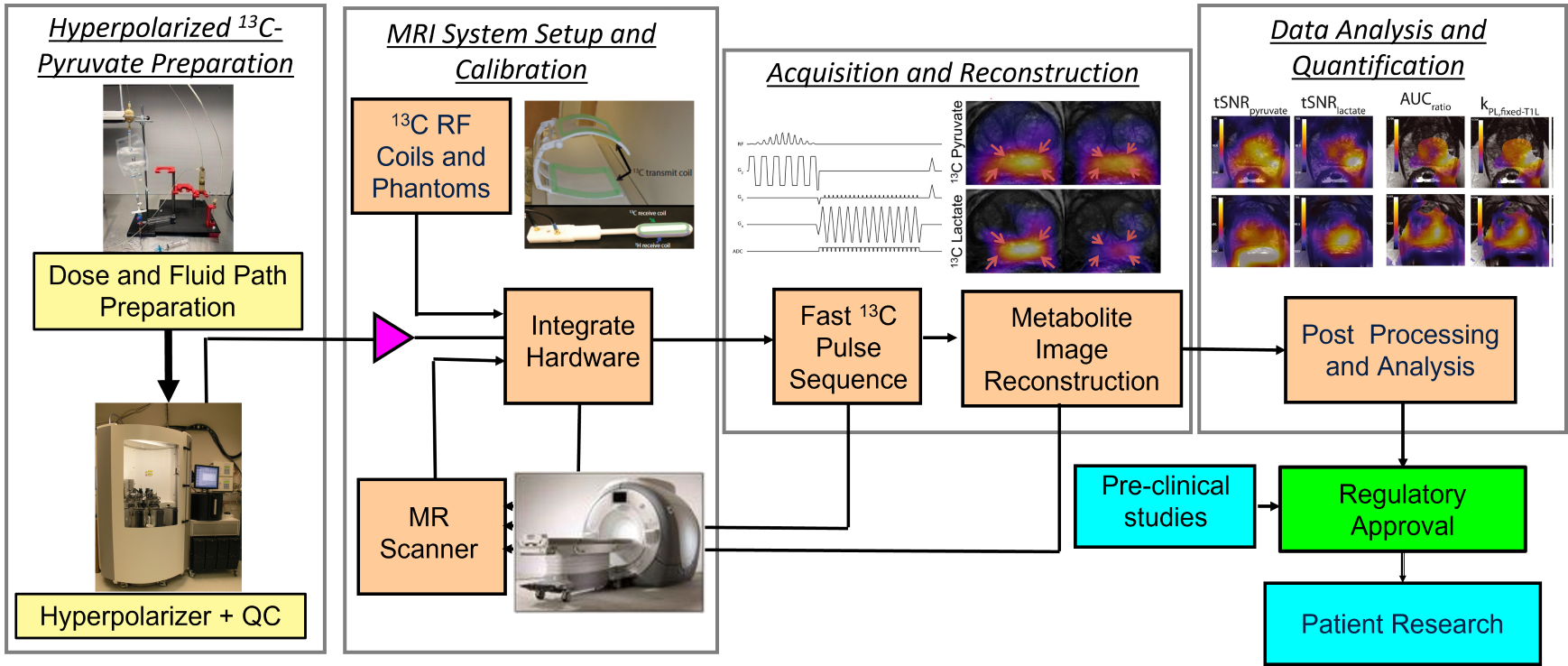
Hyperpolarized 13C MRI clinical studies require safe processes for hyperpolarized agent preparation,
MRI system capable of 13C and specialized calibration methods, acquisition and reconstruction
methods that can capture dynamic and spectroscopic information, and data analysis methods to quantify metabolism.