Spatial Encoding: Gradients & Beyond
Jason Stockmann1
1Martinos Center for Biomedical Imaging, United States
1Martinos Center for Biomedical Imaging, United States
Synopsis
Keywords: Image acquisition: Sequences, Physics & Engineering: Physics, Image acquisition: Artefacts
This talk starts from basic principles of the Fourier transform to build intuition for how linear gradient coil fields perform spatial encoding in MRI. We will review k-space and how to set basic imaging parameters related to FOV, resolution, etc. A few basic k-space trajectories and their imaging properties (such as point spread function) and associated artifacts will be discussed. We will then consider imperfections in spatial encoding arising from gradient eddy currents and methods for correcting these effects. Finally, we will look at emerging methods for spatial encoding including the nonlinear gradients and their associated imaging properties and artifacts.Acknowledgements
The author thanks Larry Wald (MGH) for loaning several slides related to spatial encoding.References
[1] Nishimura D, Principle of Magnetic Resonance Imaging, Stanford University, 2010.
[2] Liang Z-P, Principles of Magnetic Resonance Imaging: A Signal Processing Perspective, Wiley-IEEE Press, 1999.
[3] Bernstein MA, King KF, Zhou XJ. Handbook of MRI Pulse Sequences, Academic Press, 2004.
Figures
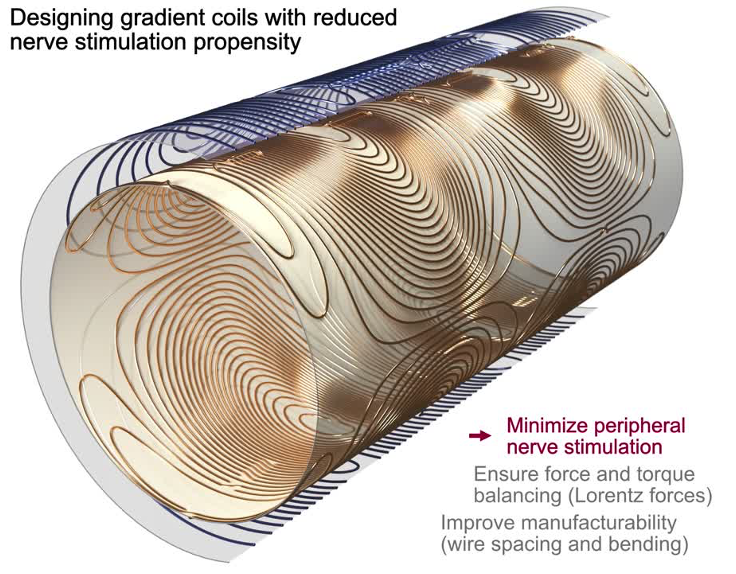
Figure 1