Exploiting AI in Prostate Cancer Assessment
1Centre for Biomedical Engineering, Indian Institute of Technology Delhi, New Delhi, India
Synopsis
Keywords: Body: Pelvis, Cross-organ: Cancer, Image acquisition: Machine learning
Prostate cancer is sixth leading cause of cancer related death and is one of the most prevalent malignancies in men. Artificial intelligence (AI) methods are potentially useful in prostate cancer management for detection and characterization of prostate lesion. AI solutions are assisting in streamlining patient workflow and optimizing treatment plans for individual patient leading to precision medicine-based approach. Machine learning methods are being used for segmentation of prostate gland and its anatomical structures, image registration, detection of lesions, lesion characterization, automated PI-RADS scoring, and risk stratification, which ultimately leads to enhanced diagnosis, treatment planning, and patient outcomes in prostate-related conditions.Introduction
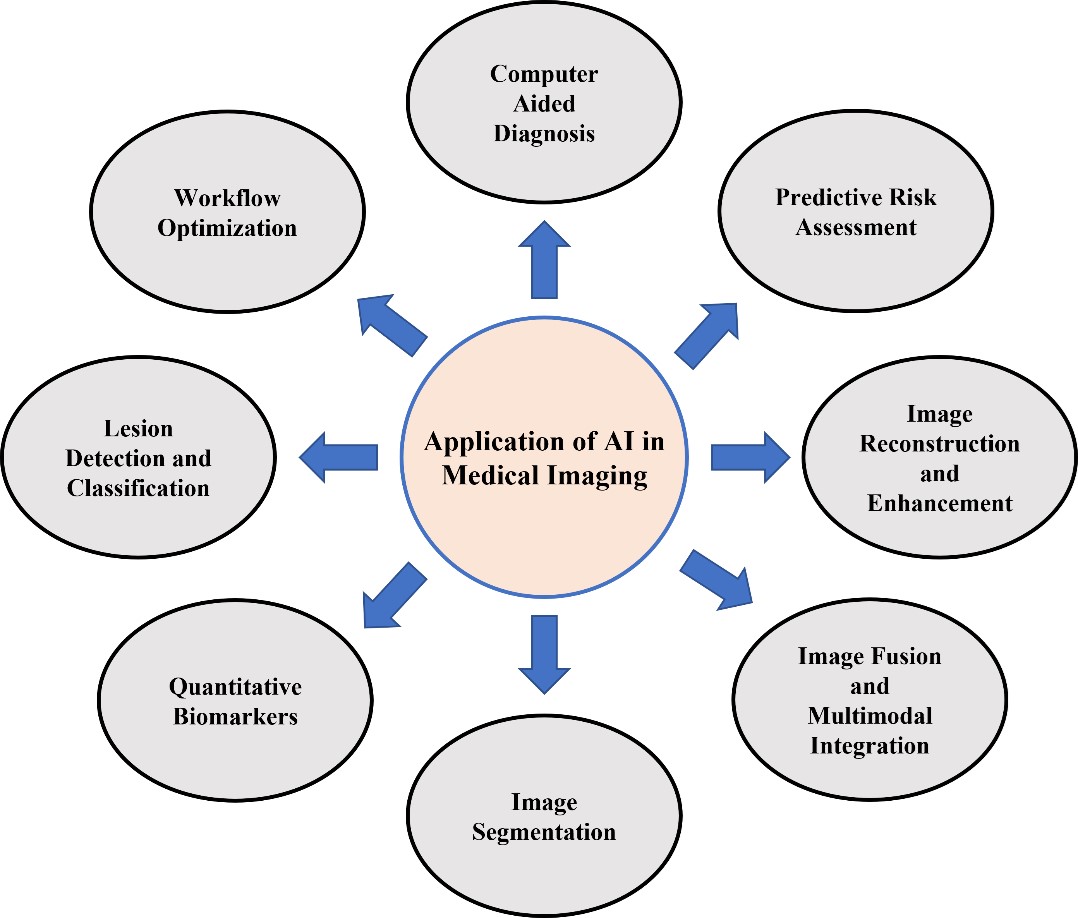
a) Prostate cancer: Prostate cancer is the sixth leading cause of cancer-related mortality and the second most prevalent malignancy in men globally. According to GLOBOCAN 2020 estimates, 1.4 million new cases of prostate cancer and 375,000 deaths were reported worldwide [1]. Most prostate cancers tend to develop slowly, are of a low grade, and are associated with a relatively low risk and limited aggressiveness. Screening for prostate cancer often involves a prostate-specific antigen (PSA) test and a digital rectal exam (DRE). In cases where screening results or symptoms raise suspicion, further tests such as biopsy are performed to confirm the diagnosis of prostate cancer [2]. MRI has revolutionized prostate cancer diagnosis and treatment [3]. MRI offers precise and comprehensive images of the prostate gland, enabling improved detection, localization, and characterization of prostate cancer lesions. Prostate Imaging Reporting and Data System (PI-RADS) is a standardized system for interpreting and reporting MRI of the prostate, particularly for the detection and characterization of prostate cancer [4].b) Artificial Intelligence (AI) in non-invasive imaging-based lesion detection: AI has significantly improved the detection of lesions by using machine learning or deep learning algorithms trained on large sets of medical images [5]. AI-driven lesion detection systems are valuable clinical decision support tools that can assist radiologists in analysing images, streamlining workflow, and optimizing treatment plans. Radiologists could save time and reduce inter-reader variability with these tools. The application of AI in medical imaging is shown in figure 1.
AI in prostate image analysis
AI algorithms are transforming the analysis of prostate imaging by improving precision, efficiency, and clinical decision-making [6]. These algorithms have the potential to carry out various tasks, such as segmentation of prostate gland and its anatomical structures, image registration, detection of suspicious lesions, lesion characterization, and risk stratification, which ultimately leads to enhanced diagnosis, treatment planning, and patient outcomes in prostate-related conditions. AI algorithms play a crucial role in MRI-targeted biopsy procedures, where they assist in accurately identifying suspicious lesions within the prostate gland. AI algorithms leverage deep learning and image analysis techniques to automate tasks such as Gleason grading, improving the accuracy and reproducibility of histopathological assessments.AI in automated PI-RADS scoring
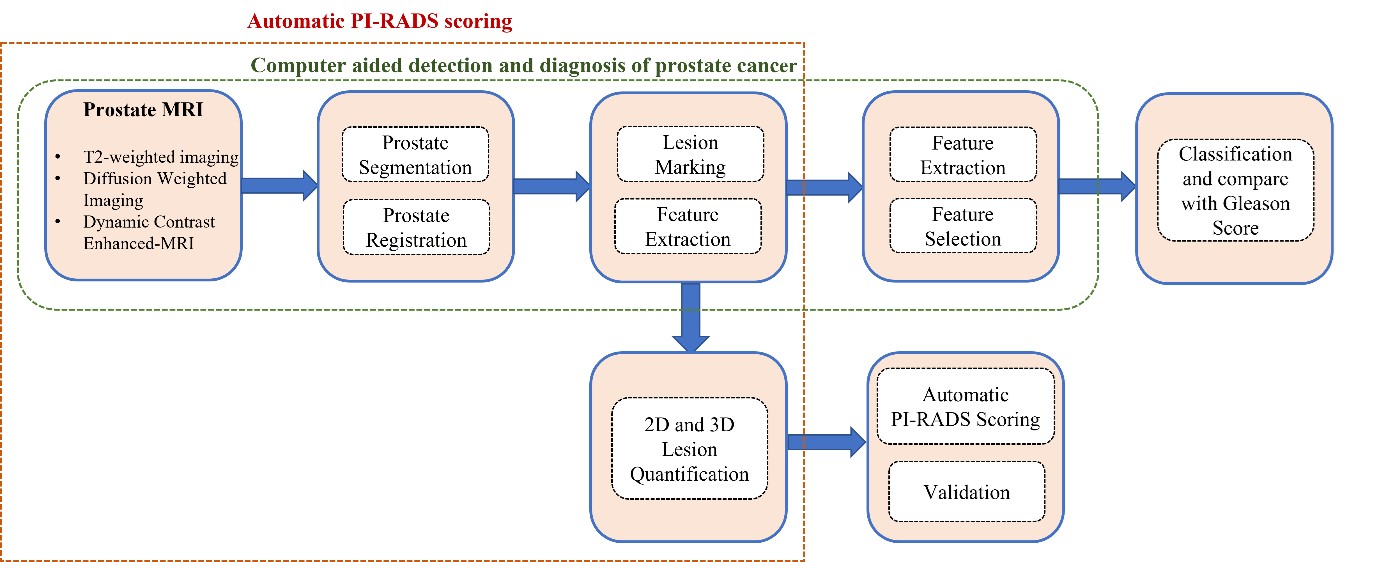
The PI-RADS scoring system is a qualitative scale that assigns higher values to indicate higher suspicion of prostate cancer [4]. A radiologist qualitatively assesses the PI-RADS score, which is a time-consuming process as reporting time is a key healthcare performance indicator. AI-driven approaches offer promising solutions to the time-consuming nature of PI-RADS assessment by automating and expediting the process of prostate MRI interpretation [7,8]. AI based computer aided diagnosis systems have the potential to assist radiologists in evaluating MR images and assigning PI-RADS scores in the screening process by reducing inter-reader variability and evaluation time [9]. The workflow for the automatic PI-RADS scoring is shown in figure 2.Future scope of AI in prostate imaging
The future of AI in prostate cancer assessment with MRI has enormous potential for improving clinical practice, enhancing diagnosis accuracy, and optimizing patient outcomes. Future AI models will need to integrate diverse data sources, including imaging, genomics, proteomics, clinical data, and patient outcomes, to provide comprehensive assessments of prostate cancer. AI-driven decision support systems will offer real time guidance to radiologists during the evaluation and treatment of prostate cancer. The integration of AI-driven prostate cancer assessment tools with electronic health records systems will facilitate the automation of data analysis, documentation, and decision support processes.Acknowledgements
Dr. Dharmesh Singh has assisted in preparing the slides for this talk.References
1. Sung H, Ferlay J, Siege RL, et al., Global cancer statistics 2020: GLOBOCAN estimates of incidence and mortality worldwide for 36 cancers in 185 countries. CA Cancer J Clin. 2021;71:209-249.
2. Descotes JL. Diagnosis of prostate cancer. Asian J Urol. 2019;6(2):129-136.
3. Zhen L, Liu X, Yegang C, et al. Accuracy of multi-parametric magnetic resonance imaging for diagnosing prostate Cancer: a systematic review and meta-analysis. BMC Cancer. 2019;19(1244):1-10.
4. Turkbey B, Rosenkrantz AB, Haider MA, et al. Prostate Imaging Reporting and Data System Version 2.1: 2019 Update of Prostate Imaging Reporting and Data System Version 2. Eur Urol. 2019;76(3):340-351.
5. Hosny A, Parmar C, Quackenbush J, et al. Artificial intelligence in radiology. Nat Rev Cancer. 2018;18(8):500-510.
6. Rabaan AA, Bakhrebah MA, AlSaihati H, et al. Artificial intelligence for clinical diagnosis and treatment of prostate cancer. Cancers (Basel). 2022;14(22):5595.
7. Singh D, Kumar V, Das CJ, et al. Machine learning-based analysis of a semi-automated PI-RADS v2.1 scoring for prostate cancer. Front. Oncol. 2022; 12:961985.
8. Sanford T, Harmon SA, Turkbey EB, et al. Deep-Learning-Based Artificial Intelligence for PI-RADS Classification to Assist Multiparametric Prostate MRI Interpretation: A Development Study. J Magn Reson Imaging. 2020;52(5):1499-1507.
9. Bardis MD, Houshyar R, Chang PD, et al. Applications of Artificial Intelligence to Prostate Multiparametric MRI (mpMRI): Current and Emerging Trends. Cancers (Basel). 2020;12(5):1204
Figures