Minimizing Patient Motion
Suraj Serai1
1University of Pennsylvania
1University of Pennsylvania
Synopsis
Keywords: Image acquisition: Motion correction, Image acquisition: Fast imaging
Emerging MRI motion reduction techniques have promising potential to substantially improve image quality and reduce scan time as well as allow free-breathing acquisition. Motion-reducing free-breathing MRI protocols allow the imaging of pediatrics and geriatrics while they are awake or distracted using movie goggles or other audio-video options. These emerging imaging techniques are suitable for use with certain MR pulse sequences, acquisition planes, age groups, and for specific situations. They also have the potential to decrease exposure to sedation and to paralytics used during intubation and ventilation for patients requiring anesthesia by reducing the scan time and minimizing the motion artifacts.One of the main challenges that continues to drive innovation in pediatric imaging is motion. Much time and effort is devoted to reducing the numerous sources of motion and their resultant artifacts. These sources of motion include gross body (i.e., voluntary)motion, respiratory motion, cardiac contractions, vascular pulsations, and bowel peristalsis. Obtaining diagnostic-quality images requires the patient to lie still during image acquisition; however, many infants and children are unable to comply with this request for various reasons and often require sedation or general anesthesia. In our presentation, we will discusses several established and emerging motion-mitigation methods that may become routine clinical practice to obtain diagnostic quality abdomen MR images in the pediatric population. Familiarity with the advantages and trade-offs of these methods is essential for the radiologist to perform the optimal study and to guide the technologist acquiring the MR images. Techniques fall under two general categories: undersampling the k-space for accelerated imaging and motion compensation and correction techniques. Some of the newer methods combine the two categories as self-navigating accelerated imaging techniques. Most of the techniques can be used with physiologic motion-compensation strategies such as breath-holding and respiratory synchronized acquisition. Newly emerging MRI techniques for reducing physiologic motion in pediatric abdomen imaging include compressed sensing, simultaneous multislice excitation, radial imaging, combined radial and compressed sensing imaging, and motion resolved imaging in combination with non-cartesian sampling and compressed sensing reconstruction. These new acceleration and motion-robust MR techniques allow free-breathing abdominal MRI in children and should allow a decrease in MR imaging times and sedation requirements. Each of these techniques is more suitable for use with certain MR pulse sequences and acquisition planes and in specific situations and age groups. Diverse imaging indications may require different pragmatic approaches and specific protocols should be maintained with an intent to truly exploit the best method suitable to a specific situation. Clearly understanding the strengths and limitations of motion reduction methods can enable practitioners of pediatric MRI to select and combine the appropriate techniques and potentially reduce the need for sedation and anesthesia.
Acknowledgements
No acknowledgement found.References
Newly Developed Methods for Reducing Motion Artifacts in Pediatric Abdominal MRI: Tips and Pearls.
Serai SD, Hu HH, Ahmad R, White S, Pednekar A, Anupindi SA, Lee EY.
AJR Am J Roentgenol. 2020 May;214(5):1042-1053. doi: 10.2214/AJR.19.21987. PMID: 32023117
Figures
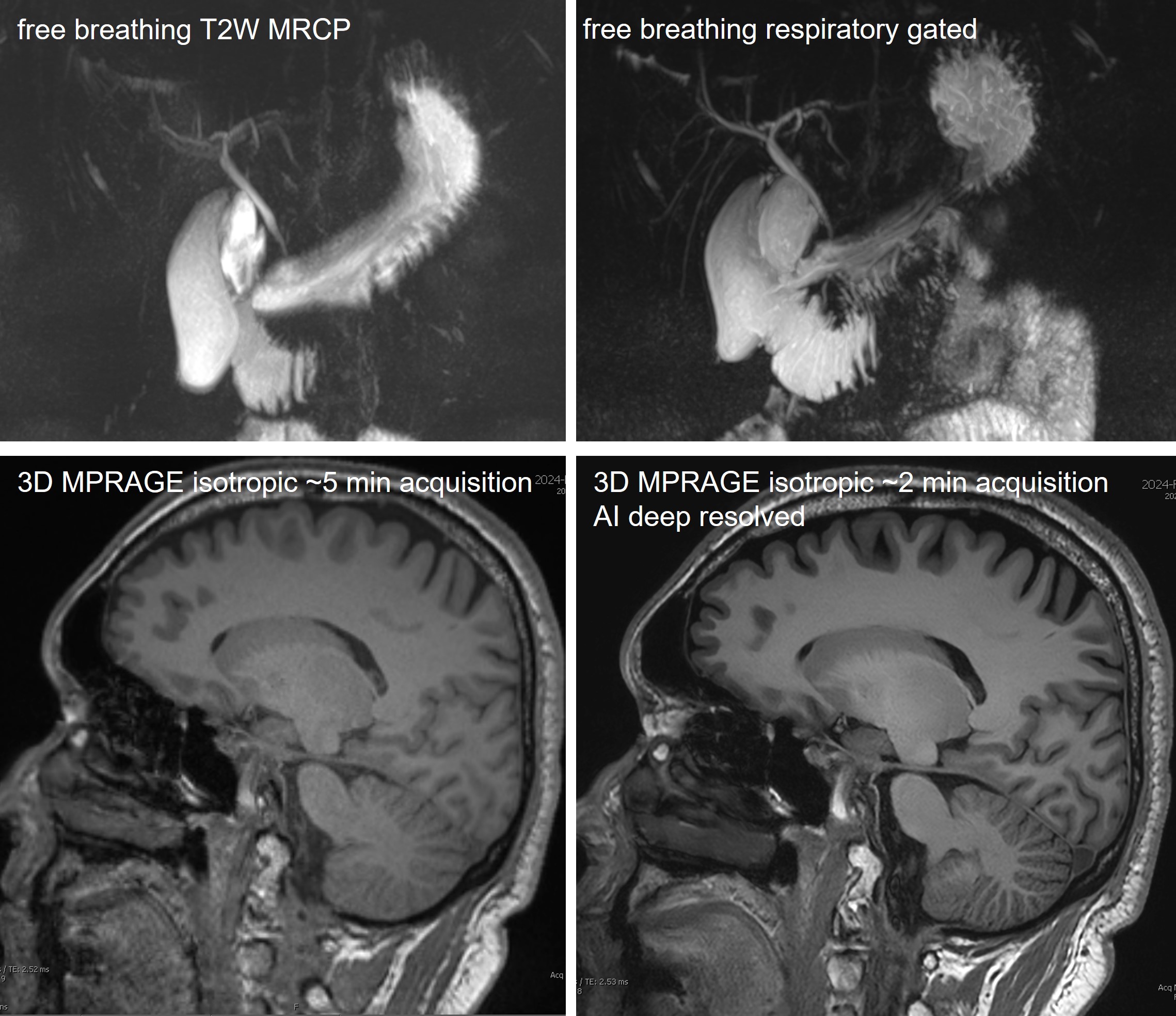
Optimized MRCP (top row) and 3D T1W (bottom row) with faster and efficient imaging (right side).