Transcending the Limitations of Traditional Research Dissemination
1Polytechnique Montreal, Montreal, QC, Canada
Synopsis
Keywords: Transferable skills: Reproducible research, Transferable skills: Public engagement
This talk explores transcending traditional research dissemination. Beginning with an analysis of its limitations, we delve into the necessity for a change in approach. We examine the audience and accessibility of traditional dissemination, emphasizing the need to broaden impact. Discover how to use modern tools such as social media, collaborative code and data sharing platforms, and open-review processes to enhance dissemination. Practical strategies for implementation and overcoming challenges are discussed. Examples of publications and supplementary material that use an interactive approach will be shared. Join us in transforming research dissemination for greater reach and impact.I. Introduction
II. Understanding the Need for Change
- Highlighting the constraints and challenges of increasing the reach of your work using conventional methods.
- Why transcending these limits is essential for advancing research impact.
- Code and Data sharing platforms
- Citable platforms
- Why you should share your publications in a interactive format
- Social media tips
- Markdown
- Jupyter Notebooks / Jupyter Books
- Dashboards
- Current Platforms (eg. NeuroLibre [7], MyBinder, Google Colab, CurveNote, CodeOcean)
- Practical strategies for integrating modern dissemination methods into MRI research workflows
- Guidelines for choosing appropriate tools and platforms
- Do’s and Don'ts
VII. Conclusion
Acknowledgements
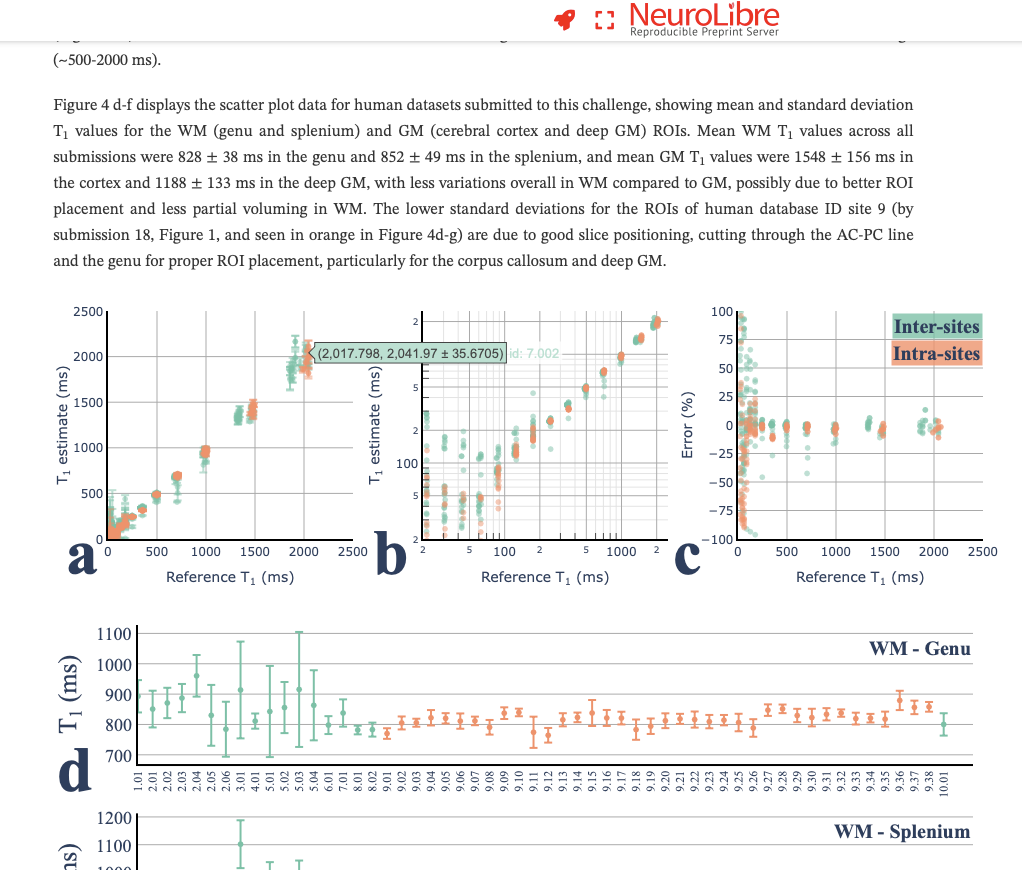
We would like to thank the Canadian Open Neuroscience Platform (CONP), the Quebec Bioimaging Network (QBIN), and the Montreal Heart Institute Foundation for their support in creating some of the NeuroLibre preprints that will be shown as examples during this talk (Figure 1).References
1. Ross-Hellauer T, Tennant JP, Banelytė V, Gorogh E, Luzi D, Kraker P, et al. Ten simple rules for innovative dissemination of research. PLoS Comput Biol. 2020;16: e1007704.
2. Weissburg IX, Arora M, Pan L, Wang WY. Tweets to Citations: Unveiling the Impact of Social Media Influencers on AI Research Visibility. arXiv [cs.DL]. 2024. Available: http://arxiv.org/abs/2401.13782
3. Boudreau M, Stikov N, Jezzard P. On the open-source landscape of Magnetic Resonance in Medicine. Magn Reson Med. 2022;88: 1495–1497.
4. Winter L, Periquito J, Kolbitsch C, Pellicer-Guridi R, Nunes RG, Häuer M, et al. Open-source magnetic resonance imaging: Improving access, science, and education through global collaboration. NMR Biomed. 2023; e5052.
5. MR-hub. [cited 12 Feb 2024]. Available: https://ismrm.github.io/mrhub/
6. OSI2. [cited 12 Feb 2024]. Available: https://www.opensourceimaging.org/
7. Karakuzu A, DuPre E, Tetrel L, Bermudez P, Boudreau M, Chin M, et al. NeuroLibre : A preprint server for full-fledged reproducible neuroscience. 2022. doi:10.31219/osf.io/h89js
8. Boudreau M. et al. Paper is not enough: Crowdsourcing the T<sub>1</sub> mapping common ground via the ISMRM reproducibility challenge. NeuroLibre Reproducible Preprints, 23. 2024. doi.org:10.55458/neurolibre.00023
Figures