Encoding/Reconstruction To Exploit High-Performance Gradients
Gabriel Ramos Llordén1,2
1Radiology, Athinoula A. Martinos Center for Biomedical Imaging, Massachusetts General Hospital, Charlestown, MA, United States, 2Harvard Medical School, Boston, MA, United States
1Radiology, Athinoula A. Martinos Center for Biomedical Imaging, Massachusetts General Hospital, Charlestown, MA, United States, 2Harvard Medical School, Boston, MA, United States
Synopsis
Keywords: Physics & Engineering: Hardware, Image acquisition: Sequences, Image acquisition: Reconstruction
Advancements in gradient technology and hardware have significantly enhanced the capabilities of human MRI scanners. To fully utilize these high-performance gradients, sophisticated encoding and reconstruction techniques are essential. This educational session delves into acquisition and reconstruction methodologies designed to maximize the potential of high-performance gradients and overcome concomitant challenges, thereby ensuring high-fidelity MRI imaging. Additionally, the session will highlight various medical applications that benefit from these technological advancements, e.g., hardware and dedicated image encoding/reconstruction frameworks.Content
High-performance gradients have become increasingly prevalent in human MRI scanners as gradient technology and hardware advance, providing exciting opportunities for improved MR imaging and encoding capabilities. This course is designed to exploit these cutting-edge developments, exploring the intricacies of encoding optimization, system calibration methodologies, and advanced reconstruction strategies that maximize the potential of these advanced systems. The syllabus includes:- Fundamental principles of gradient hardware design
- A comprehensive review of the latest breakthroughs in gradient technology
- Gradient performance metrics and their influence on imaging quality
- Gradient waveform design to push the limits of hardware: strategies and physiological constraints.
- Advanced spatial encoding strategies
- Examinations of field imperfections, such as eddy currents, Maxwell terms, and nonlinear effects, along with their implications for image fidelity
- State-of-the-art field correction methods and reconstruction techniques
- Practical applications in diffusion MRI and functional MRI, highlighting their clinical and research significance
Acknowledgements
K99NS132984 (K99/R00 Pathway to Independence Award)References
No reference found.Figures
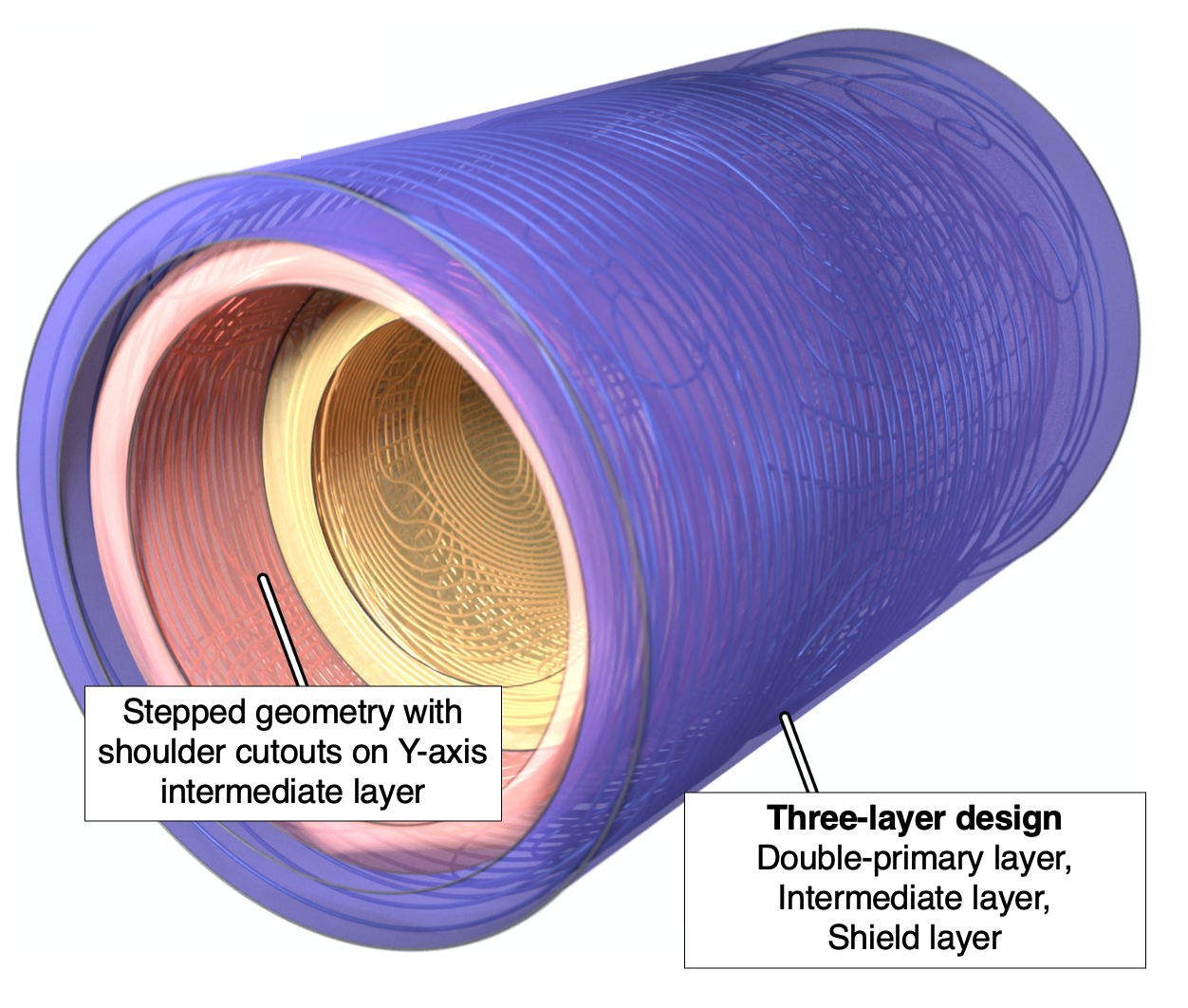
Example of winding geometry of a high-performance gradient coil (Connectome 2.0)