Motion Artifacts in Clinical Practice
1Radiology, Shanghai Children's Medical Center, School of Medicine, Shanghai Jiao Tong University, Shanghai, China
Synopsis
Keywords: Education Committee: Clinical MRI, Image acquisition: Artefacts
This talk will cover MRI motion artifacts in clinical practice of fetuses and children, including the understanding of the influence of MRI examination of fetuses and children, and strategies to reduce or minimize the impact of motion artifacts on image diagnostic quality. The strategies to reduce or minimize the impact of motion artifacts will include exam preparation with MRI simulation, optimization of MRI environment, role of child life specialists, noise-reduction, optimization of MRI protocol design, the application of fast sequences and fast scanning technology, and motion-compensation and retrospective motion correction techniques.Abstract
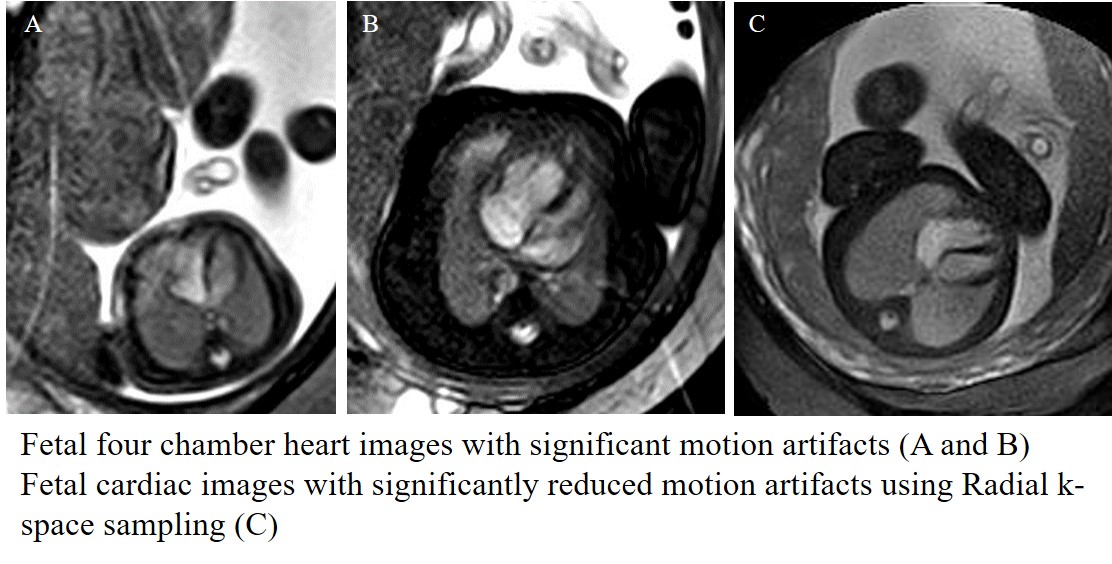
This talk will cover MRI motion artifacts in clinical practice of fetuses and children, including the understanding of the influence of MRI examination of fetuses and children, and strategies to reduce or minimize the impact of motion artifacts on image diagnostic quality. The strategies to reduce or minimize the impact of motion artifacts will include exam preparation with MRI simulation, optimization of MRI environment, role of child life specialists, noise-reduction, optimization of MRI protocol design, the application of fast sequences and fast scanning technology (radial k-space sampling and compressed sensing), and motion-compensation and retrospective motion correction techniques. In addition, insights into future developments and emerging techniques of motion compensation including deep learning/artificial intelligence, will also be introduced.Acknowledgements
We are very grateful to Prof. Dorothy Bulas and Ming Zhu for their fundamental contribution to the talk editing and revision. This work was supported by Shanghai 2023 Science and Technology Innovation Action Plan Medical Innovation Research Special Project (23Y11907800); the Fundamental Research Funds for the Central Universities (YG2023ZD22); National Natural Science Foundation of China Grants (number 81971582, 81571628, 81101032); Natural Science Foundation of Shanghai under Grant (number 19ZR1476700); Shanghai Pujiang Program under Grant (number 2019PJD030).References
1. Dong SZ, Zhu M, Bulas D. Techniques for minimizing sedation in pediatric MRI. J Magn Reson Imaging 2019;50(4):1047-1054.
2. Graves MJ, Mitchell DG. Body MRI artifacts in clinical practice: a physicist's and radiologist's perspective. J Magn Reson Imaging 2013;38(2):269-287.
3. Harrington SG, Jaimes C, Weagle KM, Greer MC, Gee MS. Strategies to perform magnetic resonance imaging in infants and young children without sedation. Pediatr Radiol 2022;52(2):374-381.
4. Malamateniou C, Malik SJ, Counsell SJ, et al. Motion-compensation techniques in neonatal and fetal MR imaging. AJNR Am J Neuroradiol 2013;34(6):1124-1136.
5. Uus AU, Egloff Collado A, Roberts TA, et al. Retrospective motion correction in foetal MRI for clinical applications: existing methods, applications and integration into clinical practice. Br J Radiol 2023;96(1147):20220071.
Figures