Transition Bands in Balanced SSFP: From Artifacts to Refined Method for fMRI Contrast
Rahel Heule1,2
1Center for MR Research, University Children's Hospital, Zurich, Switzerland, 2Department of Biomedical Magnetic Resonance, University of Tübingen, Tübingen, Germany
1Center for MR Research, University Children's Hospital, Zurich, Switzerland, 2Department of Biomedical Magnetic Resonance, University of Tübingen, Tübingen, Germany
Synopsis
Keywords: Contrast mechanisms: fMRI, Image acquisition: Sequences, Physics & Engineering: Physics
Balanced steady-state free precession (bSSFP) signal formation exhibits a characteristic sensitivity to resonance frequency. Due to fully balanced gradients along all axes and thus the absence of any gradient-induced precession, bSSFP is highly sensitive to any source of off-resonance-induced precession. This strong dependency on off-resonance can constitute a confounder in the presence of magnetic field inhomogeneities or local susceptibility differences, causing signal voids (banding artifacts) in clinical images. On the other hand, the frequency sensitivity of bSSFP, which is prominent in the transition band, reveals interesting applications, e.g. as a refined fMRI contrast mechanism.Outline of educational talk
We will review the frequency-sensitive signal formation of balanced steady-state free precession (bSSFP), including a discussion of resulting artifacts and typical strategies to mitigate them. The frequency response of bSSFP carries tissue-specific information about the different molecular species contained in an imaging voxel (e.g., myelin, deoxyhemoglobin, or lipids), giving rise to a number of interesting applications, which will be described briefly. We will then exploit the frequency-selective signal profile of bSSFP as a contrast mechanism with a focus on the transition band. The pronounced frequency dependency in the transition band can be utilized to discriminate between different oxygenation levels associated with different neuronal activation levels in fMRI or to track paramagnetic marker material in interventional MRI.Acknowledgements
No acknowledgement found.References
No reference found.Figures
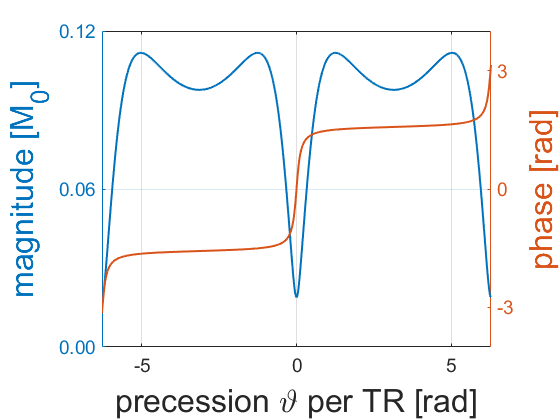
Illustration of the bSSFP frequency response versus precession angle. Both, magnitude and phase, demonstrate a strong sensitivity to the off-resonance-induced precession angle, which can be modulated, e.g. to generate BOLD contrast. Simulation parameters: α = 15°, TR = 5 ms, TE = TR/2, T2/T1 = 0.05.