RF Coils as Respiratory & Motion Sensor: Pilot Tone
1Siemens Healthcare GmbH, Germany
Synopsis
Keywords: Image acquisition: Motion correction, Physics & Engineering: Hardware, Cross-organ: Development
This presentation introduces Pilot Tone as a versatile method to gather physiologic information in parallel with and without disturbing MR imaging. A small signal generator generates a weak continuous magnetic signal near Larmor frequency. This Pilot Tone is modulated by physiologic motion and is acquired with the standard MR receive system in parallel to the spin signal. The presentation will describe how to get started and then focus on the physics of the signal formation and the current state of retrospective and prospective applications for cardiac, body and head imaging as described in the literature.Introductory Comments
For the “McGyver part”, i.e., how to get started with a basic scanner independent implementation, please consult last year’s syllabus [Speier 2023B]. This syllabus focuses on signal characteristics and applications.Since its inception Pilot Tone hardware, signal processing and applications have been developed at multiple sites, sometimes jointly, sometimes independently, as demonstrated by the many abstracts on the topic listed below. Historically inclined readers can find recounts of the development at two of these sites in [Slabiac 2022] and [Speier 2023A].
Pilot Tone Background
It has been shown several decades ago that electromagnetic fields at low frequencies that enter the chest are modulated by respiratory and cardiac activity (900 MHz [Moskalenko 1958], 100 kHz [Tarjan 1968], 170MHz [Wen 1995]). The interaction of electromagnetic fields with electrically conductive body tissues is well understood and by itself has been used as an imaging modality [Griffiths 1999] [Ma 2017].This phenomenon has already been used to characterize motion in an MRI environment for multiple setups such as noise navigators [Andreychenko 2014] [ Navest 2020], transmit coil reflections [Buikman 1988] [Jaeschke 2019] and local coil loading [Kudielka 2016]. It has been shown that a multi-channel system can acquire rich information that allows separation of multiple motion modes [Jaeschke 2019].
The idea of Pilot Tone (PT) based motion correction is to implement an (electro)magnetic motion sensor with minimal hardware (HW) effort by adding hardware just for the generation of a reference signal and reuse the existing MR system infrastructure for receiving and processing the modulation of these signals [Speier 2015].
It has been demonstrated previously that information from external sensors can be recorded together with the MR data [Hanson 2007]: if modulated onto a magnetic field carrier signal of the right amplitude and frequency, the external information can be encoded in the oversampling region of the MR data. Physiologic motion will modulate the carrier signal that is received in Hanson’s experiment, which in communication science lingo would be called a Pilot Tone (PT).
Pilot Tone Signal Characteristics
In the range of typical MR frequencies [20…300MHz] the tissue interaction is weak, leading only to a weak modulation of the signal. Typical values at 3T are ~5 % for respiratory, and ~1 % for cardiac motion in the optimally placed receive channels. The main source for signal modulation are eddy currents that are induced by the oscillating magnetic PT in electrically conductive tissue. The energy that is dissipated by the eddy currents leads to bulk coil loading. However, of interest in the PT method is not the changing coil load, but the changing secondary magnetic fields B2 that are generated by changing eddy currents. The spatial distribution of these currents depends on the tissue distribution. For example, during cardiac contraction weakly conductive lung tissue fills the space that in the relaxed state is occupied by highly conductive blood and cardiac muscle, likewise for respiration lung is displaced by more conductive liver tissue.Because the PT is detected with the local receive coil arrays of the MR system, the scanner “sees” multiple views of the B2 distribution with different spatial weightings. Therefore, motion modes at substantially different spatial positions can be separated based on their relative signal intensities and phases in the receive channels. (Side note: This holds as well for other multi-channel electromagnetic navigation techniques like “scatter matrix” [Jaeschke 2019] and the “noise navigator” [Andreychenko 2014]: separability of cardiac and respiratory motion by noise navigation has been analyzed in detail using EM simulations [Navest 2019] [Navest 2020].) For example, [Schroeder 2016A] demonstrated that PT coil combination weights can be trained on image ground truth to separate respiratory chest and diaphragm motion by weighted linear combination of the channels.
The weak interaction, on the positive side, ensures that the signal is not attenuated significantly with penetration depth and therefore enables motion encoding from deep inside the body. For example, this means that the cardiac component of the Pilot Tone signal changes in sync with the cardiac volume [Bacher 2021], i.e., one extremum of the modulation corresponds to end-diastole, the other to end-systole. Thus, the cardiac phase can be derived from the Pilot Tone signal alone.
One the negative side, the small modulation depth limits the achievable SNR because the PT amplitude is limited by the dynamic range of the MR receiver. Also, the stability of the PT signal generation and detection system must be high compared to the modulation depth.
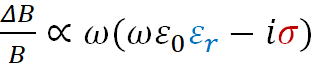
The modulation from tissue interaction is frequency dependent and since the PT must be close to Larmor frequency to be detectable by the MR receiver, the modulation consequently depends on the static magnetic field of the MRI system. The dependency can be estimated using information from [Griffiths 1999] and the Tissue Frequency Chart by IT'IS Foundation (itis.swiss): When adding a body with conductivity s and electrical permittivity er into the system, the magnetic induction signal changes as (Fig.1)
While at typical MR frequencies the PT signal can be generated as a magnetic near field with a suppressed electric field component, for frequencies above 1 GHz self-propagating electromagnetic waves are required due to the short wavelength. Higher order tissue interactions become relevant, and the interaction is better described by a radar wave model. Compared to PT, the modulation depth increases while the signal penetration into the body reduces [Neumann 2023]. Recently a hybrid method has been published, “Beat Pilot Tone” (BPT), which implements MR detected radar [Anand 2023]. The primary advantage of BPT is that it decouples the frequency of the PT signal that interacts with the body from the operating frequency of the MRI scanner and therefore from its static magnetic field strength. It thus allows optimization of the tissue interaction for a given application, e.g., for optimal tradeoff between depth of penetration and SNR, or motion linearity and sensitivity. For example, BPT with an interaction frequency near 2.4GHz was shown to enable head motion detection with high sensitivity at 0.25T [Chen S 2023] and 3T [Huttinga 2023]. While BPT is quite promising, the topic is outside the scope of this syllabus. However, when operated as magnetic near field generator at interaction frequencies in the frequency range of clinical MRI, the performance of BPT should be similar to that of PT (besides effects from the non-negligible electric field and for potential quality loss due to the not completely controlled coupling mechanism) and the processing should be identical to that of PT.
Pilot Tone Technical Aspects
This section lists publications that focus on technical aspects of various PT applications.General descriptions: [Solomon 2021] [Speier 2023B]
Respiratory application:
- retrospective [Solomon 2021] [Huang SS 2021]
- prospective triggering: [Huang YT 2023]
- prospective slice following: [Ludwig 2021]
Cardiac application: [Bacher 2017] [Bacher 2018A] [Speier 2022] [Pan 2022]
Blind source separation methods [Sahonero 2017] applied to PT:
- SOBI [Solomon 2021], FastICA [Bacher 2017]
- ROVIR [Pan 2022]
- PCA based projection [Zhang 2020] [Speier 2022] [Huang YT 2023]
RF artefact suppression:
[Zhang 2020] and [Huang YT 2023] applied PCA based sub-space projection methods to remove RF interference from PT traces for respiratory triggering, [Speier 2022] extended these to separate cardiac from respiratory signal contributions and RF interference. [Pan 2022] applied ROVIR to separate cardiac from respiratory signal contributions.
PT hardware:
(B)PT generator frequency control: [Grelling 2022]
PT generator for patient communication (squeeze ball): [Bacher 2022]
Pilot Tone Applications
PT has been used for various applications. These can be clustered as follows:Retrospective Respiratory Gating
[Vahle 2020] evaluated PT based respiratory navigation in a moving human torso phantom and volunteers. During a calibration scan a motion model was built PT data acquired during subsequent MR measurements was used to bin simultaneously acquired PET data.
[Solomon 2021] compared respiratory PT to respiratory cushion and self-navigation data in 16 volunteers and achieved improved image sharpness using a PT data-informed XD GRASP reconstruction.
[Pruitt 2020] compared 4D Flow respiratory binning based on PT with self-gated binning and found comparable results in three volunteers.
Prospective Respiratory Triggering
[Huang YT 2023] implemented sequence independent respiratory triggering by eliminating RF interference on the PT signal with a PCA based projection algorithm.
Prospective Respiratory Slice Tracking
[Ludwig 2021] implemented prospective slice tracking for respiratory motion based on the Pilot Tone. A linear model was built on image registration data from a calibration scan. The model was applied to subsequent cine scans under free breathing. [Ludwig 2023] extended this navigation approach to T1 cines under free breathing.
Retrospective Cardiac Gating
[Pruitt 2021] compared 4D Flow cardiac retrogating based on PT with cardiac self-gating and found comparable results in eight volunteers.
Retrospective Respiratory and Cardiac Gating
[Falcao 2022] applied PT based respiratory and cardiac navigation to 3D free running PC-flow measurements. [Falcao 2024] demonstrated that PT can achieve consistent respiratory navigation between Cine and PC-flow measurements and thus enables transfer of cine based segmentation results to the PC-flow analysis.
[Mackowiak 2023] compared PT binning to “self”-gated binning (based on added SI-projections) in an eight echo T2* free running 3D sequence in 10 volunteers and found comparable results.
[Chen C 2023] compared in 23 patients respiratory PT signals with data from a scanner integrated respiratory sensor, and PT based cardiac triggers with ECG triggers. Comparison to fluoroscopic MR images as ground truth yielded improved fidelity for PT in case of respiration and comparable fidelity for cardiac triggering with potential advantages in arrhythmic cases.
Prospective Cardiac Triggering
For cardiac applications, the dominating respiratory signal is suppressed to a high degree by choosing coil combination weights that maximize the cardiac component while minimizing the respiratory component. [Schroeder 2016B] showed for the first time, that cardiac activity can be seen in PT signals if a PT generator close to the heart is used and that the cardiac component can separated by weighted channel combination from respiratory contributions. [Bacher 2017] applied ICA on PT magnitude values to separate respiratory and cardiac components. The processing generated reproducible trigger time points around R-wave and was robust against placement variations of the PT generator over the heart. He showed that the resulting cardiac signal is closely following the cardiac volume time curve [Bacher 2021] and obtained, after adding extended Kalman filtering (EKF) for minimal lag, prospectively triggered Cines in volunteers [Bacher 2018A] [Bacher 2018B]. [Speier 2022] applied complex valued PCA based sub-space projections, to maximize the cardiac component while suppressing respiration and RF artefacts to extend cardiac PT triggering to non-Cine measurements. For increased robustness EKF was substituted by constant velocity Kalman filtering and further processing the velocity. The method has been tested against ECG triggering with comparable results at three clinical sites [Lin 2023] [Pan 2023].
Head Motion Correction
In general, correction of head motion has high quality demands: it requires characterization of 6 degrees of freedom with higher resolution than the image data. The motion is in general non-periodic and can range from slow drifts to rapid movements. To achieve both high temporal and spatial resolution as well as long term stability, multiple methods can be combined. PT provides motion information with high temporal resolution but requires additional navigators to calibrate it to a geometric motion model, e.g., MR navigators. In that sense it behaves similar to FID navigators [Wallace 2023A] with the advantage that it does not interrupt the MR acquisition. [Speier 2018] demonstrated that a PT setup with a single source and a 20-channel head coil can be used to quantify and distinguish “yes” and “no” motion. [Wilkinson 2021] compared PT to self-navigation using the DISORDER framework. [Huang YT 2022] demonstrated iterative retrospective head motion correction based on PT. [Brackenier 2022] combined DISORDER with PT navigation and optimized PT calibration with fat nav [Wilkinson 2022]. [Wallace 2023B] used PT to optimize selection of kSpace lines for 3D radial navigators.
Conclusion
While the original target application for Pilot Tone had been respiratory navigation, the method has since been successfully applied to various motion scenarios and applications, alone or in combination with other motion managing techniques. Still, as the large number of conference abstracts in the literature references demonstrates, the research on most applications is still in its infancy and there is still a lot to do to make the already demonstrated applications clinically robust and usable.Also, there are many applications left to be explored. Just a few examples: PT has not yet been applied to manage motion during orthopedic exams, or to manage motion outside the field of view, e.g., to provide cardiac information to fMRI studies or to trigger peripheral non-contrast angiography.
Acknowledgements
I want to thank my colleagues Mario Bacher and Dominik Nickel for reviewing the manuscript.
References
New references compared to last year’s syllabus are marked (*)
The list is by no means complete. For example, conference abstracts that were extended into peer-reviewed journal articles have been omitted. I apologize in advance if I failed to include relevant work.
Still the list should serve as a good introduction into the field.
[Anand 2023] *
Anand S, Lustig M. Beat Pilot Tone: Versatile, Contact-Free Motion Sensing in MRI with Radio Frequency Intermodulation. 2023, https://doi.org/10.48550/arXiv.2306.10236
[Andreychenko 2014]
Andreychenko A, Crijns S, Raaijmakers A, Stemkens B, Luijten P, Lagendijk J, et al. Noise variance of an RF receive array reflects respiratory motion: a novel respiratory motion predictor. ISMRM 2014 Milan, #0092
[Bacher 2017]
Bacher M. Cardiac Triggering Based on Locally Generated Pilot-Tones in a Commercial MRI Scanner: A Feasibility Study. Master thesis. Graz: Graz University of Technology; 2017. 103 p. https://diglib.tugraz.at
[Bacher 2018A]
Bacher M SP, Bollenbeck J, Fenchel M, and Stuber M. Pilot Tone Navigation Enables Contactless Prospective Cardiac Triggering: Initial Volunteer Results for Prospective Cine. ISMRM 2018 Paris, #2960
[Bacher 2018B]
Bacher M, Speier P, Bollenbeck J, Fenchel M, and Stuber M. Model-Based Lag Free Processing of Pilot Tone Navigator Data Enables Prospective Cardiac Triggering. ISMRM, Paris 2018, #4913
[Bacher 2021]
Bacher M, Dornberger B, Bollenbeck J, Stuber M, and Speier P. Listening in on the Pilot Tone: A Simulation Study. ISMRM 2021 Online, #1364
[Bacher 2022]
Bacher M, Speier P, and Bollenbeck J. A Wireless Pilot Tone Based Patient Squeeze-Ball (P2TSB). ISMRM 2022 London, #2004
[Brackenier 2022]
Brackenier Y, Wilkinson T, Cordero-Grande L, Tomi-Tricot R, Bridgen P, Giles S, De Vita E, Malik SJ, and Hajnal JV. Pilot Tone meets DISORDER: Improved data-driven motion-corrected brain MRI by leveraging Pilot Tone signal variations. ISMRM 2022 London, #0859
[Buikman 1988]
Buikman D, Helzel T, Röschmann P. The rf coil as a sensitive motion detector for magnetic resonance imaging. Magnetic Resonance Imaging, Volume 6, Issue 3,1988, Pages 281-289
[Chen C 2023] *
Chen C, Liu Y, Simonetti O, Tong M, Jin N, Bacher M et al. Cardiac and respiratory motion extraction for MRI using pilot tone–a patient study. The International Journal of Cardiovascular Imaging 2023, 40, 10.1007/s10554-023-02966-z.
[Chen S 2023] *
Chen S, Sun H, Chen H, Anand S, Lustig M, and Zhang Z. Towards contact-free motion sensing technique at low-field MRI using beat pilot tone. ISMRM2023 Toronto #1019
[Falcao 2022]
Falcão MBL, Di Sopra L, Ma L, Bacher M, Yerly J, Speier P, Rutz T, Prša M, Markl M, Stuber M, Roy CW. Pilot tone navigation for respiratory and cardiac motion-resolved free-running 5D flow MRI. Magn Reson Med. 2022 Feb;87(2):718-732.
[Falcao 2024] *
Falcão M, Mackowiak A, Rossi G, Prša M, Tenisch E, Rumac S et al. Combined Free-running 4D anatomical and flow MRI with native contrast using Synchronization of Neighboring Acquisitions by Physiological Signals (SyNAPS), Journal of Cardiovascular Magnetic Resonance, 2024, 101006, ISSN 1097-6647
[Grelling 2022]
Grelling J. An Automated Control System for Beat Pilot Tone in MRI. Thesis 2022. EECS Department, University of California, Berkeley 2022, https://www2.eecs.berkeley.edu/Pubs/TechRpts/2022/EECS-2022-203.html
[Griffith 1999]
Griffiths H, Stewart WR, and Gough W. Magnetic induction tomography: a measuring system for biological tissues. Annals of the New York Academy of Sciences, 873:335–345, 1999.
[Hanson 2007]
Hanson LG, Lund TE, Hanson CG. Encoding of electrophysiology and other signals in MR images. J Magn Reson Imaging 2007, 25(5), 1059-1066
[Hayes 2022]
Hayes C, Huang YT, Rick M, Kroeker R, Bacher M, Pan Y, et al. Multi-center evaluation of the novel Beat Sensor Cardiac triggering technology. ISMRM 2022 London, #4786
[Huang SS 2021]
Huang SS, Boyacioglu R, Bolding R, MacAskill C, Chen Y, Griswold MA. Free-Breathing Abdominal Magnetic Resonance Fingerprinting Using a Pilot Tone Navigator. J Magn Reson Imaging. 2021 Oct;54(4):1138-1151
[Huang YT 2022]
Huang YT, Speier P, Hilbert T, and Kober T. Motion correction using Pilot Tone: a general model-based approach. ISMRM2022, #3169
[Huang YT 2023]
Huang YT, Tan X, Zhang Q, Speier P. Pilot Tone respiratory signal processing with RF interference suppression and validation against image navigator. ISMRM 2023 Toronto, #3014
[Huttinga 2023] *
Niek R.F. Huttinga N, Suma Anand S, van den Berg CAT, Sbrizzi A, and Lustig M. Three-dimensional rigid head motion correction using the Beat Pilot Tone and Gaussian Processes. ISMRM 2023 Toronto #1019
[Jaeschke 2019]
Jaeschke, Sven & Robson, Matthew & Hess, Aaron. (2019). Scattering matrix imaging pulse design for real‐time respiration and cardiac motion monitoring. Magn Reson Med. 2019; 82: 2169– 2177
[Kim 2021]
Kim D, Cauley SF, Nayak KS, Leahy RM, Haldar JP. Region-optimized virtual (ROVir) coils: Localization and/or suppression of spatial regions using sensor-domain beamforming. Magn Reason Med. 2021; 86: 197–212
[Kudielka 2016]
Kudielka GP. Coil load changes for physiological motion acquisition in cardiac magnetic resonance imaging. Thesis 2016 l'Université de Lorraine, Nancy.
http://docnum.univ-lorraine.fr/public/DDOC_T_2016_0071_KUDIELKA.pdf
[Lin 2023]
Lin K, Sarnari R, Speier P, Hayes C, Davids R, Carr JC, Markl M. Pilot Tone-Triggered MRI for Quantitative Assessment of Cardiac Function, Motion, and Structure. Invest Radiol. 2023 Mar 1;58(3):239-243
[Ludwig 2021]
Ludwig J, Speier P, Seifert F, Schaeffter T, Kolbitsch C. Pilot tone–based motion correction for prospective respiratory compensated cardiac cine MRI. Magn Reson Med. 2021 May;85(5):2403-2416.
[Ludwig 2023]
Ludwig J, Kerkering KM, Speier P, Schaeffter T, Kolbitsch C. Pilot tone-based prospective correction of respiratory motion for free-breathing myocardial T1 mapping. MAGMA. 2023 Feb;36(1):135-150
[Ma 2017]
Ma L and Soleimani M. Magnetic induction tomography methods and applications: a review. Measurement Science and Technology, Volume 28, Number 7
[Mackowiak 2023] *
Mackowiak ALC, Roy CW, Yerly J, Falcão M, Bacher M, Speier P, et al. Motion-resolved fat-fraction mapping with whole-heart free-running multiecho GRE and pilot tone. Magn Reson Med. 2023; 90(3): 922-938.
[Moskalenko 1958]
Moskalenko YE. Utilization of superhigh frequencies in biological investigations. Biophysics (USSR) (English translation).1958;3:619–26. [Only secondhand knowledge! I have not been able to find a copy of the original article yet. If you find it, please let me know]
[Navest 2019] *
Navest RJM, Mandija S, Andreychenko A, Raaijmakers AJE, Lagendijk JJW, van den Berg CAT. Understanding the physical relations governing the noise navigator. Magn Reson Med. 2019; 82: 2236–2247. https://doi.org/10.1002/mrm.27906
[Navest 2020]
https://github.com/rnavest/noise-navigator
[Neumann 2023]
Neumann T, Ludwig J, Kerkering KM, Speier P, Seifert F, Schaeffter T, and Kolbitsch C. Ultra-wide band radar for prospective respiratory motion correction in the liver. Physics in Medicine & Biology, Volume 68, Number 5, 2023
[Pan 2022] *
Pan Y, Chen C, Liu Y, Jin N, Speier P Bacher M et al. A Preliminary Investigation of Pilot Tone Signal & Cardiac Triggering at 0.55T MRI. ISMRM Workshop on Low Field MRI 2022
[Pan 2023] *
Pan Y, Varghese J, Tong M, Yildiz V, Azzu A, Gatehouse P et al. Two-center validation of Pilot Tone based cardiac triggering of a comprehensive cardiovascular magnetic resonance examination.
Int J Cardiovasc Imaging (2023). https://doi.org/10.1007/s10554-023-03002-w
[Pruitt 2020]
Pruitt A, Speier P, Chen C, Liu Y, Jin Y, Simonetti O5, and Ahmad R. Extracting the respiratory signal from Pilot Tone for highly accelerated, respiratory-resolved whole-heart 4D flow imaging. ISMRM 2020 Online, #1331
[Pruitt 2021] *
Pruitt A, Liu Y, Jin N, Speier P, Chen C, Simonetti O, and Ahmad R. Evaluating Pilot Tone and self-gating for retrospective cardiac binning in highly accelerated, whole heart 4D flow imaging. ISMRM 2021 Online, #2094
[Sahonero 2017]
Sahonero G, Calderon H. A Comparison of SOBI, FastICA, JADE and Infomax Algorithms.
Conference: International Multi-conference on Complexity, Informatics and Cybernetics: IMCIC 2017, Orlando, Florida, US.
[Schroeder 2016A]
Schroeder L, Wetzl J, Maier A, Rehner R, Fenchel M, Speier P. Two-Dimensional Respiratory-Motion Characterization for Continuous MR Measurements Using Pilot Tone Navigation. ISMRM 2016 Singapore, #3103
[Schroeder 2016B]
Schroeder L, Wetzl J, Maier A, Lauer L, Bollenbeck J, Fenchel M, et al. A Novel Method for Contact-Free Cardiac Synchronization Using the Pilot Tone Navigator. ISMRM 2016 Singapore, #410
[Slabiak 2022] *
https://cai2r.net/how-the-small-pilot-tone-is-taking-on-mris-big-challenge , retrieved 2024/2/10
[Solomon 2021]
Solomon E, Rigie DS, Vahle T, Paška J, Bollenbeck J, Sodickson DK, Boada FE, Block KT, Chandarana H. Free-breathing radial imaging using a pilot-tone radiofrequency transmitter for detection of respiratory motion. Magn Reson Med. 2021 May;85(5):2672-2685
[Speier 2015]
Speier P, Fenchel M, Rehner R. PT-Nav: a novel respiratory navigation method for continuous acquisitions based on modulation of a pilot tone in the MR-receiver. Magnetic Resonance Materials in Physics, Biology and Medicine. 2015; 28:1–135.
[Speier 2018]
Speier P, Bacher M, Bollenbeck J, Fenchel M, Kober T. Separation And Quantification Of Head Motion Modes By Pilot Tone Measurements. ISMRM 2018 Paris, #4101
[Speier 2022]
Speier P, Huang YT, Hayes C, Kroeker R, Rick M, Schwertfeger M, and Bacher M. Enabling Pilot Tone cardiac triggering for complete cardiac examinations using an RF calibration procedure. ISMRM 2022 London, #1653
[Speier 2023A] *
Speier P, Bacher M. Skip the Electrodes, But Not A Beat: The Engineering Behind the Beat Sensor. MAGNETOM Flash (83) 1/2023, p. 16-27
[Speier 2023B] *
Speier P. A Hands-On Introduction to Motion Correction with Pilot Tone. ISMRM 2023 Toronto, # E4286
[Tarjan]
Tarjan PP, McFee R. Electrodeless measurements of the effective resistivity of the human torso and head by magnetic induction. IEEE Trans Biomed Eng. 1968;15(4):266-78.
[Vahle 2020]
Vahle T, Bacher M, Rigie D, Fenchel M, Speier P, Bollenbeck J, et al. Respiratory Motion Detection and Correction for MR Using the Pilot Tone: Applications for MR and Simultaneous PET/MR Examinations. Invest Radiol. 2020;55(3):153-159.
[Wallace 2023A] *
Wallace T, Piccini D, Kober T, Warfield S, Afacan O. (2023). Rapid motion estimation and correction using self-encoded FID navigators in 3D radial MRI. Magn Reson Med. 2024 Mar, 91(3):1057-1066
[Wallace 2023B] *
Wallace T, Ariyurek C, Calakli F, Kober T, Warfield S, and Afacan O. High Temporal Resolution Head Motion Tracking using Pilot Tone and 3D Radials. ISMRM2023 Toronto, #1010
[Wen 1995]
H. Wen, T.J. Denison, R.S. Balaban. A Low Noise Monitoring Mechanism of the Cardiac and Respiratory Cycles Using Their Influence on Penetrating R.F. Fields. ISMRM 1995, Nice, #307
[Wilkinson 2021]
Wilkinson W, Godinez F, Brackenier Y, Tomi-Tricot R, Cordero-Grande L, Bridgen P, Giles S, Hajnal JV, and Malik SJ. Motion Estimation for Brain Imaging at Ultra-High Field Using Pilot-Tone: Comparison with DISORDER Motion Compensation. ISMRM 2021 Online, #122
[Wilkinson 2022] *
Wilkinson T, Brackenier Y, Godinez F, Tomi-Tricot R, Sedlacik J, Bridgen Ph, Giles S, Hajnal JV and Malik SJ. Pilot-Tone Motion Estimation for Brain Imaging at Ultra-High Field Using FatNav Calibration. ISMRM 2022 London, #1955
[Zhang 2020]
Zhang Q, Zhang YX, Liu Y. A Component Projection Algorithm for eliminating the interference of Pilot Tone Signal. ISMRM 2020 Singapore, #4287
Figures