5166
Accessibility Of MRI Services At The Top Of The World, Nepal1Allied Health Sciences, Brainware University, Kolkata. India, India, 2Radiology, Kist Medical College, Lalitpur, Nepal, 3Radiology, Sharda UNiversity, Sharda University, Delhi, India, India, 4Radiology, Bir Hospital, Kathmandu, Nepal, 5Indiana University Shool of Medicine, USA, IN, United States
Synopsis
Motivation: Due to the geographical landscape, lack of developmental infrastructure, poor healthcare system, and expensive health costs, Magnetic Resonance Imaging (MRI) is not accessible in all parts of Nepal.
Goal(s): Our goal was to evaluate the accessibility of MRI services in Nepal
Approach: A cross-sectional survey was conducted to collect the data from different clinical settings.
Results: We demonstrated the non-uniform distribution of MRI systems across the country.
Impact: The results of this study could be used by authorized healthcare legal bodies to improve uniform MRI accessibility across the country.
Introduction
According to a 2008 report from the World Health Organization, 90% of the world does not have access to MRI. Accessibility to MRI and other medical imaging services can vary widely from country to country and region to region due to several factors, including economic development, healthcare infrastructure, and healthcare policies. Nepal, a landlocked country located in South Asia, nestled in the Himalayas has an estimated population of more than 30 million people. Nepal has mixed public and private healthcare providers that are operated by the national government and various organizations and individuals. Access to quality healthcare services is difficult for people living in rural and mountainous regions. With a per capita income of US$1034 [2], the total healthcare expenditure accounts for 5.5% of the government’s total budget [1]. Healthcare infrastructure in Nepal varies significantly between urban and rural areas [4]. The need for radiology services is a small but important part of the highly complex problem of health needs for this country [3]. Nepal does have MRI (Magnetic Resonance Imaging) facilities available in some of its major cities and larger medical centers. MRI was introduced in 1989 at the Shree Birendra Military Hospital, in Kathmandu. 10 MRI units were available earlier in the 20th century that were operating at low field strength. Among the member countries of the Organization of Economic Co-operation and Development (OECD), Japan has the highest density of magnetic resonance imaging (MRI) units where 55 units are available per every million of its population followed by the USA and Germany at 40 and 35 per one million populations respectively. However, it's important to note that the availability and quality of medical services, including MRI, can vary significantly depending on the location. This study is done to evaluate the accessibility of MRI systems in Nepal.Methods
Data Collection: A cross-sectional survey was conducted from government sources to calculate the accessibility of MRI scanners throughout the country The data was collected from registry books of Nepal Radiological Society (NRS) and different MRI vendors namely GE, Philips, Siemens, Hitachi, United Health Care, and Neusoft. The data collection interval was from September 2023 to October 2023. A structured proforma was designed for collecting data from the MRI Scanners. The proforma was designed which included the number of MRI Scanners, location (7 provinces), geographical distribution of MRI in different provinces, manufacturing company, and strength of MRI.Data Analysis:Data was inserted in an Excel sheet. Exploratory data analysis (EDA) was conducted. The bar plot and a Pie chart were created.
Results
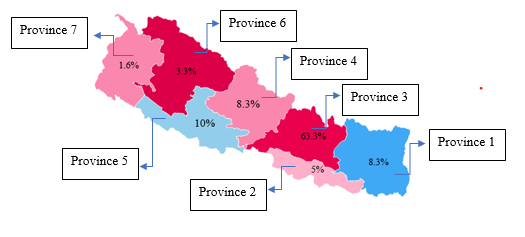
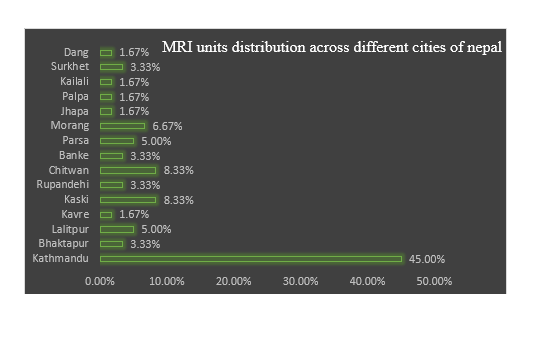
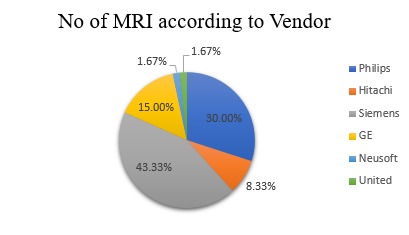
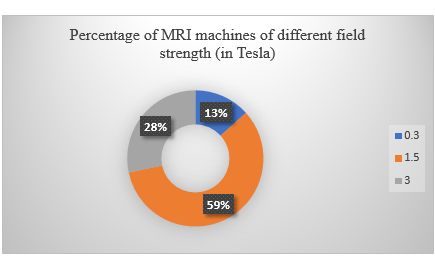
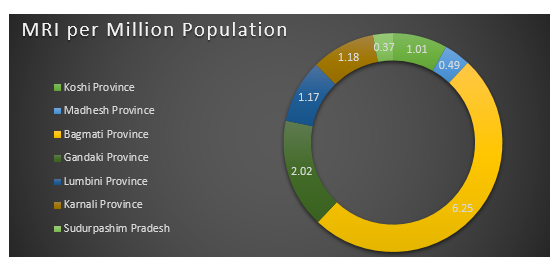
According to our research, Nepal had access to 60 MRI machines in 2023 (Figure 1). Most of the MRI Units were available in Bagmati Province, while the fewest were available in Sudurpaschim Province (Figure 1). In comparison to other cities in Nepal, Kathmandu has a greater availability of MRI units (Figure 2). Currently, 7 different vendors' MRIs are being used in Nepal, with Siemens MRI scanners being the most used, while Neusoft and United are the least used vendors by various hospitals and diagnostic centers. (Figure 3). The maximum field strength of the MRI Unit available in Nepal is 3 Tesla which is available in 17 hospitals and diagnostic centres (Figure 4). The use of MRI per million populations as represented in a pie chart (Figure 5) reflects that one MRI is used by 500,000 people.Discussion and Conclusion
n this study, we provided a snapshot of the accessibility of MRI systems in Nepal. Previous literature evaluated the status of radiation protection, knowledge of radiation protection, and Knowledge of MRI Safety and Perception Among Patients[5,6,7,8.]. Moreover, no study has been done to evaluate the accessibility of MRI in Nepal yet. We found MRI is not accessible in Nepal due to various factors including the high cost of MRI scanners. Nepal, being an underdeveloped country, does not have sufficient financial resources for investment, geographical challenges, lack of government policy, and limited healthcare infrastructure (cite). We concluded that there is a low uneven distribution of MRI scanners throughout the nation, which adversely affected the health Nepalese population.Acknowledgements
I would like to express my sincere gratitude to all those who contributed to the completion of this research article. My special thanks go for Mr. Suraj Sah, Purushottam Khatiwada and Ms. Debashri Debnath, without whose willingness to share their experiences and insights in assisting with data analysis and interpretation this research would lack its foundation. Finally, I want to express my heartfelt thanks to my friends and family for their unwavering support, encouragement, and understanding throughout this research journey. This article is a collective effort, and I am deeply indebted to all those mentioned above for their contributions.References
1. Subedi KS, Sharma P. Development of radiology in Nepal: gearing up for mountainous challenges. Journal of the American College of Radiology. 2013 Apr 1;10(4):291-5.
2. The World Bank. GDP per capita (current US$)—Nepal. 2018. Accessed June 2, 2023. https://data.worldbank.org/indicator/NY.GDP.PCAP.CD?locations=NP
3. Brant WE, Budathoki TB, Pradhan R. Radiology in Nepal. AJR. American journal of roentgenology. 1996 Feb;166(2):259-62.
4. Pokharel N. Health system infrastructure of Nepal and role of medical colleges in rural medicine: is there need for collaboration?. Journal of Lumbini Medical College. 2013 Dec 5;1(2):i-i.
5. Adhikari KP, Jha LN, Galan MP. Status of radiation protection at different hospitals in Nepal. Journal of medical physics/Association of Medical Physicists of India. 2012 Oct;37(4):240.
6. Shrestha S, Khadka B. Assessment of patients’ knowledge, perception and safety regarding MRI scan. Journal of Manmohan Memorial Institute of Health Sciences. 2020 Aug 7;6(1):3-19.
7. Maharjan S, Parajuli K, Sah S, Poudel U. Knowledge of radiation protection among radiology professionals and students: A medical college-based study. European journal of radiology open. 2020 Jan 1;7:100287.
8. Maharjan S. Radiation knowledge among radiographers and radiography students. Radiography Open. 2017 Apr 1;3(1):17
Figures