5163
A study of current clinical practice: Do MRI technologists in New Zealand always ask patients to change before examinations?1Faculty of Medical and Health Sciences, University of Auckland, Auckland, New Zealand
Synopsis
Keywords:
Motivation: Failure to change MRI patients into facility-supplied attire has led to burns and projectile injuries, and MRI technologists are responsible for ensuring appropriate patient preparation.
Goal(s): To investigate the current practice of changing patients into gowns by New Zealand (NZ) MRI technologists and examine factors that influence decision-making.
Approach: An online questionnaire was distributed to MRI technologists and trainees currently working in NZ.
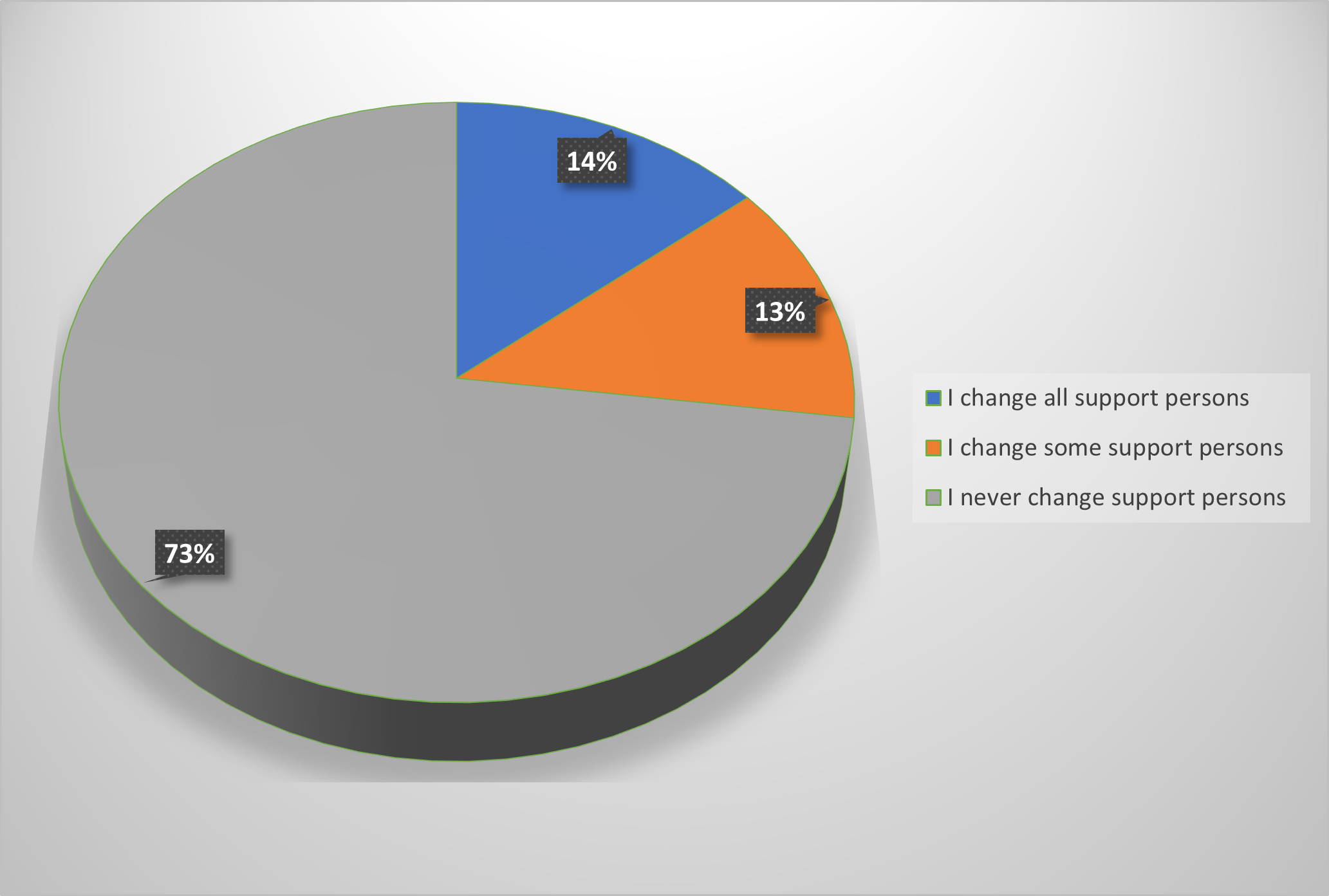
Results: Most technologists change all or most patients, but emerging practices of removing patient underwear and changing patient companions are less well-adhered to. Workplace policies are recommended as they influence technologists’ practice, and management support is needed to implement these.
Impact: Failure to change MRI patients into facility-supplied attire has led to numerous avoidable injuries, yet a survey of MRI technologists in New Zealand has revealed that clinical practice varies. Workplace policies influence practice and are recommended to maximise patient safety.
Background
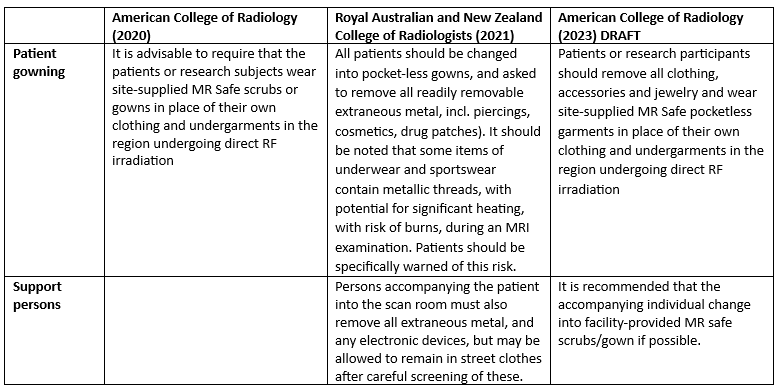
Failure to change MRI patients into facility-supplied attire has led to numerous burns and projectile injuries. The 2021 Royal Australian and New Zealand College of Radiologists’ (RANZCR) MRI safety guidelines1 recommend that all patients should be changed into pocketless gowns and warned of the risk of underwear heating to minimise these risks. Similarly, the American College of Radiology’s (ACR) 2020 guidelines2 advise that patients should be changed into MR Safe scrubs/gowns in place of their own clothing, but add that undergarments in the region undergoing direct radiofrequency (RF) irradiation should also be removed. The 2023 draft ACR guidelines3 include an additional recommendation to change support persons into facility-provided attire if possible.A study in 2018 examining the MRI safety knowledge of 246 MRI technologists in New Zealand (NZ) and Australia4 identified that 85% of participants recognised that changing all patients into a gown is best practice. Nevertheless, 14% asserted that patients only needed to be changed if they needed to remove clothing from the area being examined and/or if they had metallic components on or in their clothing. However, these reasons are flawed since the former does not consider the fact that RF transmission can extend beyond the area being examined, and the latter is based on an assurance that metallic components can be readily identified. Neither reason considers the risk of potentially hidden projectiles.
Based on a similar study performed in 2016 in Canada5, this current study sought to investigate the clinical practice of MRI technologists in NZ in relation to changing patients into gowns and examine the factors that influence their decision-making. The emerging practices of removing patient underwear and changing support persons into gowns were also explored.
Methods
An online questionnaire, administered via Qualtrics, was distributed in April 2023 via MRI social media forums, websites and newsletters of relevant professional bodies in NZ. The questionnaire included open and closed questions to enable qualitative and quantitative data analysis.Results
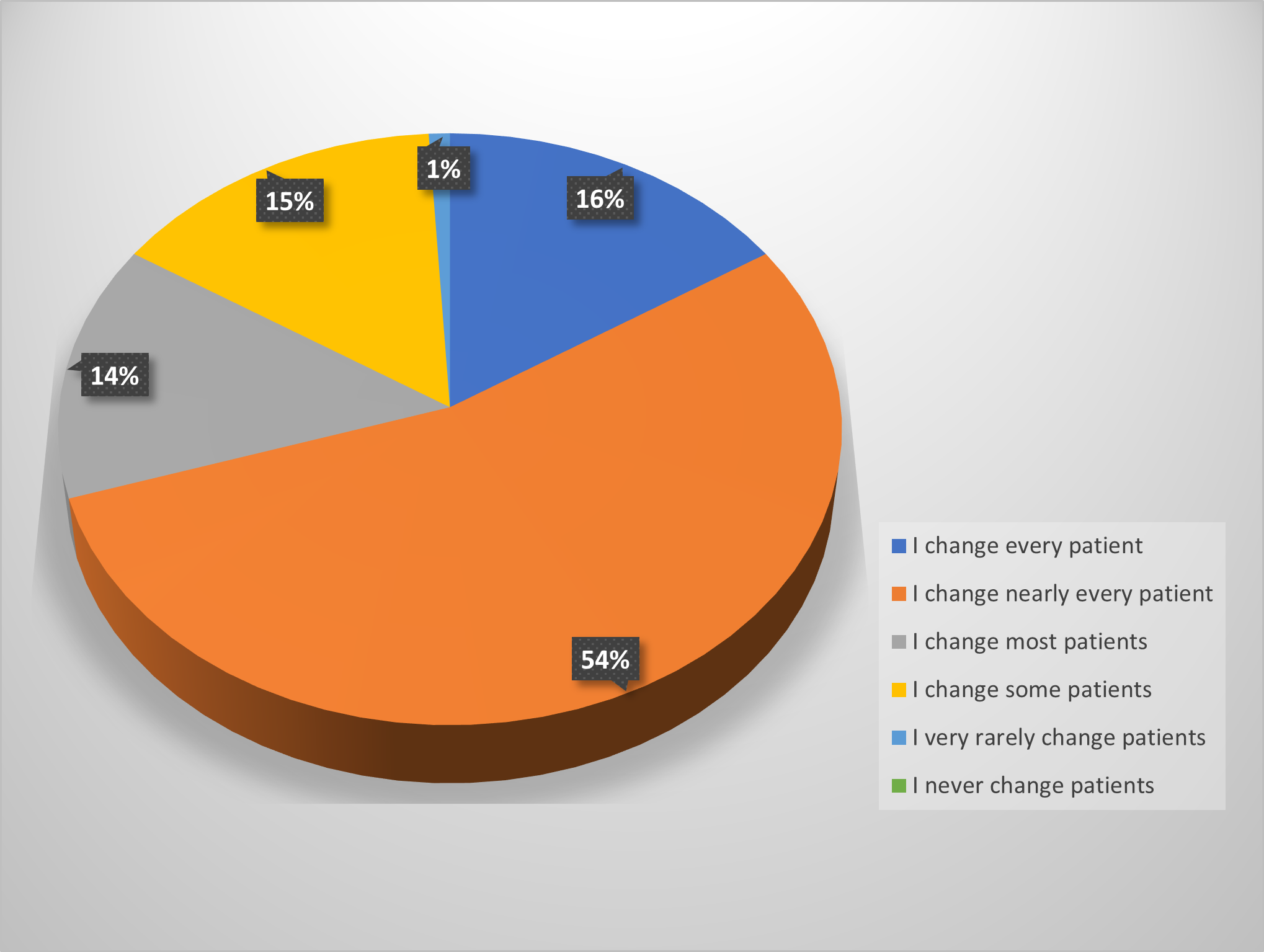
In total, 122 participants responded to the questionnaire, with 107 participants fully completing it. The fifteen incomplete responses were eliminated from data analysis.While awareness of burns and projectile incidents was high amongst this group, few practitioners change every patient prior to their MRI scan (15.9%), although the majority change nearly every patient (54.2%). This was confirmed by their responses to a clinical scenario question where the patient arrives wearing a T-shirt and stretch pants, and 64.5% identified that they would change this patient regardless of what they were wearing or the type of examination. Concerningly, 15% indicated that they would not get this patient changed because they have no metal on. This is particularly interesting because all the practitioners in this latter group stated that they were aware of MRI clothing-related burn incidents.
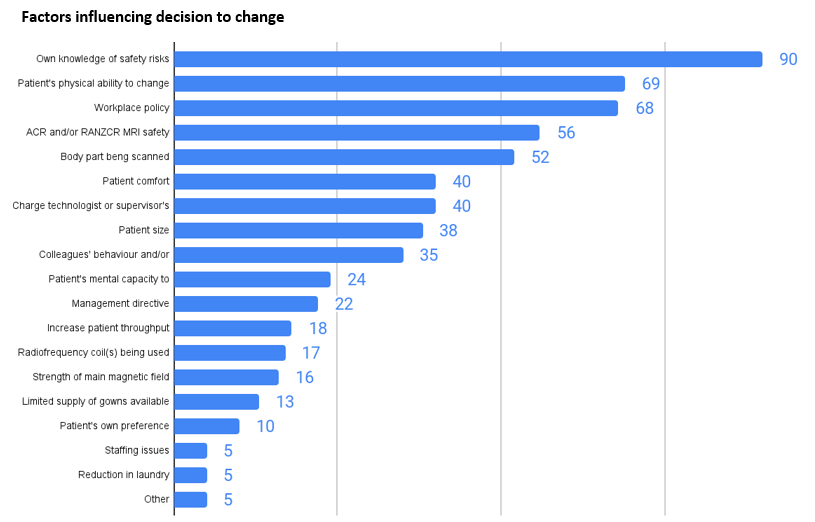
Exceptions to changing were most commonly made for patients with poor mobility, physically impaired patients in wheelchairs, and obese patients, although many participants qualified this decision by presuming the patient arrived wearing suitable clothing such as leisurewear, or a hospital gown in the case of inpatients. Other commonly identified barriers to changing every patient were workplace considerations such as need to reduce laundry or inadequate supply of patient gowns.
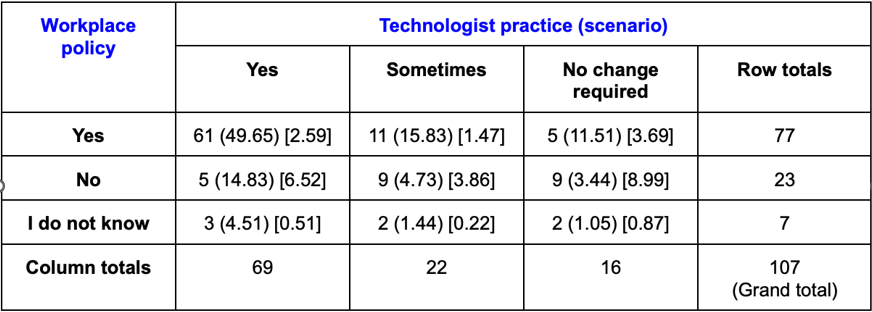
While years of clinical experience and participation in MRI safety related continuing professional development (CPD) opportunities were not shown to significantly impact technologists’ practice, the presence of a workplace policy demonstrated a statistically significant influence, highlighting the importance of this aspect.
Conclusions
Decisions based on the area being examined are potentially flawed, depending on the practitioner’s knowledge of RF coils and their associated RF field spatial distribution. Similarly, practitioners can no longer be confident that patients’ clothing is MR-safe, as labelling can be inaccurate, non-existent or, in the case of underwear, not readily accessible. Furthermore, with the growing availability of antimicrobial hospital gowns, and underwear containing metallic fibres or magnets, it is increasingly difficult to ascertain the safety of clothing from outside the MRI department.Recommendations from this study include the implementation of a workplace policy at all MRI sites, that includes the changing of all patients into gowns, including the removal of underwear, to minimise the risks of projectiles and burns. The policy should also consider identifying that accompanying/support persons be changed into gowns to further minimise the risk of projectile incidents. Support from management is required to implement this policy by adequate resourcing of a wide range of sizes of MR-Safe, pocketless garments and disposable underwear. Additionally, management must allow longer appointment times for elderly and mobility-impaired patients to enable them time to change with staff assistance.
Acknowledgements
No acknowledgement found.References
1. The Royal Australian and New Zealand College of Radiologists. MRI safety guidelines version 3 [Internet]. Sydney, Australia: The Royal Australian and New Zealand College of Radiologists; 2021. Available from: https://www.ranzcr.com/college/document-library/ranzcr-mri-safety-guidelines
2. American College of Radiology. ACR manual on MR safety version 1.0 [Internet]. Virginia, USA: American College of Radiology; 2020. Available from:
https://www.acr.org/-media/ACR/Files/Radiology-Safety/MR-Safety/Manual-on-MR-Safety.pdf
3. American College of Radiology. Draft ACR manual on MR safety [Internet]. Virginia, USA: American College of Radiology; 2023. Available from:
https://www.acr.org/-/media/ACR/NOINDEX/Radiology-Safety/MR-Safety/Draft-ACR-Manual-on-MR-Safety.pdf
4. Mittendorff, L. C. An investigation into MRI safety education in the changing face of MRI safety [unpublished master's thesis]. Auckland, (NZ): University of Auckland; 2020.
5. Yang HH, Charette MF, Talbot N. Do magnetic resonance imaging technologists in Canada always ask patients to change before examinations? Med Imag Radiat Sci [Internet] 2016;47(2):124e8. Available from:
Figures