5141
Enhanced Fat Suppression Effect by Integrating STIR DWI with PROSET1Department of Radiology, Tokai University Hospital, Kanagawa, Japan, 2Medical Systems, Philips Electronics Japan, Tokyo, Japan, 3Department of Biomedical Engineering, Tokai University School of Engineering, Kanagawa, Japan
Synopsis
Motivation: In this study, the motivation was to improve fat signal suppression in Diffusion-weighted Whole Body Imaging with Background Body Signal Suppression (DWIBS).
Goal(s): The specific goals were to evaluate the fat suppression effect of the Principle of Selective Excitation Technique (PROSET) in combination with STIR DWI (PROSET-STIR DWI) compared to conventional methods.
Approach: The approach involved scanning healthy volunteers using PROSET-STIR DWI, STIR DWI and SPAIR DWI.
Results: The results revealed that PROSET-STIR DWI achieved superior fat suppression for Methylene signals compared to conventional methods. Overall, PROSET-STIR DWI demonstrated enhanced fat suppression, highlighting its potential in clinical applications.
Impact: The PROSET-STIR DWI technique demonstrates superior fat suppression compared to conventional methods, with notable differences in Methylene fat signals. This advance can benefit medical imaging, potentially improving cancer detection and diagnostic accuracy.
Purpose
The conventional technique of Diffusion-weighted Whole Body Imaging with Background Body Signal Suppression (DWIBS) employs the inversion recovery method to capture malignant cancer in comprehensive body images1. However, clinical experience has shown that fat signals are occasionally not entirely suppressed. This is due to the presence of multiple lipid resonances in fat tissue, with Methylene and Olefin representing frequency peaks2. The null points for Methylene and Olefin differ. As a result, complete suppression of fat is not achievable using inversion recovery3. The Principle of Selective Excitation Technique (PROSET) exploits the disparity in resonance frequencies between water and fat to selectively excite water molecules. This process effectively suppresses the Methylene signal, which exhibits a substantial deviation in resonance frequency compared to water. This study introduces the PROSET technique as an adjunct to STIR DWI (PROSET-STIR DWI), with the expectation of enhancing fat suppression compared to the conventional approach. The objective of this study is to evaluate the fat suppression effect of PROSET-STIR DWI by comparing it with conventional methods in terms of signal-to-noise ratio (SNR).Methods
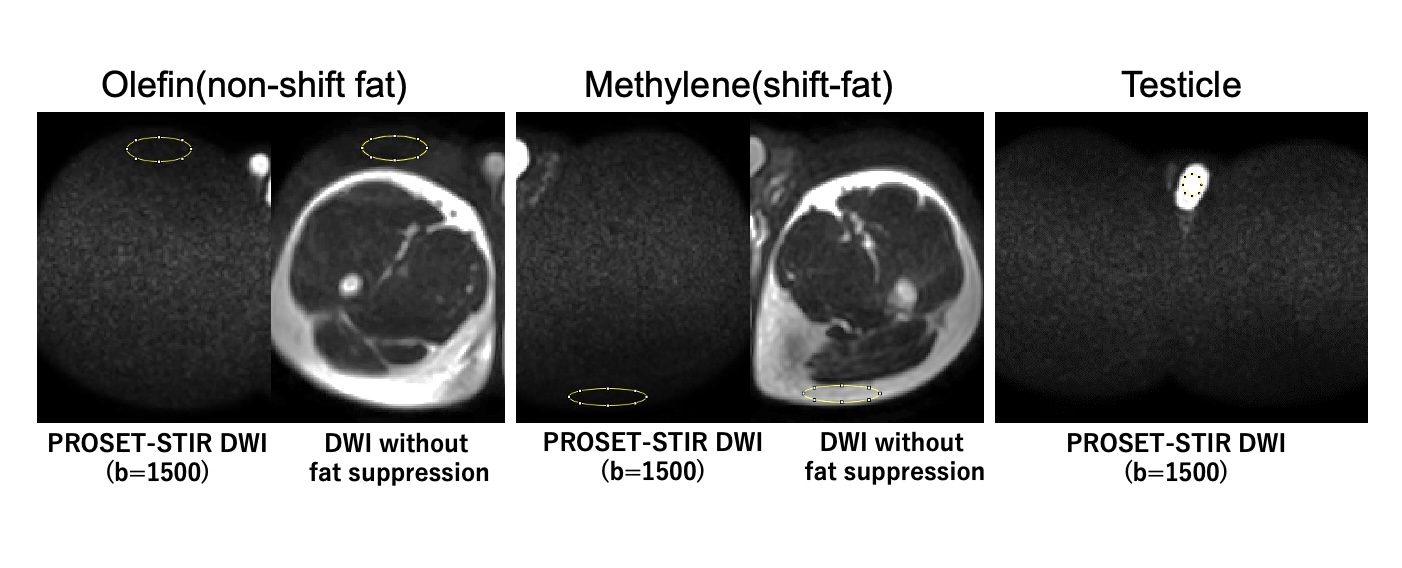
The study was approved by the IRB, and written informed consent was obtained from all subjects. Six healthy volunteers (6 males; mean age, 26.5 ± 1.7 years; age range: 24-29 years) underwent imaging in the pelvic region on an Ingenia Ambition 1.5T with an anterior coil and posterior built-in coils (Philips Healthcare, Best, The Netherlands). STIR-DWI, diffusion-weighted imaging with Spectral Attenuated Inversion Recovery (SPAIR DWI) and PROSET-STIR DWI were scanned with the following parameters: TR = 5000 msec, TE = 79 msec, FOV = 350 mm, acquisition voxel size 3.1 × 3.1 × 6.0 mm³, the number of packages 1, the number of slices 25, b-values 0-1500 s/mm², NSA 2 (b=0)4(b=1500). The fat signals were visually classified into two categories based on diffusion images acquired without fat suppression. One is mainly methylene-derived fat signal that exhibits chemical shift on the image. The other is mainly olefin-derived fat signal that does not shift on the image. Regions of interest (ROIs) were drawn in subcutaneous fat regions for Methylene and Olefin and in the testicles as virtual tumors, having ADC values close to malignant tumors4,5, in each sequence (Figure 1). The muscle was considered the background, and SNR values were compared using the subtraction method6. SNR was calculated as follows: SNR = √2 × signal value / muscle standard deviation. Paired t-tests were conducted to assess the respective SNRs.Results
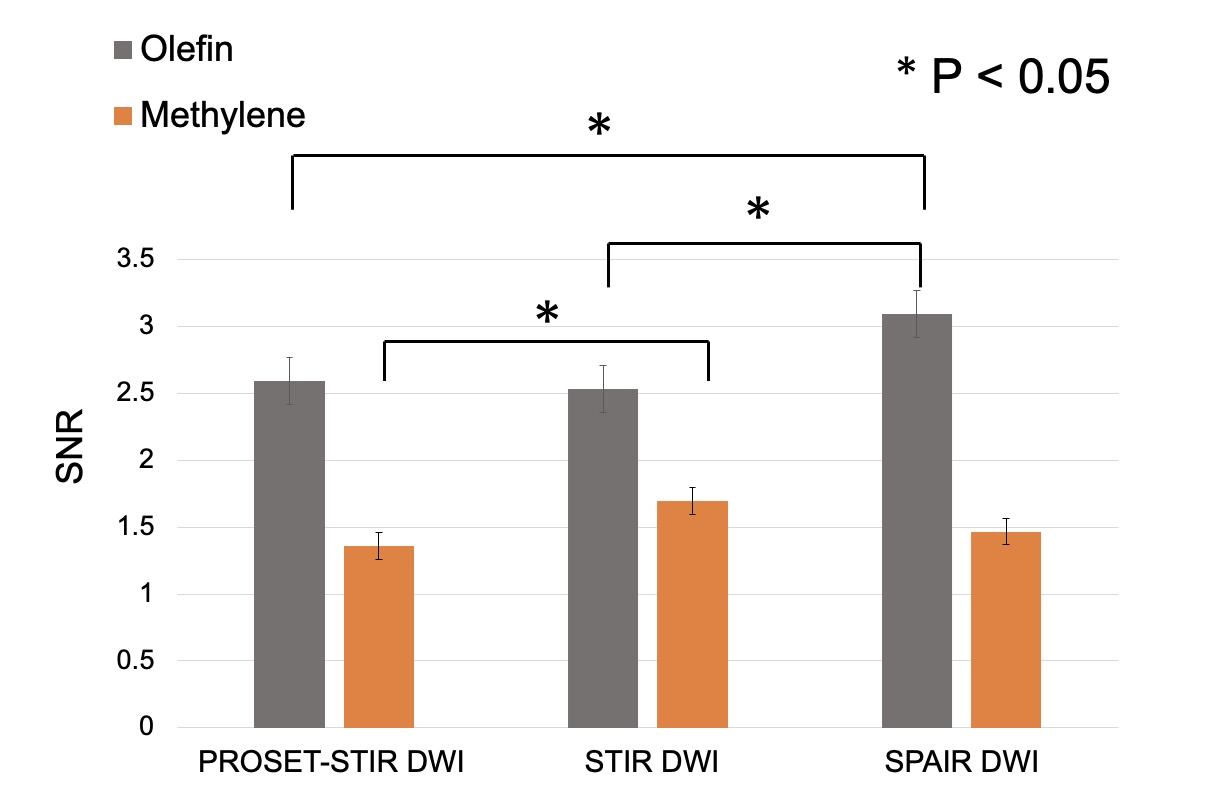
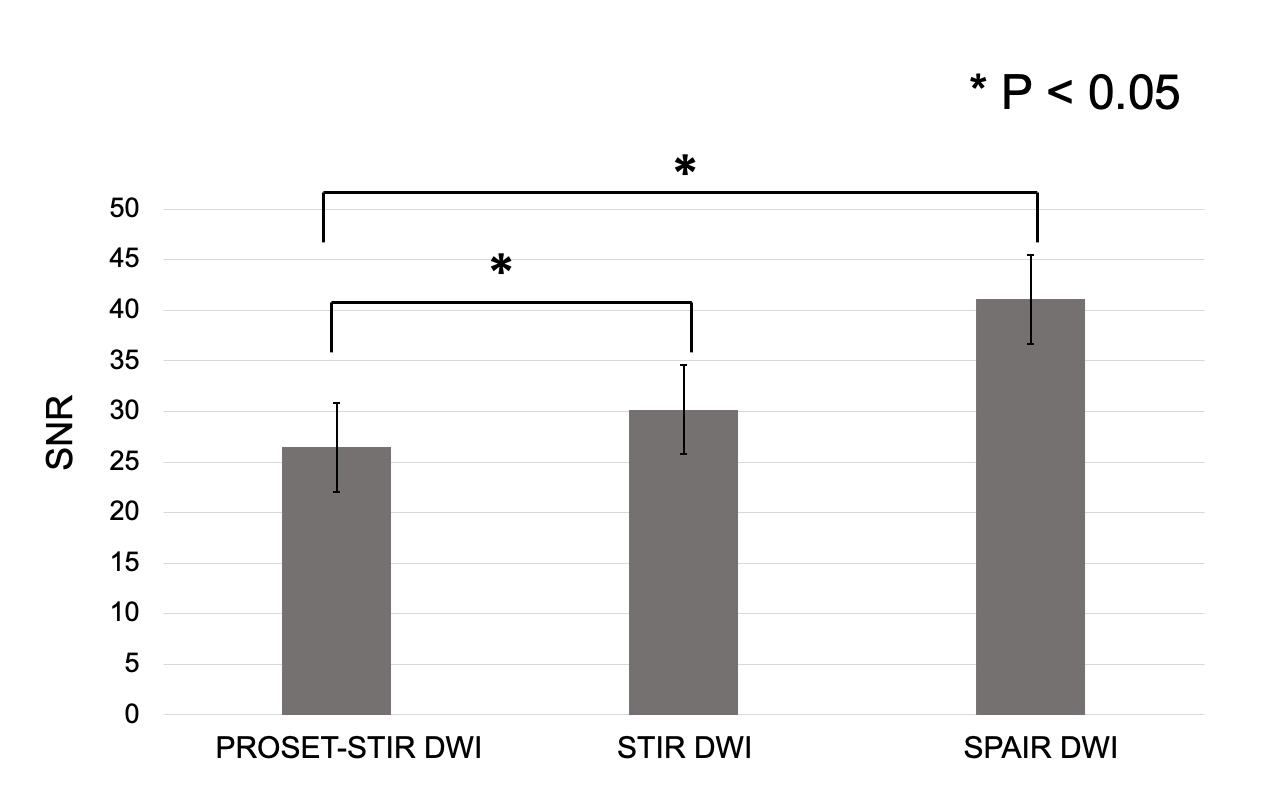
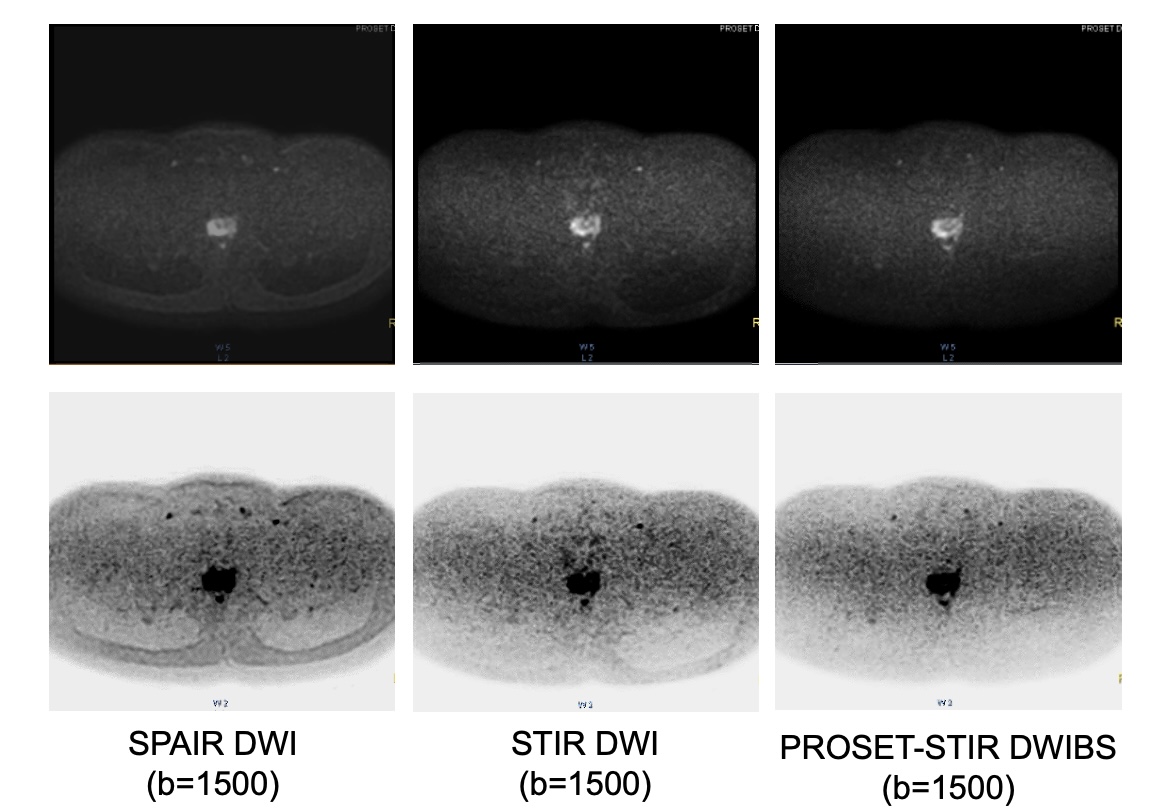
In terms of Olefin, PROSET-STIR DWI exhibited a lower SNR compared to SPAIR DWI, similar to STIR DWI. There was a significant difference among the sequences (p < 0.05). On the other hand, STIR DWI yielded the highest SNR for Methylene, followed by SPAIR DWI, and then PROSET-STIR DWI. A significant difference was observed between PROSET-STIR DWI and STIR DWI (p < 0.05)(Figure 2). In terms of the testicles, SPAIR DWI demonstrated the highest SNR, followed by STIR DWI, and then PROSET-STIR DWI (p < 0.05)(Figure 3). Concerning Olefin, PROSET-STIR DWI achieved a comparable level of fat suppression to STIR DWI, in contrast to SPAIR DWI. For Methylene, PROSET-STIR DWI showed superior fat suppression compared to the other two methods, with significant differences noted, particularly between PROSET-STIR DWI and STIR DWI (Figure 4). In PROSET-STIR DWI, both the fat suppression from PROSET for Methylene and the fat suppression from STIR for Olefin and Methylene seem to work together, suggesting a significantly higher fat suppression effect compared with the other methods. However, the virtual tumors representing the testicles exhibited decreased SNR in PROSET-STIR DWI when compared to the other two methods.Conclusions
PROSET-STIR DWI showed a superior fat suppression effect compared to the two conventional fat suppression techniques.Acknowledgements
No acknowledgment found.References
1. Takahara T, Imai Y, Yamashita T, et al. Diffusion weighted whole body imaging with background body signal suppression (DWIBS): technical improvement using free breathing, STIR and high resolution 3D display. Radiat Med. 2004;22(4):275-82.
2. Yu H, Shimakawa A, Charles A McKenzie, et al. Multi echo water-fat separation and simultaneous R2* estimation with multifrequency fat spectrum modeling. Magn Reson Med. 2008;60(5):1122-34.
3. Minami H, Takahashi M, Hata H, et al. A Phantom Study to Investigate Fat Suppression in DWIBS. JJMRM. 2020;40:118-127.
4. Tsili AC, Giannakis D, Sylakos A, et al. Apparent diffusion coefficient values of normal testis andvariations with age. Asian J Androl.2014;16:493–7.
5. TC Kwee, Takahara T, Ochiai R, et al. Diffusion-weighted whole-body imaging with background body signal suppression (DWIBS): features and potential applications in oncology. Eur Radiol. 2008;18(9):1937-52.
6. Imai H, Miyati T, Ogura A, et al. Signal-to-noise ratio measurement in parallel MRI with subtraction mapping and consecutive methods. JJRT. 2008;64(8):930-36
Figures