5134
Feasibility of single-shot compressed sensingcine imaging in arrhythmia patients
Nan Zhang1, Fan Du1, and Xiuzheng Yue2
1Zhongshan Hospital of Fudan University, Shanghai, China, 2Philips Healthcare, Beijing, China
1Zhongshan Hospital of Fudan University, Shanghai, China, 2Philips Healthcare, Beijing, China
Synopsis
Motivation: The quality of cardiac film sequences in patients with arrhythmia is poor, which affects the clinical diagnosis.
Goal(s): To observe the value of single-shot compressed sensing cine imaging inevaluating cardiac structure and function in arrhythmia patients
Approach: MRI;ICC;Kappa
Results: n arrhythmia group, there was statistical difference of myocardial thickness in 12 myocardial segments between the 2 sequences,as well as peak and average values of myocardial radial and circumferential strain.
Impact: For arrhythmia patients, single-shot compressed sensing cine imaging cine sequence could improve image quality of cardiac MRI.
Introduction
To observe the value of single-shot compressed sensing cine imaging inevaluating cardiac structure and function in arrhythmia patients.methods
Totally 33 arrhythmia patients (arrhythmia group) and 48 normal rhythm subjects (normal group) underwent cardiac MRI with Totally 33 arrhythmia patients (arrhythmia group) and 48 normal rhythm subjects (normal group) underwent cardiac MRI with conventional cine (balanced steadystate free-precession [bSSFP]) sequence and single-shot compressed sensingcine imaging sequence. Myocardial thickness, cardiac function,myocardial strain parameters of left ventricle and image quality of 2 sequences were compared in the two groups,respectively. Myocardial thickness, cardiac function,myocardial strain parameters of left ventricle and image quality of 2 sequences were compared in the two groups,respectively.Results
In arrhythmia group, there was statistical difference of myocardial thickness in 12 myocardial segments between the 2 sequences (all P<0.05),as well as peak and average values of myocardial radial and circumferential strain (all P<0. 05). In normal group, there was no statistical difference of myocardial thickness and stain parameters between the 2 sequences (all P>0.05). Additionally, no statistical difference of cardiac function was found between the 2 sequences in two groups (all P>0.05).In arrhythmia group, the image quality of single-shot compressed sensingcine imaging sequencewas better than that of bSSFP sequence ((P<0.05).Conclusion
For arrhythmia patients, single-shot compressed sensing cine imaging cine sequence could improve image quality of cardiac MRI.Acknowledgements
No acknowledgement found.References
No reference found.Figures
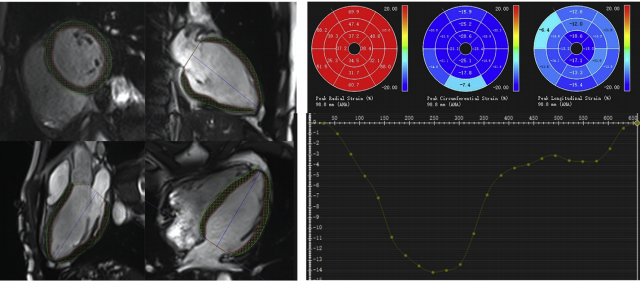
Fig.For arrhythmia patients, single-shot compressed sensing cine imaging cine sequence could improve image quality of cardiac MRI.
DOI: https://doi.org/10.58530/2024/5134