5104
High-frequency asymptotic behaviour of the apparent diffusion coefficient measured with approximate cosinusoidal gradient waveforms1Applied MRI Research, National Institute of Radiological Sciences, QST, Chiba, Japan
Synopsis
Keywords: Diffusion Acquisition, Diffusion/other diffusion imaging techniques, oscillating gradient, OGSE, universality, asymptotic limit, high frequency
Motivation: Existing theory for OGSE-DWI has been developed under the assumption of an ideal cosinusoidal gradient waveform, but it is impossible to implement such a waveform in practice.
Goal(s): The purpose of this work was to investigate how the high-frequency asymptotic behaviour of the ADC is affected when an approximate cosinusoidal waveform is used for OGSE-DWI measurements.
Approach: A theoretical study was performed that derived the asymptotic behaviour of the ADC from first principles for three MPG waveforms.
Results: The difference in predicted behaviour between an approximate cosinusoidal waveform and an ideal waveform may be important when making precise measurements of the surface-to-volume ratio.
Impact: The microstructure of a complex medium can be characterised by measuring the high-frequency limit of the ADC with OGSE-DWI. However, it is important to understand how the limitations of the gradient hardware affect the interpretation of the data.
Introduction
Oscillating-gradient spin-echo diffusion-weighted imaging (OGSE-DWI) has been promoted as a promising technique for probing in vivo tissue microstructure. The target of the OGSE-DWI technique is the spectral density of molecular diffusion, $$$u_2(\omega)$$$, which is known to obey the asymptotic universality relation $$u_2(\omega) \sim 2D_0 - c_0\, \omega^{-1/2},\qquad\omega\rightarrow\infty,$$ where $$$c_0$$$ is a constant related to the surface-to-volume ratio [1]. In principle, the microstructure of a complex medium can be characterised by measuring the spectral density in its high-frequency limit. Unfortunately, practical limitations on the spectral resolution and range of the technique mean that it is not possible to directly sample the spectral density with OGSE-DWI [2]. In addition, existing theory for OGSE-DWI has been developed under the assumption of a pure single-harmonic cosinusoidal motion-probing gradient (MPG). Sadly, real gradient hardware is unable to track the discontinuous changes in amplitude at the beginning and end of an ideal cosine waveform, so some compromise in the shape of the MPG is necessary. OGSE-DWI is instead commonly used to measure the apparent diffusion coefficient (ADC) with some type of approximation to a cosinusoidal waveform. The purpose of this work was to investigate how the high-frequency asymptotic behaviour of the ADC is affected when an approximate cosinusoidal waveform is used for OGSE-DWI measurements.Theory
For a uniplanar MPG, $$$g(t)$$$, of duration $$$T$$$ and obeying the rephasing condition $$$\int_0^T\!dt\, g(t)=0$$$, the ADC is related to the spectral density via the equation $$ADC(g)=\frac{1}{2}\int_0^\infty \!\!d\omega\, u_2(\omega) H(\omega;g).$$ In this equation, $$$H(\omega;g)=\gamma^2 g_T(\omega) g_T(-\omega)/\pi b(g) \omega^2$$$, $$$g_T(\omega)=\int_0^T\! dt\,g(t) e^{i\omega t}$$$ and $$$b(g)$$$ is the b-value corresponding to the selected MPG. Essentially, the ADC is a representation of the spectral density filtered by the function $$$H(\omega;g)$$$ constructed from the MPG. Note that the argument of $$$g$$$ is used as a reminder that each quantity depends on the parameters of the MPG. Although the asymptotic behaviour of the signal could be considered for any of the parameters, it is highly likely that $$$\beta=t/\tau$$$, where $$$\tau$$$ represents the timescale characterizing the response of the system, is the key asymptotic parameter [3]. In that case, investigating the high-frequency behaviour of the ADC is equivalent to taking the limit $$$\beta\rightarrow\infty$$$.Results
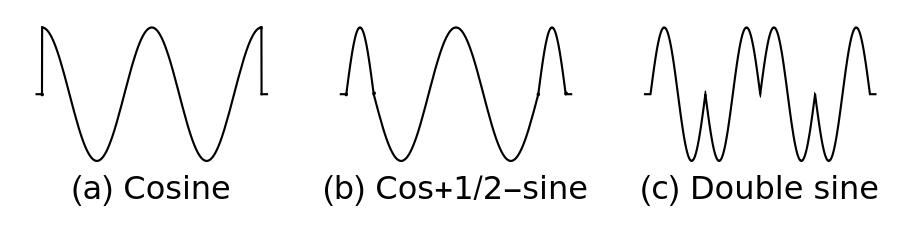
The Mellin transform method (MTM) for the asymptotic expansion of integrals [4] was used to show that the ADC behaves as $$ADC(g)\sim D_0-C_0(g)\, {\omega_k}^{1/2},\qquad\beta\rightarrow0,$$ where $$$\omega_k=2\pi k/T$$$ is the frequency and $$$k$$$ is the number of oscillations of the applied MPG. $$$C_0(g)$$$ was calculated for an ideal cosine and two approximations to a cosine suggested in [5] (Fig. 1):(a) Cosine $$C_0(g)/c_0=C(2k^{1/2})+3S(2k^{1/2})/4\pi k$$ (b) Cos+½-sine edge $$\begin{align}\frac{C_0(g)}{c_0}&=\frac{40+48(2k-1)\pi+(\pi+29)\sqrt{2}}{24(8k-1)\pi}\\&\quad+\frac{8\sqrt{2}}{3(8k-1)\pi^{3/2}}\left\{\bar{I}(1/2;(2k-1)\pi)+(8/3)\left[\bar{H}(1/2;\pi/2)+\bar{H}(1/2;(2k-1)\pi)+\bar{H}(1/2;(4k-1)\pi/2)\right]\right\}\\&\quad+\frac{1}{3(8k-1)\pi^{3/2}}\left\{2\bar{I}(1/2;\pi)+\bar{I}(1/2;4\pi k)+2\bar{I}(1/2;(4k-1)\pi)+\bar{I}(1/2;(4k-2)\pi)\right.\\&\hspace{8cm}\left.-(8/3)\left[\bar{H}(1/2;\pi)+\bar{H}(1/2;(4k-2)\pi)+\bar{H}(1/2;(4k-1)\pi)\right]\right\}\end{align}$$ (c) Double-sine $$\frac{C_0}{c_0}=\frac{1}{6\sqrt{2}}+\frac{7(4k-1)}{48\pi\sqrt{2}k}-\frac{1}{18\pi^{3/2}k}\bar{I}(1/2;4\pi k)-\frac{1}{3\pi^{3/2}k}\sum_{n=1}^{2k-1}(-)^n(2k-n)\bar{I}(1/2;2\pi n).$$ In these results, $$$C(z)$$$ and $$$S(z)$$$ are the Fresnel integrals, $$\bar{I}(s;t)=\mbox{si}(3-s,t)\left[(s-4)\cos t-t\sin t\right]-\mbox{ci}(3-s,t)\left[(s-4)\sin t+t\cos t\right],$$ $$\bar{H}(s;t)=\mbox{si}(3-s,t)\cos t-\mbox{ci}(3-s)\sin t,$$ and $$$\mbox{si}(z,t)$$$ and $$$\mbox{ci}(z,t)$$$ are the upper generalised sine and cosine integrals, respectively (Sec. 8.21, Digital Library of Mathematical Functions).
Discussion
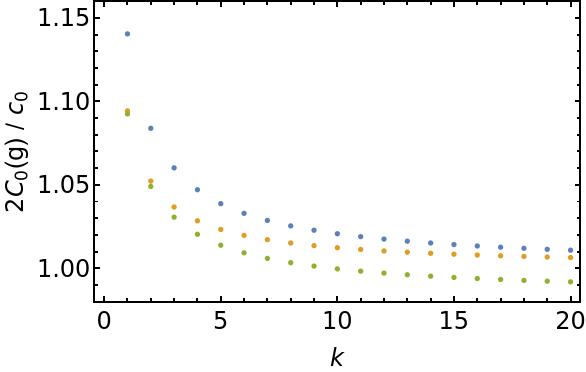
Figure 2 plots $$$2C_0/c_0$$$ against $$$k$$$ for each of the waveforms in Fig. 1. The result for an ideal cosine MPG has been presented previously [6,7,3]. $$$2C_0/c_0$$$ deviates most from 1 when $$$k=1$$$, but thereafter it approaches 1 from above as $$$1/k$$$. $$$2C_0/c_0$$$ for the cos+½-sine edge waveform also approaches 1 for large $$$k$$$, which is to be expected as the influence of the ½-sine edges reduces with increasing $$$k$$$. $$$2C_0/c_0$$$ for the double-sine waveform is similar to that for the cos+½-sine edge waveform at low $$$k$$$, but noticeably deviates with increasing $$$k$$$ to approach a limit that is less than 1.Summary
For all three MPG waveforms, the quantity $$$2C_0/c_0$$$ has its greatest deviation from unity for low values of $$$k$$$, which is important because that is where OGSE-DWI observations will be made due to the limitations of the gradient hardware. Care should be taken to include the $$$k$$$-dependence of $$$2C_0/c_0$$$ when estimating the surface-to-volume ratio of a complex medium from OGSE-DWI data. The differences in $$$2C_0/c_0$$$ between the approximate cosinusoidal waveforms and the ideal cosine result may be important when attempting to make precise measurements.Acknowledgements
This work was supported by JSPS Kakenhi Grant No. JP20K08150.References
[1] Novikov DS & Kiselev VG, J Magn Reson, 210:141-145 (2011).
[2] Kershaw J & Obata T, J Magn Reson 326:106962 (2021).
[3] Kershaw J & Obata T, arXiv:2309.07484 [physics.med-ph].
[4] Bleistein N & Handelsman RA, Asymptotic expansions of integrals, Dover Publications.
[5] Does M et al, MRM 49:206-215 (2003).
[6] Sukstanskii AL, J Magn Reson 234:135-140 (2013).
[7] Novikov DS et al, NMR Biomed 32:e3998 (2019).
Figures