5101
Spatially Regularized Super-Resolved Constrained Spherical Deconvolution (SR2-CSD) of diffusion MRI data1Signal Processing Laboratory 5 (LTS5), École Polytechnique Fédérale de Lausanne (EPFL), Lausanne, Switzerland, 2Department of Computer Science, Université de Sherbrooke, Sherbrooke, QC, Canada, 3Intelligent Systems Engineering, Indiana University Bloomington, Bloomington, IN, United States, 4CIBM, Center for Biomedical Imaging, Lausanne, Switzerland, 5Radiology Department, Centre Hospitalier Universitaire Vaudois and University of Lausanne, Lausanne, Switzerland
Synopsis
Keywords: Microstructure, White Matter, Spherical Deconvolution, Spatial Regularization
Motivation: Constrained Spherical Deconvolution (CSD) is a state-of-the-art method for estimating the fiber orientation distribution function (fODF) in white matter from diffusion MRI data. However, CSD faces limitations in resolving fiber crossings with small inter-fiber angles when using low spherical harmonic order and produces noisy fODFs when using high order.
Goal(s): This study aims to improve the stability and angular resolution of fODFs from CSD.
Approach: We extend the CSD estimation framework by including a spatial regularization term that promotes fiber continuity, using a J-invariant auto-calibrated total variation denoiser.
Results: The proposed method enhances fiber crossing estimation and reduces spurious fibers.
Impact: The improved stability of the proposed method enables the utilization of higher spherical harmonic orders, with a superior ability to solve complex fiber crossings. This work has the potential to increase the accuracy of fiber-tracking algorithms and brain connectivity estimations.
Introduction
Constrained Spherical Deconvolution (CSD)1 has become a state-of-the-art method for estimating complex fiber configurations in the brain’s white matter, offering the ability to resolve multiple fiber orientations per voxel. However, CSD struggles to resolve fiber crossings with inter-fiber angles smaller than 40-45 degrees when low spherical harmonic orders are used (i.e., lmax=8). Conversely, the super-resolved CSD version (Super-CSD)1 encounters challenges in handling noise at high spherical harmonic orders (e.g., lmax $$$\geq$$$12), producing noisy estimations with spurious lobes. To overcome these limitations, our study introduces a novel approach called Spatially Regularized Super-Resolved CSD (SR2-CSD) that leverages the redundancy and spatial correlations of fiber Orientation Distribution Functions (fODFs) among adjacent voxels as prior information to enhance the accuracy and robustness of the Super-CSD method.Methods
We generalize the CSD formulation by introducing a spatial regularization prior term in the convex optimization problem to incorporate information from neighboring voxel solutions. This term is obtained by applying Total Variation (TV) filtering2 to the spherical harmonic coefficients of the standard Super-CSD solution with lmax=12 and projecting them onto the constrained set, ensuring the fODF amplitudes are non-negative. TV filtering is chosen for its ability to smooth along fiber trajectories and promote spatial continuity, while avoiding smoothing in the perpendicular direction to the fibers and image edges3. We employ the J-invariance principle4 to calibrate the strength of the TV denoiser automatically. The final problem is solved using Quadratic Programming (QP) for its ability to enforce the non-negativity constraint on the fiber amplitudes5 and to include the new spatial regularization term in the estimation. The pipeline is implemented in DIPY library6. SR2-CSD is formulated as follows:$$\boldsymbol{\hat{f}}=argmin\{||\boldsymbol{Af} - \boldsymbol{b}||^2 + \rho ^2 ||\boldsymbol{f-f_0}||^2\}$$
$$\text{subject to } \boldsymbol{Bf} \geq \boldsymbol{0}$$
where A is the problem matrix, b is the dMRI data, fo is the spatial prior estimate, B is the non-negativity constraint matrix, and ρ is the regularization weight (we recommend ρ=2 based on empirical evidence).
To evaluate the proposed method, we employ synthetic phantoms from the diffusion-simulated connectivity (DiSCo) dataset7,8 and a dataset generated for the HARDI reconstruction 2013 challenge9. In the DiSCo phantom, 90 gradient directions were used to simulate the data with b=3094 s/mm2, while in the HARDI phantom, 64 directions were employed using b=3000 s/mm2. Mean-squared error (MSE), angular correlation coefficient (ACC), angular error (AE), and peak number error (PNE) metrics are computed for numerical evaluation9,10,11, along with visual qualitative assessments.
We tested the Single-Shell Single-Tissue (SSST) CSD version in the reconstruction. Although the experiments are focused on the estimates with lmax=12, CSD is also evaluated using the standard value of lmax=8. We evaluated the estimation methods on the synthetic datasets at three signal-to-noise ratios (SNRs=10, 20 and 30) and five different noise repetitions per SNR. We employed two pipelines, one incorporating the Marchenko–Pastur Principal Component Analysis (MPPCA) method12, as implemented in DIPY6, to denoise the dMRI data and the other not utilizing it. Additionally, we estimated the fODFs from in vivo human dMRI data (‘Penthera 3T’ dataset13, 60 directions and b=2000 s/mm2).
Results and Discussion
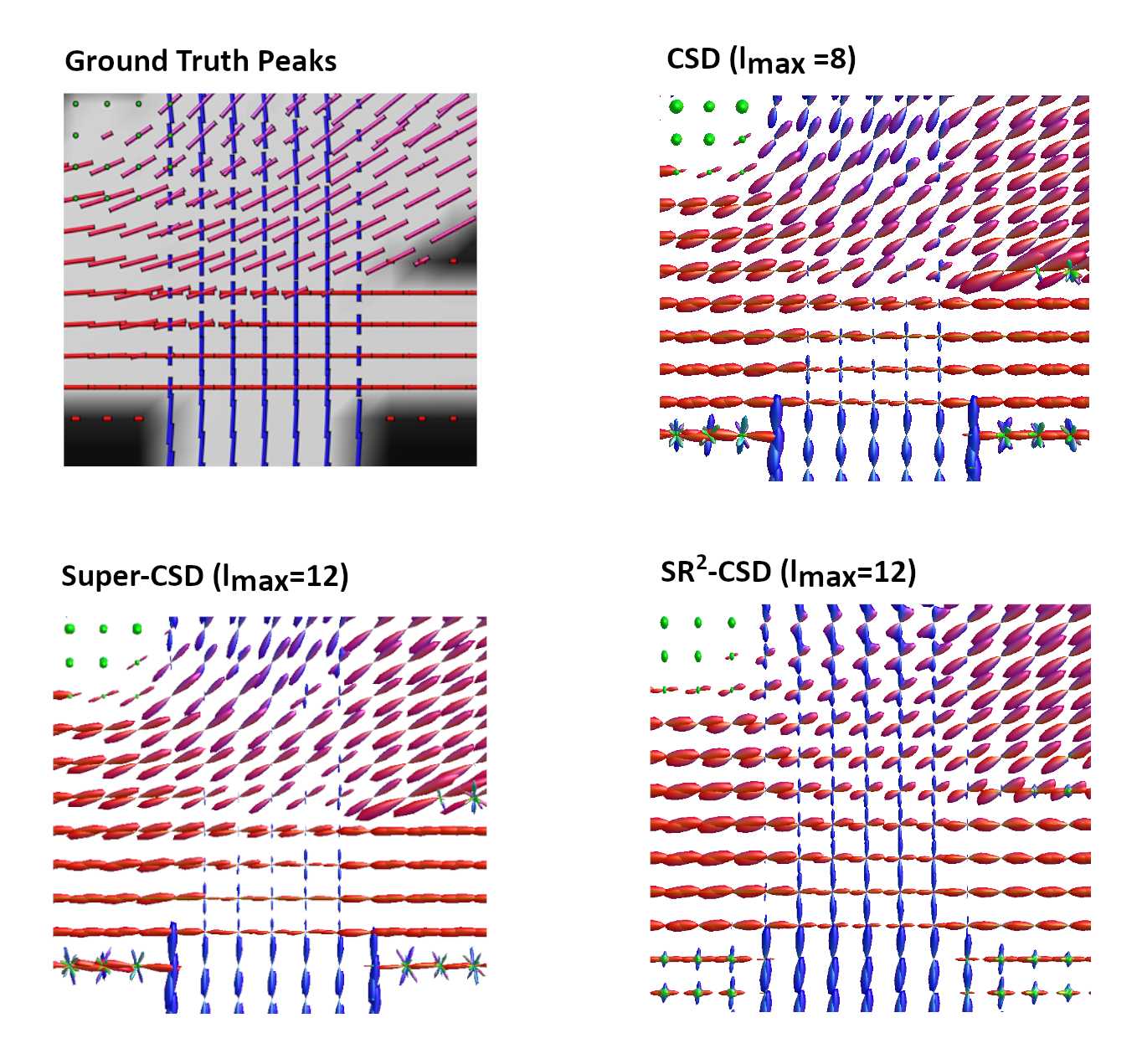
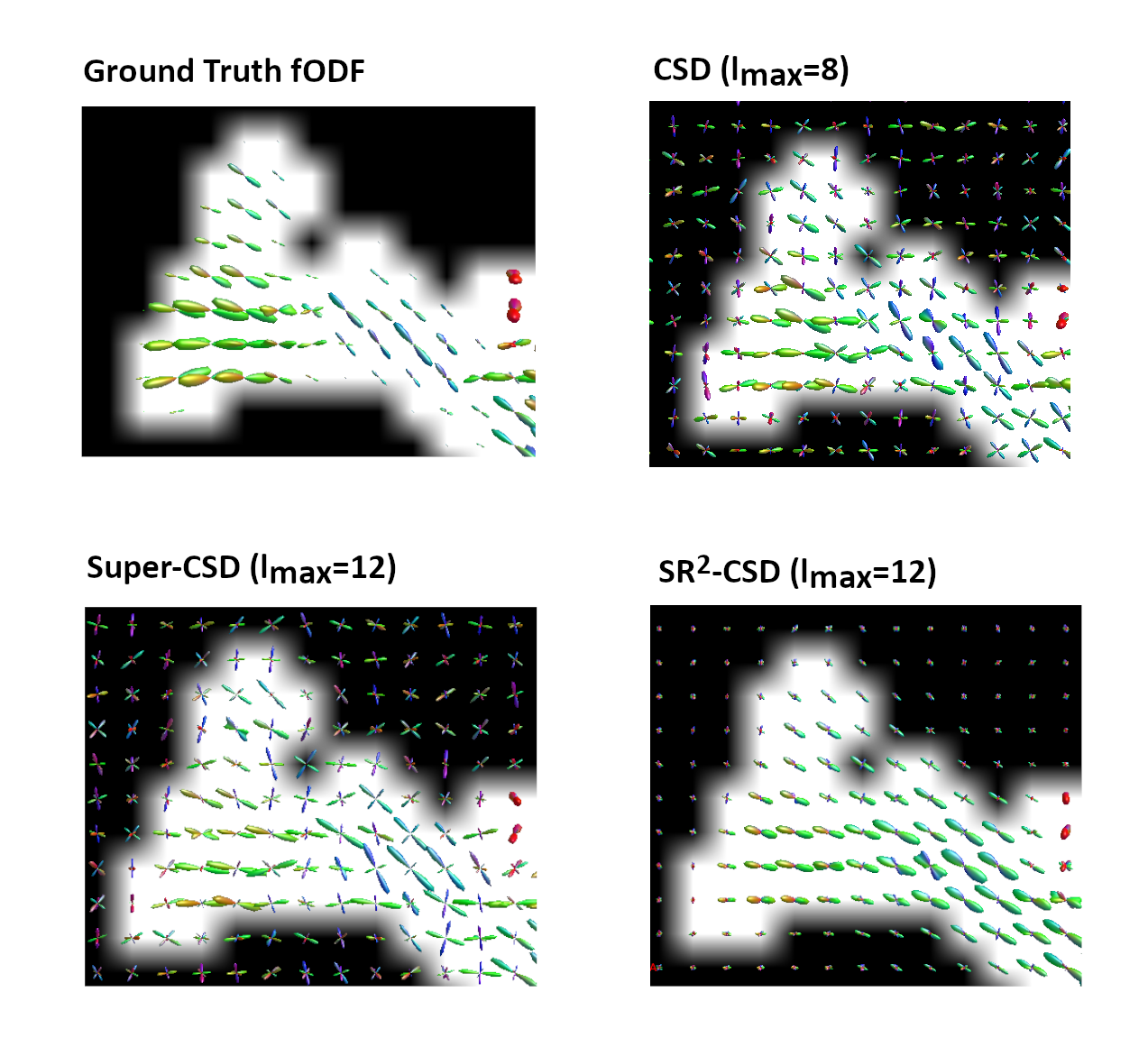
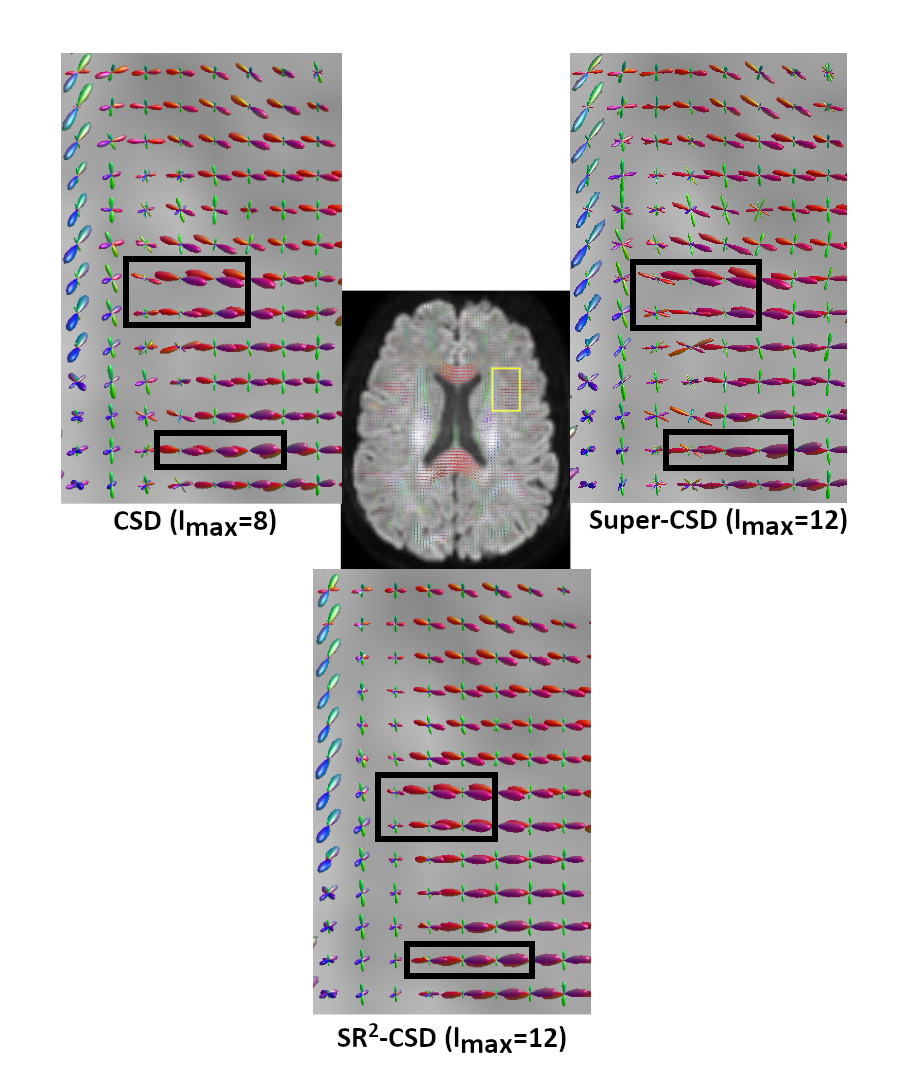
In both DiSCo and HARDI phantoms, our findings indicate that MPPCA denoising improves the fODF estimation for CSD with lmax=8 and lmax=12. However, solutions closer to the ground truth were found for SR2-CSD when MPPCA was not utilized. In Table 1, optimal metrics from each method for the DiSCo (panel a) and HARDI (panel b) datasets with SNR=20 are reported. SR2-CSD with lmax=12 consistently outperforms CSD in all the evaluation metrics. Figure 1 shows a region of interest in the HARDI phantom where SR2-CSD demonstrates a superior ability to detect fiber crossings that CSD and Super-CSD cannot resolve. Figure 2 and Figure 3 show the estimated fODFs from the DiSCo phantom with SNR=20 and the human dataset, respectively. In both figures, SR2-CSD provided more spatially coherent fODF estimates than CSD with lmax=8 and lmax=12.Conclusion
The current state-of-the-art CSD algorithm faces challenges in resolving complex fiber crossings with small inter-fiber angles and exhibits instability in the Super-CSD variant. In this study, we introduce SR2-CSD as an improvement over the Super-CSD method. SR2-CSD incorporates total variation denoised Super-CSD estimates as prior information to mitigate the influence of noise, especially in the higher frequency spherical harmonic orders. The numerical evaluation metrics consistently demonstrate the superiority of SR2-CSD. Visual assessments confirm that SR2-CSD produces fODF estimates with higher spatial coherence and reduced spurious fibers. These advancements could potentially enhance the reliability of fiber-tracking algorithms and improve brain connectivity mapping. Further validation studies must be conducted to verify these hypotheses and to implement the Multi-Shell Multi-Tissue (MSMT) CSD version5.Acknowledgements
This work is partly supported by the Swiss National Science Foundation (SNSF) under grant Nbr 205320_204097. Erick J. Canales-Rodríguez was supported by the SNSF, Ambizione grant PZ00P2_185814.
References
1. Tournier, J.-D., Calamante, F. & Connelly, A. Robust determination of the fibre orientation distribution in diffusion MRI: non-negativity constrained super-resolved spherical deconvolution. Neuroimage 35, 1459–1472 (2007).
2. Rudin, L. I., Osher, S. & Fatemi, E. Nonlinear total variation based noise removal algorithms. Physica D: Nonlinear Phenomena 60, 259–268. ISSN: 0167-2789. https://www.sciencedirect.com/science/article/pii/016727899290242F (1992).
3. Canales-Rodríguez, E. J., Daducci, A., Sotiropoulos, S. N., Caruyer, E., Aja-Fernández, S., Radua, J., Mendizabal, J. M. Y., Iturria-Medina, Y., Melie-García, L., Alemán-Gómez, Y., Thiran, J.-P., Sarró, S., Pomarol-Clotet, E., & Salvador, R. (2015). Spherical Deconvolution of Multichannel Diffusion MRI Data with Non-Gaussian Noise Models and Spatial Regularization. PLOS ONE, 10(10), e0138910.
4. Batson, J. & Royer, L. Noise2self: Blind denoising by self-supervision in International Conference on Machine Learning (2019), 524–533.
5. Jeurissen, B., Tournier, J.-D., Dhollander, T., Connelly, A. & Sijbers, J. Multi-tissue constrained spherical deconvolution for improved analysis of multi-shell diffusion MRI data. NeuroImage 103, 411–426 (2014).
6. Garyfallidis, E. et al. DIPY, a library for the analysis of diffusion MRI data. Frontiers in Neuroinformatics 8, no.8 (2014).
7. Rafael-Patino, J. et al. The diffusion-simulated connectivity (DiSCo) dataset. Data in Brief 38, 107429 (2021).
8. Girard, G., Rafael-Patiño, J., Truffet, R., Aydogan, D. B., Adluru, N., Nair, V. A., Prabhakaran, V., Bendlin, B. B., Alexander, A. L., Bosticardo, S., Gabusi, I., Ocampo-Pineda, M., Battocchio, M., Piskorova, Z., Bontempi, P., Schiavi, S., Daducci, A., Stafiej, A., Ciupek, D., … Thiran, J.-P. (2023). Tractography passes the test: Results from the diffusion-simulated connectivity (DISCO) Challenge. NeuroImage, 277, 120231. https://doi.org/10.1016/j.neuroimage.2023.120231
9. Daducci, A., Canales-Rodríguez, E. J., Descoteaux, M., Garyfallidis, E., Gur, Y., Lin, Y. C., Mani, M., Merlet, S., Paquette, M., Ramirez-Manzanares, A., Reisert, M., Reis Rodrigues, P., Sepehrband, F., Caruyer, E., Choupan, J., Deriche, R., Jacob, M., Menegaz, G., Prčkovska, V., Rivera, M., … Thiran, J. P. (2014). Quantitative comparison of reconstruction methods for intra-voxel fiber recovery from diffusion MRI. IEEE transactions on medical imaging, 33(2), 384–399.
10. HARDI reconstruction challenge 2013: http://hardi.epfl.ch/static/events/2013_ISBI/contest.html#evaluation-criteria.
11. Canales-Rodríguez, E. J., Legarreta, J. H., Pizzolato, M., Rensonnet, G., Girard, G., Patino, J. R., Barakovic, M., Romascano, D., Alemán-Gómez, Y., Radua, J., Pomarol-Clotet, E., Salvador, R., Thiran, J. P., & Daducci, A. (2019). Sparse wars: A survey and comparative study of spherical deconvolution algorithms for diffusion MRI. NeuroImage, 184, 140–160.
12. Veraart J, Novikov DS, Christiaens D, Ades-aron B, Sijbers, Fieremans E, 2016. Denoising of Diffusion MRI using random matrix theory. Neuroimage 142:394-406. doi: 10.1016/j.neuroimage.2016.08.01
13. Paquette, M., Gilbert, G., & Descoteaux, M. (2019). Penthera 3T [Data set]. Zenodo. https://doi.org/10.5281/zenodo.2602049
Figures

Table 1. (a) Optimal metrics from each method for the DiSCo dataset with SNR=20, (b) Optimal metrics from each method for the HARDI dataset with SNR=20. Ground truth spherical harmonic coefficients are available in the DiSCo dataset, whereas only the ground truth peaks are available in the HARDI dataset. Therefore, angular error and peak number error metrics are computed in the HARDI dataset.