5092
Multiparametric MRI for Tumor Restaging of Locally Advanced Gastric Cancer Following Neoadjuvant Therapy1Department of Radiology, the First Affiliated Hospital with Nanjing Medical University, Nanjing, China, 2MR Application Predevelopment, Siemens Healthineers AG, Erlangen, Germany, 3MR Research Collaboration Team, Siemens Healthineers Ltd., Shanghai, China
Synopsis
Keywords: Digestive, Diffusion/other diffusion imaging techniques, DCE
Motivation: Accurate presurgical restaging of tumor invasion depth (ycT stage) is critical to determining appropriate therapies and evaluating outcomes for locally advanced gastric cancer after neoadjuvant therapy. Despite the reported advantages of computed tomography, its accuracy is low, with often heterogeneous results.
Goal(s): We tested the performance of multiparametric MRI for gastric cancer tumor restaging.
Approach: Three radiologists evaluated ycT stage based on T2WI, DWI, ZOOMit DWI, and XD-VIBE DCE sequences.
Results: Multiparametric MRI provides accurate differentiation of restaging after neoadjuvant therapy. ZOOMit DWI and XD-VIBE achieved higher accuracy than did conventional T2WI and DWI in assessing ycT stage.
Impact: Multiparametric MRI is expected to improve the accuracy of restaging gastric cancer after neoadjuvant therapy and guide decision making for clinical treatment.
Introduction
Accurate tumor restaging for patients with locally advanced gastric cancer after undergoing neoadjuvant therapy (NAT) is crucial. Previous studies have indicated that restaging by computed tomography after NAT can be inaccurate in patients with locally advanced gastric cancer1. Historically, magnetic resonance imaging (MRI) has played a limited role in evaluating gastric cancer. However, with continuous improvements in abdominal imaging, such as with ZOOMit diffusion-weighted imaging (DWI) and free-breathing extra-dimensional volumetric interpolated breath-hold examination (XD-VIBE)2, MRI has become a promising imaging technique. Lu et al. reported that contrast-enhanced MRI can help distinguish between pathologic stages ypT0–1 and ypT2–4 rectal cancer following neoadjuvant chemotherapy and radiation therapy3. Therefore, we aimed to determine the diagnostic performance of multiparametric (mp)MRI in tumor restaging for gastric cancer following NAT.Methods
From November 2021 to September 2023, we enrolled 55 patients with biopsy-proven gastric cancer, who underwent MRI scanning after NAT and before surgical resection. mpMRI, including T2WI, DWI, ZOOMit DWI research sequences, and XD-VIBE DCE research sequences, were conducted on a 3T system (MAGNETOM Skyra, Siemens Healthineers, Erlangen, Germany). We optimized the scan positions relying on the tumor location, where the upper 1/3 of the tumor was scanned in the supine position, and the lower 2/3 was scanned in the prone position. Three radiologists were recruited to interpret ycT stage on each sequence and on the combination of all sequences, with a 2-week washout period. All readers were blinded to the pathological information except for the primary tumor location. Interpretation of each patient included five sets: sets 1–4 included separately reviewing the T2WI, conventional DWI, multi-orientation ZOOMit DWI, and XD-VIBE DCE, and set 5 included reviewing the mpMRI images all together. The diagnostic accuracy of tumor invasion depth (ycT) staging was analyzed and compared with postoperative pathologic T staging. P<0.05 was considered statistically significant.Results
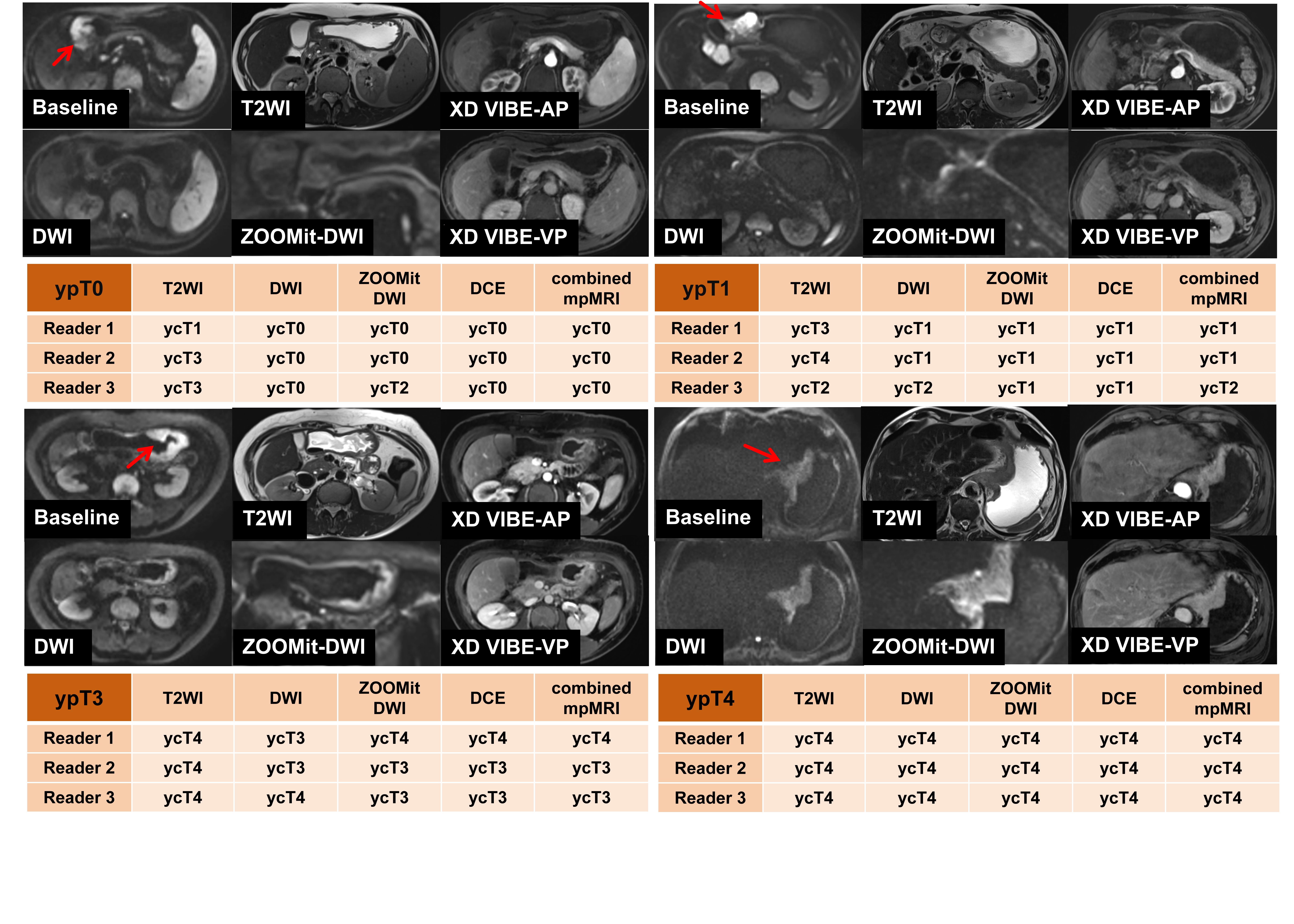
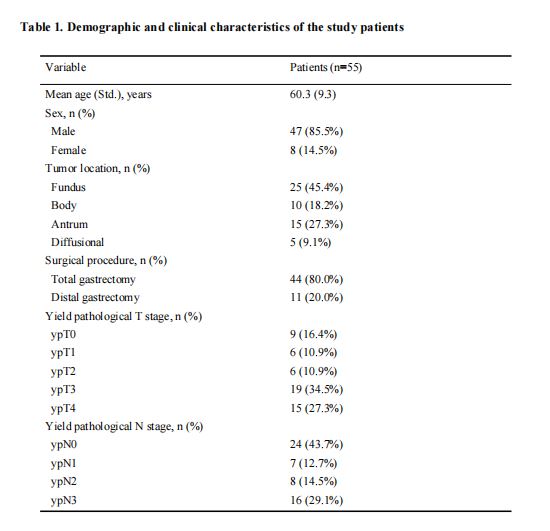
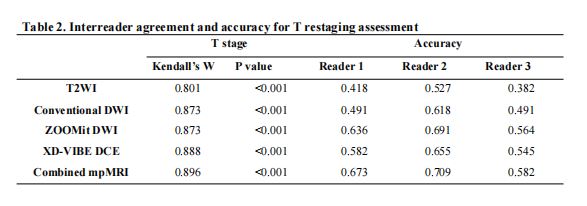
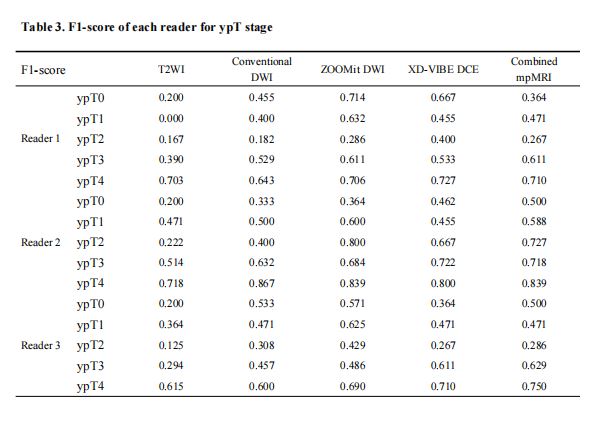
Table 1 lists the demographic and clinical characteristics of all study participants. The mean time from the end of NAT until surgery was 39 days (range, 14–63 days). The mean time from post-NAT MRI until surgery was 11 days (range, 1–14 days). Interreader agreement on T restaging was excellent among the three readers, with Kendall's W values ranging from 0.801–0.896 for each sequence and the combined mpMRI (Table 2). Table 2 summarizes the accuracy of the ycT stage relying on mpMRI with a pathological standard reference. Novel ZOOMit DWI and XD-VIBE achieved higher accuracy than did conventional T2WI and DWI in tumor ycT assessment for each reader. Furthermore, new ZOOMit DWI and XD-VIBE DCE performed better in inter-imaging comparisons among four separate MRI sequences (P<0.05) in terms of precision, recall, and F1-score than did conventional DWI and T2WI in T restaging (Table 3). ZOOMit DWI yielded markedly higher accuracies than did conventional DWI for T restaging (all P<0.05). After combining all three readers’ interpretations, mpMRI achieved clinically significant results for staging advanced-stage (ypT4a) tumors. Figure 1 shows the results of four representative cases of gastric cancer interpreted by three readers using mpMRI, thus highlighting the clinical superiority of mpMRI for gastric cancer T restaging.Discussion
Using mpMRI as a preoperative test enabled accurately determining 58.2%–70.9% of tumors in T restaging. XD-VIBE DCE and ZOOMit DWI outperformed conventional T2WI and DWI sequences. Additionally, mpMRI with novel ZOOMit and XD-VIBE DCE allows free breathing and is faster with fewer artifacts, thus making it available for real-world applications. Furthermore, mpMRI achieved much higher accuracy in detecting ypT4a tumors. Therefore, we believe that mpMRI offers advantages where conventional imaging falls short and can thus help optimize treatments.Conclusion:
Novel mpMRI techniques, particularly XD-VIBE DCE and ZOOMit DWI, exhibit improved diagnostic performance for gastric cancer after NAT.Acknowledgements
No acknowledgement found.References
1. Park SR, Lee JS, Kim CG, et al. Endoscopic ultrasound and computed tomography in restaging and predicting prognosis after neoadjuvant chemotherapy in patients with locally advanced gastric cancer. Cancer. 2008;112(11):2368-2376. doi:10.1002/cncr.234832.
2. Yoon JH, Yu MH, Chang W, et al. Clinical Feasibility of Free-Breathing Dynamic T1-Weighted Imaging With Gadoxetic Acid-Enhanced Liver Magnetic Resonance Imaging Using a Combination of Variable Density Sampling and Compressed Sensing. Invest Radiol. 2017;52(10):596-604. doi:10.1097/RLI.00000000000003853.
3. Lu QY, Guan Z, Zhang XY, et al. Contrast-enhanced MRI for T Restaging of locally advanced rectal cancer following neoadjuvant chemotherapy and radiation therapy. Radiology. 2022;305(2):364-372. doi:10.1148/radiol.212905
Figures