5087
Lymphatic congestion in Fontan circulation demostrated by Gd-EOB-DTPA magnetic resonance lymphangiography1Tokyo Women's Medical University Hospital, Tokyo, Japan, 2Philips health care, Tokyo, Japan
Synopsis
Keywords: Liver, Contrast Agent, Fontan circulation
Motivation: In the Fontan circulation, congestive liver and lymphatic congestion caused by elevated central venous pressure become permanent. These complications (called as FALD) are considered poor prognostic factors as Fontan-associated liver disease, and hyperplasia of abnormal lymphatic pathway have often been seen.
Goal(s): We attempt to depict abnormal lymphatic pathway using Gd-EOB-DTPA MRI and propose a classification of their severity.
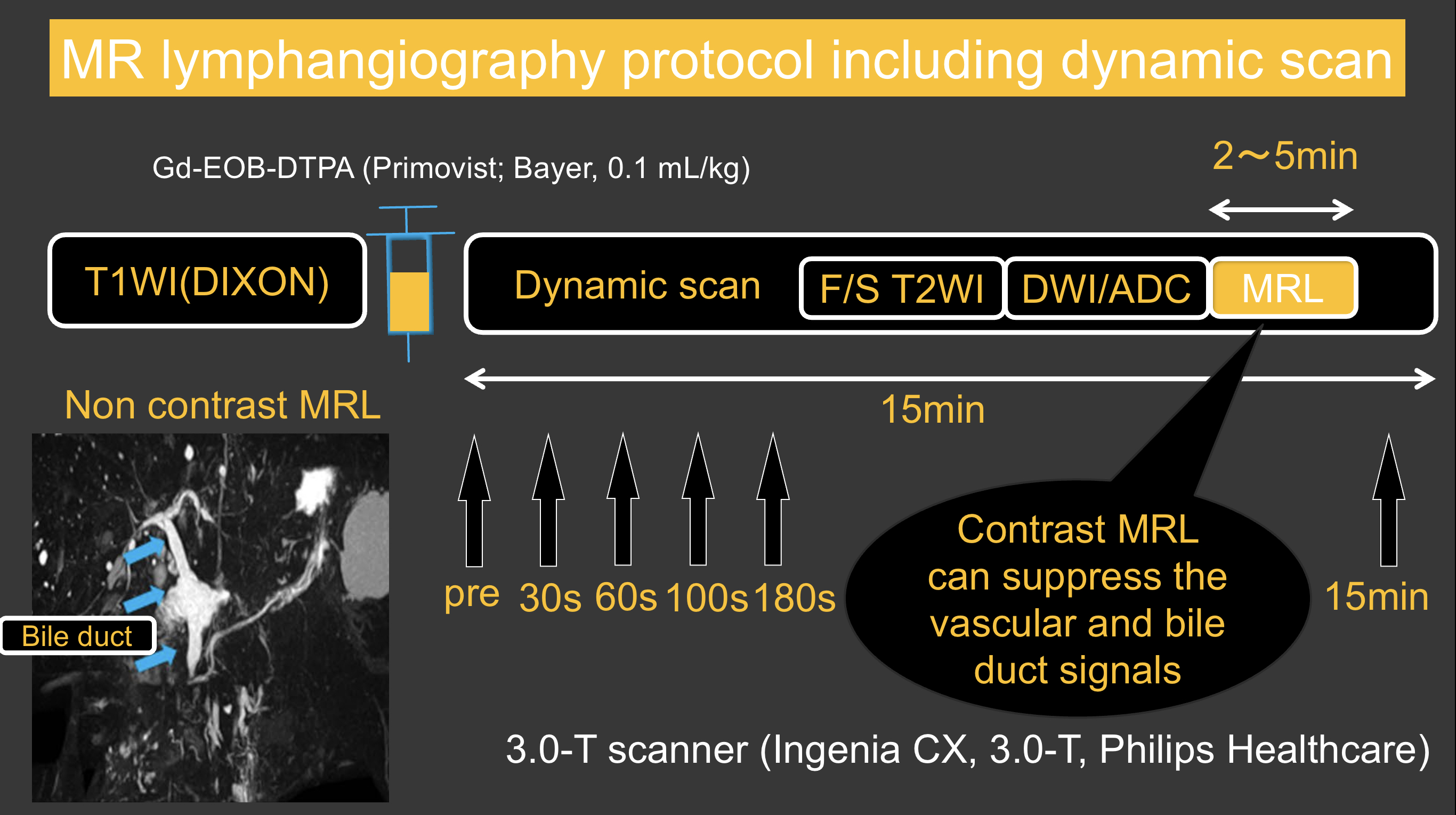
Approach: MR lymphangiography was scanned using three-dimensional heavily T2-weighted imaging with a 3-tesla scanner 10 minutes after Gd-EOB-DTPA administration. Patients were classified into the three grades.
Results: MR lymphangiography with Gd-EOB-DTPA, demonstrates the localization and extent of the abnormal lymphatic pathways in Fontan circulation.
Impact: In the Fontan circulation, the higer the lymphangiographic grade using MR lymphangiography with Gd-EOB-DTPA was, the more the adverse events was seen. The lymphangiographic grade is associated with the adverse events in Fontan-associated liver disease.
INTRODUCTION
In the Fontan circulation, congestive liver and lymphatic congestion caused by elevated central venous pressure become permanent, resulting in cirrhosis, HCC, refractory ascites, and protein-losing enteropathy(PLE). These complications are considered poor prognostic factors as Fontan-associated liver disease (FALD)1. Some studies have reported that a novel non-invasive technique, heavily T2-weighted magnetic resonance (MR) imaging sequences and dynamic contrast MR lymphangiography, can detect lymphatic anatomical characteristics in Fontan circulation2-5. We attempt to depict abnormal lymphatic pathway in FALD using Gd-EOB-DTPA MRI and propose a classification of their severity.METHODS
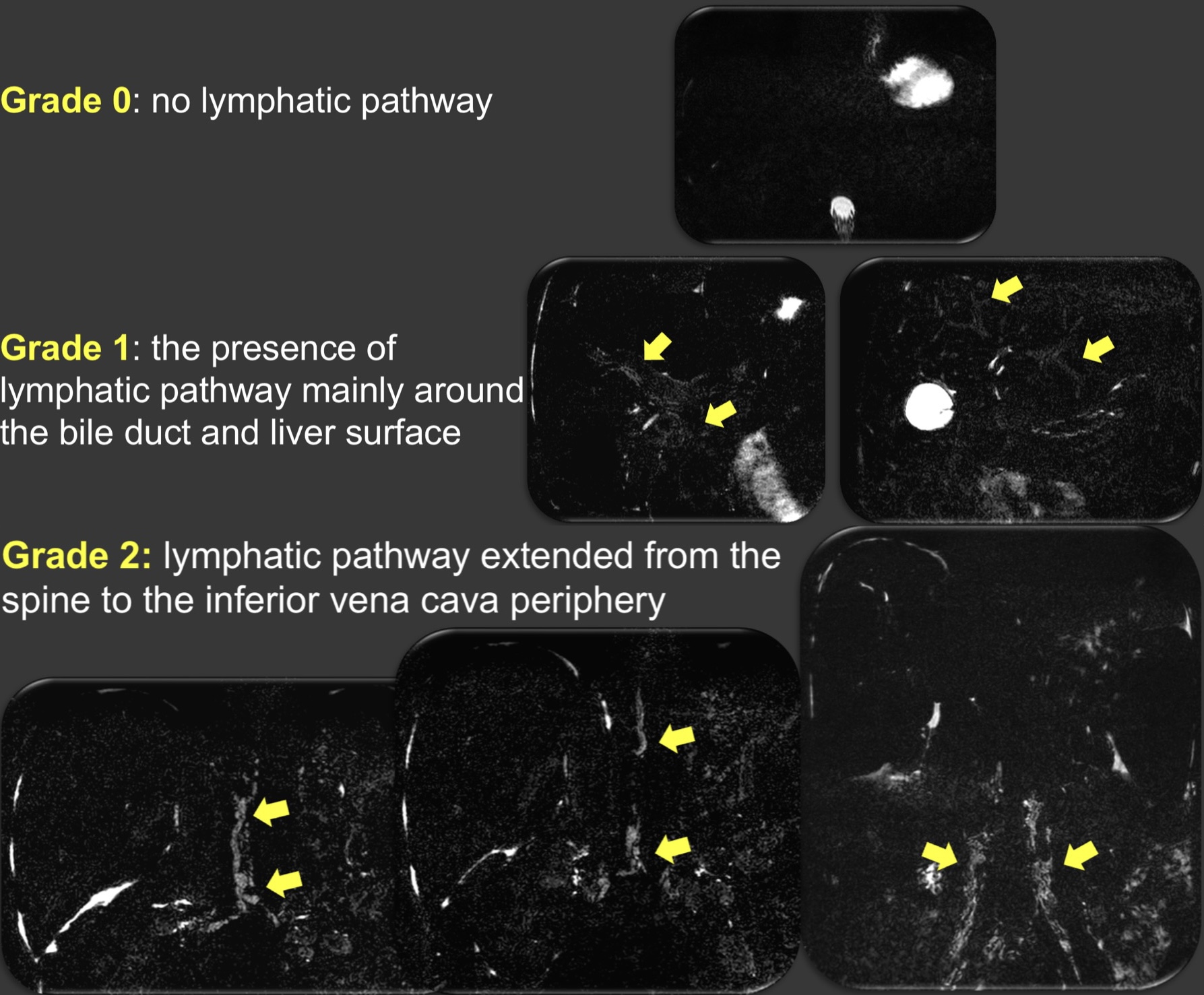
Fifty-two patients after Fontan procedure who underwent Gd-EOB-DTPA MRI(3.0-T scanner : Ingenia CX, 3.0-T, Philips Healthcare) to detect FALD were enrolled. Heavily T2-weighted MR lymphangiography was performed between Gd-EOB-DTPA dynamic studies for 180 s and 15 min using a respiratory-navigated and cardiac-gated three-dimensional turbo spin-echo sequence with the following parameters: 256 × 256; field of view, 300–450; repeti- tion time (TR)/echo time (TE), 2500/650; flip angle (FA), 140°; and voxel size, 1.1 × 1.1 × 1.1 mm. The scan time ranged from 2 to 5 min, depending on the patient’s size. Patterns of lymphatic perfusion in the abdominal cavity were characterized using heavily T2-weighted MR images. Lymphatic abnormalities in these Fontan patients were graded based on previously published categorizations6. Grade 0: no lymphatic pathway, Grade 1: the presence of lymphatic pathway mainly around the bile duct and liver surface, Grade 2: lymphatic pathway extended from the spine to the inferior vena cava periphery. Refractory ascites, PLE, development of HCC, and hospitalization for heart failure were used as composite outcomes and contrasted with lymphangiographic findings.RESULT
In MR lymphangiography, 20 patients were Grade 0, 17 were Grade 1, and 15 were Grade 2. 16 patients had composite outcomes, including 10 with HCC, 4 with refractory ascites, and 2 with heartfailure hospitalization. Grade 0 patients had no events (0/20), whereas Grade 1 and Grade 2 patients had the adverse events in 53% (9/17) and 47% (7/15) of patients, respectively.DISCUSSION
Fontan circulation is generally characterized by high central venous pressure, low cardiac output, and slightly low arterial, and it is quite different from normal biventricular physiology1. As expected, high central venous pressure wes associated with the severity of lymphatic abnormalities in our current study and promote increasing collaterals.The Philadelphia group reported that the preoperative assessment of lymphatic perfusion patterns might improve preoperative risk stratification and identify patients in whom lymphatic intervention might reduce the risk of early post- operative morbidity and mortality in children7. Most young Fontan adults, even with FALD, are generally asymptomatic, and it is very challenging to predict major Fontan complications including FALD, HCC, and PLE. The assessment of abnormal lymphatic pathway may be additional information of failing Fontan and can be clinically useful to find potential candidates. And contrast MR lymphangiography takes advantage of the suppression of vascular and bile duct signals by scanning heavily T2-weighted images after Gd-EOB-DTPA administration. It is a unique technique we firstly developed and uses Gd-EOB-DTPA as a negative contrast agent for the vessels and bile ducts. This contrasts with the lymphatic pathway around the bile duct and IVC, the main routes of lymphatic congestion. Contrast MR lymphangiography is a noninvasive test and is taken during EOB dynamic imaging protcol, so there is no extension in test time.CONCLUSION
A novel technique, MR lymphangiography with Gd-EOB-DTPA, demonstrates the localization and extent of the abnormal lymphatic pathways in Fontan circulation. The lymphangiographic grade is associated with the adverse events in FALD.Acknowledgements
References
- Gordon-Walker TT, Bove K, Veldtman G (2019) Fontan-associated liver disease: a review. J Cardiol 74(3):223–232
- Gooty VD, Veeram Reddy SR, Greer JS, Blair Z, Zahr RA, Arar Y, Castellanos DA, Pimplawar S, Greil GF, Dillenbeck J, Hussain T (2021) Lymphatic pathway evaluation in congenital heart disease using 3D whole-heart balanced steady state free precession and T2-weighted cardiovascular magnetic resonance. J Cardiovasc Magn Reson 23(1):16
- Dori Y, Smith CL, DeWitt AG, Srinivasan A, Krishnamurthy G, Escobar FA, Biko DM (2020) Intramesenteric dynamic contrast pediatric MR lymphangiography: initial experience and com- parison with intranodal and intrahepatic MR lymphangiography. Eur Radiol 30(10):5777–5784
- Biko DM, Smith CL, Otero HJ, Saul D, White AM, DeWitt A, Glatz AC, Piccoli DA, Mamula P, Rome JJ, Dori Y (2019)Biko DM, Smith CL, Otero HJ, Saul D, White AM, DeWitt A, Glatz AC, Piccoli DA, Mamula P, Rome JJ, Dori Y (2019) Intrahepatic dynamic contrast MR lymphangiography: initial experience with a new technique for the assessment of liver lymphatics. Eur Radiol. 29(10):5190–5196
- Ramirez-Suarez KI, Tierradentro-Garcia LO, Smith CL, Krishnamurthy G, Escobar FA, Otero HJ, Rapp JB, Dori Y, Biko DM (2022) Dynamic contrast-enhanced magnetic reso- nance lymphangiography. Pediatr Radiol 52(2):285–294
- Ghosh RM, Griffis HM, Glatz AC, Rome JJ, Smith CL, Gillespie MJ, Whitehead KK, O’Byrne ML, Biko DM, Ravishankar C, Dewitt AG, Dori Y (2020) Prevalence and cause of early fontan complications: does the lymphatic circulation play a role? J Am Heart Assoc 9(7):e015318
- Ghosh RM, Griffis HM, Glatz AC, Rome JJ, Smith CL, Gillespie MJ, Whitehead KK, O’Byrne ML, Biko DM, Ravishankar C, Dewitt AG, Dori Y (2020) Prevalence and cause of early fontan complications: does the lymphatic circulation play a role? J Am Heart Assoc 9(7):e015318
Figures