5022
Exploring deceased-related attention and memory in suicide and non-suicide bereavement through fMRI decoding1Department of Biomedical Engineering, Columbia University, New York, NY, United States, 2Department of Psychiatry, Columbia University, New York City, NY, United States, 3Division of Molecular Imaging and Neuropathology, New York State Psychiatric Institute, New York City, NY, United States, 4Department of Electrical Engineering, Columbia University, New York City, NY, United States
Synopsis
Keywords: Psychiatric Disorders, Psychiatric Disorders, Mental health, Suicide Bereavement, Grief
Motivation: Losing of a loved one to suicide is a uniquely difficult form of grief, often affecting a person’s ability to cope. It remains unclear what neural processes may cause intrusive thoughts to happen.
Goal(s): To understand the processes that contribute to intrusive and spontaneous thoughts of loss.
Approach: We trained a decoder to identify fMRI voxel-patterns associated with deceased-related attention and mental representations, which we then applied to another dataset acquired during mind-wandering to understand how these processes contribute to the occurrence of thoughts of loss.
Results: Engagements of attention and memory increased during blocks where subjects reported having thought about their loss.
Impact: The identification of attention and memory neural patterns in suicide related bereavement has the potential to recognize patients experiencing a poorer grief outcome and to help them improve grief trajectories
Introduction
The process of grieving is complex and vastly different across patient populations. The feeling of sadness after losing a loved one is often magnified by rejection, confusion, guilt, and avoidance1,2.These feelings are often coupled with recurrent intrusive thoughts of the deceased loved one3. Past studies have shown how negative cognitions and avoidance are central to and predictive of successful processing of the loss4,5. Others findings have raised the question of whether conscious grief-related thinking correlates with adaptation and length of bereavement.6 Here, we study the interplay between attention and memory in the process of suicide bereavement via neural decoding of fMRI.Methods
Subjects recruited were bereaved of a first-degree relative or partner to suicide in the prior 6 months. They underwent three different tasks during functional magnetic resonance imaging (fMRI): 1) a variation of the emotional STROOP task7 that uses deceased-related words to probe deceased-related attention, 2) a mental representation task in which subjects viewed pictures and stories of the deceased and a living attachment, 3) a subliminal mental representation of the deceased task in which the name of the deceased and a living attachment were presented subliminally, and 4) a Sustained Attention to Response Task (SART)8. This is a mind-wandering task in which subjects respond to numbers presented on screen over the course of 10 minutes. Approximately 30-second interval thought probes are presented to ask if subjects were thinking about the deceased during the previous block. An easy and hard version of the SART were employed. During the easy version, stimuli were presented at a rate of 1.5 seconds and during the hard version they were presented at a rate of 0.5 seconds. We trained an ElasticNet9 regression model on the emotional STROOP task to identify a pattern associated with reaction time to deceased-related words indicating greater attention to the deceased. We also trained a logistic regression decoder with l2-regularization10 on the mental representation and subliminal representation tasks to identify the neural patterns that discriminated deceased vs. living-related trials. The best performing decoder was chosen through permutation and applied to the mind-wandering data (i.e. the SART) to track deceased-related attention and mental representations as they occurred during the mind-wandering task. A linear mixed effects logistic regression model was implemented in SPSS to understand how the decoder outputs predicted the spontaneous thoughts of loss occurring during the mind-wandering task.Results
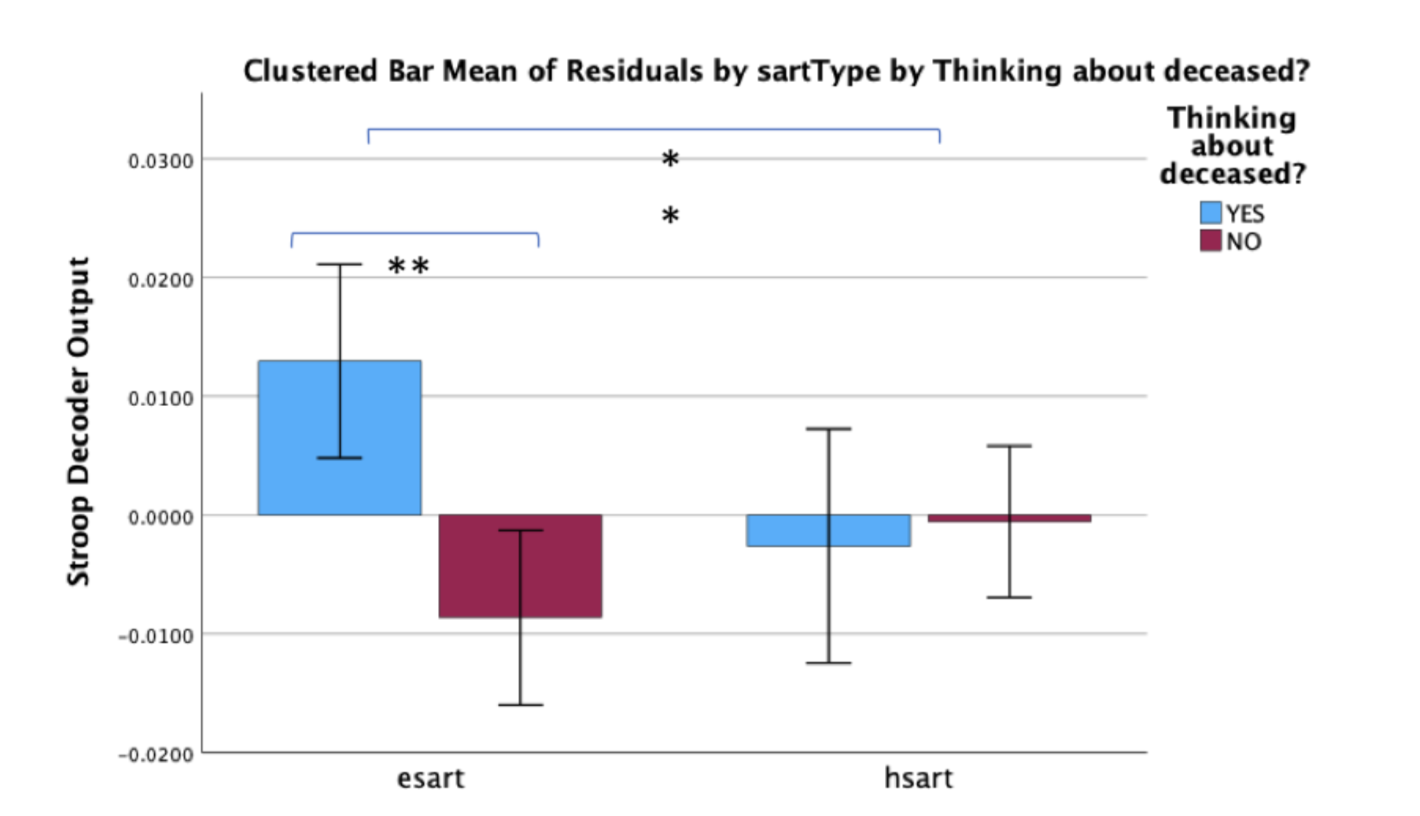
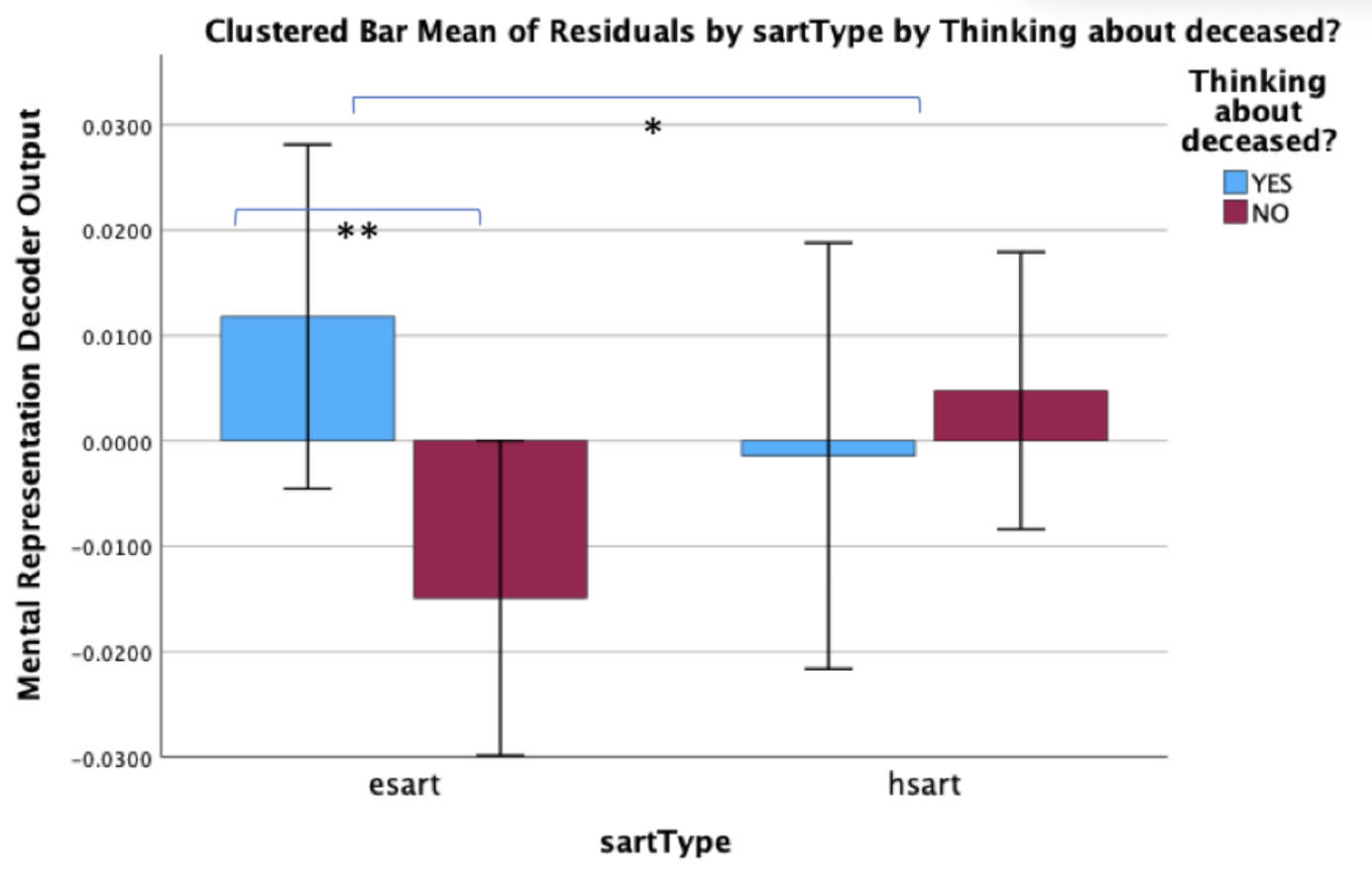
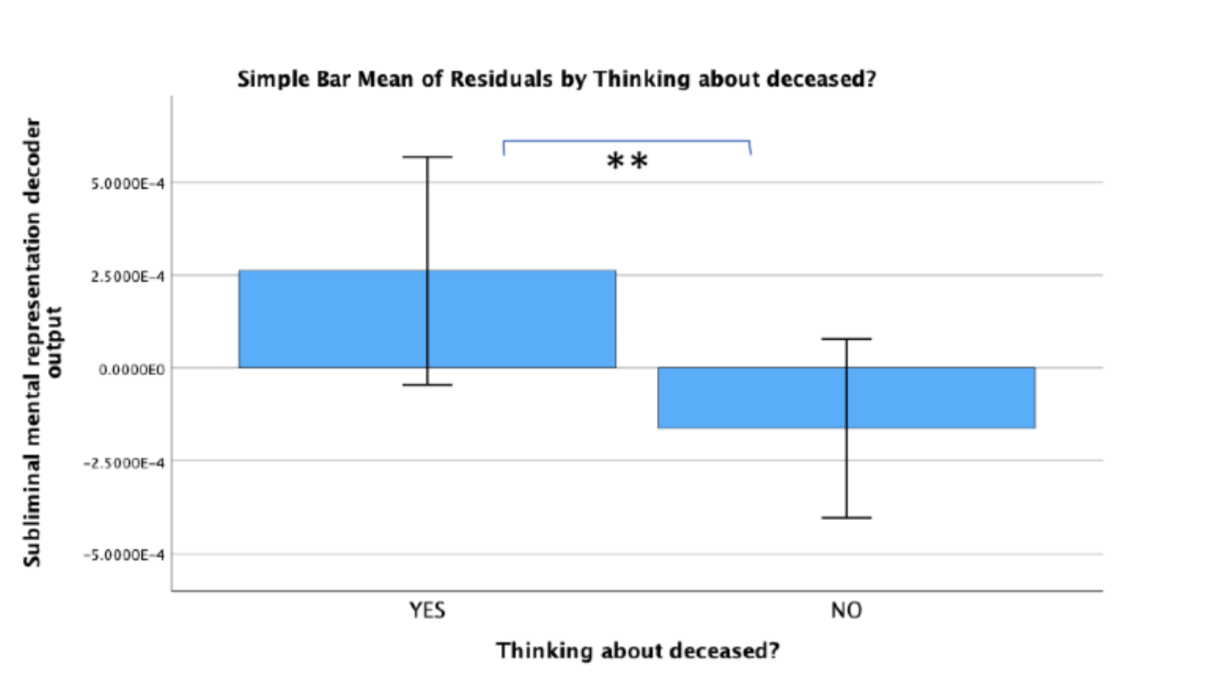
Subjects were 41 individuals bereaved by suicide within the past six months. The best performing decoders achieved a Pearson correlation R-value of 0.38 for the emotional STROOP task and an area under the curve (AUC) of 0.62 and 0.66 for the mental representation and subliminal representation tasks respectively. During the mind-wandering task, thoughts of loss occurred approximately 30% of the time during the HSART and 45% of the time during the ESART. For the attention and mental representation decoders an interaction effect was observed indicating that the relationship between self-reported intrusive thoughts and decoder output differed across the ESART and HSART tasks (B32652=.024,SE=.008,t=2.85,p<.004, Figure 1; B32652.=.033, SE=.017, t=196, p=.04, Figure 2). Specifically, during the ESART task both decoders showed higher output (indicating more deceased-related processing) during blocks in which an intrusive thought had happened (B1192.=.028, SE=.006, t=4.39; 95% CI: .004-.029, B1192.=.027, SE=.011, t=2.36; 95% CI: .004-.049). However, no differentiation was observed during the HSART task. A different pattern was observed for the decoder based on subliminal mental representation. Specifically, no significant interaction was observed by SART type and across both SART tasks, the decoder showed greater engagement during deceased-intrusion blocks vs. non intrusion blocks B32652=.001,SE<.001,t=2.62, p<.009, 95%CI:.000-.001, Figure 3).Conclusion
This study demonstrates the ability of our neural decoding approach to identify mental processes that contribute to the occurrence of spontaneous thoughts of loss. Elements of attention and conscious and unconscious mental representations contribute to the occurrence of thoughts of loss that happened during a mind-wandering task. The identification of neural patterns related to deceased-related attention and memory in suicide bereaved individuals has the potential to recognize patients experiencing complicated grief and to help them identify the barriers to improving grief trajectories.Acknowledgements
This work was funded by a Center of Excellence grant from the Air Force Office of Scientific Research (FA9550-22-1-0337).References
1. Young, Ilanit Tal, et al. "Suicide bereavement and complicated grief." Dialogues in clinical neuroscience (2022).
2. ZISOOK, S., & SHEAR, K. (2009). Grief and bereavement: What psychiatrists need to know. World Psychiatry, 8(2), 67–74. https://doi.org/10.1002/j.2051-5545.2009.tb00217.x
3. Shear, M. K. (2010). Exploring the role of experiential avoidance from the perspective of attachment theory and the Dual Process Model. OMEGA - Journal of Death and Dying, 61(4), 357–369. https://doi.org/10.2190/om.61.4.f
4. Boelen, P. A., van den Bout, J., & van den Hout, M. A. (2006). Negative cognitions and avoidance in emotional problems after bereavement: A prospective study. Behaviour Research and Therapy, 44(11), 1657–1672. https://doi.org/10.1016/j.brat.2005.12.006
5. Meier, A. M., Carr, D. R., Currier, J. M., & Neimeyer, R. A. (2013). Attachment anxiety and avoidance in coping with bereavement: Two studies. Journal of Social and Clinical Psychology, 32(3), 315–334. https://doi.org/10.1521/jscp.2013.32.3.315
6. Schneck, N., Tu, T., Bonanno, G. A., Shear, M. K., Sajda, P., & Mann, J. J. (2019). Self-generated unconscious processing of loss linked to less severe grieving. Biological Psychiatry: Cognitive Neuroscience and Neuroimaging, 4(3), 271–279. https://doi.org/10.1016/j.bpsc.2018.08.003
7. Williams, J. M., Mathews, A., & MacLeod, C. (1996). The emotional stroop task and psychopathology. Psychological Bulletin, 120(1), 3–24. https://doi.org/10.1037/0033-2909.120.1.3
8. Robertson, I. H., Manly, T., Andrade, J., Baddeley, B. T., & Yiend, J. (1997). `oops!’: Performance correlates of everyday attentional failures in traumatic brain injured and normal subjects. Neuropsychologia, 35(6), 747–758. https://doi.org/10.1016/s0028-3932(97)00015-8
9. Zou, H., & Hastie, T. (2005). Regularization and variable selection via the elastic net. Journal of the Royal Statistical Society Series B: Statistical Methodology, 67(2), 301–320. https://doi.org/10.1111/j.1467-9868.2005.00503.x
10. Ng, A. Y. (2004). Feature selection, l1 vs. l2 regularization, and rotational invariance. Twenty-First International Conference on Machine Learning - ICML ’04. https://doi.org/10.1145/1015330.1015435
Figures