5002
Deep-learning-based flow-artifact correction for multi-shot multiple overlapping-echo detachment imaging (msh-MOLED)1Xiamen University, Xiamen, China, 2Department of Magnetic Resonance Imaging, the First Affiliated Hospital of Zhengzhou University, Zhengzhou, China, 3MSC Clinical & Technical Solutions, Philips Healthcare, Shenzhen, China
Synopsis
Keywords: Artifacts, Data Acquisition, Image Reconstruction
Motivation: Multi-shot overlapping-echo detachment imaging (msh-MOLED), a msh-EPI-based quantitative MR sequence, quantifies tissue T2 rapidly without the need of separately acquiring images with different TEs, but its results could be contaminated by flow-induced inter-shot phase variations.
Goal(s): To implement an instantaneous referenceless flow-artifact correction for msh-MOLED.
Approach: Flow-related features were added to the training data, and the trained network fulfilled T2 mapping free from flow artifacts without dear computational costs or additional reference data.
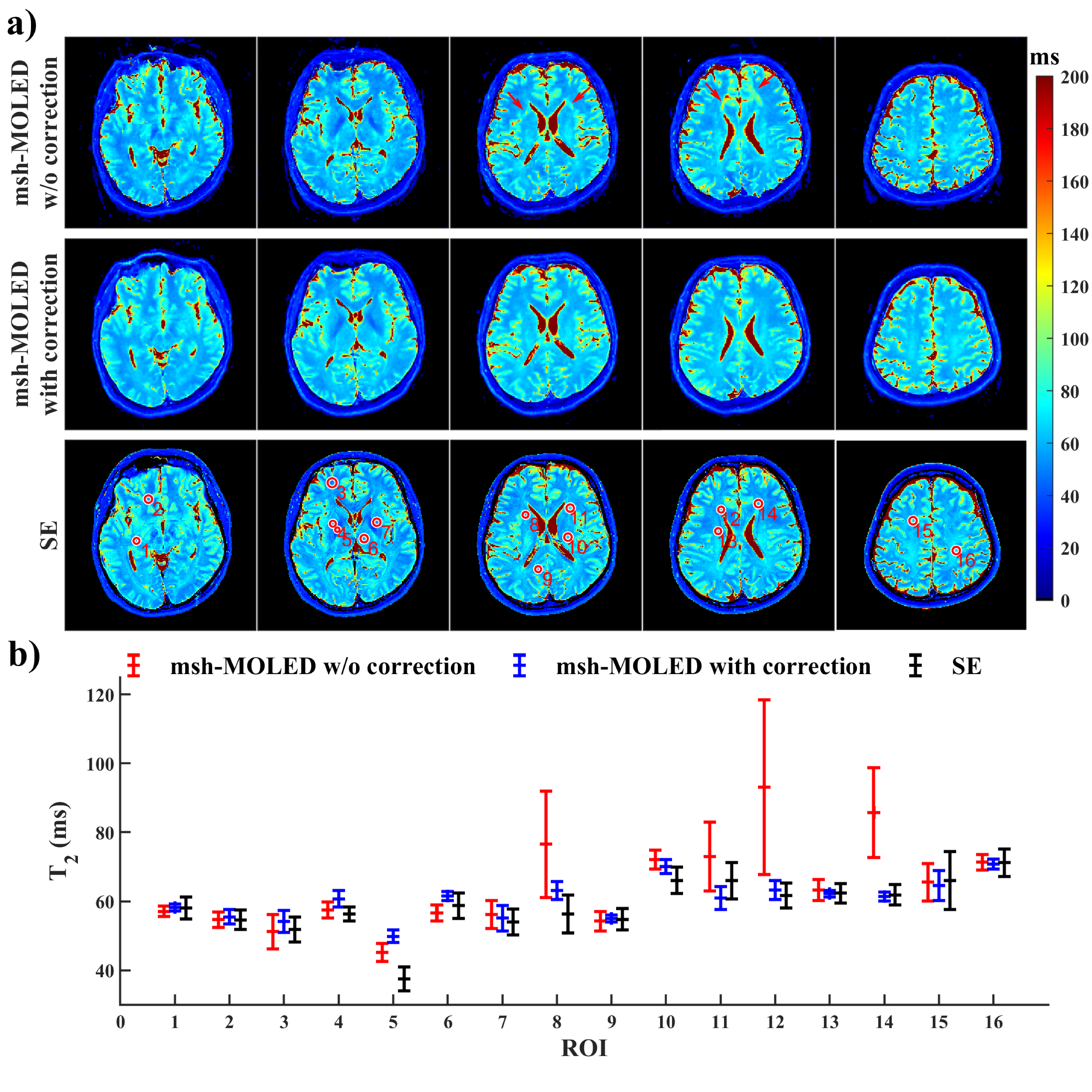
Results: After correction, the Pearson’s correlation coefficient/mean absolute error was changed from 0.6332/6.5328 (uncorrected) to 0.8808/2.7623 (corrected).
Impact: The proposed correction could be used to retain the mapping accuracy of msh-MOLED regardless of shot numbers, or to refine the reference data in high-spatial-resolution diffusion mapping potentially.
Introduction
Motion-induced inter-shot phase corruption is troublesome for multi-shot echo-planar imaging (msh-EPI). Multi-shot overlapping-echo detachment imaging (msh-MOLED)1,2 is an msh-EPI-based sequence fulfilling rapid T2 mapping with high spatial resolution and without the need of acquiring images at varying TE weights. However, because of the involvement of neural network, the flow-induced phase corruption contaminates the final T2 maps even when no diffusion bipolar gradients are applied. Herein, a deep-learning-based correction was implemented, removing flow-related contaminations without additional reference data or tedious iteration reconstruction.Methods
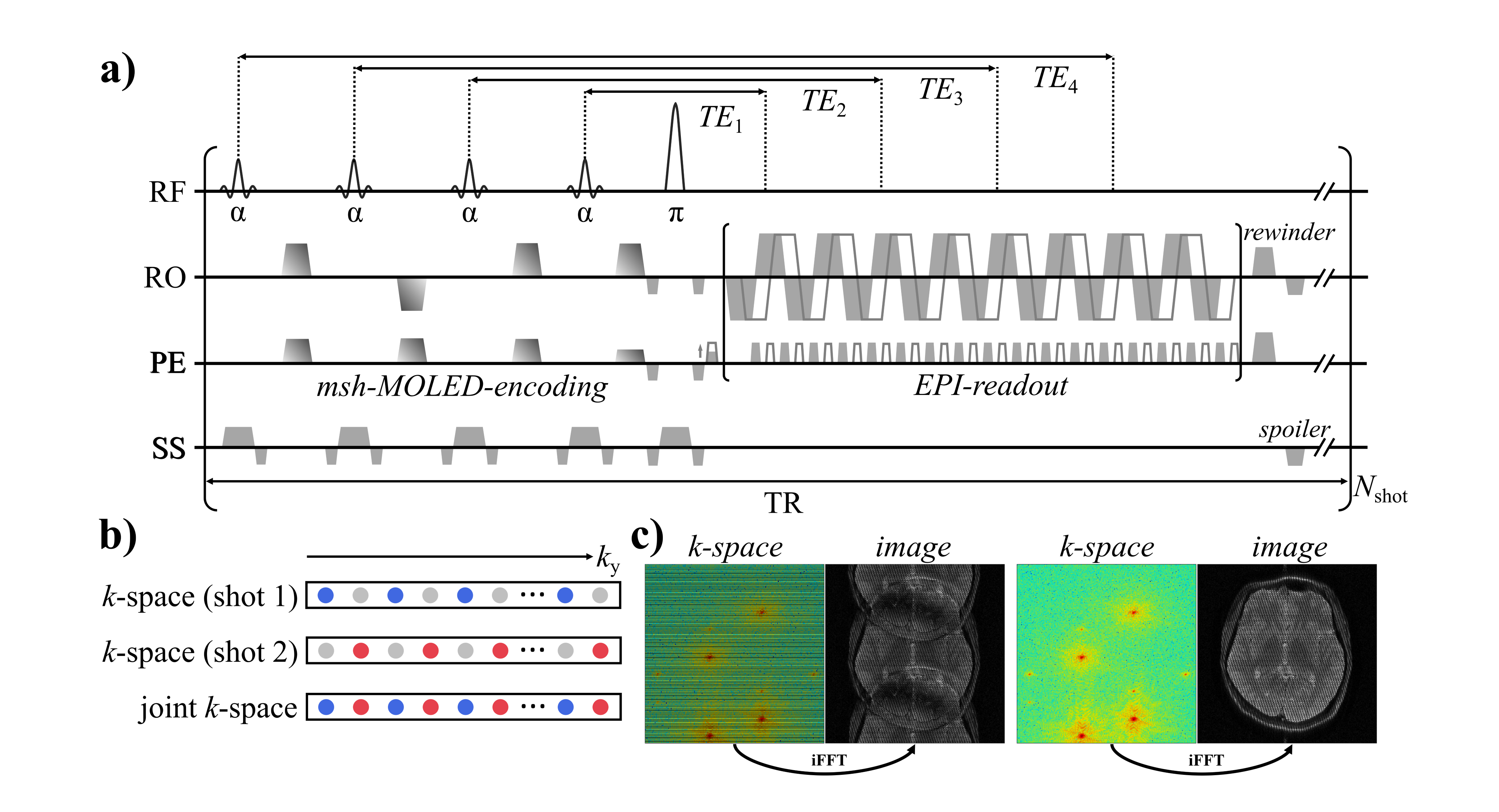
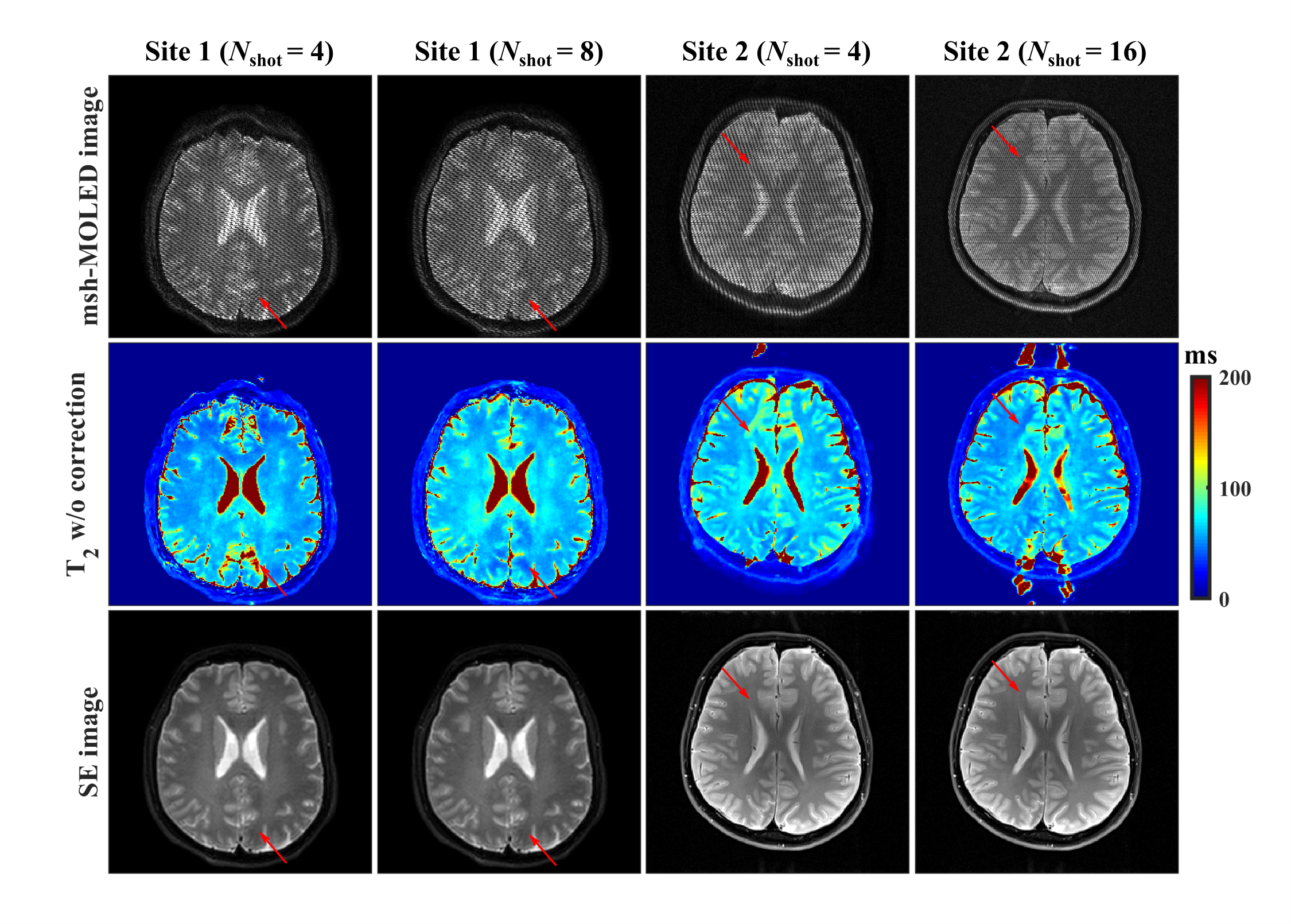
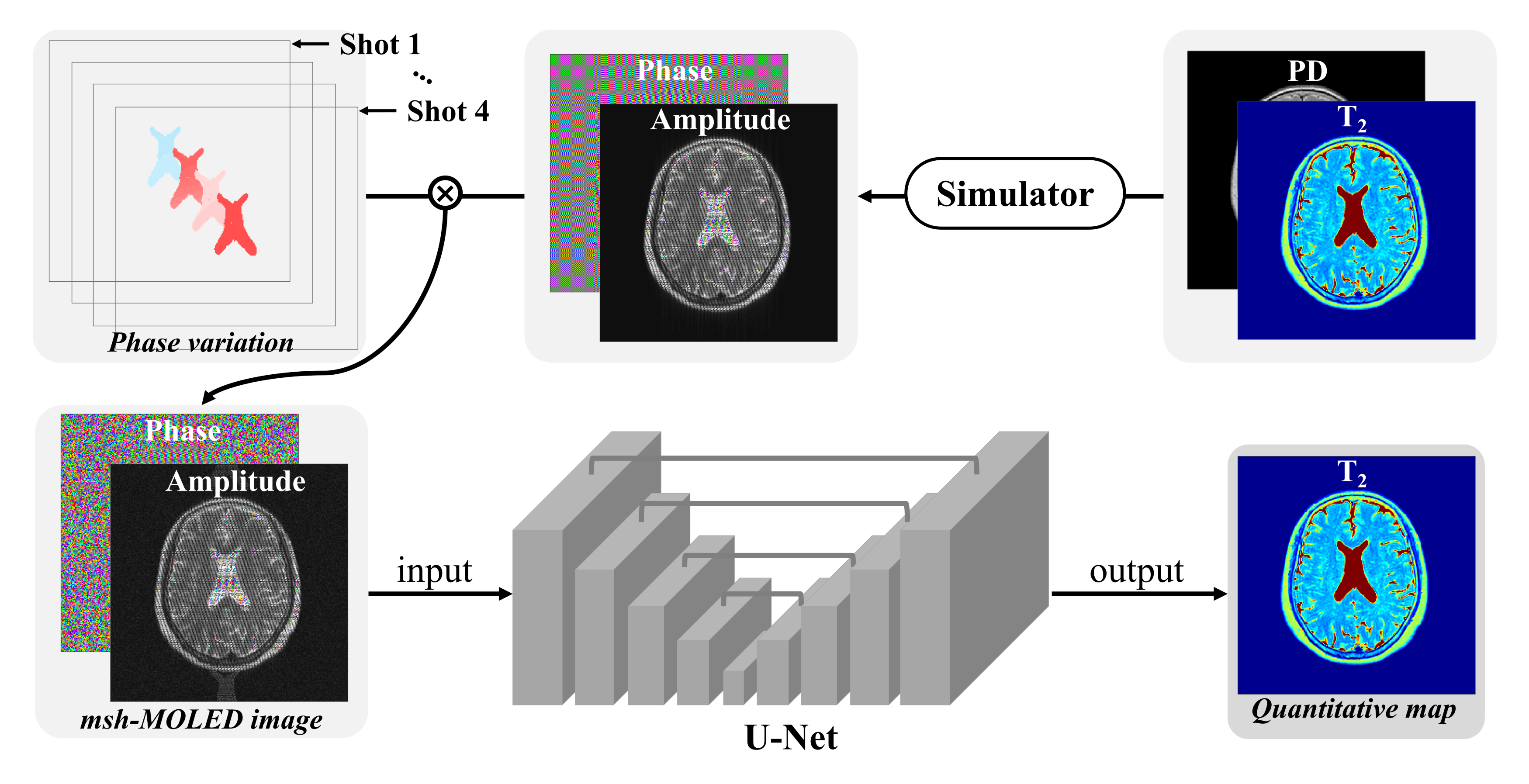
The msh-MOLED pulse sequence (Figure 1) and related parametric mapping process have been reported.2 The proposed method was built on the fact that flow-induced phase corruption was local and interfered the regularly-varying signal modulation of msh-MOLED in the phase domain. Two volunteers were scanned at two sites with different scanning parameters (Table 1) to verify the nature of flow artifacts, as shown in Figure 2. Aside from previous reconstruction and mapping processes2, the proposed method was illustrated in Figure 3 with three newly-added steps:- Flow-induced phase simulation, where flow areas were delineated according to T1 labels, and then Nshot phase variations (Nshot denoted the number of shots) were mimicked by a two-dimensional (2D) free-formed surface and masked by the flow areas;
- Training data generation, where corrupted phases were multiplied to Nshot complex-valued msh-MOLED images (simulated with MRiLab3), which were transformed into k-space domain and then ky data in the corrupted k-space were extracted to yield the flow-contaminating msh-MOLED images after inversed Fourier transform (iFFT);
- Network training, training data were converted into amplitude and phase domain for network training, and other training processes were the same as before.2,4
Results
Figure 4 displays the in vivo results, where the flow-induced phase corruption leaded to an incorrect mapping relationship for the original network, yielding gross artifacts and significantly biased T2 estimate in the final parametric maps, even when these artifacts were visually unable to be identified in msh-MOLED images (also shown in Figure 2). In contrast, the proposed method successfully removed the contamination, fulfilling T2 mapping highly close to the reference method while demanding a pronouncedly decreased acquisition time. And a PCC of 0.6332/0.8808 was found in T2 maps without/with correction, as well as a MAE of 6.5328/2.7623 ms.Discussion
Diffusion MRI utilizes non-diffusive images (i.e., b-value = 0 s/mm2), generally considered as ‘clear’ reference data, to correct motion-induced phase corruption. However, for msh-MOLED, there is no diffusion gradients applied and the obtain of reference data is difficult when deep learning and high acceleration rate (g-factor) are involved. Besides, the existing methods correcting inter-shot phase corruption are mostly based on the assumption of phase smoothness or manipulate the signal phase and amplitude separately, which is inappropriate for msh-MOLED because the intrinsic principle of parametric mapping of msh-MOLED is the complex-valued signal modulation with different weights. However, with the addition of flow-related features, neural network could self-adoptedly correct flow-induced inter-phase variations. This work could be inspiring to the pulse sequence development based on msh-MOLED, or to the refinement of non-diffusive images for further usages.Conclusion
The proposed deep-learning-based method can efficiently correct motion-induced phase corruption for the msh-MOLED, regardless of the g-factor, without the need of additional reference data or tedious iteration reconstruction.Acknowledgements
This work was supported in part by the National Natural Science Foundation of China under grant numbers 1237529, 82071913 and 22161142024.References
- Zhang J, Wu J, Chen SJ, et al. Robust single-shot T2 mapping via multiple overlapping-echo acquisition and deep neural network. IEEE Trans Med Imaging. 2019;38(8):1801-1811.
- Yang QZ, Geng WH, He HJ, et al. High spatial resolution T2 mapping via multi-shot multiple overlapping-echo detachment imaging. in Proc. 23th Ann. Meet. ISMRM, Toronto, Canada; 2023:272.
- Liu F, Velikina JV, Block WF, Kijowski R, et al. Fast realistic MRI simulations based on generalized multi-pool exchange tissue model. IEEE Trans Med Imaging. 2017;36(2):527-537.
- Ouyang BY, Yang QZ, Wang XY, et al. Single-shot T2 mapping via multi-echo-train multiple overlapping-echo detachment planar imaging and multitask deep learning. Med Phys. 2022;49(11):7095-7107.
Figures
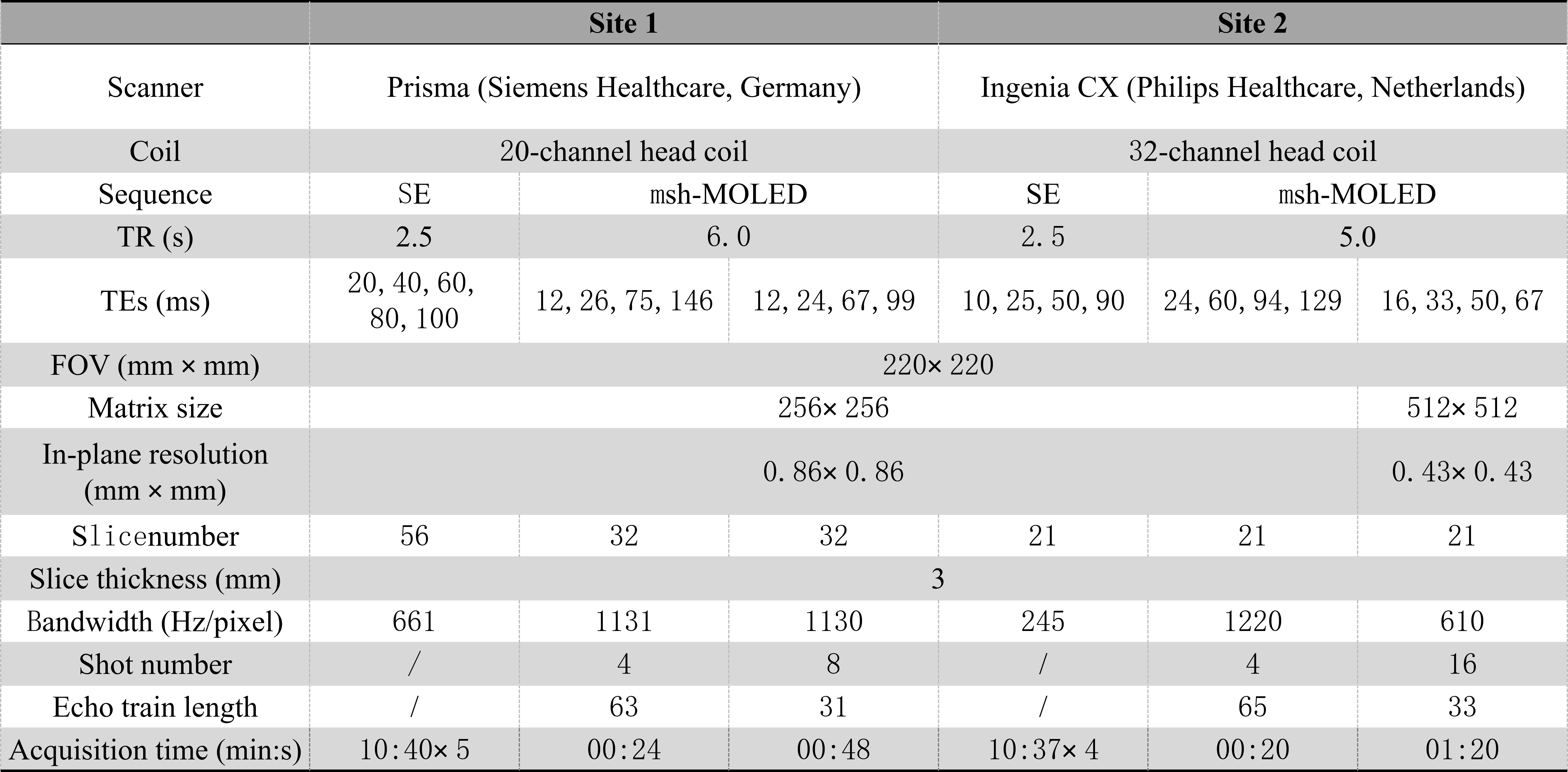
Table 1. Scan parameters