5001
Digging deeper into the pervasive problem of non-compliance in MR datasets1University of Pittsburgh, Pittsburgh, PA, United States
Synopsis
Keywords: Data Acquisition, Software Tools, Protocol Compliance
Motivation: Large MRI datasets from multiple sites are not monitored for protocol compliance and dataset integrity.
Goal(s): We previously demonstrated the pervasiveness of protocol non-compliance in MR datasets using our open source tool mrQA. We aim to produce deeper insights with vertical audit and analyze the common patterns of non-compliance.
Approach: We processed the large and open ABCD study verifying relationships between sequences in their protocol.
Results: We observed issues on non-compliance in coil, shim setting, and pixel spacing. We also observed significant disparities across vendors, scanners and sites. This underscores the necessity for tools such as mrQA that can identify non-compliance across vendors/sites.
Impact: Non-compliance in acquisition parameters is a pervasive problem in MR datasets. It is impractical to “hope” for protocol compliance across sites, and scanners. Our tool, mrQA can enable researchers to continuously monitor and identify non-compliant scans in a practical manner.
Introduction
Over the last two decades, large-scale MR datasets have paved the way for numerous brain-behavior studies. However, the validity and power of the statistical results are contingent upon the quality of acquired data. Protocol compliance necessitates that all the scans for a specific study should have identical (or compatible) MR physics parameter values. Conventionally, protocol compliance has been a manual/ad-hoc process. However, with the ever-increasing size of MR datasets, relying solely on manual methods for protocol compliance is no longer practical. Their massive scale makes it imperative to enforce automated and comprehensive evaluation of the acquisition protocol.Prior works have focused on developing image post-processing techniques[3], however not much effort has been devoted towards minimizing these discrepancies at the scanner. We demonstrated that the lack of compliance is rather pervasive in large-scale datasets[1]. We designed an open-source tool (mrQA) to aggregate and assess protocol compliance across all subjects for each sequence in DICOM datasets (horizontal audit). However, the initial exploration checked compliance on a limited subset of parameters and didn’t evaluate compatibility between sequences acquired within the same session (vertical audit).
For instance, if the acquired field map is incompatible (different PED, acquisition volume, or shim setting), with the corresponding DWI of the same subject, subsequent distortion correction would be suboptimal, and in the worst case might even be invalid[4].
We present mrQA which now inspects more than 50 imaging parameters and conducts both horizontal audit (across subjects for the same sequence) and vertical audit (across sequences within the same imaging session for each subject) for comprehensive compliance evaluation as shown in Figure 1. We also explore the patterns of non-compliance, and how they vary across different vendors, scanner models, and sites to improve our understanding of non-compliance and optimize operations of MR imaging centers.
Methods
mrQA parses the input dataset to store the acquisition parameters, and then aggregates and summarizes non-compliance to generate a comprehensive yet user-friendly report. We assess the protocol compliance or lack thereof, in the large open Adolescent Brain Cognitive Development (ABCD) dataset. For the vertical audit, we focus on field maps for DTI sequences as they play a crucial role in correcting field inhomogeneities.Results & Discussion
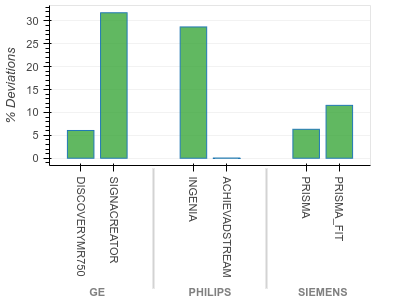
The results demonstrate a lack of compliance in coil, pixel spacing, and shim setting. We observe significant differences in non-compliance rates across vendors, scanner models and acquisition sites.We observed that most of the field maps and DWI scans were acquired using 32-channel (HEA,HEP) and 64 channel coils (HC 1-7, NC). As described[2], ABCD sites used both 32-ch/64-ch channel coils as per their availability. However, a few subjects were also scanned using body coil (BC) and spine coil (SP). Identifying scans with 32-ch/64-ch coils is important so that appropriate measures are taken to adjust for coil differences.We observed that the pixel spacing for Philips scans does not match with the published image resolution[2]. In contrast to reference resolution (1.71 mm x 1.71 mm), the Philips scans had pixel spacing as 1.66 mm x 1.66 mm. The acquisition matrix and pixel spacing was consistent for Siemens and GE scanners as shown in Table 1.
Furthermore, a total of 217 subjects had a non-compliant shim value, meaning that the first order and second order shim values were not identical for the field map and DWI. Some subjects had a non-complaint PED for both the field map and the DWI scan potentially due to manual propagation of the acquisition information from prior sequences (DWI) to the latter ones (field map) at scanning interface. Although, this doesn’t impede distortion correction, but a non-compliant PED may cause differences in fractional anisotropy estimates.
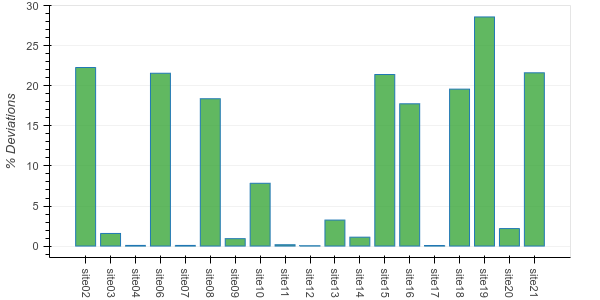
We observed large variations in non-compliance rates among different MRI vendors. Certain scanner models (Figure 2) and acquisition sites (Figure 3) exhibited higher level of non-compliance rates, indicating the influence of scanner & site-specific factors. This highlights the need for automated tools, such as mrQA, that can identify non-compliance across vendors and sites. We recommend daily/weekly monitoring of DICOM datasets to identify non-compliant scans promptly.
Conclusions
We have demonstrated that the problem of non-compliance is pervasive in MR imaging. We explored deeper issues of non-compliance through vertical audits. As we move towards even larger MR datasets, automated tools (such as mrQA) would be critical to identify any issues of non-compliance at the scanner itself, without which the issues may go unnoticed. Corrective action is possible only when such tools can identify the non-compliant scans. We recommend that both horizontal and vertical audit should be conducted promptly rather than waiting for years to complete data acquisition.Acknowledgements
No acknowledgement found.References
- Sinha, H., & Raamana, P. R. (2023). Solving the Pervasive Problem of Protocol Non-Compliance in MRI using an Open-Source tool mrQA. bioRxiv, 2023-07. https://doi.org/10.1101/2023.07.17.548591
- Hagler Jr, D. J., Hatton, S., Cornejo, M. D., Makowski, C., Fair, D. A., Dick, A. S., ... & Dale, A. M. (2019). Image processing and analysis methods for the Adolescent Brain Cognitive Development Study. Neuroimage, 202, 116091.
- Fortin J.-P, Cullen N, Sheline Y. I, et al. Harmonization of cortical thickness measurements across scanners and sites. NeuroImage. 2018;167:104–120.
- Wang, S., Peterson, D. J., Gatenby, J. C., Li, W., Grabo]wski, T. J., & Madhyastha, T. M. (2017). Evaluation of field map and nonlinear registration methods for correction of susceptibility artifacts in diffusion MRI. Frontiers in neuroinformatics, 11, 17.
Figures

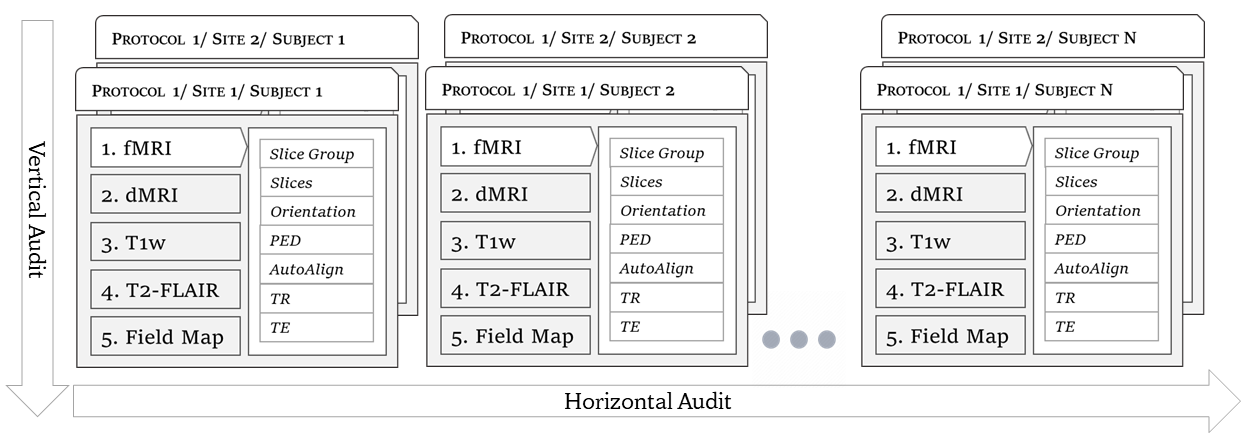
Figure 1: Overview of the relationship between different various levels relevant to protocol compliance checks such as subject, sequence, site, etc. We define a horizontal audit to be across all subjects for a given sequence whereas a vertical audit checks if all the sequences are compatible for a subject in a given session.