4993
Accelerating multiparametric imaging(MTP) by 12-fold using 64 channel head coil and CS Wave reconstruction1Inner mongolia university, Hohhot, China, 2Shenzhen Institute of Advanced Technology, Shenzhen, China, 3Shenzhen Institute of Advanced Technology,University of Chinese Academy of Sciences, Beijing, China, 4UIH America, Houston, TX, United States
Synopsis
Keywords: Quantitative Imaging, Quantitative Imaging
Motivation: The MULTIPLEX technique could quantify the T1/T2*/PD/Susceptibility maps in a single 3D scan but leads to a long scan time.
Goal(s): This study aimed to develop sparsity regularized Wave-SNMs reconstruction methods to address the issue of slow 3D scanning of the MULTIPLEX technique.
Approach: This work is based on a SNMs reconstruction method with the addition of a sparsity regular term of L1, which utilizes nulling maps with a short calibration time to achieve a 12-fold accelerated imaging.
Results: Sparsity regularized Wave-SNMs reconstruction with Multi-Dimensional Integration quantification accelerate MULTIPLEX by 12-fold into a single scan of 2 minutes.
Impact: The L1 regularized Wave-SNMs reconstruction could benefits the Mutli-Dimensional lntegration (MDI) quantification to achieve comparable accuracy and robustness as the reference scan with 70% reduction of scan time.
Introduction
The MULTI-Parametric MR imaging with fLEXible design technique (MULTIPLEX) provides quantitative T1/T2*/PD/susceptibility maps and qualitative augmented T1/susceptibility-weighted images (aT1w) jointly in a single 3D scan [1]. The resulting Wave-CAIPI spreads the aliasing evenly in all spatial directions, thereby taking full advantage of 3D coil sensitivity distribution [2]. Rapid acquisition and high-quality image reconstruction with wave-CAIPI is demonstrated for high-resolution magnitude and phase imaging and quantitative susceptibility mapping [2]. However, the dual-TR, dual-flip angle and multi-echo signal acquisition strategy leads to a long scan time and limits the achievable spatial resolution [3,4]. Whereas sparsity regularized Wave-SNMs reconstruction with Multi-Dimensional Integration quantification accelerate MULTIPLEX (obtains quantitative T1/T2* maps and qualitative aT1w image jointly) by 12-fold into a single scan of 2 minutes.Methods
This work is based on a SNMs [10] reconstruction method with the addition of a sparsity regular term of L1, which utilizes nulling maps [9,10] with a short calibration time to achieve a 12-fold accelerated imaging.$$\min _{\substack{x_{i}, i=1: R_{z}}}\left\|N_{i} x_{i}\right\|_{2}^{2}+\alpha\left\|A F_{x}^{-1} P_{s f}^{i} F_{x} x_{i}-I_{a}\right\|_{2}^{2}+\mu \sum_{i=1}\left\|W x_{i}\right\|_{\text {Joint} l_{1}}$$
where $$$x_{i}$$$ denote the unknown multi-coil images of $$$R_{z}$$$ slices which are aliased together by the $$$R_{z}$$$-fold undersampling in the $$$k_{z}$$$ dimension, $$$N_{i}$$$ denotes the nulling maps operating in the image domain of each aliased slice, $$$P^{i}_{sf}$$$ denotes the point spread function (PSF) characterizing the Wave sampling, $$$F_{x}$$$ and $$$F_{x}^{-1}$$$ denote the Fourier transform (FT) along the $$$k_{x}$$$ dimension and its inverse, $$$A$$$ represents the image aliasing induced by CAIPI undersampling in the $$$k_{y}$$$-$$$k_{z}$$$ dimensions, $$$I_{a}$$$ denotes the aliased image calculated by inverse FT of the Wave-CAIPI accelerated k-space data, $$$W$$$ denotes the 2D Daubechies Wavelet transform, and $$$\|\cdot\|_{\text {Joint } l_{1}}$$$ denotes the joint sparsity model for multi-coil images. The L1-Wave-SNMs model is solved iteratively by the FISTA algorithm. The regularization weight of dataconsistency term is set to $$$\alpha = 0.6$$$,while the sparsity regularization weight $$$\mu$$$ varies between 3.3e-3 and 5.6e-3 according to the different signal-to-noise evels of multi-echo images. In the L1-Wave-SNMs, we employed coil compression as a technique to reduce the reconstruction time of the 12-fold Wave-CAlPl accelerated MULTIPLEX scanning data. The SNMs-L1 method is a technique that combines sparse and non-negative matrix factorization with L1 regularization. By representing the data as a sparse non-negative matrix factorization, this method effectively reduces noise while simultaneously leveraging the dimensional orthogonality of multi-dimensional regularized MR signals. As a result, it enhances coil-by-coil reconstruction and facilitates a subsequent multi-dimensional integration quantization strategy [1,7,8].
The in vivo experiments were completed by the Lauterbur Biomedical Imaging Laboratory with written informed consent from two healthy volunteers. A 64-channel head coil was used to perform all the 12-fold Wave-CAlPl accelerated MULTIPLEX scans on a 3T scanner. For each item, we also conducted corresponding 9-fold Wave-CAlPl accelerated MULTIPLEX scans of the corresponding echo to compare and evaluate the quality of the reconstructed image.
Results
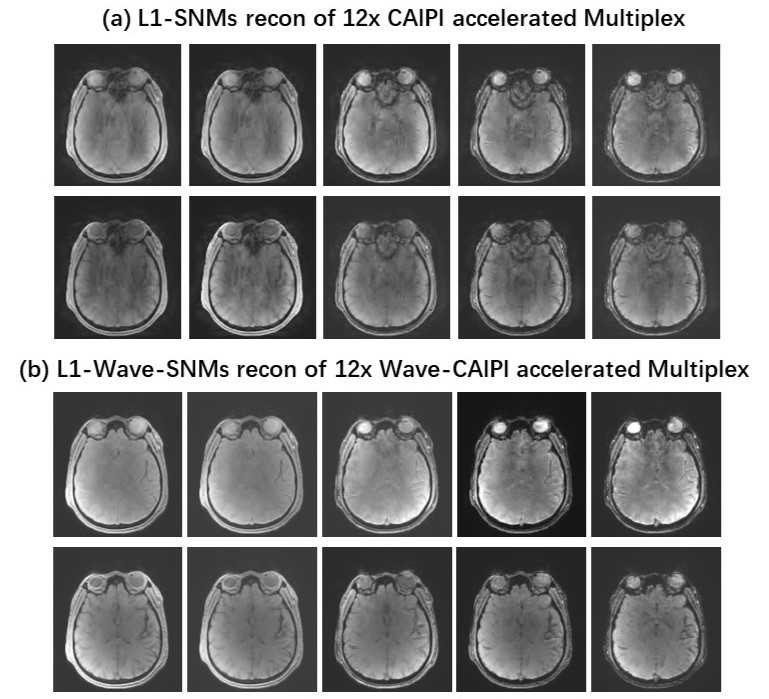
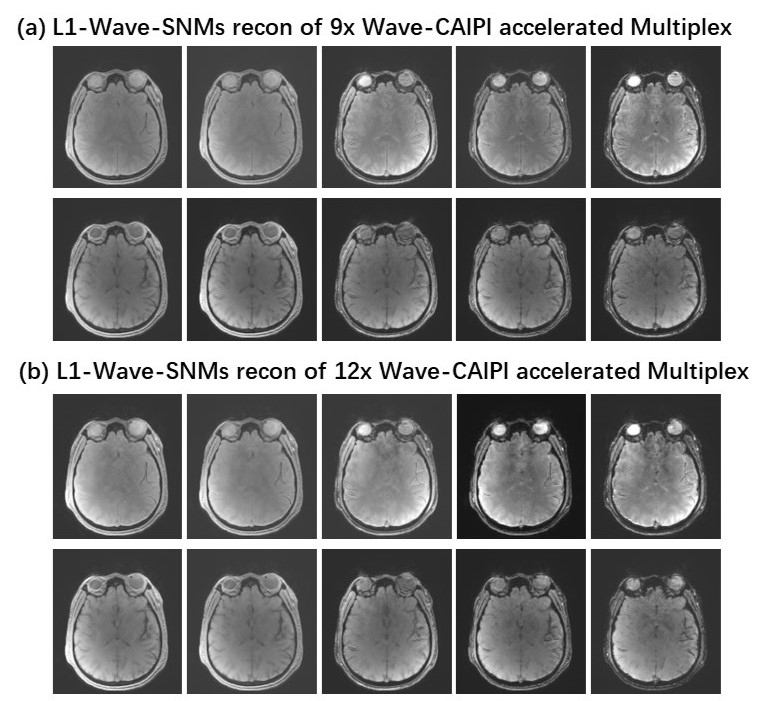
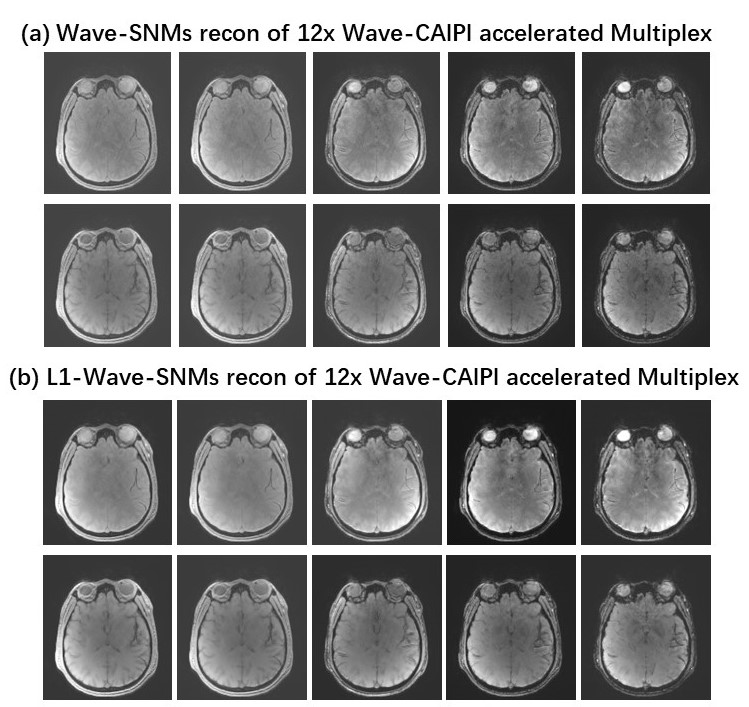
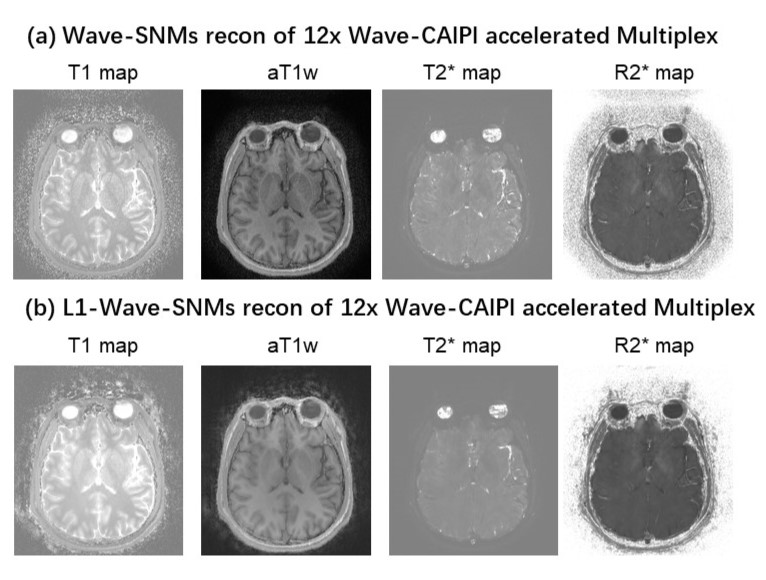
Figure 1 shows that the Wave-CAIPI reconstruction with SNMs can effectively reduce the artifacts amplification in multi-echo images of the 12-fold accelerated MULTIPLEX data compared to CAIPI accelerated reconstruction. Figure 2 demonstrates that the proposed L1-Wave-SNMs reconstruction with MDI quantification for the 9-fold accelerated MULTIPLEX data could achieve comparable quantification accuracy and qualitative SNR as the reference scan, reducing the scan time by 70%. Figure 3 illustrates that L1-Wave-SNMs reconstruction could reduce the noise amplification effectively in the multi-echo images of the 12-fold accelerated MULTIPLEX data. Figure 4 highlights the improvement by L1 regularization on the quantification accuracy of T1/T2*/R2*/Susceptibility maps and the visual signal-to-noise-ratio (SNR) of qualitative aT1w images.Discussion
This work proposes an L1 regularized Wave SNMs reconstruction model for Wave-CAIPI sampling, which achieves a remarkable 12-fold acceleration of the MULTIPLEX scan while significantly reducing reconstruction noise. The coil-by-coil image reconstruction with reduced noise further benefits the subsequent multi-dimensional integration based multi-parametric quantification by fully utilizing the dimensional orthogonality. The proposed L1-Wave-SNMs acceleration could achieve comparable quantification accuracy and qualitative signal-to-noise ratio as the reference MULTIPLEX scan with a 70% reduction of scan time.Acknowledgements
This work is supported by the National Natural Science Foundation of China 62125111, the National Natural Science Foundation of China (Grants Nos. 12061052), Young Talents of Science and Technology in Universities of Inner Mongolia Autonomous Region (No. NJYT22090).References
1. Ye Y, Lyu J, Hu Y, Zhang Z, Xu J, Zhang W. MULTI-parametric MR imaging with fLEXible design (MULTIPLEX). Magn Reson Med. 2021;87:658–673.
2. Bilgic B, Gagoski BA, Cauley SF, et al. Wave-CAIPI for highly accelerated 3D imaging. Magn Reson Med. 2015,73:2152-2162.
3. Polak D, Cauley S, Huang SY, et al. Highly-accelerated volumetric brain examination using optimized wave-CAIPI encoding. J Magn Reson Imaging 2019,50: 961-974.
4. Qiu Z, Jia S, Su S, et al. Highly accelerated parallel MRI using wave encoding and virtual conjugate coils. Magn Reson Med. 2021; 86: 1345– 1359.
5. Jia S, Qiu Z, Zhang L, et al. Aliasing-free reduced field-of-view parallel imaging. Magn Reson Med. 2022;87:1574–1582.
6. Ye Y, Lyu J, Sun W, et al. A multi-dimensional integration (MDI) strategy for MR T2* mapping. NMR in Biomedicine 2021; 34:e4529.
7. Ye Y, Lyu J, Hu Y, et al. Augmented T1-weighted steady state magnetic resonance imaging. NMR in Biomedicine 2022;35:e4729.
8. Walsh DO, Gmitro AF, Marcellin MW. Adaptive reconstruction of phased array MR imagery. Magn Reson Med. 2000,43:682-690.
9. Zhang J, Liu C, Moseley ME, Parallel Reconstruction Using Null Operations. Magn Reson Med. 2011;66:1241-1253
10. Hu J, Yi Z, Zhao Y, et al. Parallel imaging reconstruction using spatial nulling maps. Magn Reson Med. 2023;90:502–519.
Figures