4970
Hierarchical auditory processing integrating macroscopic and mesoscopic neural networks1Institute of Science and Technology for Brain-Inspired Intelligence, Fudan University, Shanghai, China
Synopsis
Keywords: Task/Intervention Based fMRI, fMRI (task based), layer-fMRI, neuroscience
Motivation: The invasive microscopic research on the brain can only be widely conducted in animal models. Detecting signals in laminar level using noninvasive MRI helps us bridge knowledge between macro- and micro-research.
Goal(s): To understand the neural mechanism of hierarchical auditory processing in both macroscopic and mesoscopic brain cortex in-vivo.
Approach: We used the 7T MRI to perform the whole-brain-fMRI and layer-fMRI with ultra-high-resolution when human was listening to a hierarchical auditory sequence paradigm.
Results: The responses to the hierarchical auditory processing are not only along a pathway from auditory to frontal cortices, but also various across laminar cortex.
Impact: We used the layer-fMRI to find that the auditory processing is distributed across cortical layers in a hierarchical manner. The detection of auditory processing in both macroscopic and mesoscopic levels allows us to build predictive coding model in multiple dimensions.
Introduction
The predictive coding hypothesis is acknowledged to be a strong candidate to be a unifying model for human cognition. Hierarchical processing was believed to be a key characteristic to this theory1. Understanding the predictive processing of hierarchical auditory sequences is not only the key to explain language acquisition in brain, but also an effective way to detect brain disorders. However, limited by the recording technology of brain activity, it is in lack of research simultaneously considering spatial, temporal, and probabilistic characteristics of human auditory sequence processing in-vivo. In this project, we aimed to investigate the transmission mechanism of hierarchical auditory information in different brain regions and in different depths of auditory cortical layers.Method
We designed an auditory sequence paradigm with hierarchies in both temporal and probability directions, including 20% and 33% violation of tones in the millisecond time scale, and 20% and 32% violation of auditory sequences in the second time scale. Brain activities were collected from 24 subjects under the high-resolution 7T magnetic resonance imaging (MRI) scanner of human brain. To detect the hierarchical auditory processing in the whole brain, we conducted the functional MRI (fMRI) covering the whole brain with a multi-band GRE-EPI sequence with a multi-band factor = 5, repetition time (TR)/echo time (TE) = 1000/22.2 ms, voxel size = 1.6×1.6×1.6 mm3. To explore the processing of hierarchical auditory sequences in different depths of auditory cortical layers, we performed the layer-fMRI on the auditory cortex using the VASO sequence2,3 with TR1/TR2/TE1/TI1/TI2 = 76.5/2759/34.4/622/1846 ms, voxel size = 0.7×0.7×2 mm3, slice number = 20. The whole-brain fMRI data was analyzed using Statistical Parametric Mapping with the standard preprocessing pipeline. After the first-level analysis on individuals, we then used within-subject one-way ANOVA test for group comparison across conditions. The layer-fMRI data were analyzed with LayNii4 and FSLeyes.Results
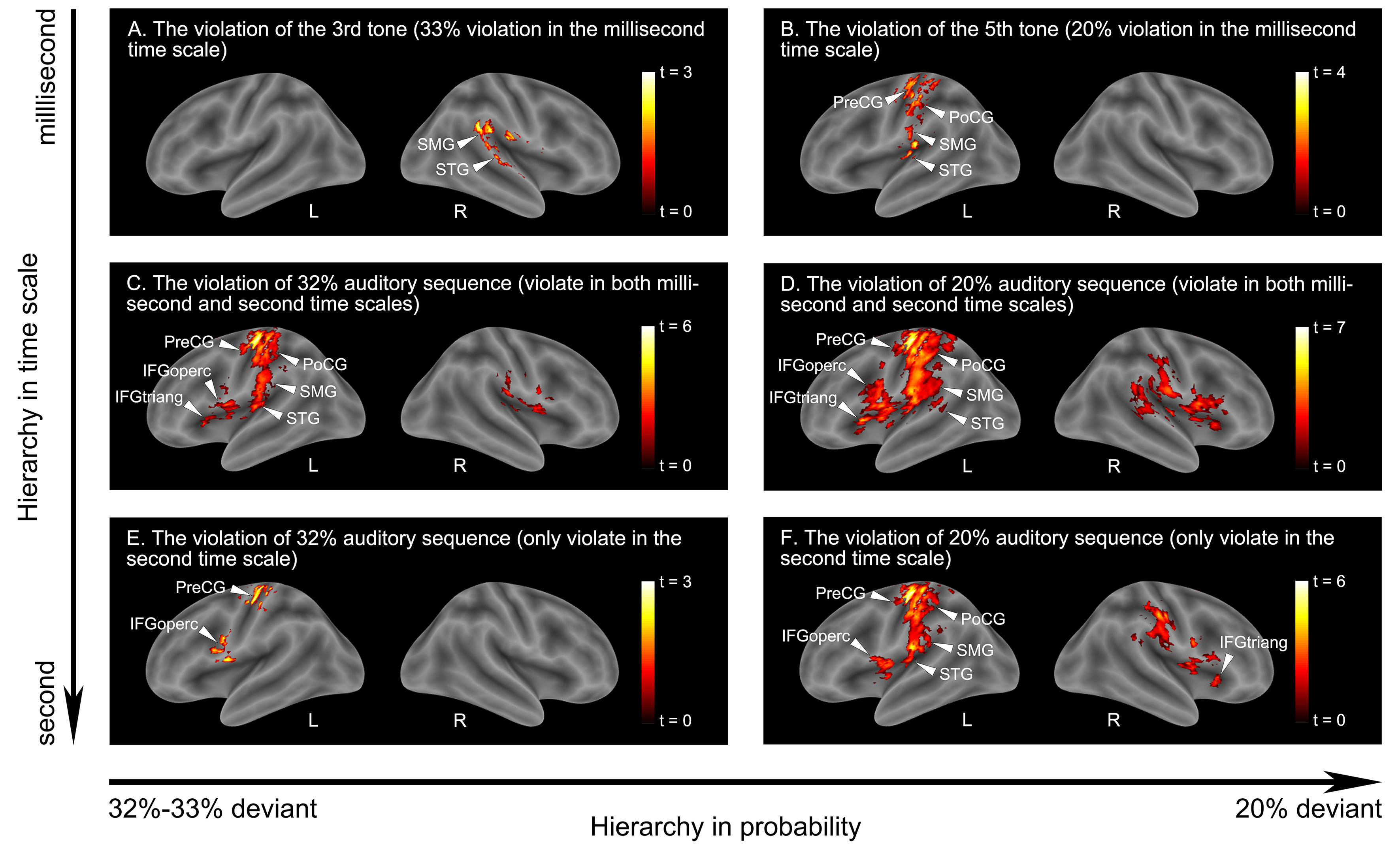
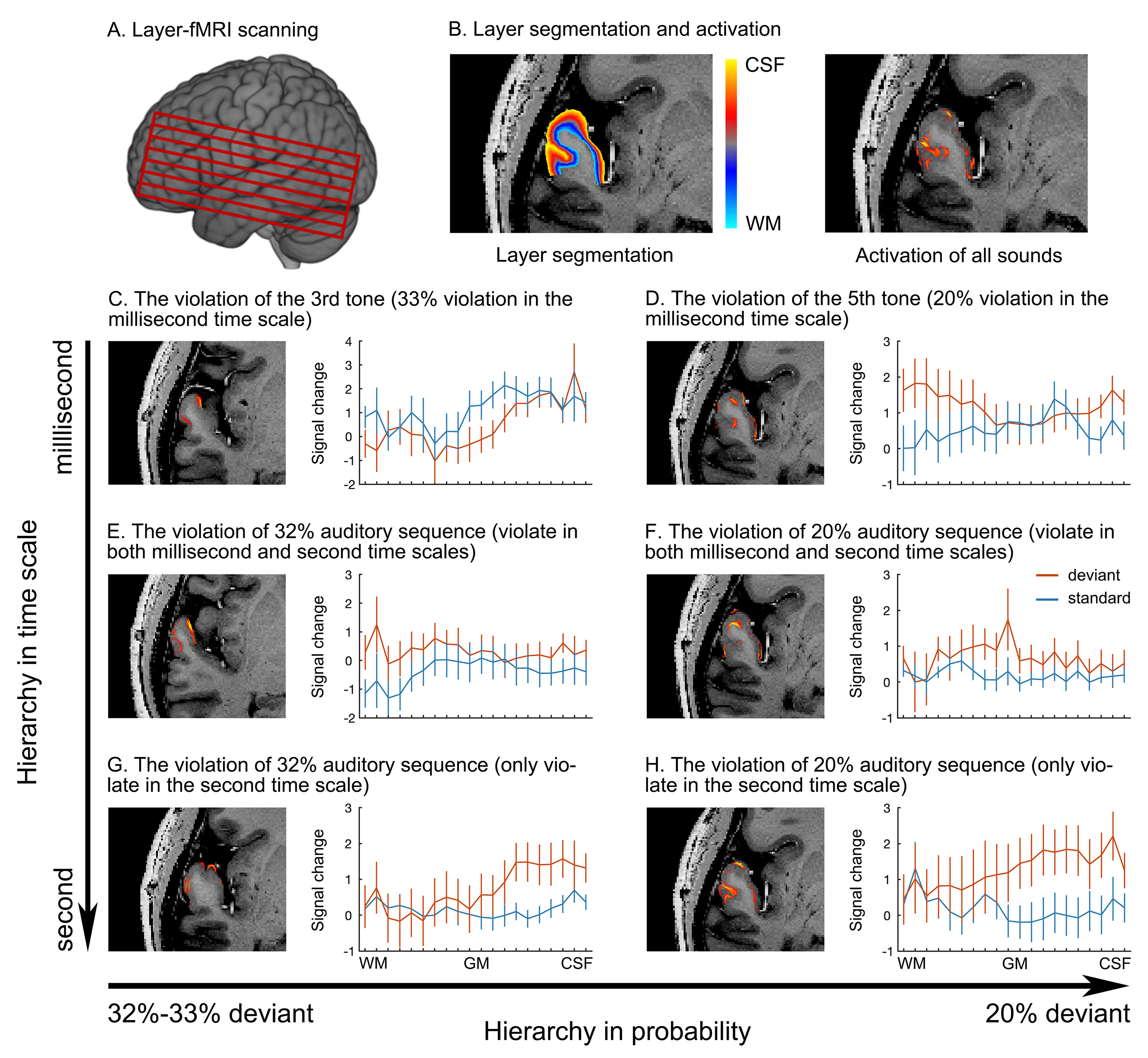
Using whole-brain-fMRI, we identified the hierarchical gradient along auditory pathway both in temporal and probability variation (Fig.1). The auditory processing based on millisecond time scale was focused on the superior temporal gyrus (STG) and supramarginal gyrus (SMG) (Fig.1A,B), whereas the opercular (IFGoperc) and triangular (IFGtriang) parts of inferior frontal gyrus contributed more to the longer, second-level scale (Fig.1C-F). Furthermore, with decreasing probability of deviants, the violation elicited greater activation in more areas of STG, SMG, IFGoperc and IFGtriang. In addition to our discovery that the auditory cortex was engaged both in millisecond and second scale processing, we also identified the hierarchical activations in different depths of auditory cortical layers (Fig. 2). The shorter-time-scale auditory information propagated mainly in superficial and deep layers, which is more significant when the deviant probability decreased; while the longer-time-scale auditory information activated more areas in superficial layers, which was almost uninfluenced regarding to two deviant probabilities.Discussion
By integrating macro- and meso-scale analysis of the neural networks, we estimated the functional hierarchies in both cerebrum and cortical layers during the cooperative processing of auditory information. Our results of temporal hierarchy of auditory processing are consistent with previous work5, while the results of probability hierarchy further confirm that the nature of auditory processing is in a hierarchical way. The findings of auditory cortical layers may indicate that the auditory sensory information may convey between superficial and deep layers, and the representation of higher-level auditory information may depend on the superficial layers.Conclusion
Our results from whole-brain-fMRI and layer-fMRI in human reveal an exquisite explanation of hierarchical auditory processing, which may contribute to the predictive processing framwork in multiple dimensions.Acknowledgements
The authors thank the Zhangjiang Brain Imaging Center from Institute of Science and Technology for Brain-Inspired Intelligence, Fudan University for data acquisition.References
1. Heilbron, M. & Chait, M. Great Expectations: Is there Evidence for Predictive Coding in Auditory Cortex? Neuroscience 389, 54-73, doi:10.1016/j.neuroscience.2017.07.061 (2018).
2. Huber, L. et al. High-Resolution CBV-fMRI Allows Mapping of Laminar Activity and Connectivity of Cortical Input and Output in Human M1. Neuron 96, 1253-1263.e1257, doi:10.1016/j.neuron.2017.11.005 (2017).
3. Huber, L. et al. Sub-millimeter fMRI reveals multiple topographical digit representations that form action maps in human motor cortex. Neuroimage 208, 116463, doi:10.1016/j.neuroimage.2019.116463 (2020).
4. Huber, L. R. et al. LayNii: A software suite for layer-fMRI. Neuroimage 237, 118091, doi:10.1016/j.neuroimage.2021.118091 (2021).
5. Schmitt, L. M. et al. Predicting speech from a cortical hierarchy of event-based time scales. Sci Adv 7, eabi6070, doi:10.1126/sciadv.abi6070 (2021).
Figures