4968
Functional brain network reconfiguration from rest to movie changes across repeated movie-viewing and associates with free recall performance1Centre for Sleep and Cognition, Yong Loo Lin School of Medicine, National University of Singapore, Singapore, Singapore, 2Centre for Translational MR Research, Yong Loo Lin School of Medicine, National University of Singapore, Singapore, Singapore, 3Integrative Sciences and Engineering Programme, NUS Graduate School, National University of Singapore, Singapore, Singapore, 4Department of Electrical and Computer Engineering, National University of Singapore, Singapore, Singapore
Synopsis
Keywords: Functional Connectivity, fMRI, functional reconfiguration, movie paradigm
Motivation: It remains unclear if brain functional reconfiguration from resting state is cognitively relevant for naturalistic conditions.
Goal(s): To establish changes in brain functional connectivity (FC) similarity between rest and repeated movie watching and their relation with memory in young adults.
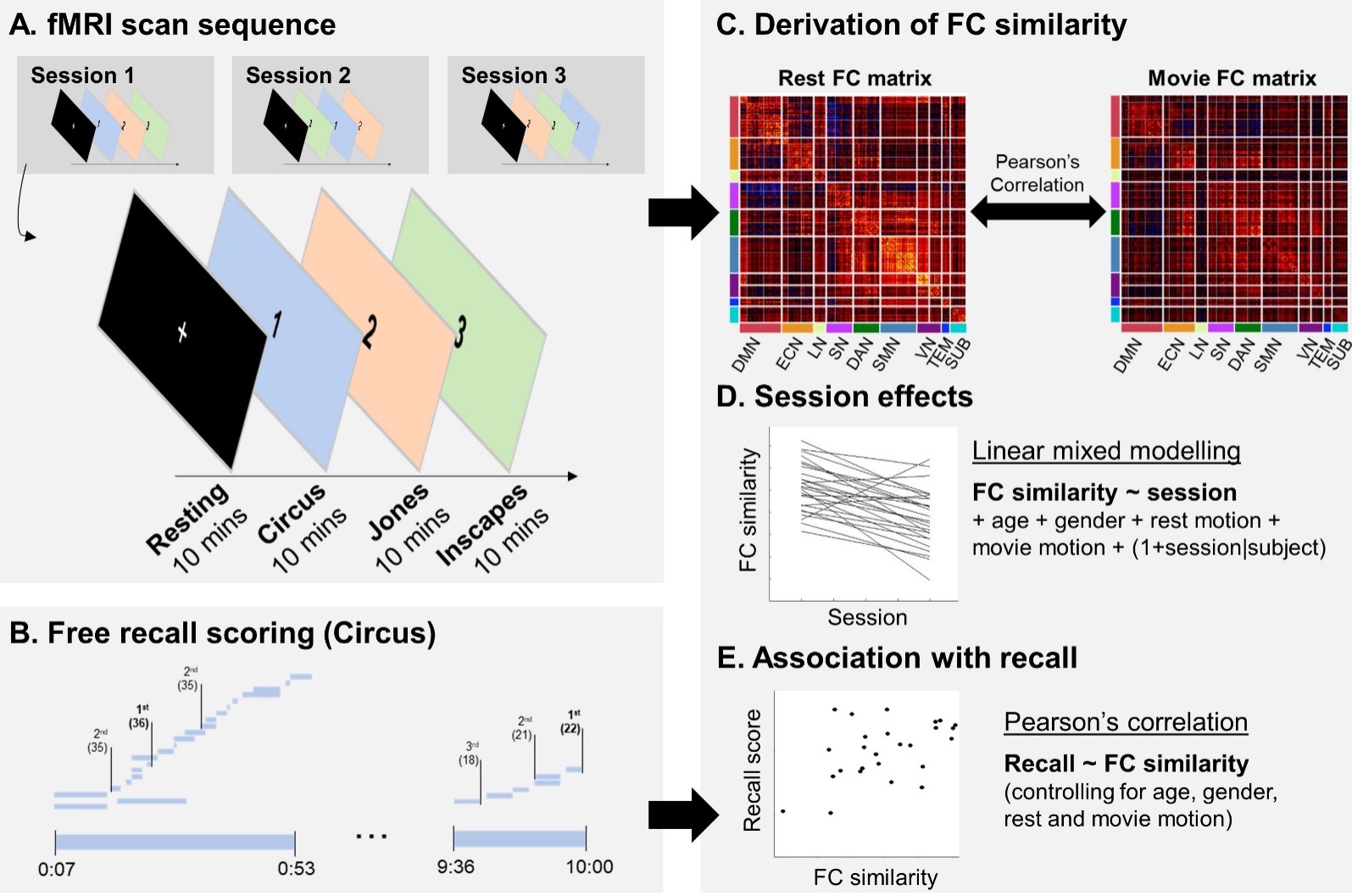
Approach: We studied intra- and inter network FC similarity changes across 3 movie-viewing BOLD fMRI sessions, and correlated similarity measures with memory recall scores of one movie.
Results: Movies with higher cognitive load and narrative structure evidenced stronger changes in rest-movie functional reconfiguration across sessions; association with recall scores shifted from sensory networks to associative networks over sessions. Higher similarity was more advantageous.
Impact: Rest-movie functional reconfiguration lent support to the hypothesis that less reconfiguration may reflect higher information processing efficiency by brain functional networks. It further informs memory encoding and retrieval in naturalistic contexts.
Background
Studies of functional connectivity (FC; temporal synchrony of brain activity from different regions with BOLD fMRI) revealed that intrinsic functional networks architecture are preserved between rest and task [1]. Among young adults, more efficient functional brain reconfiguration from low to high cognitive demand, defined as higher rest-task FC topological similarity, was shown to be associated with better cognition [2]. Similar to task, naturalistic fMRI such as movie watching induces dynamic multimodal processing and functional reorganization [3], but it remains unclear how functional reconfiguration from rest is relevant for naturalistic conditions. Furthermore, how functional reconfiguration and its association with behaviour may change across sessions has yet to be investigated [4]. To this end, we studied rest-movie functional reconfiguration across repeated viewing sessions and how this related to free recall of the movie.Methods
Healthy young adults (N = 28, 12 males, 26.5 ± 2.9 years) attended 3 sessions of 3T fMRI scans over 3 days. In each session, a resting state scan were followed by 3 movie clips viewing (Chaplin's The Circus, Indiana Jones, Inscapes; 10 minutes each, TR 720ms) in a randomised order. The same clips were used in each session. On Day 3, free recall was collected for Circus and manually scored by 3 independent raters through a consensus approach.FMRI data were preprocessed using a standard in-house pipeline [5]. Global signal regression was included to enhance sensitivity to brain-behaviour associations [6]. Voxel time series were averaged into 430 cortical and subcortical parcels [7]. For each rest or movie run, whole-brain FC matrix was constructed by computing Fisher's Z transformed Pearson correlation between all pairs of parcels. To compute intra- and inter-network FC similarity, sub-matrices were first extracted from rest and movie whole-brain matrices according to the network assignments of the parcels in each parcel pairs and then correlated. This resulted in 9 networks x 2 measures x 3 sessions reconfiguration measures per participant per movie.
Intra-/inter-network reconfiguration values were subject to separate linear mixed models to identify Session effects. For Circus, we further correlated reconfiguration measures showing trends of Session effects with recall scores. Analyses were controlled for gender, age, and motion.
Finally, to better understand the direction of the reconfiguration changes, the rest FC matrix on Day 1 (prior to any movie viewing) was treated as a 'naive' configuration state; rest-Circus intra- and inter-network similarities were recalculated with respect to this reference state and subject to a partial least square [8] (1000 permutation for statistical significance, 1000 bootstrapping to identify key reconfiguration measures).
Results
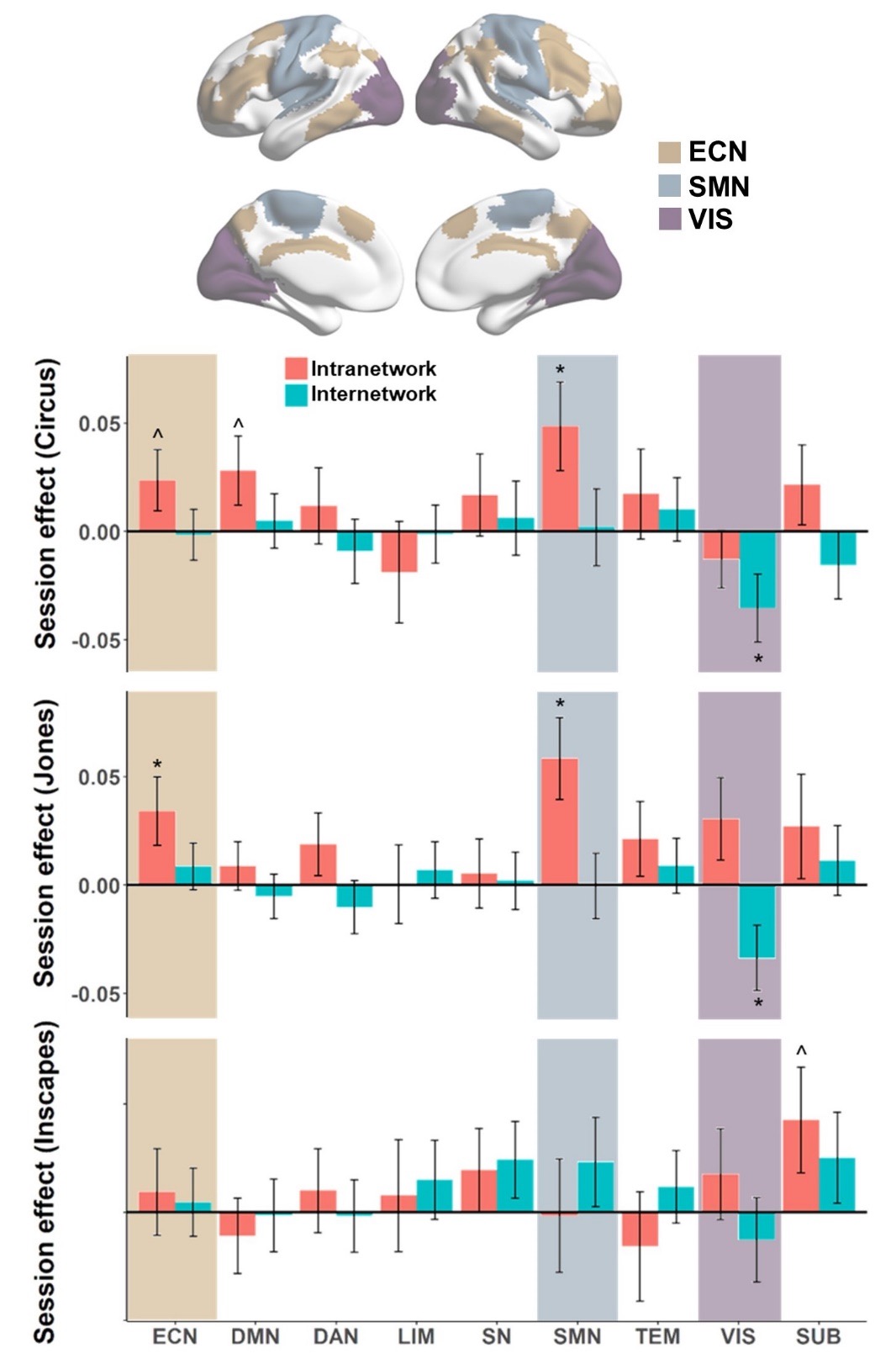
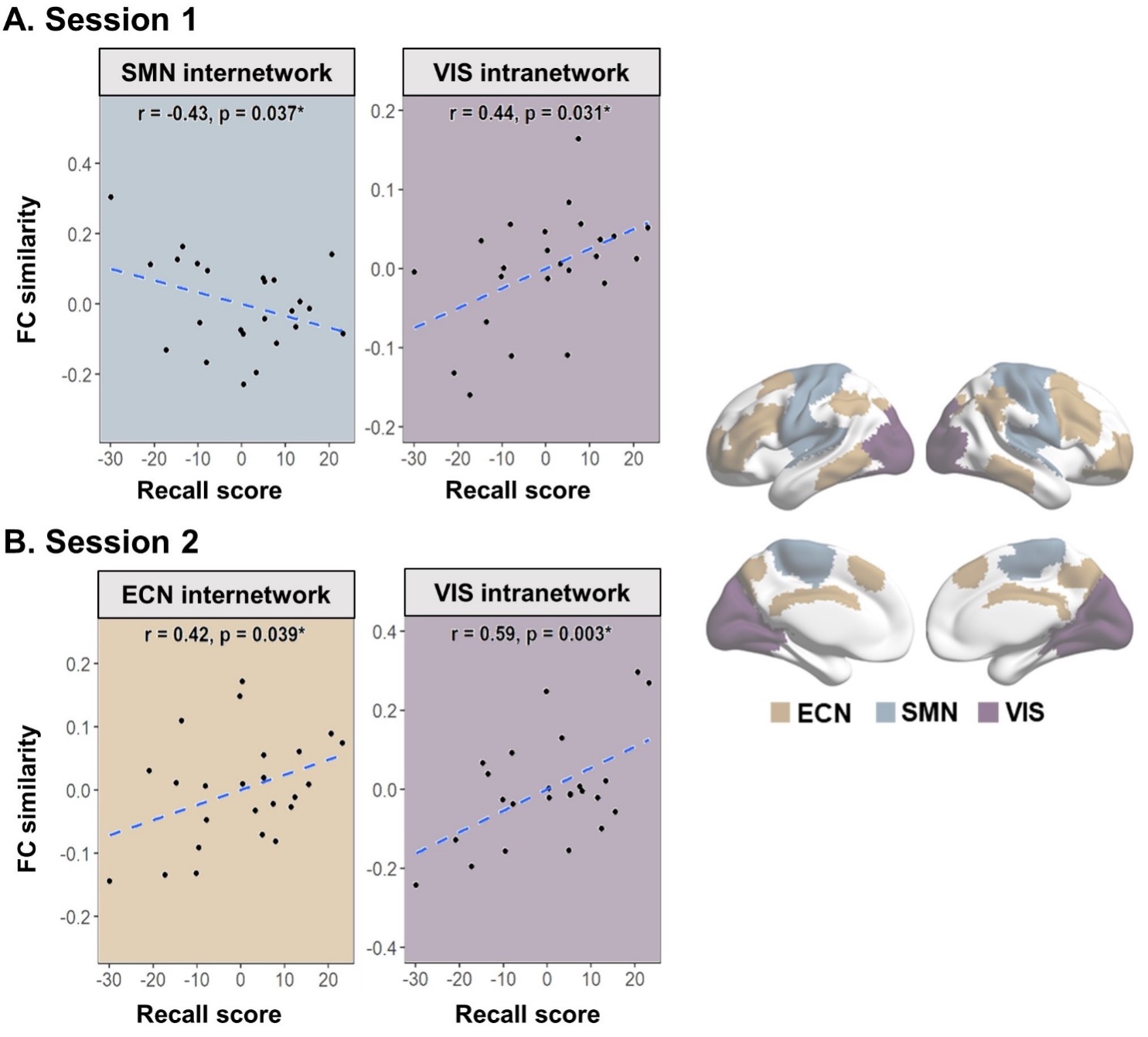
Linear mixed models identified session effects on rest-movie functional reconfiguration efficiency in both higher order cognitive networks (executive control and default mode networks, ps < .05 uncorrected) and lower order sensory networks (visual and somatomotor networks) for Circus and Jones but not Inscapes, a movie with low cognitive load developed as an alternative to resting state [9]. Reconfiguration-recall analysis with The Circus identified session-dependent relevance of network reconfiguration efficiency for recall, such that recall was related to visual and somatomotor networks on Day1 (ps = .03), to both visual and executive control networks on Day2 (ps < .05), and only marginally to executive control network on Day3 (p = .08 uncorrected). Interestingly, partial least square analysis showed that intra-executive control network configuration regained considerable similarity with its naive resting state after intensive movie re-watching (permuted p = .001, boot-strapped ratio z-score > 2.5).Conclusion
Session-dependent relationships with recall suggested that initially, sensory perceptions of the movie are important for subsequent recall, but this becomes less important with repeated viewings. Executive control network show the opposite pattern, suggesting that subsequent information processing of the movie, with its internal representation now purportedly established, became more behaviourally relevant with repeated viewings. These associations were mostly positive, indicating that participants who required less reconfiguration from rest to movie had better recall. Consistent with such positive associations, the final network configuration within the executive control networks 'regained' resemblance to its movie-naive resting configuration, hinting at a system that efficiently addresses extra short-term cognitive demand to process the movie inputs and rapidly 'normalizes' back to its intrinsic state. Overall, our findings highlight the relevance of functional network reconfiguration in naturalistic contexts.Acknowledgements
We would like to thank all subjects for their participation in this study. This work was supported by the National Medical Research Council, Singapore (NMRC/CBRG/0088/2015), Duke-NUS Medical School Signature Research Program funded by Ministry of Health, Singapore, Biomedical Research Council, Singapore: Biomedical Research Council (13/1/96/19/687), and Agency for Science, Technology, and Research (A*STAR), Ministry of Health, Singapore (MOH-OFYIRG19may-0012).References
[1] Cole MW, Bassett DS, Power JD, Braver TS, Petersen SE (2014): Intrinsic and task-evoked network architectures of the human brain. Neuron 83:238–251.
[2] Schultz, D. H., & Cole, M. W. (2016). Higher Intelligence Is Associated with Less Task-Related Brain Network Reconfiguration. J Neurosci, 36(33), 8551-8561.
[3] Samara A, Eilbott J, Margulies DS, Xu T, Vanderwal T (2023): Cortical gradients during naturalistic processing are hierarchical and modality-specific. NeuroImage 271:120023.
[4] Andric, M., Goldin-Meadow, S., Small, S. L., & Hasson, U. (2016). Repeated movie viewings produce similar local activity patterns but different network configurations. Neuroimage, 142, 613-627.
[5] Ng, K. K., Lo, J. C., Lim, J. K. W., Chee, M. W. L., & Zhou, J. (2016). Reduced functional segregation between the default mode network and the executive control network in healthy older adults: A longitudinal study. Neuroimage, 133, 321-330.
[6] Li, J., Kong, R., Liegeois, R., Orban, C., Tan, Y., Sun, N., . . . Yeo, B. T. T. (2019). Global signal regression strengthens association between resting-state functional connectivity and behavior. Neuroimage, 196, 126-141.
[7] Schaefer, A., Kong, R., Gordon, E. M., Laumann, T. O., Zuo, X. N., Holmes, A. J., . . . Yeo, B. T. T. (2018). Local-Global Parcellation of the Human Cerebral Cortex from Intrinsic Functional Connectivity MRI. Cereb Cortex, 28(9), 3095-3114.
[8] Krishnan A, Williams LJ, McIntosh AR, Abdi H (2011): Partial Least Squares (PLS) methods for neuroimaging: A tutorial and review. NeuroImage, 56, 455–475.
[9] Vanderwal, T., Kelly, C., Eilbott, J., Mayes, L. C., & Castellanos, F. X. (2015). Inscapes: A movie paradigm to improve compliance in functional magnetic resonance imaging. Neuroimage, 122, 222-232.
Figures