4945
Improved multinuclear parallel transmit optimization using multinuclear virtual observation points1Center for Magnetic Resonance Research, University of Minnesota, Minneapolis, MN, United States
Synopsis
Keywords: High-Field MRI, High-Field MRI, X-nuclei, SAR, VOP
Motivation: Managing peak local SAR for pTx-enabled studies at UHF is challenging, especially for multinuclear acquisitions.
Goal(s): To evaluate the feasibility and potential advantages of multinuclear VOPs for pTx optimizations in multinuclear studies.
Approach: Simulation data was used to perform L-curve analyses to quantify the achievable minimal excitation errors at different peak 10g local SAR levels using both mononuclear and multinuclear VOPs.
Results: Multinuclear VOPs can substantially improve excitation performance at a set peak 10g local SAR level in multinuclear acquisitions by preserving the spatial correlation between the 10g local SAR resulting from each individual nucleus’s excitation.
Impact: The improved 1H excitation performance enabled through multinuclear VOPs can lead to improved image quality and reduced scan times for a variety of multinuclear imaging applications.
Introduction
X-nuclei imaging offers valuable metabolic insights beyond 1H MRI. However, its overall sensitivity is hindered by low natural abundances and gyromagnetic ratios. Ultra-high field (UHF) MRI has emerged as a crucial tool to address these limitations. However, UHF MRI introduces substantial B1+ inhomogeneities and increased RF-induced local energy deposition (SAR)1,2. Parallel transmission techniques (pTx) are highly desirable2-4 to address these challenges. Real-time SAR monitoring is enabled by compressing electromagnetic simulation-based E-field tissue interactions (105 to 106 voxels) into a small number of virtual observation points5 (VOPs). In multinuclear MRI, the total SAR resulting from different transmit frequencies must be managed. Magill et al. introduced the concept of multinuclear VOPs6 assuming non-interacting energy deposition at different frequencies. However, this concept has not been utilized for multinuclear pTx optimizations. Therefore, we investigate the use of multinuclear VOPs for 1H pTx optimizations using an 8-channel 10.5T sodium-proton body array.Methods
The transceiver array7,8 was simulated in Sim4Life (Zurich Medtech, Switzerland) using a realistic human body model (Duke) targeting the kidneys to generate channel-wise B1+ and E-field distributions of both the proton (8 dipoles) and sodium (8 loops) elements (Figure 1). The resulting E-fields were used to separately construct Q-matrices for each nuclei which were consecutively averaged over 10g local tissue mass and then compressed into VOPs using a 1% overestimation factor (VOP23Na and VOP1H). In addition, combined multinuclear VOPs were constructed by aligning the Q-matrices of the two nuclei in a block diagonal fashion prior to compression with 1% overestimation (VOPMN).To compare approaches, a reasonable 3D-radial interleaved 23Na-1H acquisition was chosen similar to Wilferth et al.9 as depicted in Figure 2. Each 23Na readout was interleaved by ten 1H readouts with the acquisition parameters detailed in Table 1. The 23Na array was operated in CP+ mode (45° phase increment) with power calibration based on the mean B1+ value within two ROIs covering both kidneys. The 1H excitations used time-interleaved acquisition of modes10,11 (TIAMO) by optimizing two static phase-only RF shims (MIP across modes) to target uniform B1+ in an ROI that contained the entire torso along the extent of the kidneys in the z-direction. An L-curve analysis was used to minimize excitation error (ΔB1+) and peak 10g local SAR (pSAR10g):
$$$ \min_{x_1,x_2}\left\{\left(1-\lambda\right)\cdot\Delta{B}_1^+\left(x_1,x_2\right)+\lambda\cdot{pSAR}_{10g}\left(x_1,x_2\right)\right\} ~~~~~~~~~~ $$$ [1]
Here, x1 and x2 are the complex shimming vectors of the two modes, and λ is a regularization parameter.
The excitation error was defined as:
$$$ \Delta{B}_1^+\left(x_1,x_2\right)=\left\Vert{max}\left(\mid{S}\cdot{x}_1\mid{,}\mid{S}\cdot{x}_2\mid\right)-\mid\tau\mid\right\Vert^2 ~~~~~~~~~~ $$$ [2]
where the matrix S contains the channel-wise transmit sensitivities within the ROI and τ the target B1+ distribution.
To quantify the difference between calculating the pSAR10g based on the individual VOPs (VOP23Na and VOP1H) and the multinuclear VOPMN, the L-curve analysis was performed twice: I) pSAR10g of the individual VOPs was summed up to yield the total pSAR10g (Figure 2B) and II) pSAR10g was directly calculated from VOPMN (Figure 2C).
Results
Figure 3 shows the resulting L-curves of the above-described optimizations. The use of VOPMN reduces the pSAR10g in this specific case by up to 12.6% with a mean reduction of 8.5% relative to the sum of the pSAR10g values derived from VOP23Na and VOP1H. The SAR distributions calculated from the uncompressed Q-matrices for the 23Na elements operating in CP+ mode and for an example RF shim applied to the 1H elements are shown in Figure 4 (MIP along z-axis). As depicted by the white arrows, the locations of the maxima do not coincide between 23Na and 1H. Summation of the pSAR10g values yields a total pSAR10g of 6.5 W/kg, compared to the pSAR10g of the combined Q-matrices of 5.3 W/kg.Discussion
The findings here align with expectations, considering the implications of separate VOP compressions versus the multinuclear approach. Compressing Q-matrices individually into VOP23Na and VOP1H eliminates their spatial correlation, resulting in a potentially overestimated total pSAR10g. Conversely, constructing multinuclear Q-matrices and compressing them into VOPMN preserves spatial information, leading to a pSAR10g that is always smaller or equal to the aforementioned scenario. While only the 1H excitation was optimized here, the method can be extended to simultaneous optimization of both nuclei and is equally relevant when considering sequential 23Na-1H rather than interleaved acquisitions.Conclusion
We have demonstrated that the use of multinuclear VOPs is a valuable tool to accurately estimate pSAR10g in multinuclear MRI. This technique can be used to enable higher RF power levels while adhering to safety limitations and thereby improving the image quality and scan efficiency.Acknowledgements
Funding was provided by NIH P41 EB027061 and NIH R01 EB029985.
References
1. Vaughan TT, Snyder CJ, DelaBarre LJ, et al. Whole-body imaging at 7T: preliminary results. Magn Reson Med. 2009; 61:244-248
2. Hoult DI. Sensitivity and power deposition in a high-field imaging experiment. J Magn Reson Imaging. 2000; 12:46-67
3. Ibrahim TS, Lee R, Baertlein BA, et al. Application of finite difference time domain method for the design of birdcage RF head coils using multi-port excitations. Magn Reson Imaging. 2000; 18:733-742
4. Adriany G, van de Moortele PF, Wiesinger F, et al. Transmit and receive transmission line arrays for 7 Tesla parallel imaging. Magn Reson Med. 2005; 53:434-445
5. Eichfelder G, Gebhardt M. Local specific absorption rate control for parallel transmission by virtual observation points. Magn Reson Med. 2011; 66:1468-1476
6. Magill AW, Ladd ME. Multinuclear virtual observation points. In Proceedings of the 28th Annual Meeting of the ISMRM; 2020
7. Erturk MA, Lagore RL, Auerbach EJ, et al. Design and implementation of a combined sodium-loop proton-dipole transceiver array for body imaging at 10.5 Tesla. In Proceedings of the 27th Annual Meeting of the ISMRM; 2019
8. Schmidt S, Erturk MA, Lagore RL, et al. First in-vivo 23Na human imaging at 10.5T using a combined 23Na-loop 1H-dipole transceiver array. In Proceedings of the 30th Annual Meeting of the ISMRM; 2022
9. Wilferth T, Mueller M, Gast LV, etl a. Motion-corrected 23Na MRI of the huma brain using interleaved 1H 3D navigator images. Magn Reson Med. 2022; 88:309-321
10. Orzada S, Maderwald S, Poser BA, et al. RF excitation using time interleaved acquisition of modes (TIAMO) to address B1 inhomogeneity in high-field MRI. Magn Reson Med. 2010; 64:327-333
11. He X, Schmidt S, Zbyn S, et al. Improved TSE imaging at ultrahigh field using nonlocalized efficiency RF shimming and acquisition modes optimized for refocused echoes (AMORE). Magn Reson Med. 2022; 88:1702-1719
Figures

Table 1:
Acquisition parameters of the 3D radial 23Na-1H interleaved sequence. Abbreviations: TR, repetition time; FA, flip angle; TP, pulse duration;
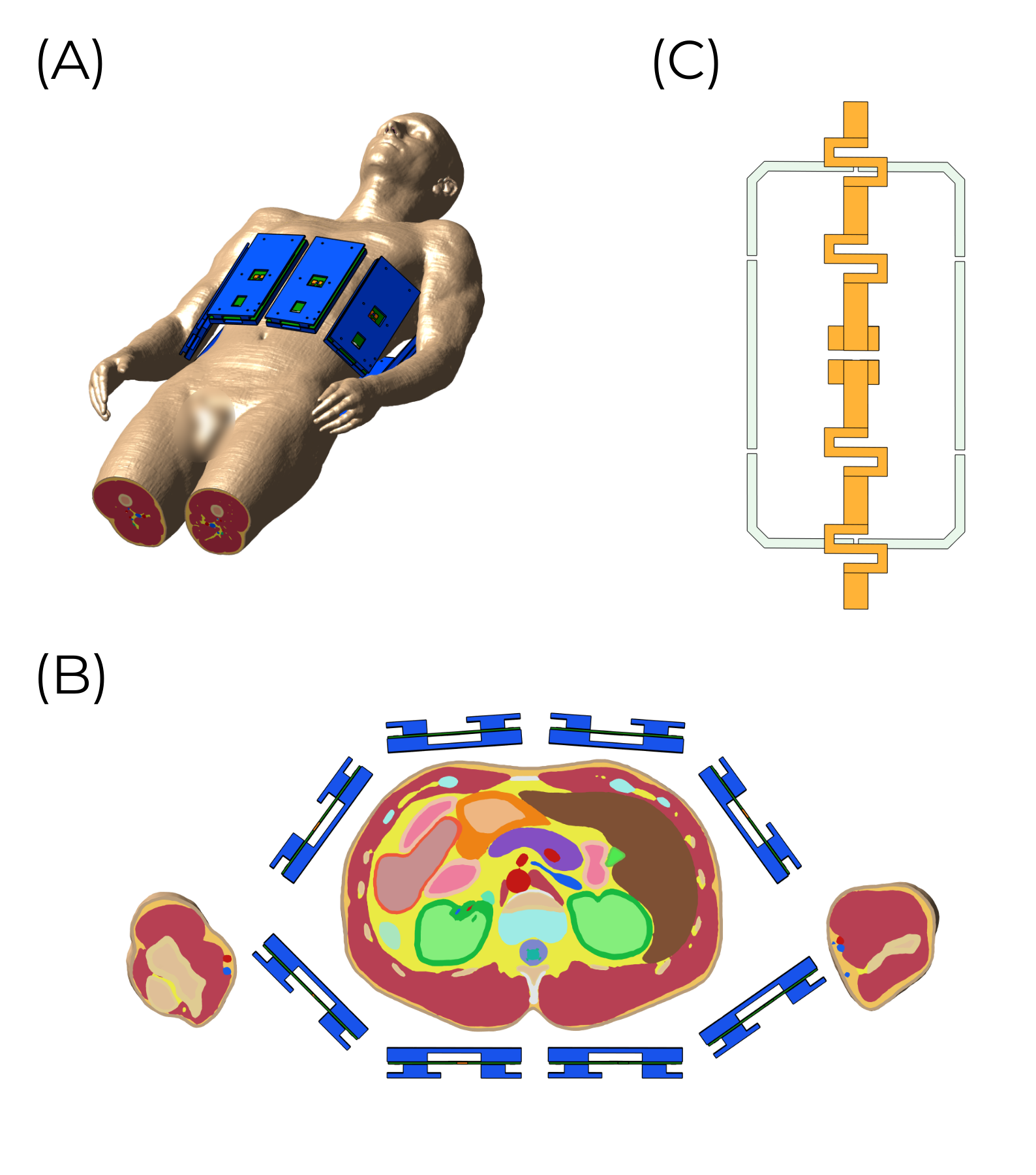
Figure 1:
(A) Overview of the EM simulation setup with the 23Na-1H transceiver array position on the male Duke model in Sim4Life. (B) Schematic of the conductor traces of a single transceiver block consisting of a loop tuned to 128 MHz and a fractionated dipole tuned to 450 MHz. (C) Cross-section of the simulation setup through the center of the coil array.
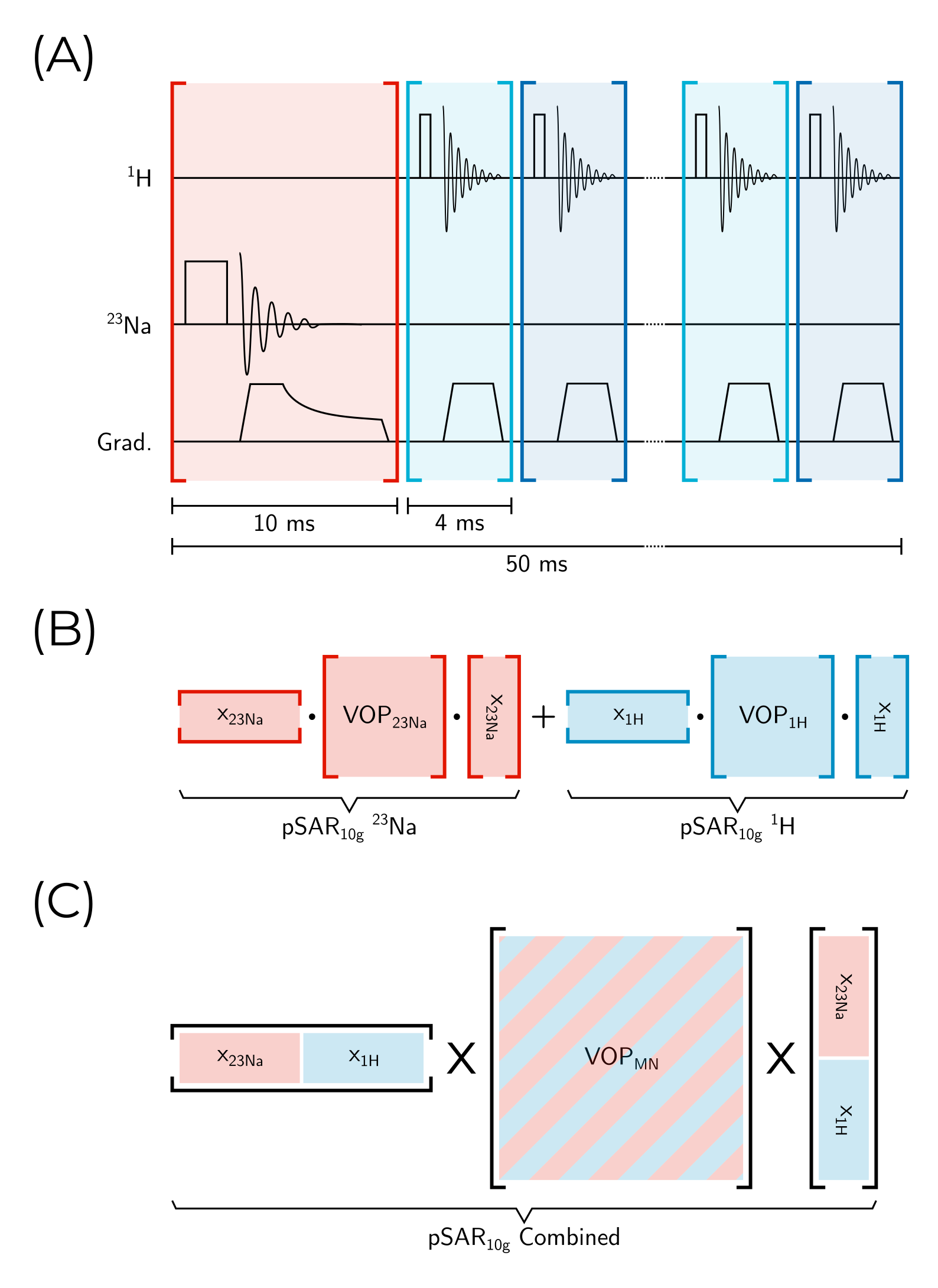
Figure 2:
3D-(A) Schematic of the 3D-radial 23Na-1H interleaved acquisition. The two different shades of blue represent the two different static RF shims used for the 1H excitation. (B) Illustration of the pSAR10g calculation using separate VOPs for the two nuclei and (C) using the multinuclear VOP.
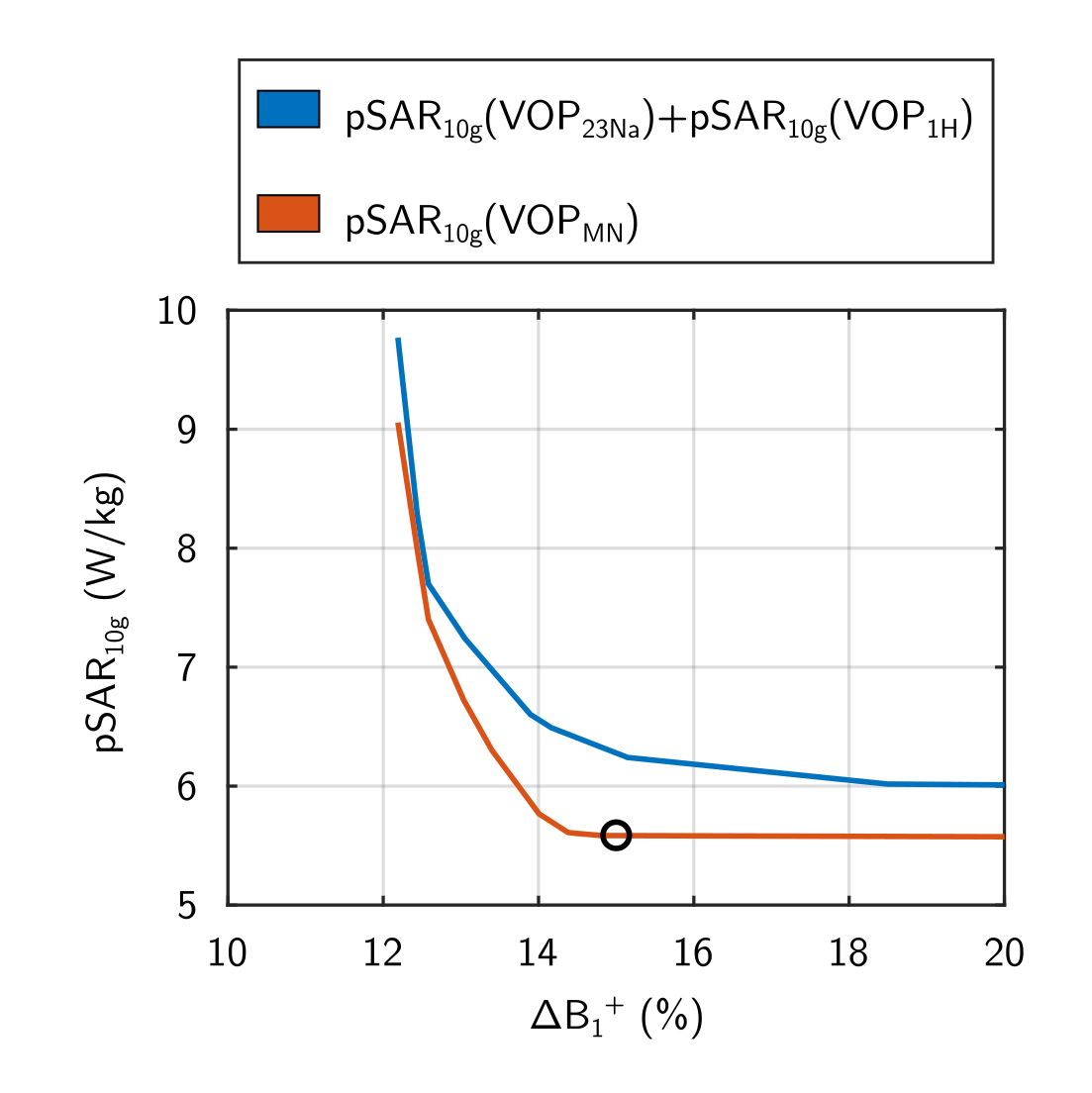
Figure 3:
L-curve analysis with the two different methods of calculating pSAR10g. The use of multinuclear VOPs yields a maximum reduction in pSAR10g of 12.6% with a mean reduction of 8.5%. The black circle marks the solution shown in Figure 4.
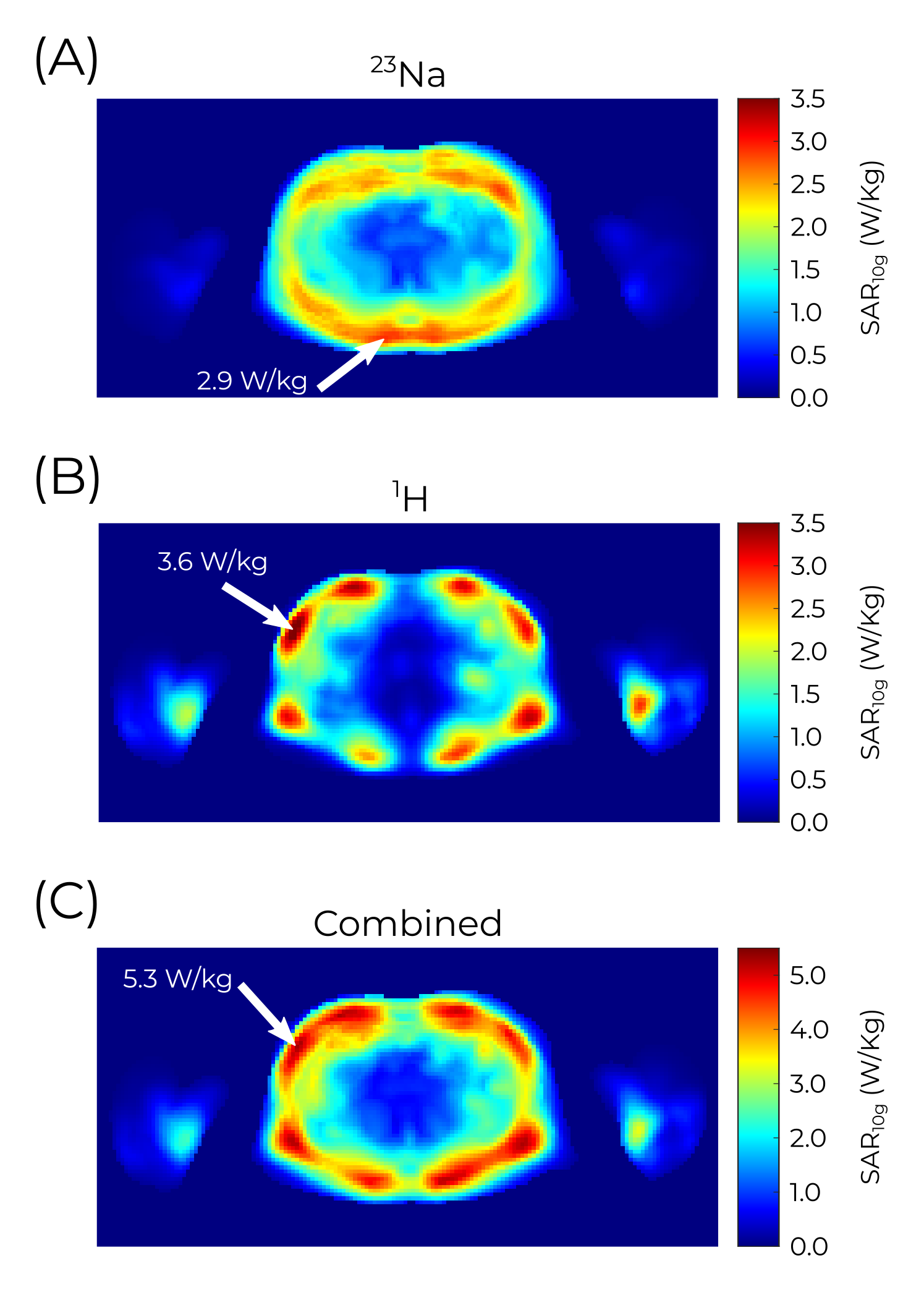
Figure 4:
10g local SAR distributions arising from (A) the 23Na element operating in CP+ mode and (B) the 1H elements driven by the optimized solution marked in Figure 3. Note that the spatial correlation between the two is lost after separate VOP compressions. Therefore, the two peak values (locations marked by white arrows) are summed up to yield the total pSAR10g of 6.5 W/kg. The construction of multinuclear Q-matrices yields the combined SAR distribution (C) with its respective pSAR10g value of 5.3 W/Kg.