4927
Diffusion tensor imaging analysis along the perivascular space in different burdens of cerebral small vessel disease1Key Laboratory of Endocrine Glucose & Lipids Metabolism and Brain Aging, Ministry of Education; Department of Radiology, Shandong Provincial Hospital Affiliated to Shandong First Medical University, Jinan, China, 2Department of Psychiatry and Psychotherapy, Jena University Hospital, Jena, Germany; Center for Intervention and Research on adaptive and maladaptive brain Circuits underlying mental health (C-I-R-C), Jena-Magdeburg-Halle, Germany, Jena, Germany, 3Department of Radiology, Beijing Tsinghua Changgung Hospital, Beijing, China
Synopsis
Keywords: DWI/DTI/DKI, Diffusion Tensor Imaging, Diffusion Tensor Imaging along the Perivascular Space
Motivation: Cognitive decline is associated with the impairment of glymphatic clearance, which can be investigated noninvasively using diffusion tensor imaging along the perivascular space (DTI-ALPS).
Goal(s): To investigate the linkage of cerebral small vessel disease (CSVD) burdens with left/right glymphatic function based on DTI-ALPS.
Approach: Glymphatic system function was assessed using diffusion tensor imaging along the perivascular space.
Results: The DTI-ALPS indexes in the CSVD groups were lower than the HC group. Hazard factors for right DTI-ALPS included CSVD severity and sex. Although the right DTI-ALPS index was associated with cognition in univariate analysis, it was not significant in regression analysis.
Impact: The DTI-ALPS technique provides a new opportunity for exploring the damage of CSVD burdens.
Introduction
Cerebral small vessel disease (CSVD) refers to a series of clinical, imaging, and pathological syndromes caused by various factors affecting cerebral small vessels and is the most common cause of vascular dementia and mixed dementia 1. The glymphatic system is a highly organized fluid transport system that facilitates brain metabolic waste clearance through the perivascular network of glia 2,3. Impairment of glymphatic clearance can lead to the accumulation of brain waste, leading to cognitive decline. Diffusion tensor imaging along the perivascular space (DTI-ALPS) 4 is a noninvasive imaging method to explore human glymphatic system function and can be quantified by the DTI-ALPS index 5. Currently, few studies have demonstrated the effect of CSVD on glymphatic function. The aim of this study was to investigate the effects of different burdens of CSVD on left/right glymphatic function based on DTI-ALPS.Methods
This cross-sectional study included 79 patients with severe CSVD (CSVD-S), 125 patients with mild CSVD (CSVD-M), and 100 healthy controls (HCs). Magnetic resonance imaging (MRI) data, including DTI, were acquired with a 3.0-T MR System (Siemens Healthcare, Erlangen, Germany) equipped with a 32-channel head coil for receiving signals. DTI-ALPS was used to measure water diffusivity in the perivenous space indirectly. The Stroop Color-Word Test was performed to assess the cognitive function of all participants. The Kruskal‒Wallis H test was used to evaluate the differences in the bilateral DTI-ALPS index among the three groups. Ordinal multinomial logistic regression was used to explore the hazard factors that affect the DTI-ALPS index. The association between cognitive function and the DTI-ALPS index was further investigated.Results
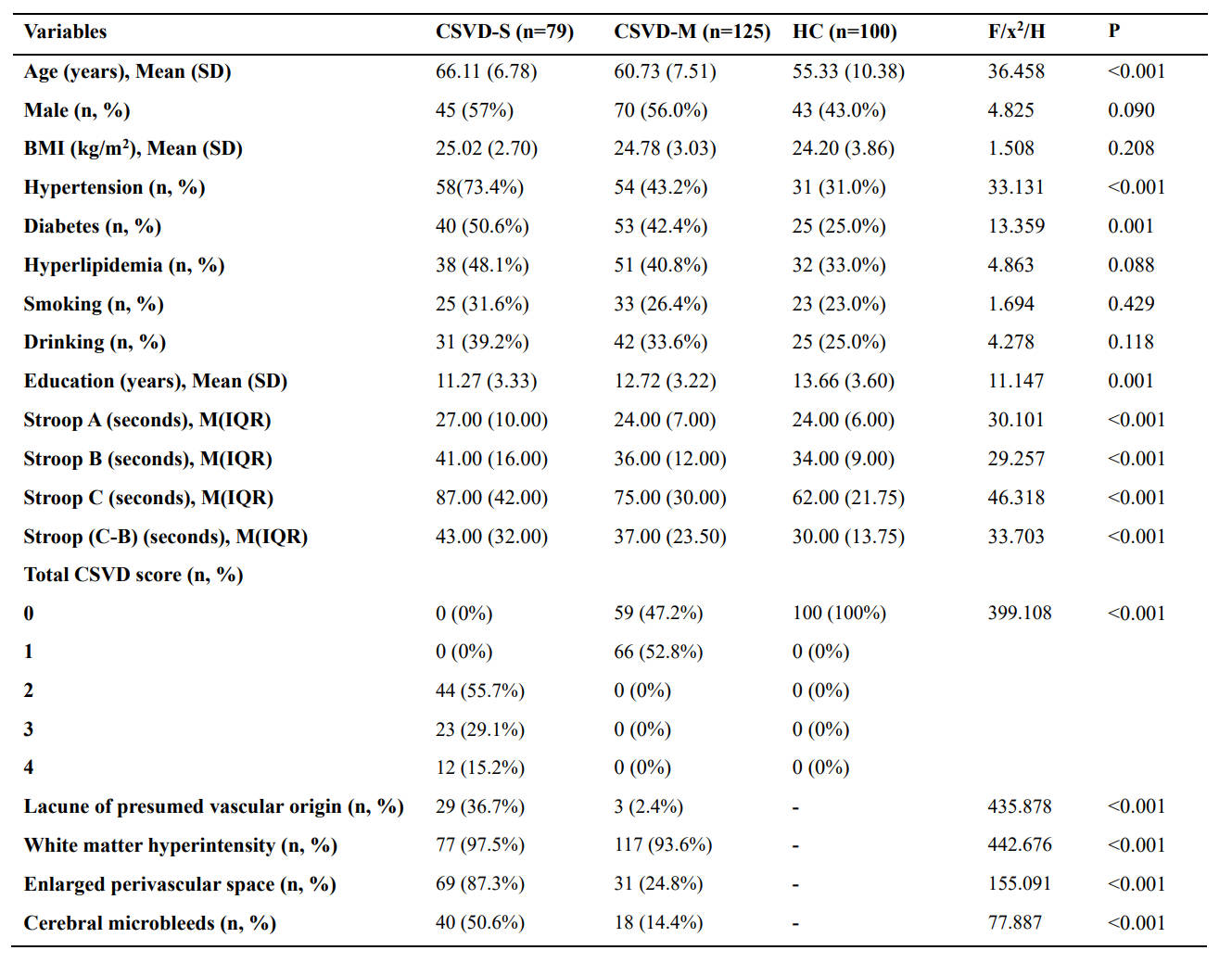
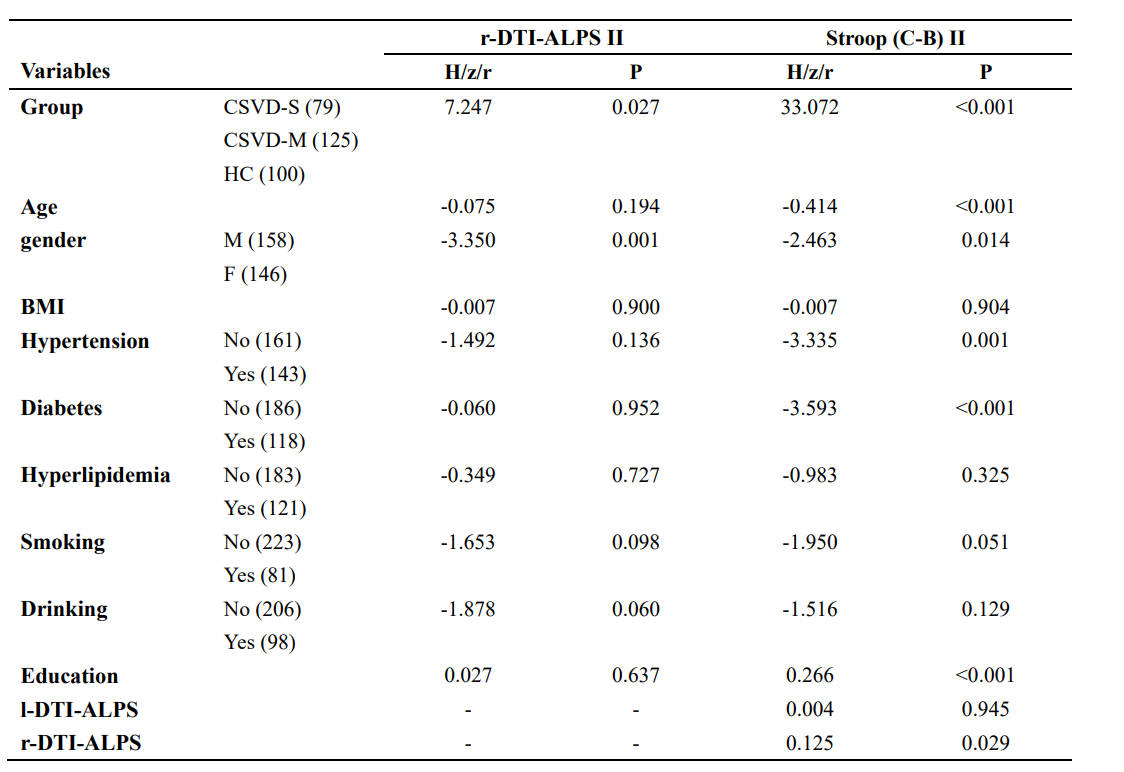
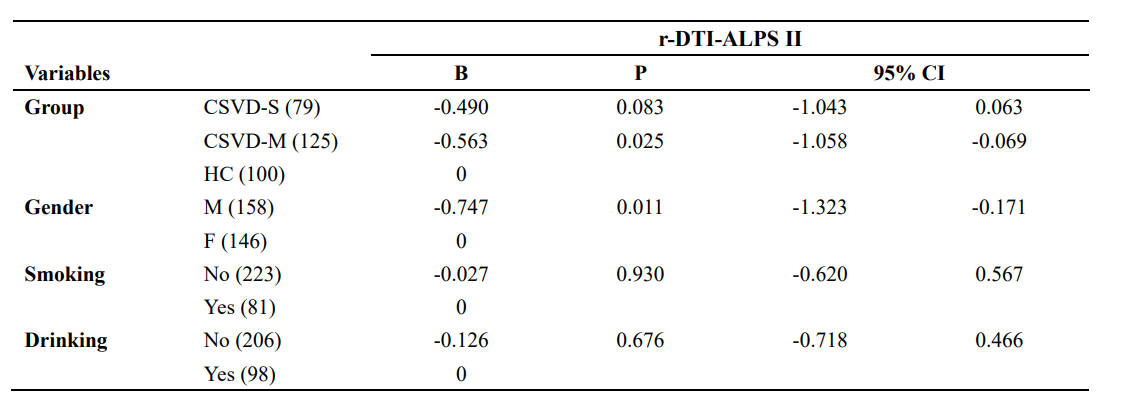
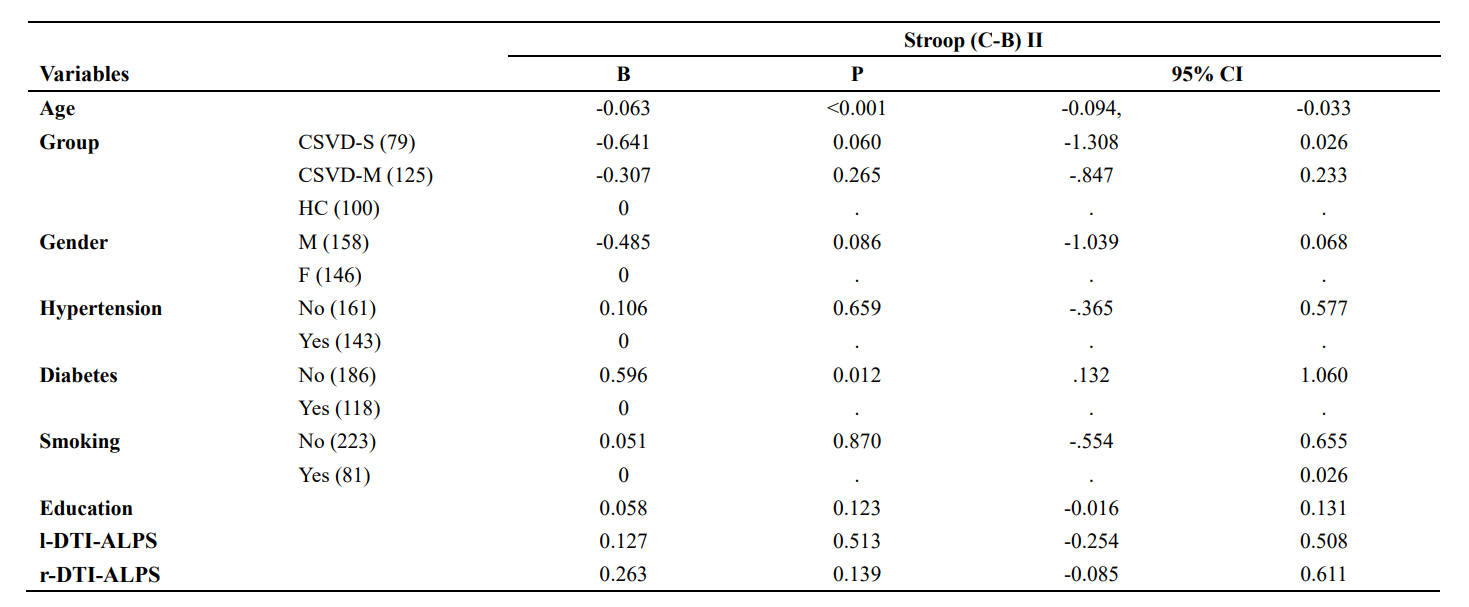
There were significant differences in cognitive test results among the three groups (P < 0.001), and the CSVD-S group took a longer time to complete the test than the CSVD-M and HC groups (Figure 1). There were significant differences among the three groups in the right DTI-ALPS index (P = 0.028, FDR correction), and the DTI-ALPS indexes in the CSVD groups were lower than those in the HC group. There was no significant difference in the left DTI-ALPS (P = 0.091, FDR correction) (Figure 2). The right DTI-ALPS was associated with Stroop test (C-B) (P = 0.029) (Figure 3). In addition, the right DTI-ALPS index was significantly correlated with CSVD-M (P = 0.025) and sex (P = 0.011) (Figure 4). However, the ordinal multinomial logistic regression (Figure 5) showed no significant correlation (P = 0.139) between Stroop test (C-B) and the DTI-ALPS index. The Stroop test (C-B) results were influenced by age (P < 0.001) and diabetes (P = 0.012).Discussion
In this study, we utilized DTI-ALPS to assess bilateral glymphatic function in different burdens of CSVD. Our findings included the following: (I) Cognitive performance decreased with the presence and severity of CSVD; (II) There were significant differences in the right DTI-ALPS index among the three groups, but there was no significant difference in the left DTI-ALPS index among the three groups; (III) Hazard factors for right DTI-ALPS included CSVD-M and sex; (IV) The results of Stroop test (C-B) were influenced by age and diabetes but had no correlation with the bilateral DTI-ALPS index.We found that the DTI-ALPS indexes of the CSVD groups were significantly lower than those of the HC group, indicating impaired glymphatic function in patients with CSVD, which is consistent with the result of a previous study 6. The right DTI-ALPS index was associated with mild CSVD but not with severe CSVD. We speculate that severe CSVD causes functional disruption of the glymphatic system through multiple mechanisms 7. Further studies are needed to explore its mechanism. Unexpectedly, there was no significant correlation between the bilateral DTI-ALPS index and cognitive decline in patients with CSVD. Although Spearman rank correlation analysis showed a significant correlation between the right DTI-ALPS index and Stroop test (C-B), the regression results were not significant when other factors, such as age, were included. Since the DTI-ALPS index was calculated from the diffusion images, age may affect white matter fiber status 5. In addition, CSVD is a highly age-related disease, and perhaps the effect of age is too large to mask the effect of the glymphatic system on cognition.
Conclusion
Cognitive decline and glymphatic dysfunction coexist in patients with CSVD, but there is no definite correlation between them. Cognitive decline in patients with CSVD is negatively correlated with age and diabetes. Therefore, aggressive glycemic control may reduce the risk of cognitive impairment in patients with CSVD. Further studies are needed to explore the pathophysiological mechanisms of glymphatic dysfunction in CSVD.Acknowledgements
We thank all of the volunteers for their participation in our study. This work was supported by grants from the National Natural Science Foundation of China (82272072), the National Natural Science Foundation of China (32100902), the Fundamental Research Funds for the Central Universities (SWU118065), the Natural Science Foundation of Shandong Province (ZR2020MH288), the Technology Development Plan of Jinan (201301049, 201602206, 201907052), Medical and Health Science and Technology Development Project of Shandong Province (2016WS0529) and Funding for Study Abroad Program by Shandong Province (201803059).
References
1. Duering, M., et al. Neuroimaging standards for research into small vessel disease-advances since 2013. Lancet Neurol (2023).2. Rasmussen, M.K., Mestre, H. & Nedergaard, M. The glymphatic pathway in neurological disorders. The Lancet Neurology 17, 1016-1024 (2018).
3. Andica, C., et al. Neuroimaging findings related to glymphatic system alterations in older adults with metabolic syndrome. Neurobiology of Disease 177(2023).
4. Taoka, T., et al. Evaluation of glymphatic system activity with the diffusion MR technique: diffusion tensor image analysis along the perivascular space (DTI-ALPS) in Alzheimer’s disease cases. Japanese Journal of Radiology 35, 172-178 (2017).
5. Taoka, T., et al. Diffusion-weighted image analysis along the perivascular space (DWI–ALPS) for evaluating interstitial fluid status: age dependence in normal subjects. Japanese Journal of Radiology 40, 894-902 (2022).
6. Tian, Y., et al. Impaired glymphatic system as evidenced by low diffusivity along perivascular spaces is associated with cerebral small vessel disease: a population-based study. Stroke and Vascular Neurology 8, 413-423 (2023).
7. Tian, Y., Zhao, M., Chen, Y., Yang, M. & Wang, Y. The Underlying Role of the Glymphatic System and Meningeal Lymphatic Vessels in Cerebral Small Vessel Disease. Biomolecules 12(2022).
Figures