4900
Design of a novel double-tuned RF coil system for 1H/13C MR imaging at 7T1Lauterbur Imaging Research Center, Shenzhen Institutes of Advanced Technology, Chinese Academy of Sciences, Shenzhen, China, 2Key Laboratory for Magnetic Resonance and Multimodality Imaging of Guangdong Province, Shenzhen, China, 3Tsinghua University, Beijing, China, 4State Key Laboratory of Brain and Cognitive Science, Beijing MRI Center for Brain Research, Institute of Biophysics, Chinese Academy of Sciences, Beijing, China, 5Department of Biomedical Engineering, State University of New York, Buffalo, NY, United States
Synopsis
Keywords: RF Arrays & Systems, RF Arrays & Systems
Motivation: Hyperpolarized 13C MR imaging is of particular interest in cancer applications such as tumor staging and monitoring treatment response as it provides unique real-time metabolic information.
Goal(s): This work is to develop a novel double-tuned RF coil that can achieve uniform excitation and highly sensitive acquisition for 1H/13C MR imaging at 7T.
Approach: The numerical electromagnetic simulation was utilized to evaluate the feasibility and performance in s-parameters and B1+ field distributions. The bench tests were conducted to further validate the performance.
Results: These simulated and measured results indicated that the development of an efficient 1H/13C RF coil for MR imaging at 7T.
Impact: A novel double-tuned RF coil system that can achieve uniform excitation and highly sensitive acquisition for 1H/13C MR imaging at 7T was developed. This coil system has the potential to be used for hyperpolarized 13C MRI at ultra-high field.
Introduction
Hyperpolarized 13C MR imaging is an emerging molecular imaging technology to study dynamic metabolic and physiological processes rapidly, non-invasively and specifically. The unique real-time in vivo metabolic information provided enables the study of a wide range of metabolism-related diseases, such as tumors, hepatic, and renal metabolic diseases (1-4). All heteronuclear molecular MRI studies require efficient heteronuclear RF coils to produce data with high sensitivity and 1H RF coils to acquire 1H anatomical images (5). The aim of this work is to design a double-tuned RF coil for 1H/13C MR imaging at 7T to meet the requirement of achieving uniform excitation and highly sensitive acquisition. The numerical electromagnetic simulation was utilized to evaluate the feasibility and performance of the developed RF coil in the s-parameters and B1+ field distributions. The bench tests were also performed by utilizing the constructed coil system to validate the performance and the feasibility for heteronuclear MRI.Method
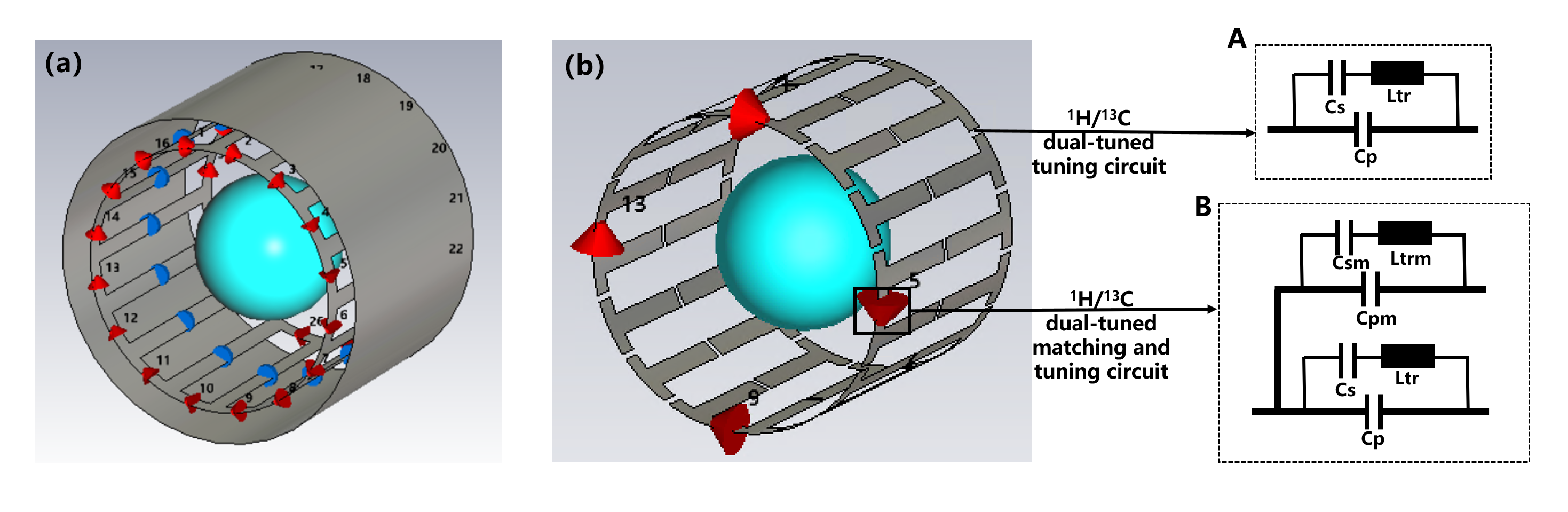
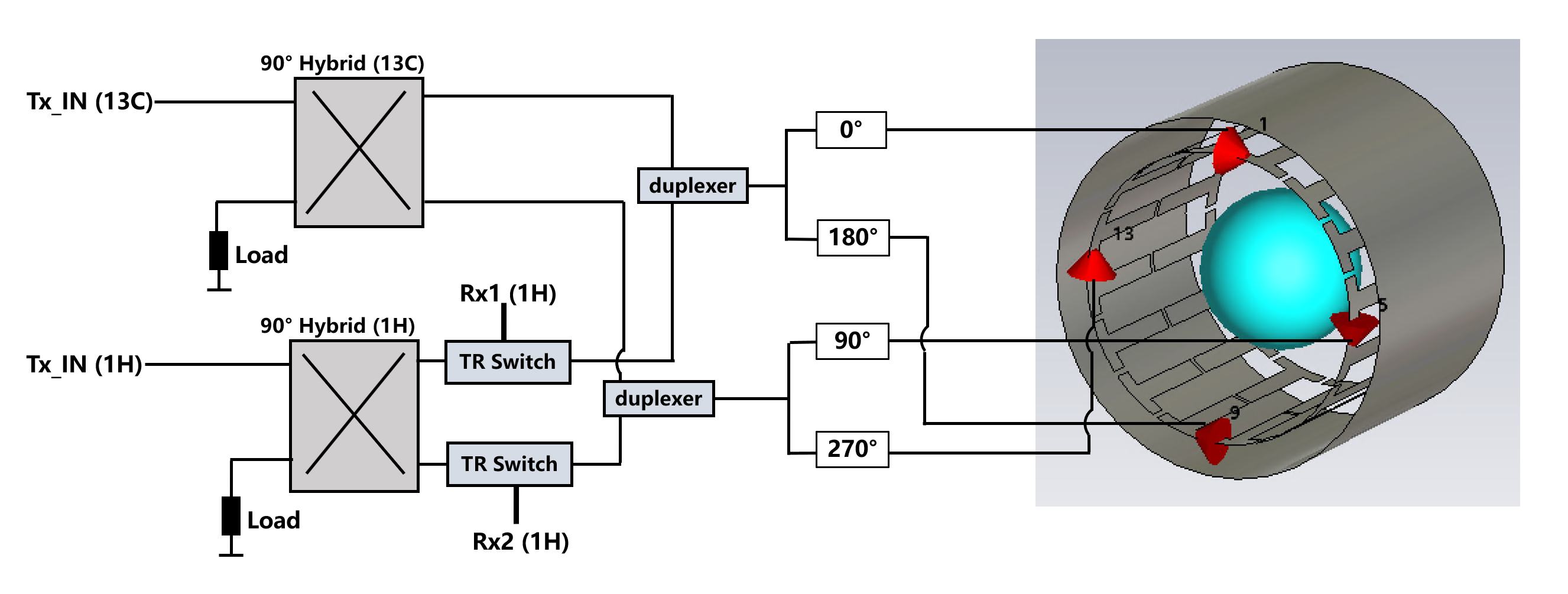
To achieve uniform excitation and highly sensitive acquisition, the developed double-tuned RF coil system for 1H/13C MR imaging at 7T incorporates a 16-leg double-tuned high-pass birdcage coil for 1H/13C transmission, in which 1H is a transceiver, and a 30-channel receive array for 13C reception. Numerical simulations and analysis of the double-tuned high-pass birdcage coil were conducted by Computer Simulation Technology, (Darmstadt, Germany). The simulation model of the double-tuned birdcage coil was built as shown in Fig.1. The coil with 300 mm diameter was set with leg and end ring copper width 20 mm, and its overall length was 260 mm. The length of RF shield was 262 mm and the distance from the coil was 35 mm. The high-pass structures at each end of the coil in the Fig. 1b were operated at 1H/13C (297.2/74.74MHz) frequencies, which could be achieved by adding the double-tuned tuning circuit in each port and additional double-tuned matching circuits in the excited ports of the end-rings. The RF front ends circuit of 1H/13C double-tuned birdcage coil was shown in Fig.2.All lumped elements at the end-rings were represented by 50 Ω discrete ports in the field simulation, which were then replaced by the electronic components and external ports in the circuit co-simulation. The coil was loaded with a spherical phantom (164 mm diameter, conductivityσ= 1 S/m, permittivity ɛr = 80). The values of capacitors and inductors was adjusted until obtained the desired resonance pattern. The phase of four excitation ports was set to 0°, 90°, 180°, and 270° to achieve a homogeneous circularly polarized field at two frequencies. The performance the proposed double-tuned birdcage coil was evaluated by the s-parameters and B1+ field in the EM simulations. The probes were added in the center of the coil for monitor the magnetic field intensity.
For comparison, the 1H and 13C single-tuned birdcage coils with the same dimension as the 1H/13C double-tuned coil were designed and simulated, respectively. Both coils were loaded a 164mm-diameter spherical phantom.
S-parameters were measured on the bench using the network analyzer to evaluate the performance of the constructed double-tuned birdcage coil.
RESULT
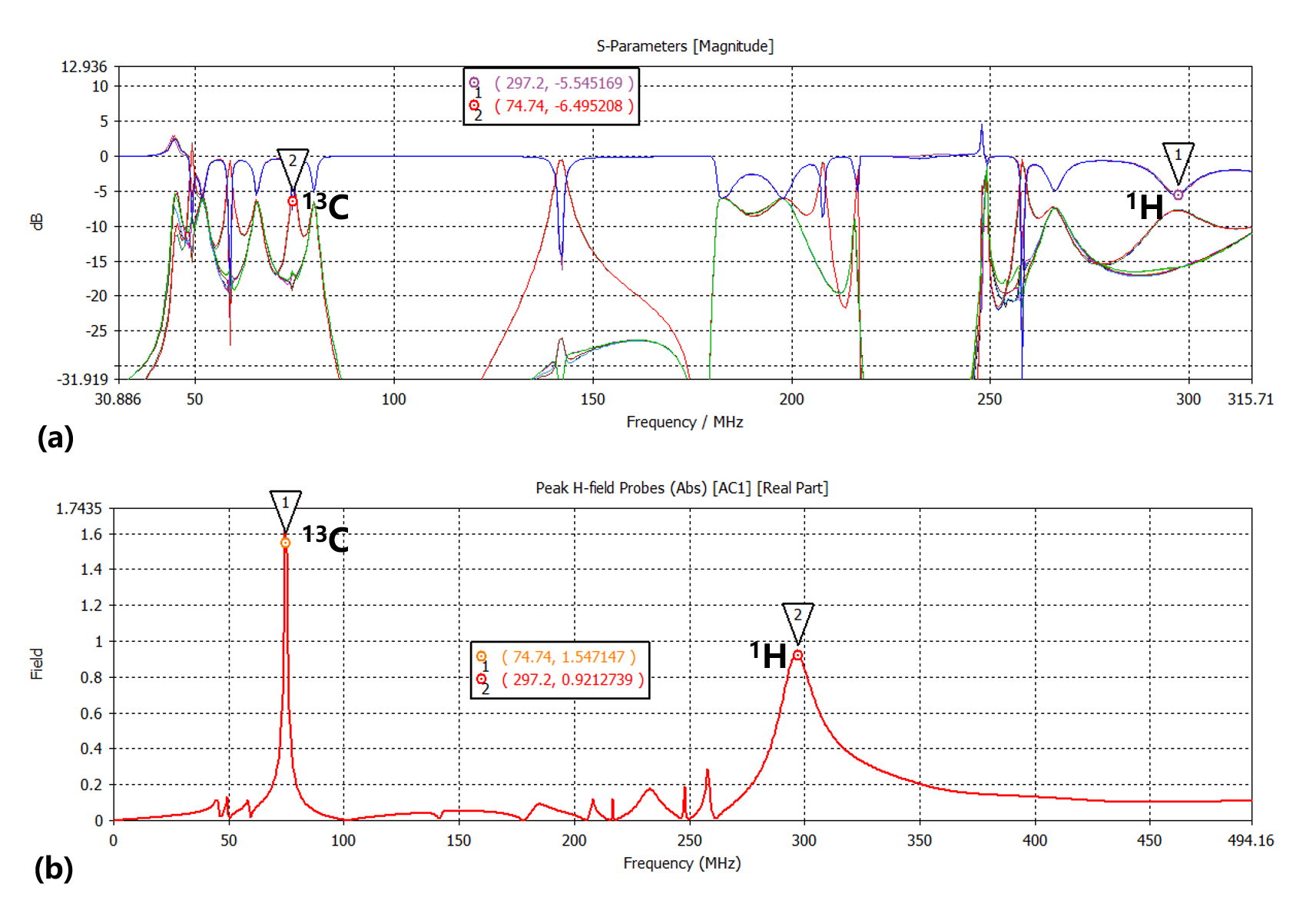
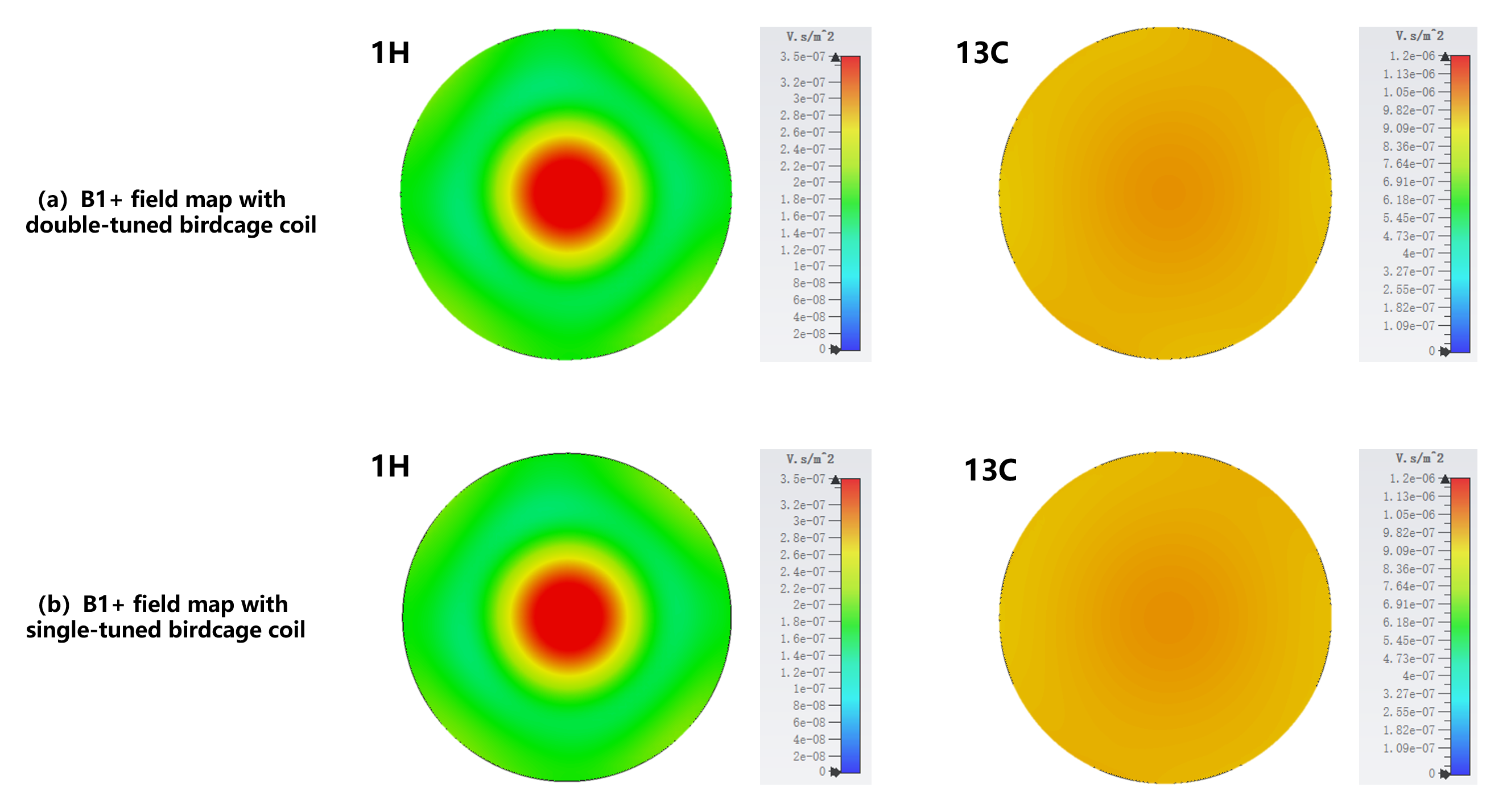
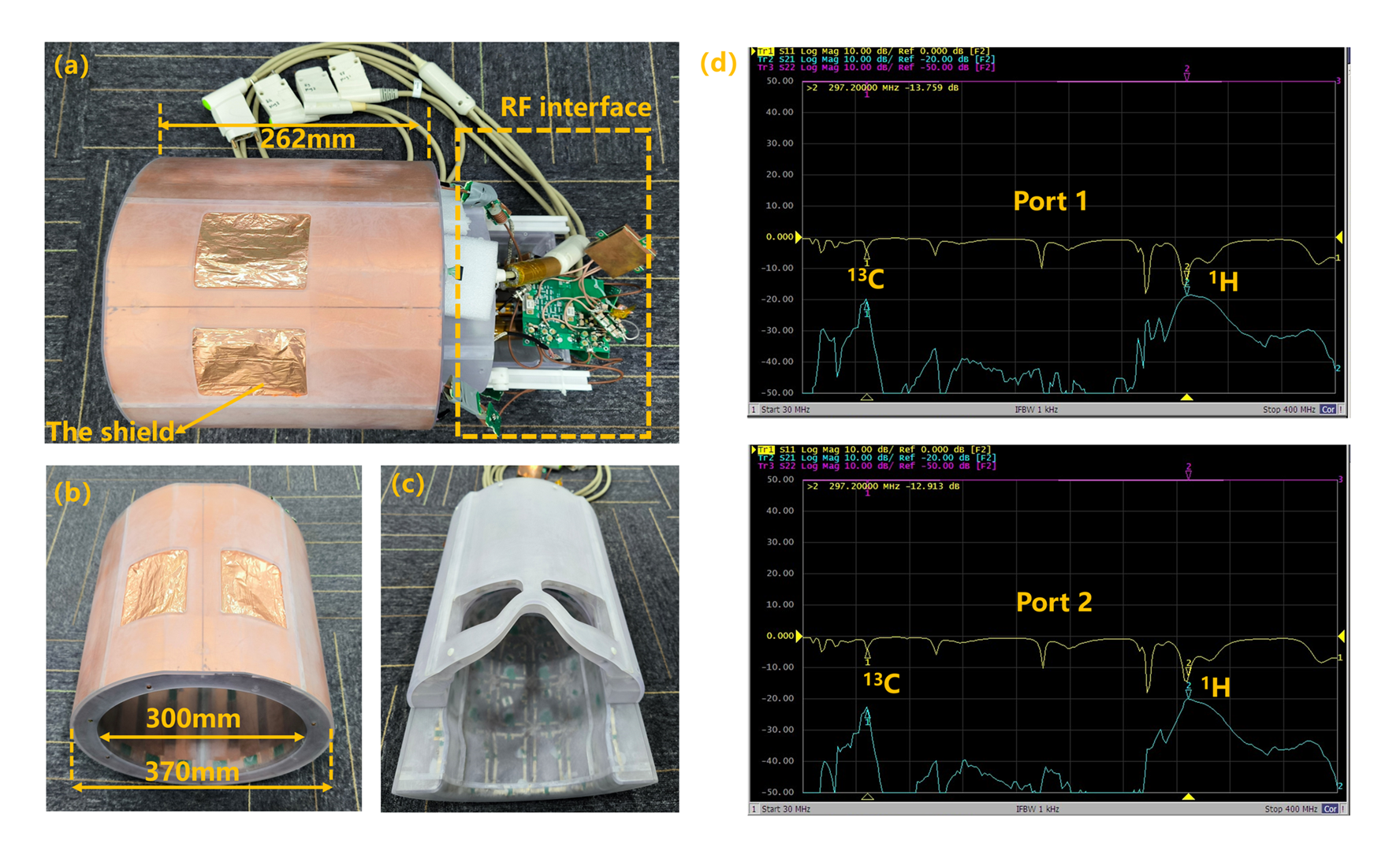
The simulated s-parameters of the double-tuned birdcage were obtained as shown in Fig.3 (a). The strength of magnetic field is the strongest at the center of the coil at the resonate frequencies as shown in the Fig.3(b). These results indicated that the double-tuned birdcage coil was able to operate at 1H/13C frequencies. The simulated B1+ fields of the double-tuned and single-tuned birdcage coils were calculated and shown in the Fig.4. The results indicated the double-tuned birdcage produced a homogeneous B1+ field in the center of the transverse plane at 1H /13C frequencies. In addition, the B1+ distribution pattern of the 1H/13C double-tuned birdcage coil at 1H and 13C frequencies is essentially the same as that of the single-tuned birdcage coils. We confirmed the performance of the by measuring the scattering parameters and resonance characteristics on the constructed coil system as shown in Fig. 5.Conclusion
In this study, a novel double-tuned RF coil system was designed and constructed for 1H/13C MR imaging at 7T. The performance of the coil was evaluated by the numerical simulation in s-parameters and B1+ field distributions. The bench tests were conducted to further validate the performance. Our performance evaluations showed that the proposed double-tuned RF coil system can be expected to achieve uniform excitation and highly sensitive acquisition for 1H/13 C MR imaging at 7T and demonstrated the feasibility for heteronuclear MRI applications. In future work, coil performance will be further optimized, and phantom and in vivo studies on a 7T MR system will be performed.Acknowledgements
This work was supported in part by the National Key Research and Development Program of China (2021YFE0204400), the NSFC grant (81627901), Project on Global Common Challenges of Chinese Academy of Sciences (No. 321GJHZ2022081GC), the Key Laboratory for Magnetic Resonance and Multimodality Imaging of Guangdong Province, (2023B12120600520), the Funding Program of Shenzhen, China (RCYX20200714114735123), the Chinese Academy of Sciences Youth Innovation Promotion Association funded project (Y2021098).References
1. Kurhanewicz J, Vigneron DB, Brindle K, et al. Analysis of cancer metabolism by imaging hyperpolarized nuclei: prospects for translation to clinical research. Neoplasia 2011;13:81–97.
2. Park I, Larson PE, Zierhut ML, et al. Hyperpolarized 13C magnetic resonance metabolic imaging: application to brain tumors. Neurooncology 2010;12:133–144.
3. Albers MJ, Bok R, Chen AP, et al. Hyperpolarized 13C lactate, pyruvate, and alanine: noninvasive biomarkers for prostate cancer detection and grading. Cancer Res 2008;68:8607–8615.
4. Nelson SJ, Kurhanewicz J, Vigneron DB, et al. Metabolic imaging of patients with prostate cancer using hyperpolarized [1-(1)(3)C]pyruvate. Sci Transl Med 2013;5:198ra108.
5. P. Cao, X. Zhang, et al. 1H-13C Independently Tuned Radiofrequency Surface Coil Applied for In Vivo Hyperpolarized MRI. Magn Reson Medi 2015; 00:00–00.
Figures