4890
Design of a nonlinear human-breast gradient coil with controllable gradient variation1Division of Medical Physics, Department of Diagnostic and Interventional Radiology, Medical Center University of Freiburg, Faculty of Medicine, University of Freiburg, Freiburg, Germany, 2Neoscan-Solutions GmbH, Magdeburg, Germany
Synopsis
Keywords: Gradients, Gradients
Motivation: To assess diffusion metrics on a cellular scale necessitates much higher gradient amplitudes. A local nonlinear breast gradient coil needs methods of controlling the field variation during the coil design stage.
Goal(s): Control the y-axis gradient variation of a double layer local breast gradient coil to achieve far above 1T/m in the whole target region.
Approach: Incorporation of a constraint to control the variation of the gradient along the y-axis with a double-layer current-carrying surface.
Results: A non-linear local human breast gradient coil with a gradient strength between 1.61 and 3.74 T/m for a current of 650 A was designed.
Impact: The coil design with a subsequent implementation paves the way to the application of novel diffusion imaging techniques for the detection and characterization of breast cancer.
Introduction
Novel diffusion methods allow to assess information of the cellular microstructure1-4. However, to access diffusion lengths on the cellular scale, much higher gradient amplitudes are required. In modern MRI the main limitation of gradient systems is posed by physiology, namely Peripheral Nerve Stimulation (PNS). PNS limitations correlate to the size of the gradient coil. Therefore smaller and more localized gradients allow circumventing PNS limitations5,6. Nonlinear gradient coils allow generating even higher gradient amplitudes locally. We recently introduced a nonlinear local breast gradient coil capable of producing a gradient strength of over 1T/m7,8. A large variation of gradient amplitudes along the posterior direction limits the diagnostic value close to the chest wall. To address this, our work introduces a novel constraint in the coil design to control y-axis gradient variation. Additionally, we utilize a double-layer current-carrying surface to increase the minimum wire width at the expense of the increased inductance.Methods
An optimization problem is proposed as follows:$$\min_{\psi}\mbox{ }F,\mbox{ }F:=\sqrt{P(\psi)}+ \alpha_J \lVert\vec{J}(\psi)\rVert_{p},$$ $$\mbox{subject to}\mbox{ }\frac{1}{k}\sum_{\vec{x}_i\in{\text{ROI}}}\left|\nabla B_z(\psi,\vec{x}_i)\right|\geq C_g,$$ $$\mbox{ }D_s:=\left( \sum_{\vec{x}_i\in{\text{ROI}}}\left(\frac{\left|\nabla B_z(\psi,\vec{x}_i)\right|}{\partial x}\right)^2+\left(\frac{\left|\nabla B_z(\psi,\vec{x}_i)\right|}{\partial z}\right)^2 \right)^\frac{1}{2}\leq k C_s C_g,$$ $$\mbox{ }D_y:=\left( \sum_{\vec{x}_i\in{\text{ROI}}}\left(\frac{\left|\nabla B_z(\psi,\vec{x}_i)\right|}{\partial y}\right)^2 \right)^\frac{1}{2}\leq k C_y C_g,$$ $$\mbox{ }|M_x|\leq M_{\max}C_g, \mbox{ } |M_y|\leq M_{\max}C_g, \mbox{ } |M_z|\leq M_{\max}C_g.$$
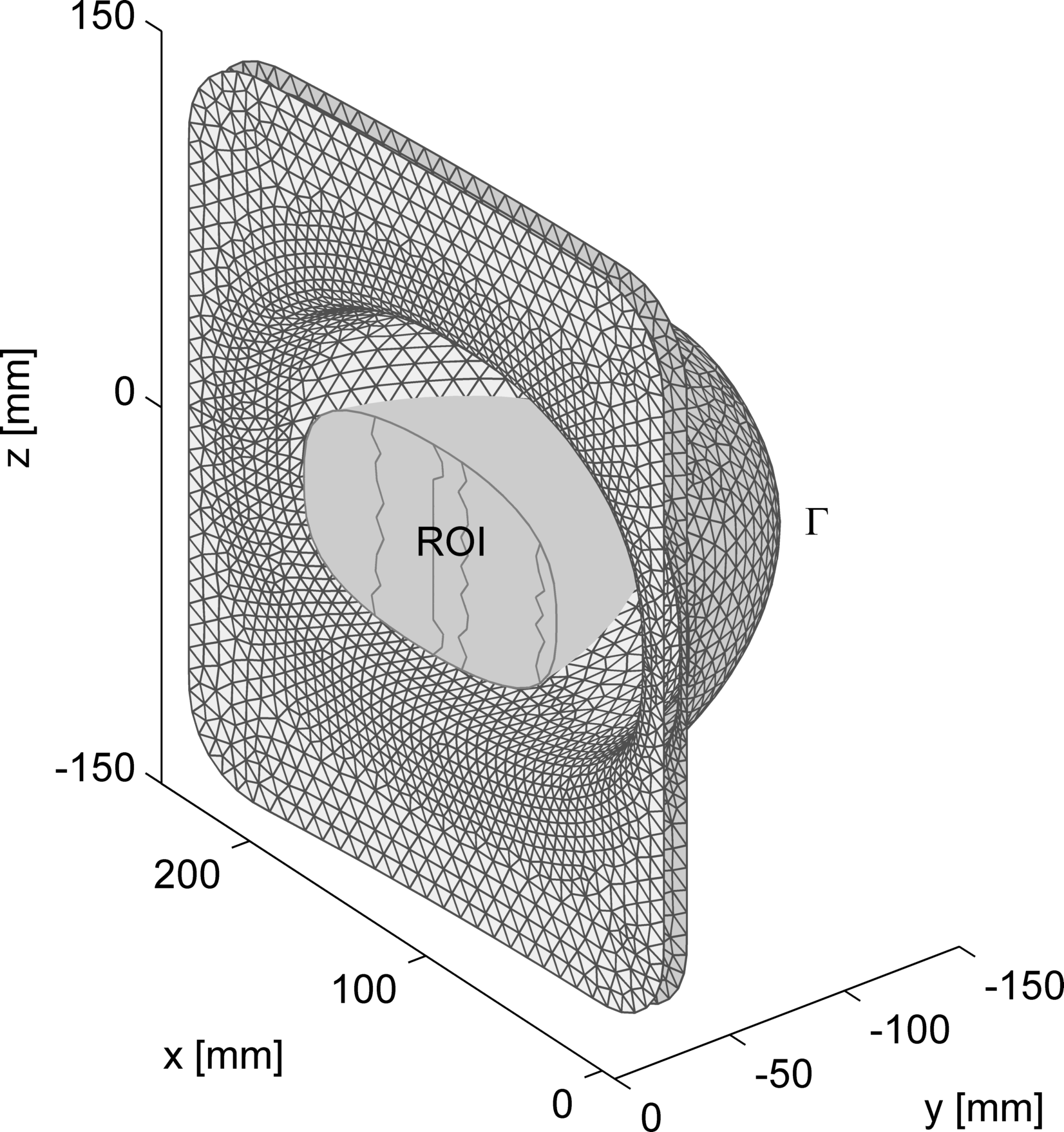
Here, ψ denotes the stream function of the electric current density vector J(x) where $$$J(\psi) = \nabla\times(\psi n)$$$ on a double-layer current-carrying surface Г (Fig. 1) with a normal unit vector n. The Bz is the z-component of the magnetic fields generated by current J on Г (Fig. 1). The points xi, i=1, …, k, denote the coordinate vectors of k test points in the ROI, P(ψ) denotes a coil power dissipation, Mmax is a given maximal torque, Cg, Cs and Cy are three tuning parameters.
Compared to the previous optimization formulation7, there are two differences: A new constraint for Dy is used to control the gradient variation along the y-axis. Second, the stream function ψ in the current optimization problem is linearly dependent on Cg. That implies that for the current problem we only need to consider two tunning parameters Cs and Cy.
Apart from the previous resistive and inductive figures of merit (βP and βW), a figure of merit related to maximum current densities is proposed: $$\beta_J:=\frac{\sum_{\vec{x}_i\in{\text{ROI}}}\lvert\nabla B_z(\psi,\vec{x}_i)\rvert}{k|J|_{\max}},$$
which is equal to the product of the average coil efficiency $$$\bar\eta$$$and the minimum coil width9. Here, the minimum width Wmin is specified to be 3.5 mm.
Results and Discussions
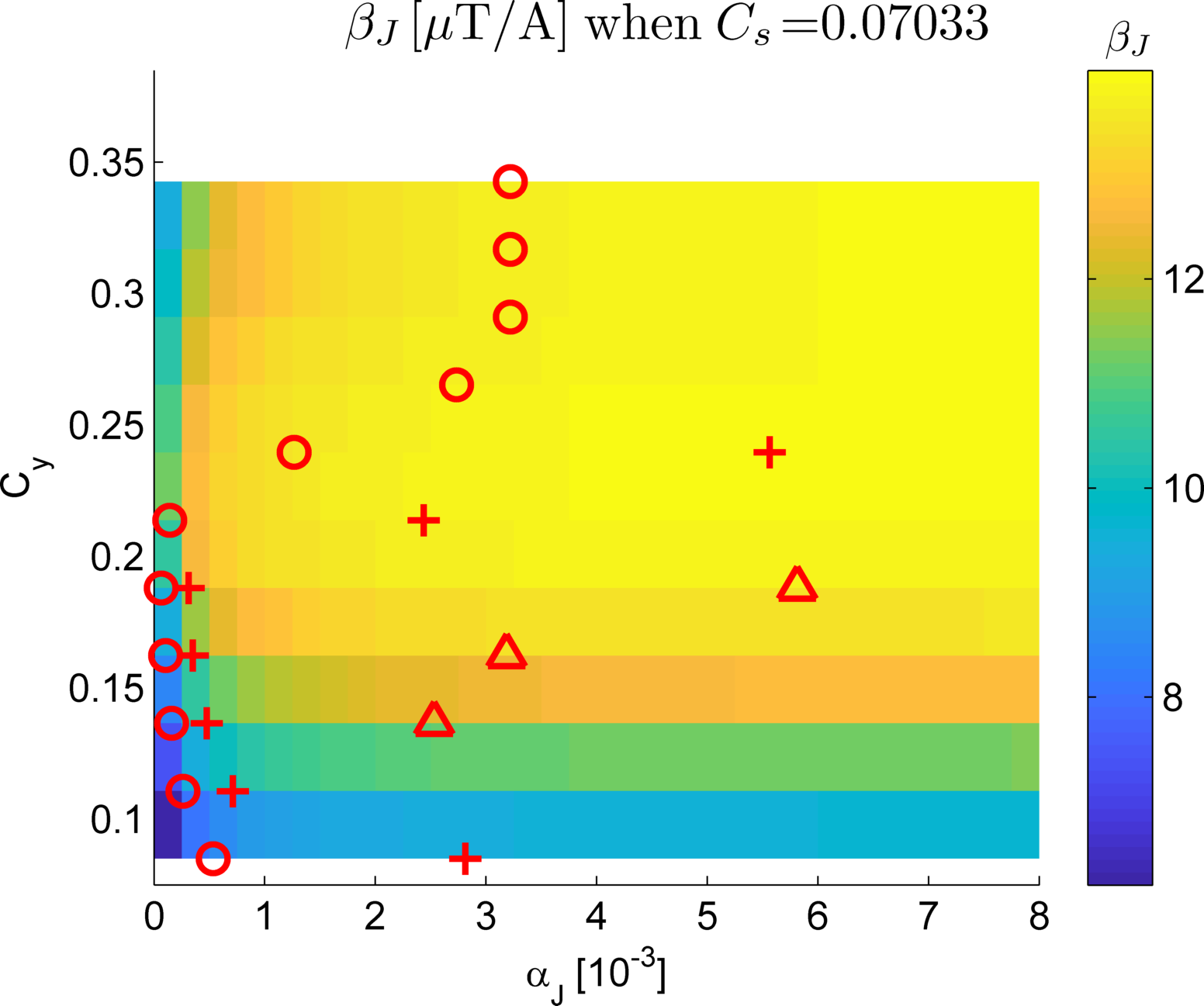
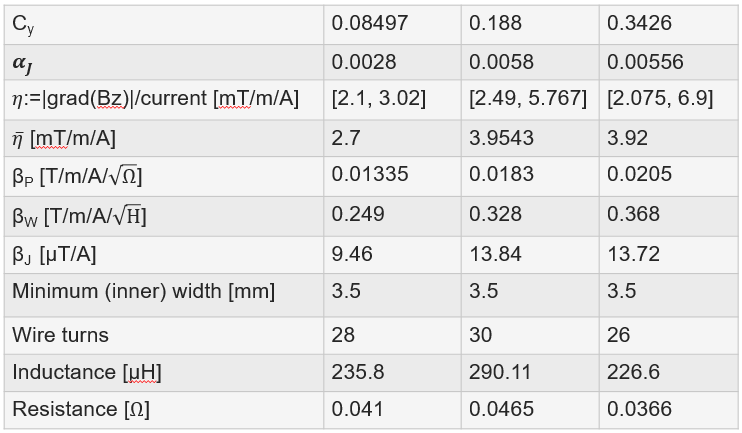
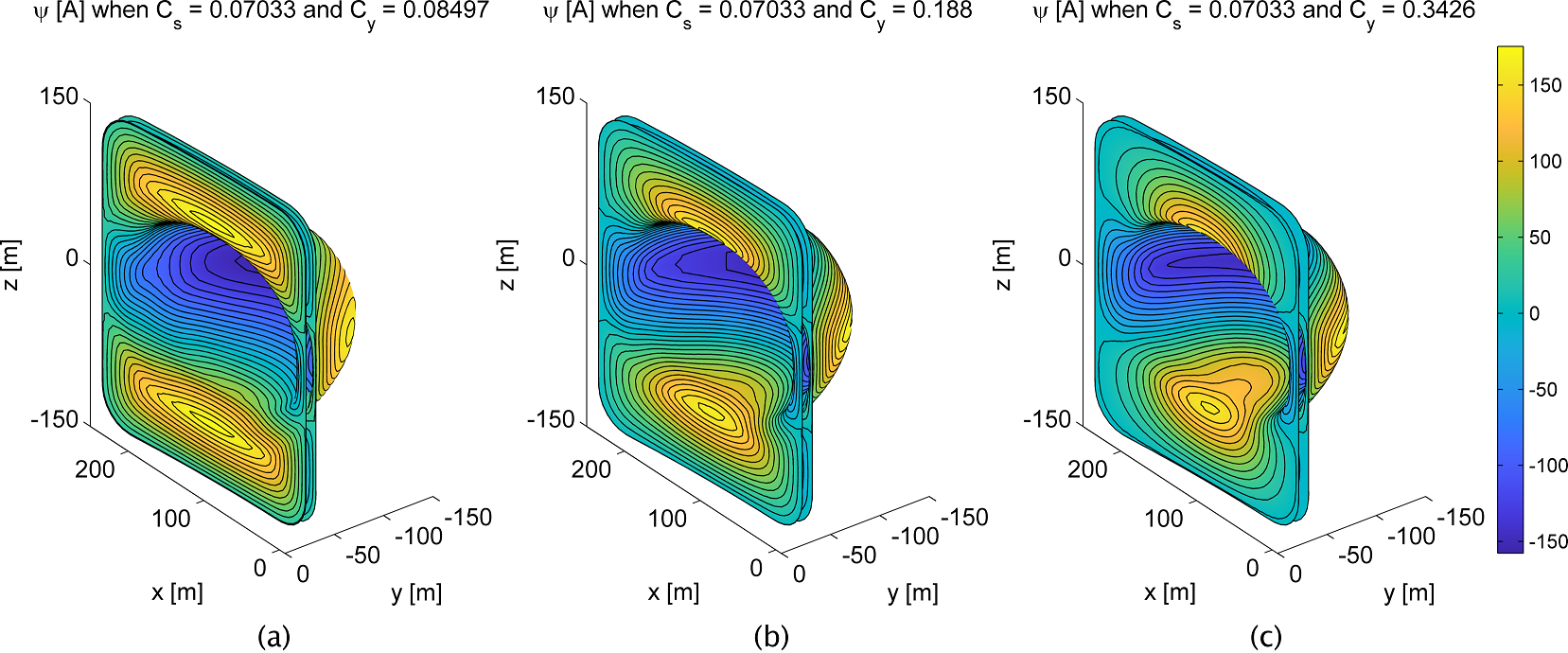
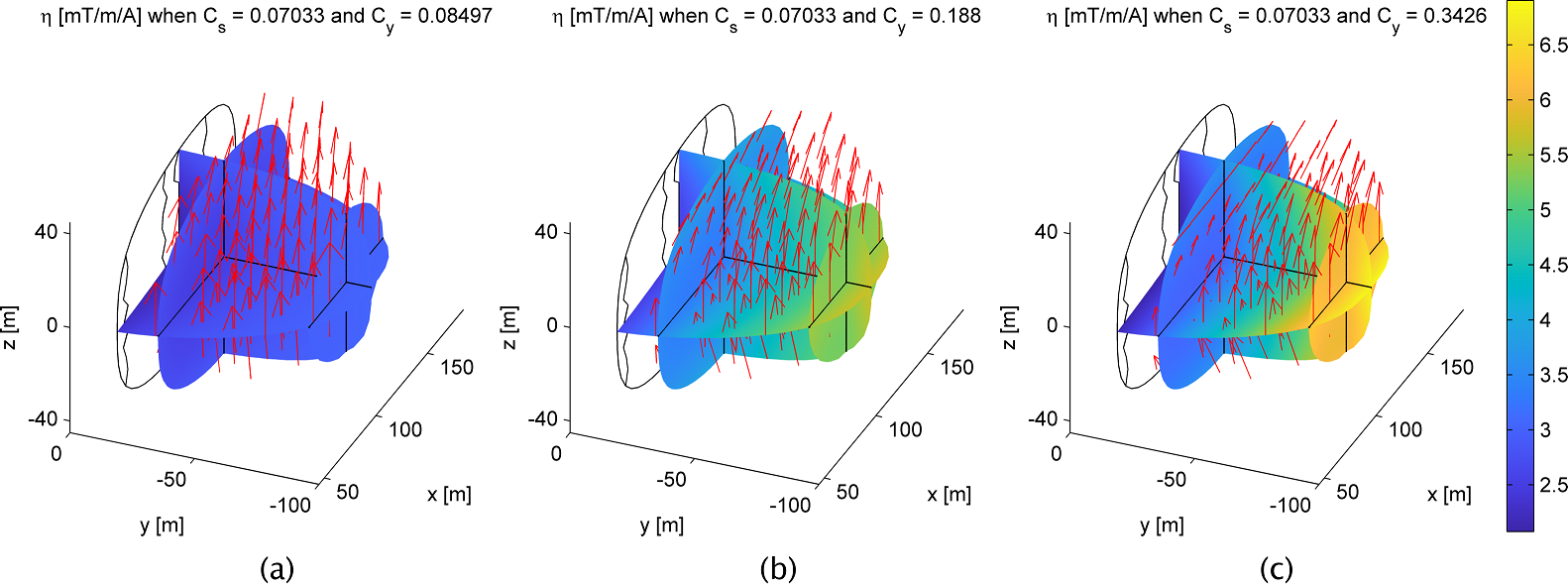
Figure 2 illustrates the tendency of the figure of merit βJ with different values of αJ and Cy. Here, the minimum and maximum of Cy come from the corresponding linear gradient coil and nonlinear coil without Dy constraint7. As seen, βJ increases with the increase of αJ for a fixed Cy. As Cy increases for a given αJ, βJ first rises and then slightly declines or levels off. That suggests that optimal average coil efficiency is found at larger αJ and moderately increased Cy for a given minimum width. Figure 2 also highlights the points with the minimum width of 3.5 mm. The red points delineated by circles, crosses and triangles represent wire turn numbers of 26, 28 and 30, respectively.Figure 3 reports the figures of merit, the coil efficiency η and other properties for the nonlinear coil designs at three highlighted points. As shown, compared to Cy = 0.08497, the average coil efficiency $$$\bar\eta$$$ for the two alternative instances raises over 1.45 times. However, the range of η, specified by the ratio of its maximum to minimum value, expands as Cy rises. Compared to Cy = 0.08497, the ratios at Cy of 0.188 and 0.3426 exhibit increases by factors of 1.61 and 2.31, respectively. Moreover, the minimum value of η for Cy = 0.188 shows an approximate enhancement of 1.2-fold relative to the other two scenarios. Furthermore, the gradient strength of more than 1.61T/m is achievable across the entire ROI using a current of 650 A in the designed nonlinear coil with a Cy of 0.188. Figure 4 and 5 show the resulting coil layouts and the distribution of coil efficiency at the three points. These findings suggest that the new constraint enables to control the gradient changes along the y-axis.
Conclusions
We have presented a new way to control the variation of the gradient magnitude along the y-axis of a nonlinear breast gradient coil. The resulting coil designed is capable of generating a gradient strength exceeding 1.61 T/m across the entire ROI. This paves the way for the application of novel diffusion techniques to potentially improve detection and characterization malignant tissue in the female human-breast non-invasively.Acknowledgements
This work was supported by the German Research Foundation (DFG) Project number 468440804 High-Power Diffusion Probe for Human Breast MRI – Phase 2.References
[1] F.B. Laun, T.A. Kuder, A. Wetscherek, B. Stieltjes, W. Semmler, NMR-based diffusion pore imaging Phys. Rev. E, 86 (2012), Article 021906
[2] Fieremans E, Burcaw, LM, Lee HH, Lemberskiy G, Veraart J, Novikov DS. In vivo observation and biophysical interpretation of time-dependent diffusion in human white matter. Neuroimage. 2016;129:414-427.
[3] Lasič, S., Oredsson, S., Partridge, S. C., Saal, L. H., Topgaard, D., Nilsson, M., and Bryskhe, K. (2016) Apparent exchange rate for breast cancer characterization. NMR Biomed., 29: 631– 639.
[4] P. T. Callaghan. Principles of nuclear magnetic resonance microscopy. Oxford University Press, Oxford, 1993.
[5] Zhang B, Yen Y-F, Chronik BA, McKinnon GC, Schaefer DJ, Rutt BK. Peripheral nerve stimulation properties of head and body gradient coils of various sizes. Magn Reson Med. 2003;50:50.
[6] Tan ET, Hua Y, Fiveland EW et al (2020) Peripheral nerve stimulation limits of a high amplitude and slew rate magnetic field gradient coil for neuroimaging. Magn Reson Med 83:352–366.
[7] F. Jia, S. Littin, P. Amrein, H. Yu, A.W. Magill, T.A. Kuder, S. Bickelhaupt, F. Laun, M.E. Ladd, M. Zaitsev Design of a high-performance non-linear gradient coil for diffusion weighted MRI of the breast J. Magn. Reson., 331 (2021), Article 107052.
[8] S. Littin, T.A. Kuder, F. Jia, A.W. Magill, P. Amrein, F.B. Laun, S. Bickelhaupt, M. Davids, V. Klein, M.E. Ladd Approaching order of magnitude increase of gradient strength: Non-linear breast gradient coil for diffusion encoding Proc. Intl. Soc. Mag. Reson. Med., 29 (2021), p. 3096.
[9] M.S. Poole, P.T. While, H.S. Lopez, S. Crozier, Minimax current density gradient coils: Analysis of coil performance and heating, Magnetic Resonance in Medicine 68 (2) (2012) 639–648.
Figures