4876
Decreased water exchange rate across blood-brain barrier 6-12 months after admission for COVID-19 pneumonia1University of Cape Town, Cape Town, South Africa
Synopsis
Keywords: Arterial Spin Labelling, COVID-19
Motivation: A proportion of patients admitted to hospital with SARS-CoV-2 infection have cognitive deficits that persist for several months. However, the mechanisms behind persistent neurological symptoms are unclear. Blood-brain barrier (BBB) dysfunction is a possible underlying cause.
Goal(s): We aimed to investigate BBB permeability in participants previously admitted to hospital with SARS-CoV-2 infection (post-acute COVID-19).
Approach: We used a diffusion-prepared pseudo-continuous arterial spin labelling (DP-pCASL) to quantify water exchange rate in post-acute COVID-19 participants and controls.
Results: Post-acute COVID-19 participants demonstrated lower whole brain water exchange rates across the BBB than controls, but no differences in arterial transit time or cerebral blood flow.
Impact: This is the first study to report reduced water exchange across the blood brain barrier in the context of post-acute infection with SARS-CoV-2. This may implicate glymphatic system dysfunction as a mechanism for neurological symptoms associated with long COVID-19.
Introduction
It has been hypothesized that blood-brain barrier (BBB) failure permits entry of SARS-CoV-2 into the brain1,2. The BBB regulates the passage of substances between the blood and the brain and acts as a physical barrier between immune cells in the circulation and brain tissue. Therefore, the BBB may be an important structure for the direct and indirect interaction of SARS-CoV-2 with the brain. Diffusion-prepared pseudo-continuous arterial spin labelling (DP-pCASL)3-5 allows quantification of water exchange rate (kw) across the BBB, as well as cerebral blood flow (CBF) and arterial transit time (ATT), providing a sensitive and comprehensive assessment of BBB damage. Here we aimed to investigate the integrity of the BBB in adults previously admitted with COVID-19 pneumonia with persistent cognitive and mental symptoms (long COVID-19). Changes in BBB integrity may provide insight into the mechanisms of the persistence of symptoms months after acute COVID-19 infection. We hypothesized that participants in the post-acute COVID-19 group would have higher kw values, indicative of higher BBB permeability.Methods
Participants were 27 adults assessed 6-12 months after discharge for the treatment of COVID-19 pneumonia at a tertiary hospital in Cape Town South Africa and 17 adults who had not tested positive for or experienced symptoms of COVID-19. DP-pCASL data were acquired using a 3D turbo-gradient and spin echo (TGSE) DP-pCASL sequence on a Siemens 3T Skyra (3.5x3.5x8 mm3; 12 slices; TR/TE 4200/36.9 ms; bolus 700 ms; TI 1800 ms; label offset 9 cm, label/control duration 1500 ms). DP-pCASL data were processed using the LOFT BBB Toolbox (http://www.loft-lab.org/index-5.html). Control and labelled images were corrected for rigid head motion and subtracted to obtain perfusion images. kw, ATT and CBF were quantified as described elsewhere5,6. Whole brain averaged kw, ATT and CBF were compared between post-acute COVID-19 and control groups using linear regression controlling for age and sex. In separate regressions we also examined the interaction of age and sex with post-acute COVID-19 group.Results
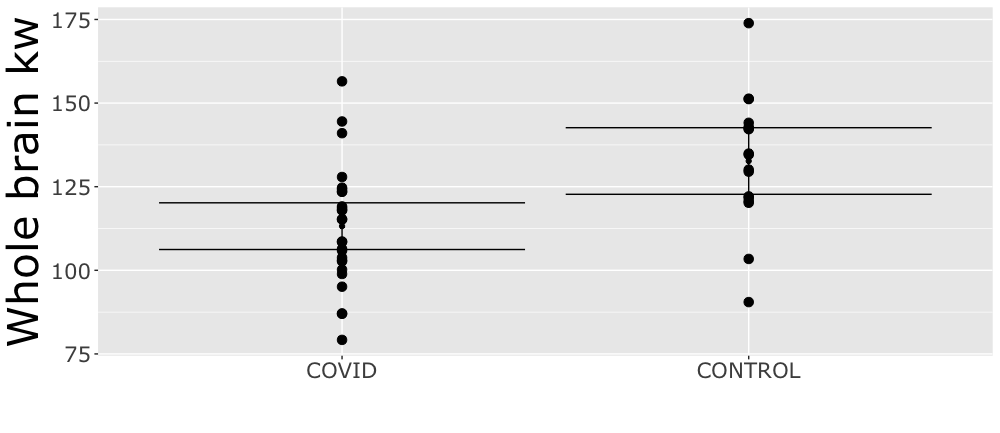
Post-acute COVID-19 participants (mean age 48±10 years) were older than controls (mean age 33±9 years). The post-acute COVID-19 group (n=27) comprised 14 males (52%) and the control group (n=17) comprised 12 males (71%).Figure 1 shows that contrary to our hypothesis, post-acute COVID-19 participants demonstrated lower whole brain water exchange rates across the BBB than controls (linear regression B=16.5, standard error (se)=7.4, p=0.03), but no differences in ATT (B=-22.2, se=44.5, p=0.6) or CBF (B=1.1, se=5.7, p=0.8).
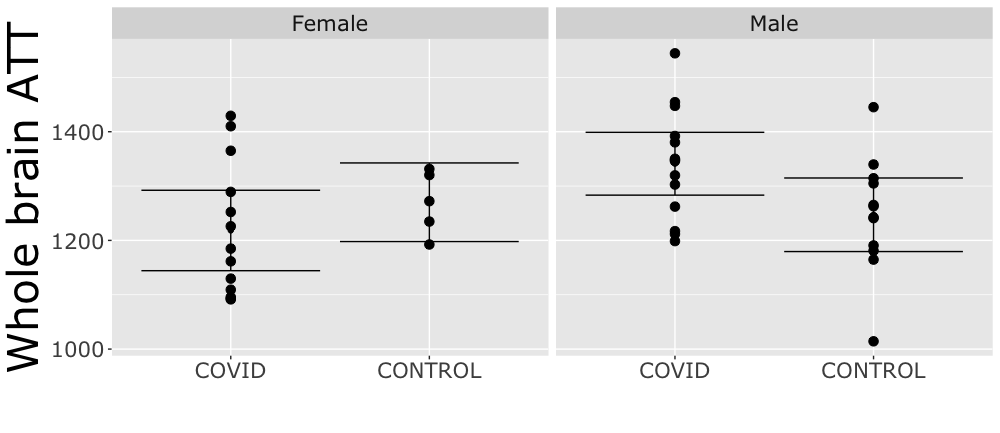
There were no significant interaction effects on CBF, but interaction effects between post-acute COVID-19 group and sex on ATT (B=-156, p=0.04) and between post-acute COVID-19 group and age on kw (B=1.78,p=0.006) were significant. ATT showed a tendency to be longer in males. When stratified by sex, male post-acute COVID-19 participants had longer whole brain ATT than controls (Figure 2), but this was not significant when controlled for age.
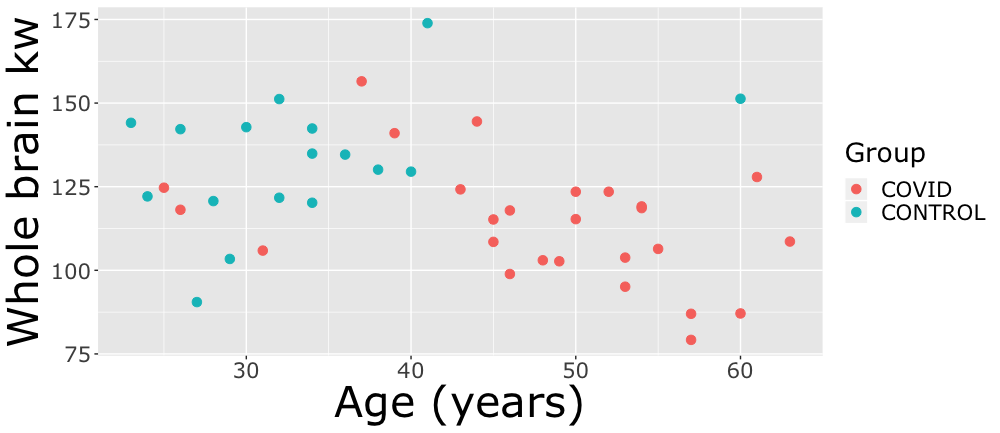
kw showed a decrease with age in post-acute COVID-19 group only (Figure 3). However, there were very few controls over 40 and very few post-acute COVID-19 participants younger than 40 years. The group difference in kw between post-acute COVID-19 and control groups remained significant after adjustment for sex, age, and age by group interactions.
Discussion & Conclusion
Whole brain kw (~125 min-1) was comparable with previously reported values in the elderly6. With ageing, the BBB becomes more permeable to large molecules, particularly in vascular dementia and cerebral small vessel disease7. However, water exchange rate across the BBB declines with ageing8, consistent with our findings in post-acute COVID-19 participants.Analogously, a recent unpublished study using dynamic contrast-enhanced magnetic resonance imaging (DCE-MRI) in long COVID patients observed elevated BBB permeability and upregulated inflammatory blood markers9, suggesting that long COVID-associated neurological impairment is characterized by persistent inflammation and increased BBB permeability to large molecules. On the other hand, our finding indicates reduced permeability to water. This suggests that several mechanisms of BBB dysfunction may co-occur in long COVID.
Water exchange across the BBB is regulated to a large degree by Aquaporin-4 (AQP4) water channels. Decreased kw may indicate a lower expression of perivascular AQP4 and reduced clearance of soluble waste from the central nervous system by the glymphatic system. Previous studies have shown that lower kw is associated with reduced brain clearance of amyloid beta as well as with poorer neuropsychological scores10-12, and has been observed in patients with small vessel disease10.
It will be important to examine the association of water exchange across the BBB with cognitive performance in long COVID patients, as well as to disentangle the effects of age and post-acute COVID-19 on BBB water exchange.
Acknowledgements
South African NRF/DSI South African Research Chairs Initiative (UID 48337, 120140 )
University of Cape Town
References
- Krasemann S, Haferkamp U, Pfefferle S, Woo MS, Heinrich F, Schweizer M, Appelt-Menzel A, Cubukova A, Barenberg J, Leu J, Hartmann K, Thies E, Littau JL, Sepulveda-Falla D, Zhang L, Ton K, Liang Y, Matschke J, Ricklefs F, Sauvigny T, Sperhake J, Fitzek A, Gerhartl A, Brachner A, Geiger N, König EM, Bodem J, Franzenburg S, Franke A, Moese S, Müller FJ, Geisslinger G, Claussen C, Kannt A, Zaliani A, Gribbon P, Ondruschka B, Neuhaus W, Friese MA, Glatzel M, Pless O. The blood-brain barrier is dysregulated in COVID-19 and serves as a CNS entry route for SARS-CoV-2. Stem Cell Reports. 2022 Feb 8;17(2):307-320. doi: 10.1016/j.stemcr.2021.12.011. Epub 2022 Jan 20. PMID: 35063125; PMCID: PMC8772030.
- Hernández-Parra H, Reyes-Hernández OD, Figueroa-González G, González-Del Carmen M, González-Torres M, Peña-Corona SI, Florán B, Cortés H, Leyva-Gómez G. Alteration of the blood-brain barrier by COVID-19 and its implication in the permeation of drugs into the brain. Front Cell Neurosci. 2023 Mar 14;17:1125109. doi: 10.3389/fncel.2023.1125109. PMID: 36998270; PMCID: PMC10043238.
- St Lawrence KS, Owen D, Wang DJJ. A two-stage approach for measuring vascular water exchange and arterial transit time by diffusion-weighted perfusion MRI. Magn Reson Med. 2012;67: 1275-1284.
- Wang J, Fernández-Seara MA, Wang S, St Lawrence KS. When perfusion meets diffusion: In vivo measurement of water permeability in human brain. J Cereb Blood Flow Metab. 2007;27: 839-849.
- Shao X, Ma SJ, Casey M, D’Orazio L, Ringman JM, Wang DJJ. Mapping water exchange across the blood–brain barrier using 3D diffusion-prepared arterial spin labeled perfusion MRI. Magn Reson Med. 2019;81:3065-3079.
- Shao X, Jann K, Ma SJ, et al. Comparison between blood–brain barrier water exchange rate and permeability to gadolinium- based contrast agent in an elderly cohort. Front Neurosci. 2020; 14:571480.
- Freeze WM, Jacobs HIL, de Jong JJ, Verheggen ICM, Gronenschild EHBM, Palm WM, Hoff EI, Wardlaw JM, Jansen JFA, Verhey FR, Backes WH. White matter hyperintensities mediate the association between blood-brain barrier leakage and information processing speed. Neurobiol Aging. 2020 Jan;85:113-122. doi: 10.1016/j.neurobiolaging.2019.09.017. Epub 2019 Sep 27
- Ford JN, Zhang Q, Sweeney EM, Merkler AE, de Leon MJ, Gupta A, Nguyen TD, Ivanidze J. Quantitative Water Permeability Mapping of Blood-Brain-Barrier Dysfunction in Aging. Front Aging Neurosci. 2022 Apr 8;14:867452. doi: 10.3389/fnagi.2022.867452. eCollection 2022.
- Greene C, Connolly R, Brennan D et al. (2023). Blood-brain barrier disruption in Long COVID-associated cognitive impairment. Research Square. doi: https://doi.org/10.21203/rs.3.rs-2069710/v2 https://www.researchsquare.com/article/rs-2069710/v2
- Li Y, Ying Y, Yao T, Jia X, Liang H, Tang W, Jia X, Song H, Shao X, Wang DJJ, Wang C, Cheng X, Yang Q. Decreased water exchange rate across blood-brain barrier in hereditary cerebral small vessel disease. Brain. 2023 Jul 3;146(7):3079-3087. doi: 10.1093/brain/awac500. PMID: 36625892; PMCID: PMC10316759.
- Gold BT, Shao X, Sudduth TL, Jicha GA, Wilcock DM, Seago ER, Wang DJJ. Water exchange rate across the blood-brain barrier is associated with CSF amyloid-β 42 in healthy older adults. Alzheimers Dement. 2021 Dec;17(12):2020-2029. doi: 10.1002/alz.12357. Epub 2021 May 5. PMID: 33949773
- Uchida Y, Kan H, Sakurai K, Horimoto Y, Hayashi E, Iida A, Okamura N, Oishi K, Matsukawa N.J APOE ɛ4 dose associates with increased brain iron and β-amyloid via blood-brain barrier dysfunction. Neurol Neurosurg Psychiatry. 2022 Apr 28:jnnp-2021-328519. doi: 10.1136/jnnp-2021-328519.
Figures