4869
ISMRM - Open Science Initiative for Perfusion Imaging (OSIPI): The multi-delay Arterial Spin Labeling Challenge1Krembil Brain Institute, University Health Network, Toronto, ON, Canada, 2Radiology and Nuclear Medicine, Vrije Universiteit Amsterdam, Amsterdam UMC location VUmc, Amsterdam, Netherlands, 3Amsterdam Neuroscience, Brain Imaging, Amsterdam, Netherlands, 4Helmholtz-Zentrum Dresden-Rossendorf, Desden, Germany, 5Institute of Biomedical Engineering, Department of Engineering Science, University of Oxford, Oxford, United Kingdom, 6Wellcome Centre for Integrative Neuroimaging, FMRIB, Nuffield Department of Clinical Neurosciences, University of Oxford, Oxford, United Kingdom, 7Department of Neurosurgery, Stanford University, Stanford, CA, United States, 8Institute of Physics, University of Campinas, Campinas, Brazil
Synopsis
Keywords: Arterial Spin Labelling, Arterial spin labelling, Challenge; multi-PLD ASL
Motivation: The OSIPI ASL Challenge is a community initiative motivated by open science principles that aim to establish good practices in ASL image analysis and Cerebral Blood Flow (CBF) quantification.
Goal(s): The second ASL challenge's main goal is to provide a thorough comparison of existing post-processing pipelines focusing on Multi-PLD methodology.
Approach: The second roadmap will provide different datasets; a population dataset which will bring real variability to the challenge and synthetic data which allows straightforward ground truth comparison.
Results: The second edition of the ASL Challenge will contribute to gaining new insights into the potential sources of variability within the multi-PLD analysis pipeline.
Impact: Through the second edition of the ASL Challenge, we seek to enhance our understanding of multi-PLD analysis in the ASL community. Its success could establish a consensus on the processing of multi-PLD ASL data, positively influencing clinical and scientific practices.
Introduction
The Open Science Initiative for Perfusion Imaging (OSIPI) is an initiative of the ISMRM Perfusion Study group aiming to disseminate MRI perfusion imaging and its software using open science philosophies. During its first roadmap, the OSIPI Task Force 6.1 organized a single-PLD Arterial Spin Labeling (ASL) challenge (1,2), which investigated the main sources of error and variability in the most used single post-labeling delay (PLD) ASL processing pipelines reported in the literature (3).Additionally, the ISMRM Perfusion Study group has made significant progress in terms of standardizing ASL continued protocols (4,5), terminology (6), and pipelines (7), whilst providing updated recommendations on the sequence and technical advances, velocity-selective ASL, clinical and outside-brain applications, and multi-time point ASL (8–12).
Among these novel developments, the acquisition of ASL data under multiple PLDs allows the tracking of the ASL inflow curve, which can be fitted to the kinetic model to extract quantitative information of the cerebral blood flow (CBF) and the arterial transit time (ATT). This second edition of the ISMRM-OSIPI ASL challenge is focused on multi-PLD ASL analysis pipelines, which will assess crucial steps in the analysis modeling, including a fitting evaluation, the accuracy of output maps, and the reproducibility of the results.
Aims
The main goal of this challenge is to provide a thorough comparison of existing post-processing pipelines (freely available, in-house, and/or commercial) for image analysis and quantification of ASL-measured CBF and ATT, and to understand the main source of errors in the processing by assessing its main steps.Challenge Overview
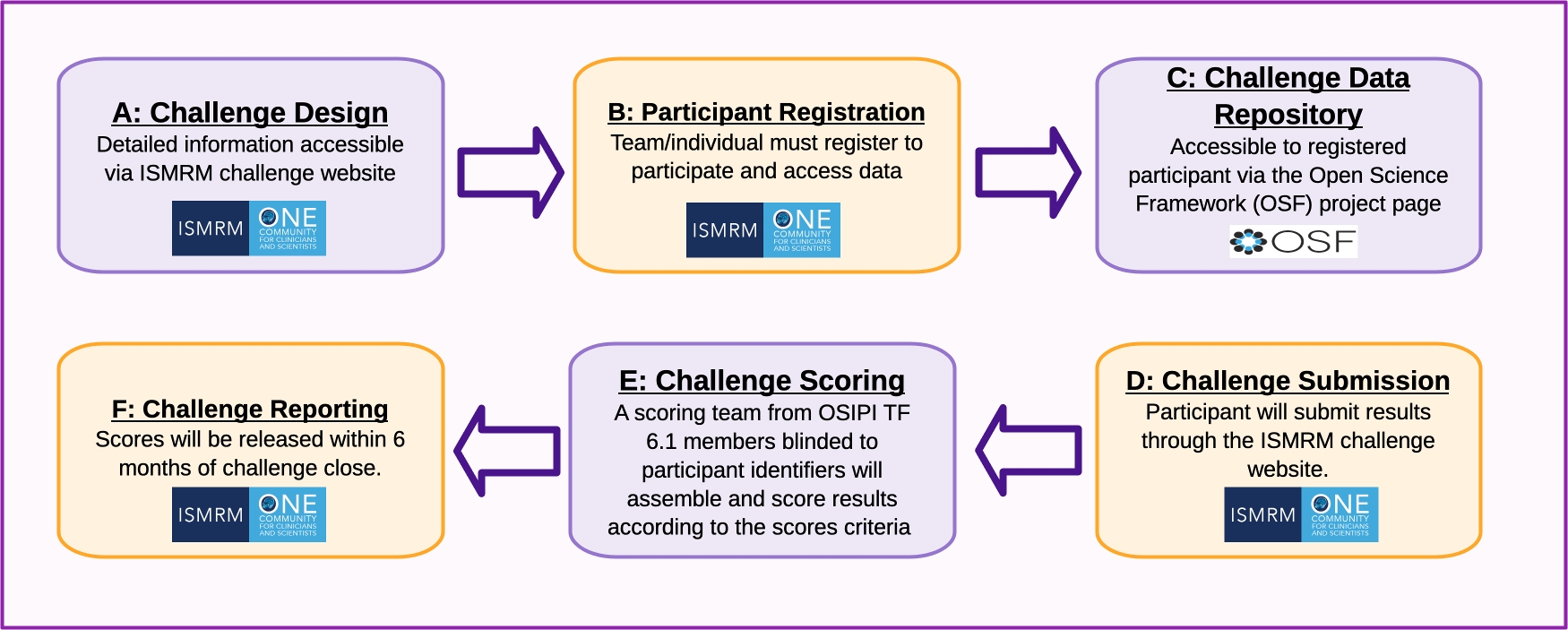
Structure: The challenge design and detailed information will be accessible on the ISMRM challenge website (https://challenge.ismrm.org/). Following online registration, challenge data will be available via an online repository. The challenge will be open for entries for six months, from February to August 2024. Figure 1 summarizes the challenge's overview.Data: The dataset will consist of two distinguished components.
- Population dataset: population data will be based on publicly available multi-PLD ASL data sets.
- Synthetic data: synthetic data will be created for different sets of PLDs using an existing ASL-DRO (https://asldro.readthedocs.io/en/stable/).
Scoring: Entries will be scored out of 100 for accuracy and reproducibility documentation quality, combined into a single final score with 70:30 weighting, respectively. Accuracy will be assessed through quantitative measures of the estimated error in the fitting process compared to the signal evolution of the synthetic data as well as a comparison to ground-truth for both voxel-wise and region-wise perfusion measures. Submissions will be reproduced by the challenge organizers according to submitted documentation (and code/notebooks where appropriate), with voxelwise and mean tissue perfusion comparisons made between submitted and reproduced data. Population-based results will establish real-world variability within the community and will contribute to quantitative scoring by assessing the variability of the data fitting.
Discussion
The OSIPI’s second ASL Challenge aims to provide an overview of the variety of multi-PLD ASL image analysis and quantification choices for both CBF quantification and ATT estimation made by the community. By emphasizing the good scientific practice of method documentation, we seek to enhance the reproducibility of results. By encouraging both developers and general users to take part, we aim to encompass a broad range of backgrounds reflecting the diverse nature of the ASL community.Acknowledgements
Moss Y Zhao: American Heart Association Grant (23SCEFIA1141920).
Joana Pinto: Engineering and Physical Sciences Research Council (EPSRC) grant EP/S021507/1.
HM is supported by the Dutch Heart Foundation (03-004-2020-T049), by the Eurostars-2 joint programme with co-funding from the European Union Horizon 2020 research and innovation programme (ASPIRE E!113701), provided by the Netherlands Enterprise Agency (RvO), and by the EU Joint Program for Neurodegenerative Disease Research, provided by the Netherlands Organisation for health Research and Development and Alzheimer Nederland (DEBBIE JPND2020-568-106).
Andre Paschoal: grant 2022/06496-7, São Paulo Research Foundation (FAPESP) and Fundo De Apoio Ao Ensino, Pesquisa E Extensão (FAEPEX) grant 2589/23.
Figures