4851
Can We Distinguish Intra- and Inter-Variability with Log Jacobian Maps Derived from Brain Morphological Deformations Using Pediatric MRI Scans?1NeuroPoly Lab, Institute of Biomedical Engineering, Polytechnique Montréal, Montréal, QC, Canada, 2Research Center, Ste-Justine Hospital University Centre, Montréal, QC, Canada, 3IRISA UMR 6074, EMPENN ERL U-1228, Université de Rennes, CNRS, Inria, Inserm, Rennes, France, 4Research Center, Ste-Justine Hospital University Centre, Montreal, QC, Canada, 5Computer Engineering and Software Engineering, Polytechnique Montréal, Montreal, QC, Canada
Synopsis
Keywords: Other AI/ML, Data Analysis, Modelling
Motivation: Importance of analyzing deformation fields derived from both intra- and inter-individual pairs of T1-weighted images which could offer insights into typical and atypical neurodevelopment.
Goal(s): We aimed to fine-tune a 3D CNN to classify intra and inter-individual variability based on log Jacobian maps from deformation fields of pediatric longitudinal MRI.
Approach: 279 log Jacobian maps of both intra- and inter-individual pairs are extracted using ANTs. A 3D CNN is trained in two ways (overlap and no overlap) for binary classification using 10-fold cross-validation.
Results: As expected, the overlap scenario had higher accuracy and F1 score compared to no-overlap, nonetheless both achieving good results.
Impact: This project's focus on pediatric MRI scans aims to understand deformations in medical imaging, advancing diagnostic tools. By distinguishing intra and inter-individual variability using log Jacobian-derived deformation patterns, it subsequently aims to model typical neurodevelopment through trajectories for deviation prediction.
Introduction
Understanding intra- and inter-individual brain variability is vital for characterizing typical brain development and detecting pathology1. Inter-individual variability refers to differences between individuals (where minor differences are expected and significant ones may suggest a pathological condition), while intra-individual variability tracks changes over time within a person giving insights into brain development. This project aims to distinguish intra- and inter-individual variability using log Jacobian maps derived from deformable registration, focusing on pediatric brain development through longitudinal magnetic resonance imaging (MRI) scans. Recent studies have made available global growth curves of lifespan brain structures2,3. These do not enable the characterization of intra-individual variabilities, particularly due to the cross-sectional nature (numerous patients, different ages, only one image per individual) of the data used. Having distinct signatures for both intra- and inter-individual variabilities could help identify deviations from typical neurodevelopment. The primary goal is to explore the utility of log Jacobian maps in distinguishing between intra and inter-variability. To achieve this, we propose a supervised method utilizing a 3D convolutional neural network (CNN). This approach aims to train the model in predicting whether the data corresponds to intra or inter categories, offering a valuable tool for differentiating individual brain developmental paths and characterizing normative brain development from its variations.Methods
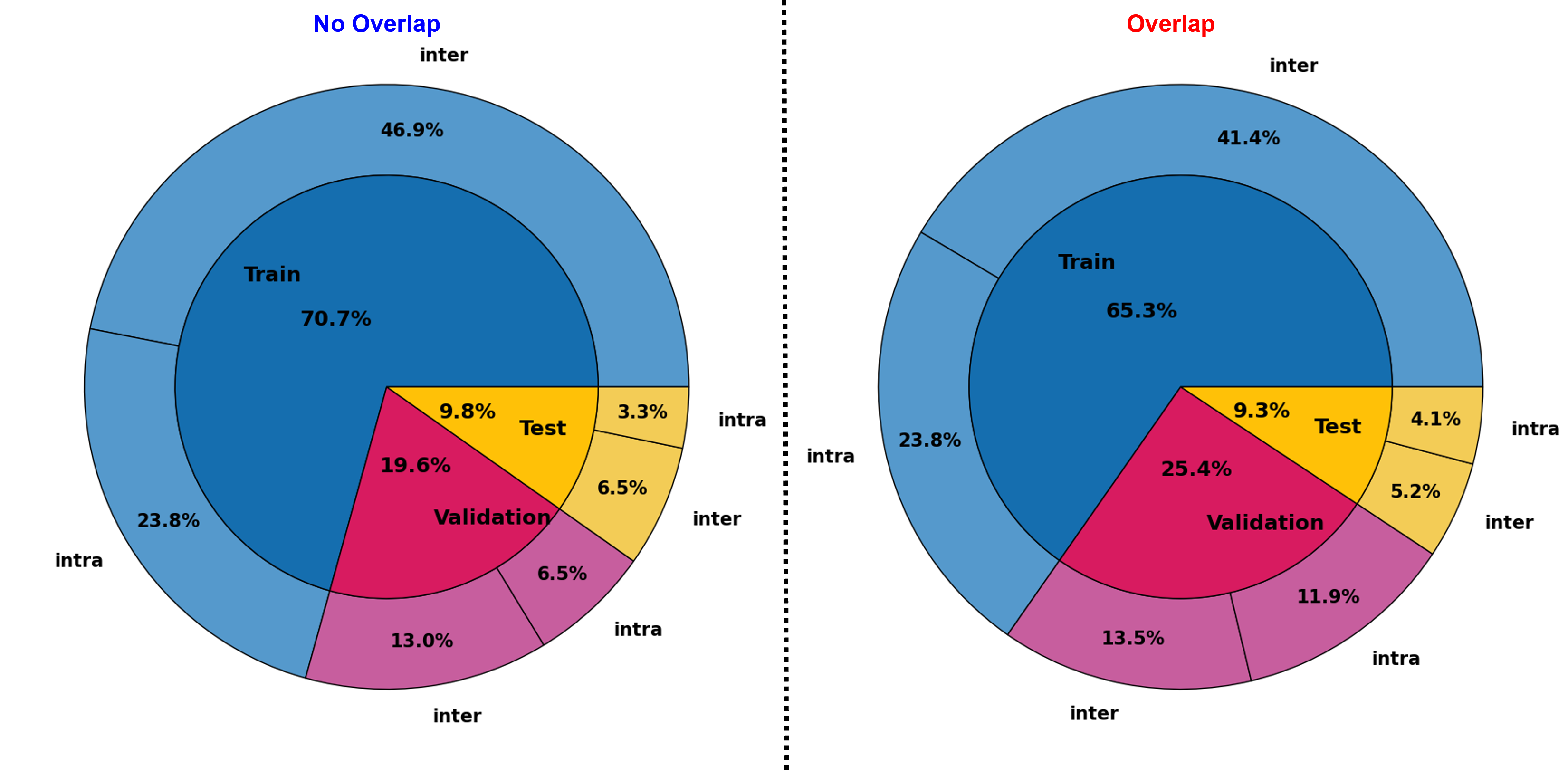
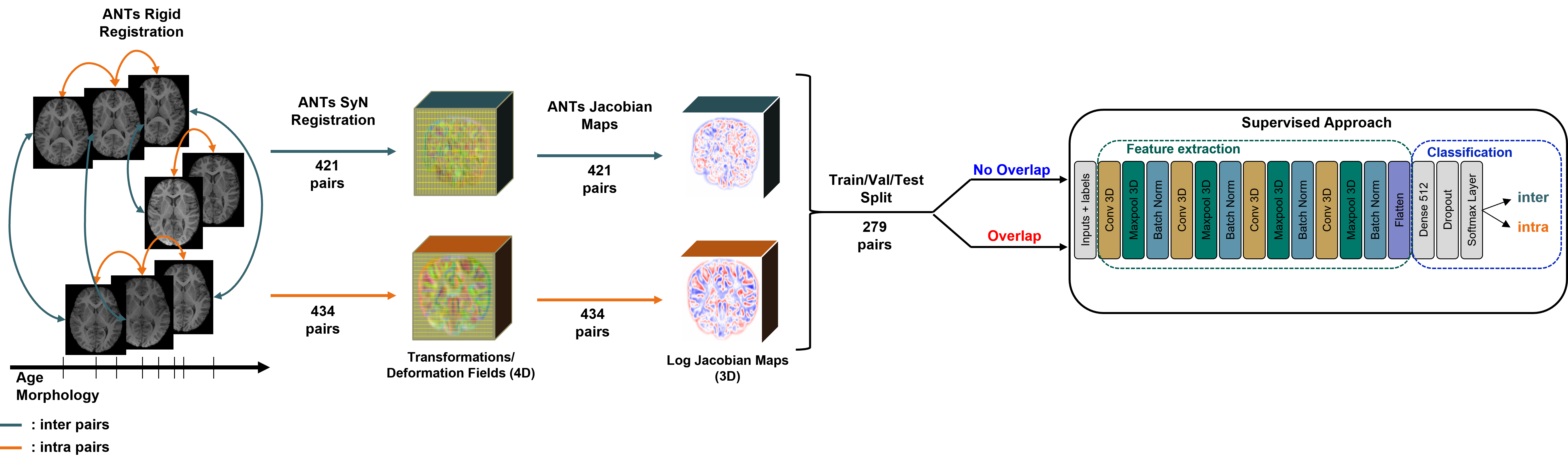
Longitudinal T1-weighted MRI (N = 247 images) of 64 children (107 females) aged 2-to-8 years old from the Calgary Preschool Dataset4 was used. 434 intra-individual (i.e., two images of the same child at two different ages; age interval: 1.18 ± 0.03) and 421 inter-individual (i.e., two images of two different children of similar age; age interval: 0.013 ± 0.008) pairs of images were first rigidly registered. Affine registration was omitted to keep variations regarding the overall brain growth. Then, elastic SyN ANTs registration5 was done to extract log valued Jacobian maps allowing the images to be normalized between -1 (local volume expansion) and 1 (local volume contraction), with zero indicating no change. The 855 pairs were separated into train (70%), validation (20%) and test (10%) sets. Two scenarios were examined: one with overlaps and the other with no overlaps between image pairs in the train and test sets from the same subjects. In standard practice, the test set typically avoids data duplication from subjects in both train and test sets. However, in this study, we explore if exposure to one time-point or underlying information from the same subject, via log Jacobian maps, aids in the classification task. Using 10-fold cross-validation, 10 sets with no overlaps were created (resulting in 279 pairs). In the overlap scenario, 279 pairs were randomly chosen, ensuring a 50/50 split between intra and inter pairs, as depicted in Fig. 1 for balanced train/validation/test sets. Data augmentation at varying angles was implemented for image diversification. The architecture for both scenarios is a 17-layer 3D CNN inspired by Zunair et al.6 trained for 100 epochs and a batch size of 2 with a binary cross entropy loss. The whole pipeline is available on Fig. 2. Finally, performances of label classification were evaluated with accuracy and F1 score (precision and recall) metrics.Results & Discussion
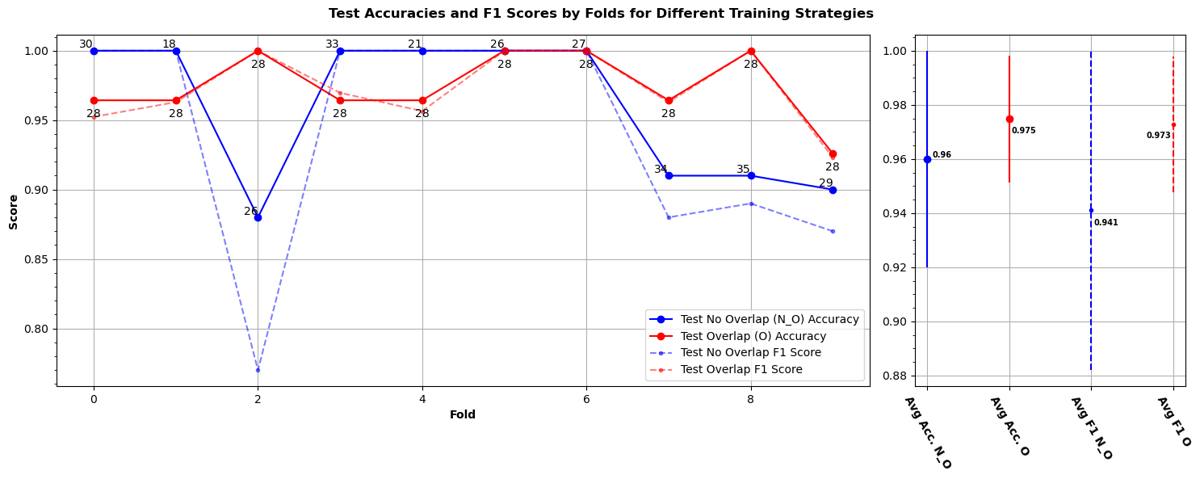
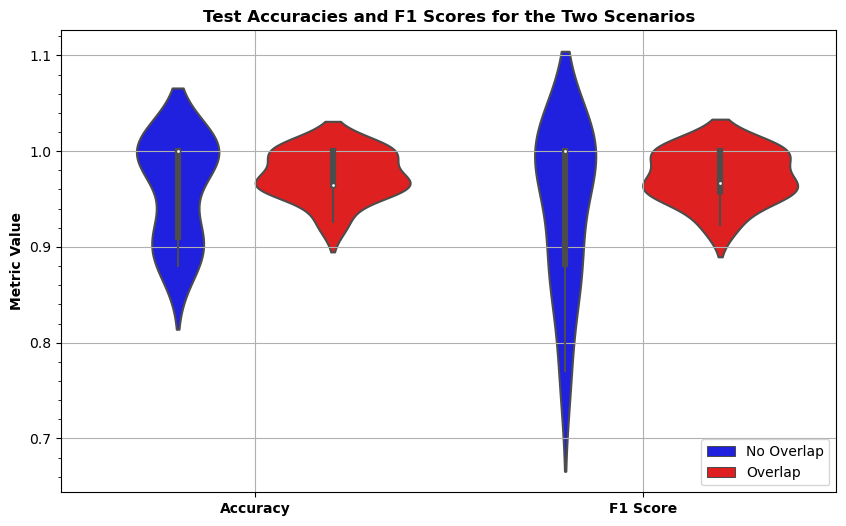
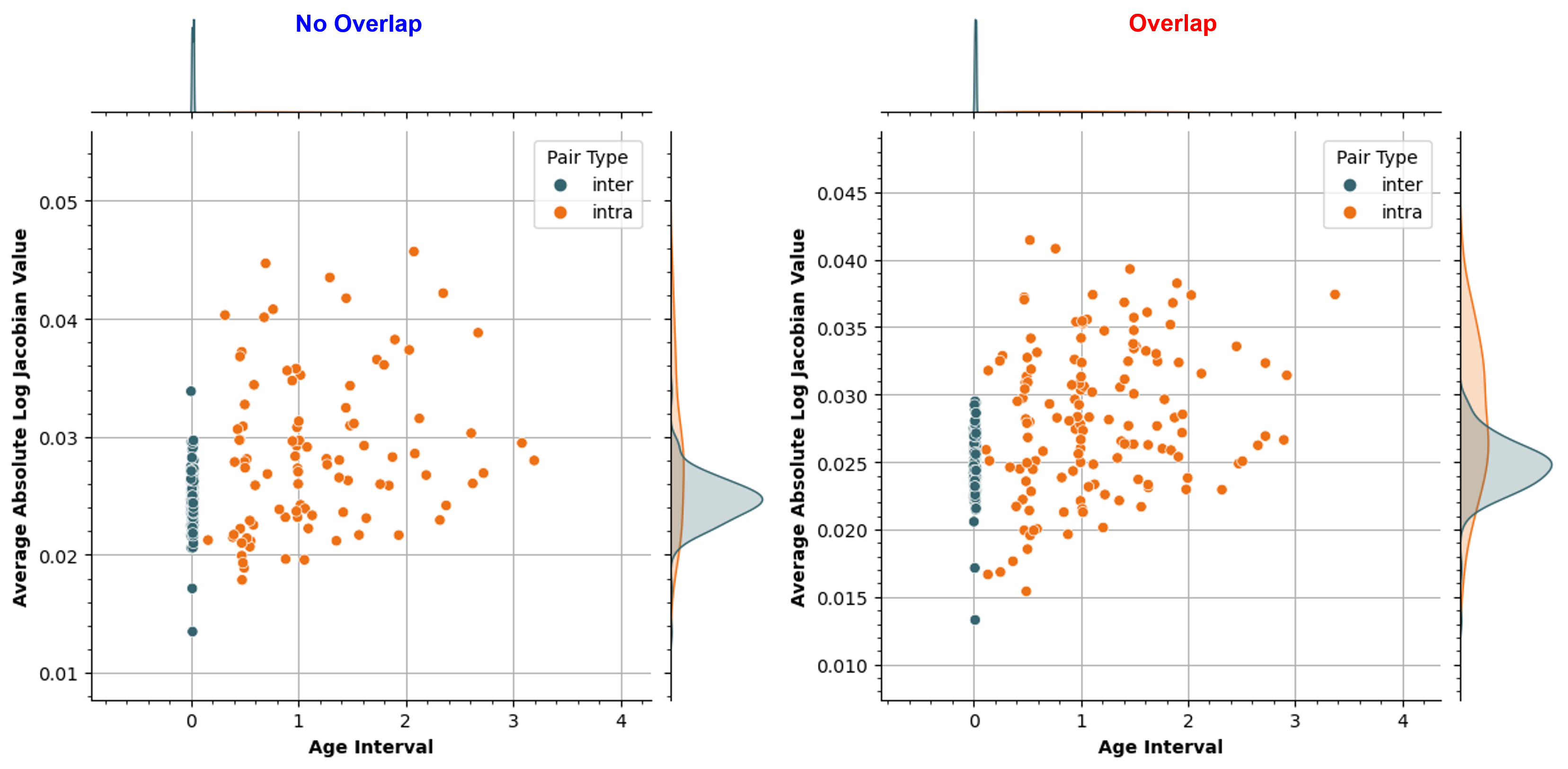
Fig. 3 and Fig. 4 show that the overlap scenario achieved higher accuracy (0.98 ± 0.02) and F1 score (0.97 ± 0.03) on average over 10 splits, surpassing the no overlap scenario (accuracy 0.96 ± 0.05; F1 score 0.94 ± 0.08). While this difference in scores highlights the impact of having overlaps, it's important to note that the no overlap scenario still yields good prediction metrics. The distributions of average absolute Jacobian values, organized by age interval and pair type for both scenarios, are depicted in Fig. 5. It suggests that the network could not simply separate these two types of pairs based on their distributions of global log Jacobian values as the two are overlapping. Higher scores in the overlap scenario imply a more robust capability to discern between intra and inter-individual pairs, strengthening the model's ability to accurately classify and differentiate deformations in pediatric MRI. The superior performance in the overlap scenario aligns with expectations, benefiting from repeated information in the test set, likely boosting the model's understanding of deformations and improving classification.Conclusion
This work successfully differentiates log Jacobian maps derived from intra and inter-individual pairs in pediatric MRI. The overlap scenario showed higher accuracy and F1 score, which could help better understand changes related to brain development, aging, pathologies, and treatments by subsequently extracting neurodevelopmental trajectories. Future research includes exploring varying age intervals for inter-individual pairs and an unsupervised variational autoencoder approach for enhanced pattern differentiation without labels.Acknowledgements
This study was supported by Polytechnique Montréal, by the Canada First Research Excellence Fund, by the TransMedTech Institute and by the Research Centre of the Sainte-Justine University Hospital.References
1. Bottenhorn KL, Cardenas-Iniguez C, Mills KL, Laird AR. Profiling intra-and inter-individual differences in child and adolescent brain development. bioRxiv. Published online 2022. https://www.biorxiv.org/content/10.1101/2022.12.19.521089.abstract
2. Rutherford S, Kia SM, Wolfers T, Fraza C, Zabihi M, Dinga R, et al. The normative modeling framework for computational psychiatry. Nat Protoc. Published online June 1, 2022. doi:10.1038/s41596-022-00696-5
3. Bethlehem RAI, Seidlitz J, White SR, Vogel JW, Anderson KM, Adamson C, et al. Brain charts for the human lifespan. Nature. 2022;604(7906):525-533.
4. Reynolds JE, Long X, Paniukov D, Bagshawe M, Lebel C. Calgary Preschool magnetic resonance imaging (MRI) dataset. Data Brief. 2020;29:105224.
5. Avants BB, Epstein CL, Grossman M, Gee JC. Symmetric diffeomorphic image registration with cross-correlation: evaluating automated labeling of elderly and neurodegenerative brain. Med Image Anal. 2008;12(1):26-41.
6. Zunair H, Rahman A, Mohammed N, Cohen JP. Uniformizing Techniques to Process CT Scans with 3D CNNs for Tuberculosis Prediction. In: Predictive Intelligence in Medicine. Springer International Publishing; 2020:156-168.
Figures