4839
A Generalized Real-time Frequency Adjustment Approach for MRSI1Siemens Healthcare Limited, Oakville, ON, Canada, 2Siemens Medical Solutions, Malvern, PA, United States
Synopsis
Keywords: System Imperfections, Spectroscopy
Motivation: Spectroscopy is sensitive to frequency drift. After running sequences that have a high gradient duty-cycle, frequency continues to drift due to gradient cooling.
Goal(s): To propose a generalized prospective real-time frequency correction that can be applied to imaging and spectroscopic sequences, where TR-variant and -invariant events are separable in time.
Approach: Real-time frequency adjustment was implemented for CSI, using a navigator placed where the spin phase is consistent across TR cycles prior to the CSI readout.
Results: Phantom measurements with the generalized navigator provide accurate estimates of the frequency drift, thereby minimizing spectral distortion and providing an improved baseline in the final spectra.
Impact: Prospective real-time frequency adjustment using a generalized navigator approach, where the spin phase is consistent across TR cycles, can be applied to spectroscopic imaging to correct for frequency drift caused by gradient heating and cooling.
Introduction
A stable B0 field is important for maintaining spectral quality; however, frequency drifts can be induced by imaging protocols that make use of a high gradient duty cycle, such as fMRI and diffusion imaging. When the RF pulse frequency drifts away from the resonance frequency, water suppression and metabolite signal quality is affected. A recent multi center study has assessed the frequency drift on 3T platforms from multiple scanner vendors, where the median drift after a 5-minute fMRI scan was 1 Hz, and as high as 10 Hz in some cases (1).Various prospective frequency correction techniques have been developed, such as an interleaved approach that can switch between acquiring a localized PRESS water reference signal and water suppressed MEGA-PRESS (2). Other prospective approaches use an image-based EPI navigator before the single voxel spectroscopy (SVS) readout, which can additionally be used for motion correction (3). A recent prospective frequency correction technique, involving no additional pulse events, inserted a 1 ms FID acquisition window after the first CHESS water suppression RF pulse in a MEGA-PRESS SVS acquisition (4).
We propose a more generalized approach, termed a generalized real-time frequency adjustment (RFA) navigator, that can be applied to imaging and spectroscopic imaging sequences using an asymmetric non-echo forming FID acquisition window.
Methods
A CSI sequence was modified to insert a 1 ms FID acquisition window for RFA after spatial location RF pulses and subsequent gradient crushers (TR-invariant events) and before the phase-encode gradients (TR-variant events). The FID signal must be acquired when the 0th order gradient moments are refocused. This condition is consistent and TR-invariant. This assumes any incidental phase change is attributed to non-sequence invoked phases such as from temperature changes. In this study, we assume there is no motion contributing to phase changes. The frequency is calculated in real-time over an adjustable sliding window (typically 7 TRs), and the system frequency is updated every TR. For comparison, the method used in (4) was also implemented with a CSI sequence where the navigator is non-selective.All phantom measurements were performed using a 3T system (Siemens MAGNETOM Prisma, Erlangen, Germany) with a 2-L Agar metabolite phantom. Three separate CSI scans were acquired, with each following a diffusion acquisition (1.7x1.7x4 mm3 with 64 directions, b=3000 sec/mm2, 5 averages, 16:43 minutes) to induce gradient heating and cooling. The CSI acquisitions used TE/TR=40/1500 msec, 13x13x15 mm3 voxel, 12x12 grid, 6 averages, 12:15 minutes, FWHM=13.7 Hz, with i) no RFA, ii) non-selective RFA (prototype sequence), and iii) generalized RFA (prototype sequence). The measured frequency was saved to a text file while the scan was running and plotted in Matlab R2019a.
Results
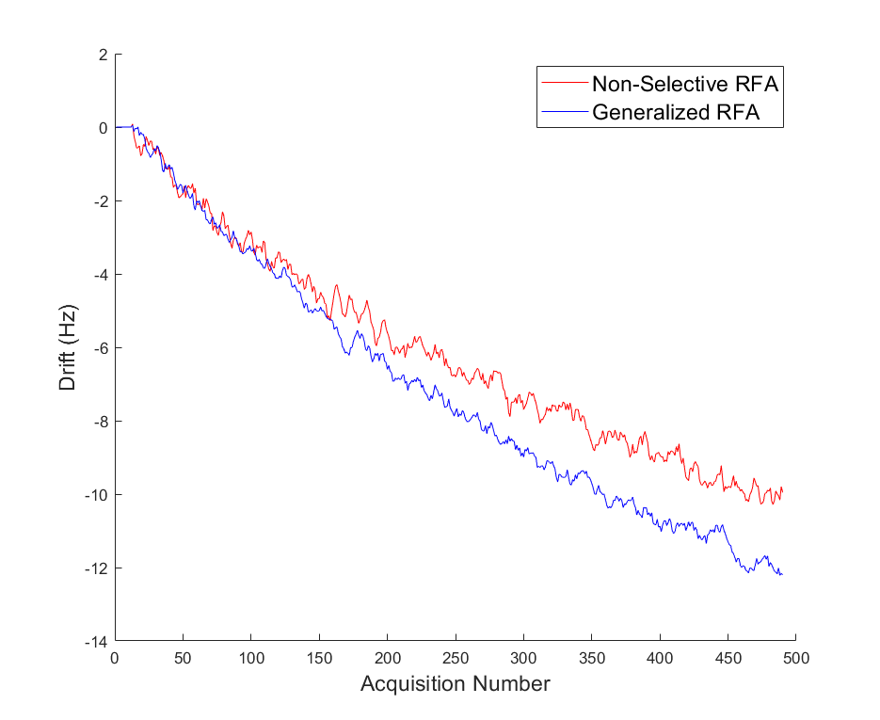
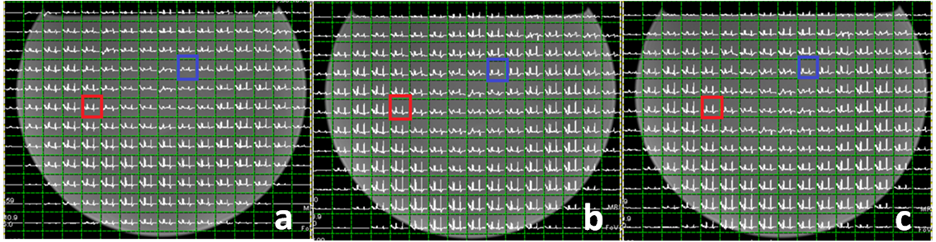
Figure 1 shows the frequency drift measured in real-time for two CSI acquisitions. The non-selective RFA navigator corrected for an 11 Hz shift in the system frequency, while the generalized RFA navigator corrected for a 13 Hz shift in the system frequency. The non-selective RFA navigator appeared to include more noise, with slightly higher mean absolute frequency jumps between acquisitions (0.128±0.096 Hz, compared to 0.094±0.069 Hz for the generalized RFA).Figure 2 shows the comparison of spectral maps acquired with and without RFA, where the prospective frequency correction shows better signals (see lateral and lower side in the spectral map) than the uncorrected. The upper part of the map suffers from field inhomogeneity due to phantom-air interface and the central part experiences a poor B1 efficiency.
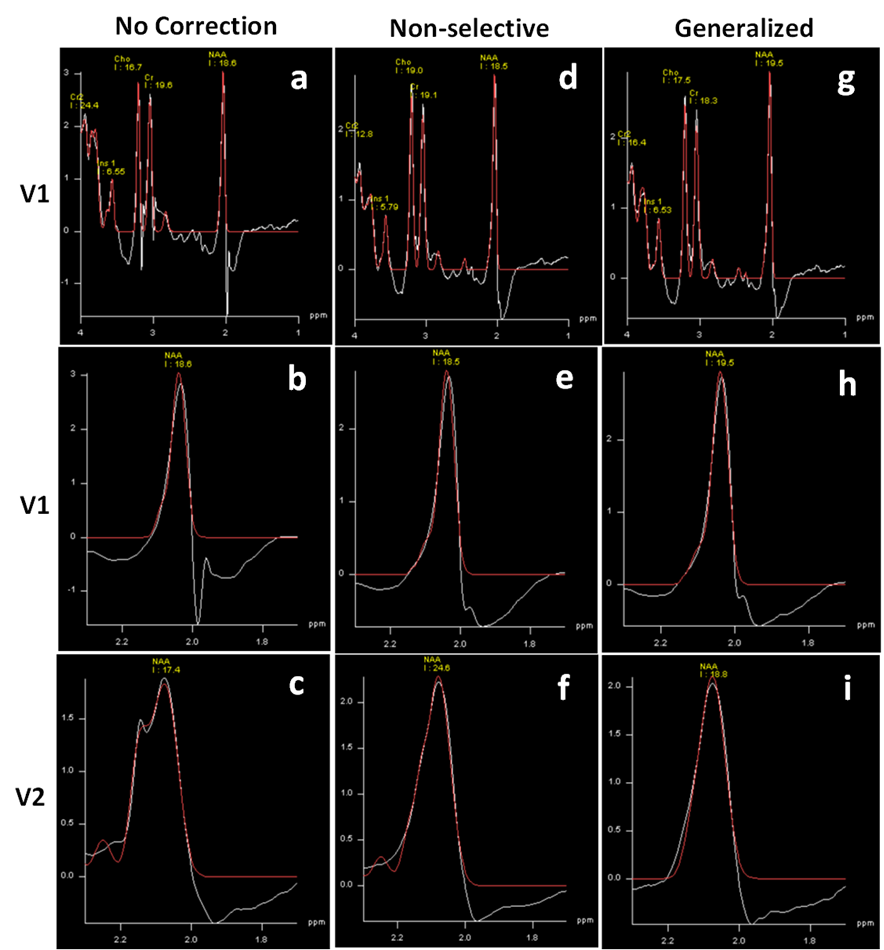
Figure 3 shows the comparison of spectral signals from two representative voxels, one from a reasonable location (V1) and one near the field-inhomogeneous location (V2). At V1, spectral signal zoomed in around NAA shows a better baseline and a slightly narrower spectrum in the frequency corrected spectra, with the generalized navigator (h) being slightly better than the non-selective RFA navigator (e). At V2, the uncorrected NAA signal shows a split peak, whereas the corrected ones maintain the NAA peak shape.
Discussion
This work has shown that a generalized RFA can be applied to CSI to correct for frequency drift caused by gradient heating and cooling, where the frequency estimation is done only on the imaging ROI. The non-echo forming navigator with a short readout (high readout bandwidth) of water suppressed signal has sufficient SNR with the sliding window approach. Minimum TE allowable may increase slightly but the proposed technique may be considered for cases where the benefit outweighs the min TE restriction. The generalized RFA navigator had, on average, smaller frequency jumps between acquisitions compared to the non-selective RFA navigator which includes signal from outside of the shim-optimized volume of interest.Acknowledgements
No acknowledgement found.References
- Steve C N Hui et al. Frequency drift in MR spectroscopy at 3T. NeuroImage (2021) 241: 118430.
- Richard A E Edden, Georg Oeltzschner, Ashley D Harris, Nicolaas A J Puts, Kimberly L Chan, Vincent O Boer, Michael Schär, and Peter B Barker. Prospective frequency correction for macromolecule-suppressed GABA editing at 3T. Journal of Magnetic Resonance Imaging (2016) 44:1474–1482.
- Aaron T. Hess, M. Dylan Tisdall, Ovidiu C. Andronesi, Ernesta M. Meintjes, and Andre J. W. van der Kouwe. Real-Time Motion and B0 Corrected Single Voxel Spectroscopy Using Volumetric Navigators. Magnetic Resonance in Medicine (2011) 66:314–323.
- Sinyeob Ahn, Tongbai Meng,
Dieter J. Meyerhoff, and Gerhard Laub. MEGA-PRESS Single-voxel Spectroscopy
for GABA J-editing with Real-time Frequency Adjustment. Proceedings of
ISMRM (2016) 4008.
Figures