4829
Open-Source Algorithm for Automatic Magnetic Susceptibility Determination from Field Maps1Division of Medical Physics, Department of Diagnostic and Interventional Radiology, University Medical Center Freiburg, Faculty of Medicine, University of Freiburg, Freiburg, Germany
Synopsis
Keywords: Software Tools, Susceptibility
Motivation: The magnetic susceptibility is a fundamental material property for MR and NMR equipment engineering. The literature provides several theoretical solutions to measure the magnetic susceptibility. However, an openly available implementation that allows to determine the magnetic susceptibility automatically is missing.
Goal(s): Develop a non-proprietary approach to determine the magnetic susceptibility from measured field maps.
Approach: Measure the field map of a cylindrical sample. Develop a Python program to extract the magnetic susceptibility of the sample.
Results: The measured reference samples reflect the magnetic susceptibility of the literature. Code for data processing is available through the open access repository.
Impact: Our research provides a programmatic solution to automatically determine the magnetic susceptibility of cylindrical samples from field map measurements in MRI systems. This will aid MR and NMR equipment engineers to measure the magnetic susceptibility of any material of interest.
Introduction:
Achieving a consistent magnetic field is crucial for most magnetic resonance experiments. Therefore, from an MR engineering perspective, it's essential to carefully manage and minimize any magnetic field distortions in the design of equipment located near the object of interest during measurements, including the object itself.The literature provides several theoretical solutions to measure and determine the magnetic susceptibility. Furthermore, many materials have already been characterized and can be found in the literature [1] and material databases. However, the ever expanding zoo of polymers and available metal alloys can make it difficult to find adequate values for the magnetic susceptibility. The magnetic susceptibility of a cylindrical sample can be measured with an MRI system as described by Wappler et al. [1].
In practice, writing the data processing pipeline just for one or two measurements is often a barrier to perform the measurements. Potentially resulting in the use of roughly estimated values for the magnetic susceptibility and suboptimal equipment design.
With this work, we provide an openly available python script that allows anyone with access to an MRI system to measure a field map of a cylindrical sample and determine its magnetic susceptibility.
Methods:
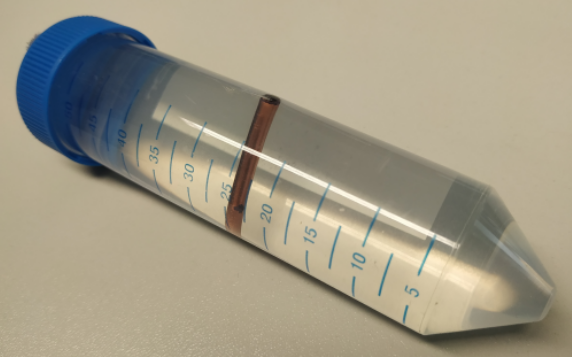
In this study, we measured the field map of cylindrical samples. The samples were placed in the center of a 50 ml Falcon tube orthogonal to its rotational symmetry axis and immersed in demineralized water. The prepared sample is depicted in Figure 1.The field maps were obtained with a 9.4 T Bruker BioSpec 94/21 system. A quadrature birdcage Tx/Rx coil with 38 mm inner diameter for RF excitation and signal acquisition was used. The field maps were obtained with a 3D double gradient echo sequence with TE1 = 1.5 ms TE2 = 3.5 ms and TR = 30 ms and isotropic resolution of 0.117 mm.
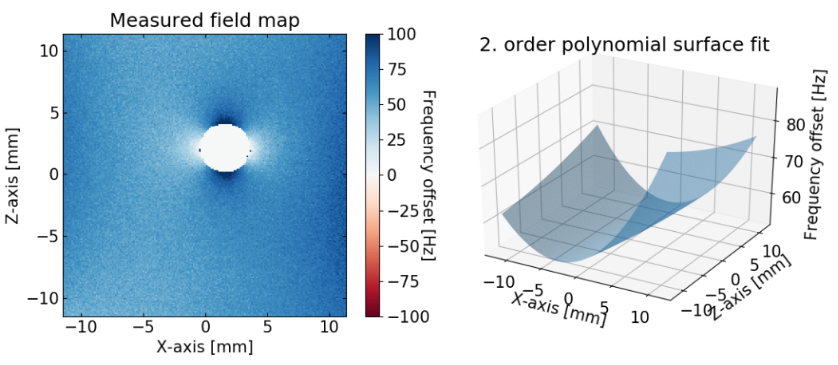
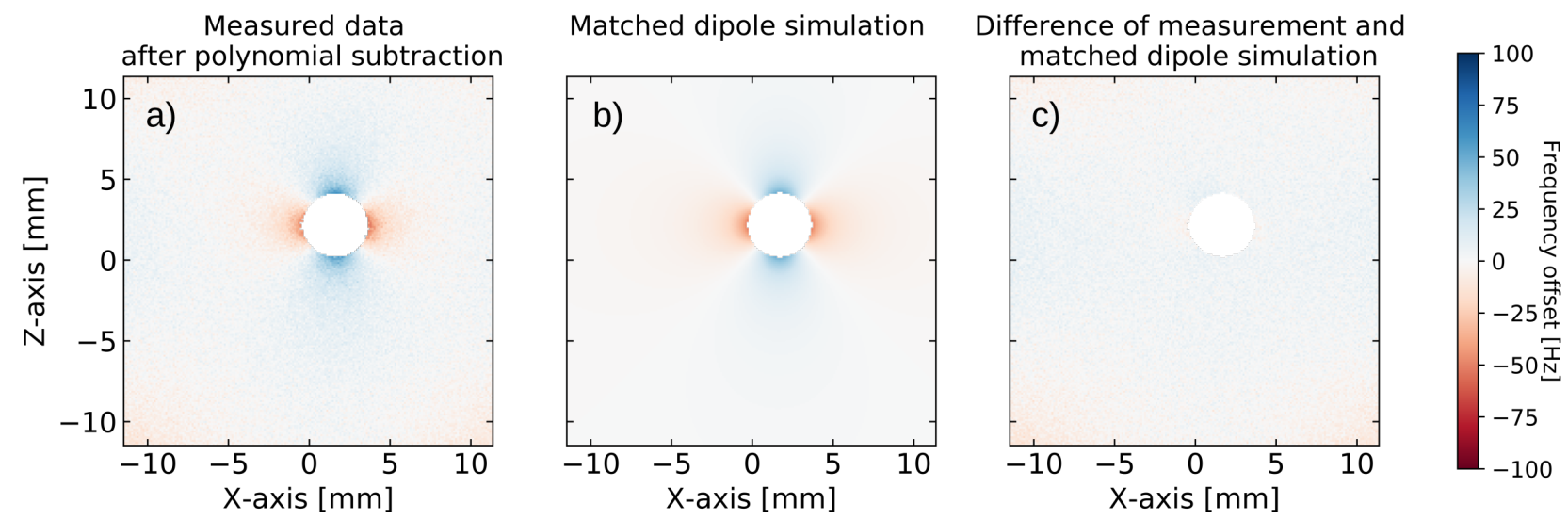
The developed python program was used to do the following: Determine the sample position using a discrete convolution to find the position of the sample. Then, the measured data are masked to exclude the values at the position of the cylinder in the measurement. The left side of Figure 2 shows an example of this masked data. A second order polynomial is subtracted from the masked field map data, to compensate for imperfect shimming during the measurement. This is illustrated on the right side of Figure 2. Figure 3a) shows the field map after subtraction of the second order polynomial.
The prepared field maps were then fitted with an analytical model derived from the first order solution to Maxwell equations in integral form. The susceptibility was determined by varying the susceptibility value in the analytical simulation, until the difference of measurement and simulation was minimized. The resulting simulated dipole is illustrated in Figure 3 b). Figure 3 c) shows the difference of the measured and matched dipole simulation data. The reference value for the magnetic susceptibility of water χV = −9.032 × 10⁻⁶ from [2] was used for the calculations.
A link to the python script for the data processing can be found in the Acknowledgment section.
Results:
We determined the volume susceptibility in the SI system (dimension less number) for Poly(methyl methacrylate) (PMMA), High-density polyethylene (HDPE) and Copper. The results are listed in Table 1. The measured magnetic susceptibility values confirmed the literature values reasonably well.Table 1: Volume susceptibility (SI system)
| Material | Measured | Literature |
| PMMA | -9.065×10⁻⁶ | −9.06×10⁻⁶ [1] |
| HDPE | -9.510×10⁻⁶ | −9.67 ×10⁻⁶ [1] |
| Copper | -9.307×10⁻⁶ | −9.30×10⁻⁶ [3] |
Discussion:
Our proposed method allows to measure the magnetic susceptibility of cylindrical samples. Providing the Open-Source Python Algorithm (see Acknowledgements) will lower the barrier to measure the magnetic susceptibility.Acknowledgements
This work was funded in part through the German Federal Ministry of Education and Research under grant number 13GW0356B. And in part through the National Institute of Health under grant Nr. NIH R01 EB032378 and NIH U24 NS120056.
The authors thank the Core Facility AMIRCF (DFG-RIsources N° RI_00052) for support with measurements at James and Enno with funding number: INST 39/1224-1.
The python code for the data processing can be found at: “https://gitlab.com/fpm9000/mag _sus_finder”.
References
[1] M. C. Wapler, et al., Magnetic properties of materials for MR engineering, micro-MR and beyond, Journal of Magnetic Resonance, vol. 242, pp. 233–242, May 2014.
[2] J. F. Schenck, The role of magnetic susceptibility in magnetic resonance imaging:MRI magnetic compatibility of the first and second kinds, Medical Physics, vol. 23,pp. 815–850, June 1996.
[3] Bowers, R. Magnetic Susceptibility of Copper Metal at Low Temperatures. Phys. Rev. 102, 1486–1488 (1956).
Figures