4827
QSM-CI: An automated continuous QSM challenge1School of Electrical Engineering and Computer Science, The University of Queensland, Brisbane, Australia, 2School of Electrical Engineering and Computer Science, The University of Queensland, St Lucia, Australia, 3Queensland Digital Health Centre, The University of Queensland, Brisbane, Australia
Synopsis
Keywords: Electromagnetic Tissue Properties, Challenges, Quantitative Susceptibility Mapping
Motivation: Reconstruction challenges for Quantitative Susceptibility Mapping (QSM) offer a common evaluation but are challenging to run and offer only a single snapshot of algorithm performance in time.
Goal(s): To develop a QSM challenge with continuous integration (QSM-CI), enabling automatic, transparent evaluation of community-submitted algorithms across diverse datasets and metrics.
Approach: QSM-CI was implemented using GitHub Actions and a user interface for displaying metrics and collecting community visual ratings, which inform a qualitative Elo metric alongside quantitative assessments.
Results: The QSM-CI prototype implementation is publicly available and has been tested using a range of QSM algorithms.
Impact: QSM-CI will facilitate a QSM challenge that allows for continuous evaluations using current and future datasets, algorithms, and metrics. This ensures the continued accessibility of the challenge and continued relevance as new methods, metrics and test data are made available.
Introduction
Quantitative Susceptibility Mapping (QSM) is an MRI phase post-processing technique that derives the magnetic susceptibility distribution of tissues and is mostly applied in human brain imaging applications1. QSM involves a complex post-processing pipeline that involves solving multiple ill-posed inverse problems. This ill-posedness makes QSM evaluation challenging, with the first QSM challenge2 using a silver-standard COSMOS3 acquisition as the ground truth and the second4 using a realistic in-silico head phantom5. Public challenges like these are great opportunities to involve the QSM community and report on the current landscape of QSM algorithms under a common evaluation framework. However, running these challenges is a lot of effort, and there is an opportunity to build an open-source platform for continuous QSM evaluation that is maintained by the community and is always available to submit algorithms, metrics or updated test data and remain relevant into the future. This work presents a continuous QSM challenge platform called QSM-CI, with a prototype implementation published using Back4app and automated using GitHub Actions (https://github.com/QSMxT/QSM-CI). Users can submit algorithms to automatically evaluate against a range of simulated datasets using quantitative metrics and a qualitative Elo rating system.Methods
The QSM-CI GitHub project includes instructions on how to generate and download test datasets, run QSM algorithms and compute metrics.The datasets include simulations for gradient-echo (GRE) magnitude and phase images and other necessary data required for QSM reconstruction using the Brain Imaging Data Structure6 (BIDS). These simulations include a susceptibility phantom consisting of cylinders with constant susceptibility values and data derived from a realistic in-silico head phantom5. The forward simulation was implemented using the qsm-forward pip package7.
The algorithms include user-submitted instructions to execute QSM reconstruction pipelines against the BIDS dataset. The current submissions include algorithms available in QSMxT8,9.
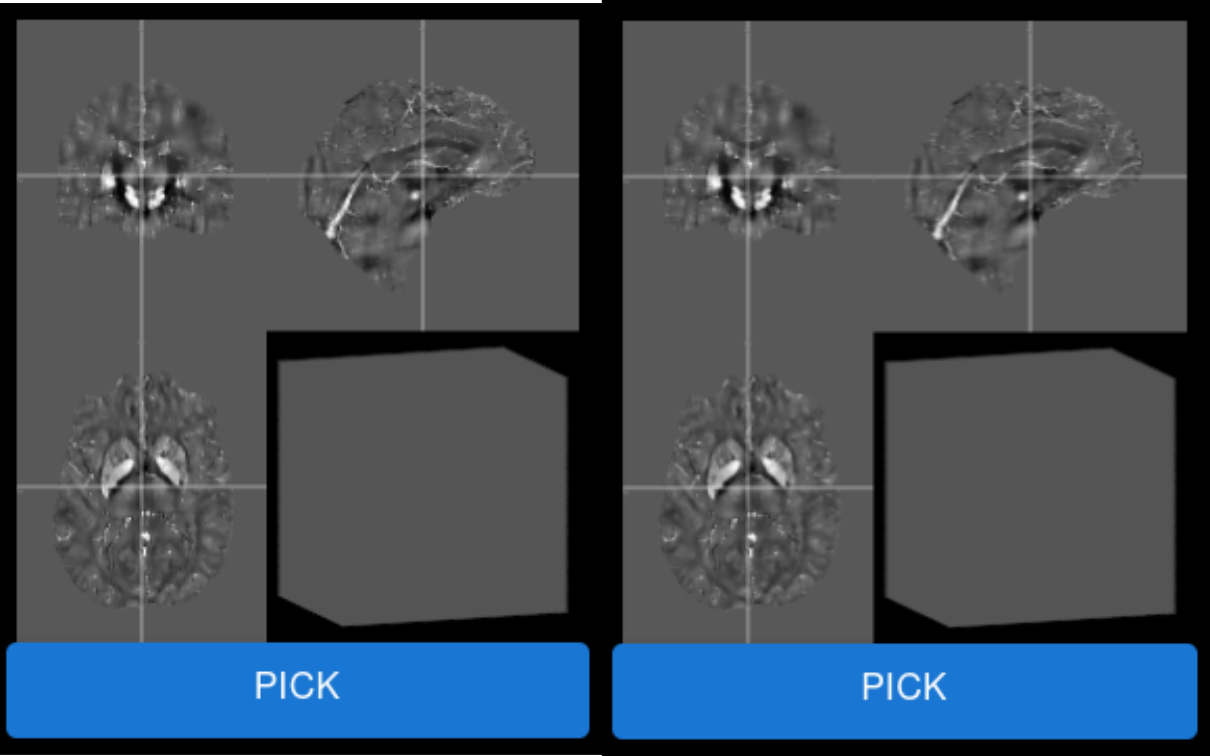
The metrics include the quantitative metrics from the second QSM challenge, including RMSE, NRMSE, HFEN, XSIM10, MAD, CC and GXE, and a qualitative Elo metric. After a user submits or updates one of their algorithms via a pull request, a GitHub Action will automatically run their pipeline against the datasets and evaluate it using quantitative metrics, publishing them to a Parse backend. Qualitative metrics remain blank until the community contributes to the anonymised evaluation of the final images in a frontend interface using Niivue11 (see Figure 1).
Results
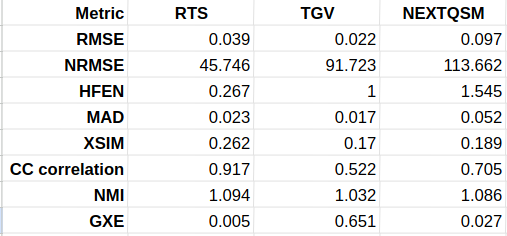
Multiple algorithms have been submitted to QSM-CI with metrics automatically computed and uploaded to the database (see Figure 2).Discussion and conclusion
A platform for automatically evaluating QSM algorithms was developed and published using GitHub and automated using GitHub Actions. A frontend interface was developed to display the computed metrics for each algorithm against the test datasets, along with an interactive frontend that uses Niivue11 to allow users to interactively rate image quality and determine a qualitative Elo ranking. The QSM-CI project provides a proof-of-concept for an always-online QSM challenge platform to streamline the evaluation of QSM algorithms.Acknowledgements
No acknowledgement found.References
[1] Deistung A. et al., NMR Biomed., 2017; [2] Langkammer C. et al., MRM, 2018; [3] Liu T. et al., MRM, 2009; [4] Bilgic B. et al., MRM, 2021; [5] Marques J. P. et al., MRM, 2021; [6] Gorgolewski K. J. et al., Sci Data, 2016; [7] Stewart A. W. et al., GitHub, 2023, https://github.com/astewartau/qsm-forward [8] Stewart A. W. et al., GitHub. 2020. https://qsmxt.github.io/; [9] Stewart A. W. et al., MRM, 2022; [10] Milovic C. et al., Proc Intl Soc Mag Reson Med, 2022; [11] Hanayik T., Rorden C. et al., GitHub, 2023, https://github.com/niivue/.Figures