4743
Assessing Liver Fibrosis with Diffusion-weighted MRI-based Virtual Elastography: Comparison with US Shear-wave Elastography1Department of Radiology, Zhongshan Hosptial of Fudan University, Shanghai, China, 2Zhongshan Hospital of Fudan University, Shanghai, China, 3MR Application Development, Siemens Shenzhen Magnetic Resonance Ltd, Shenzhen, China
Synopsis
Keywords: Liver, Liver
Motivation: Recent reports have shown a strong correlation between tissue water diffusivity and liver elasticity.
Goal(s): The aim to this study was to compare the performance of DW MRI-based virtual shear modulus (µDiff) and liver stiffness (LS) measured using US shear-wave elastography (SWE) for staging liver fibrosis.
Approach: We retrospectively analyzed µDiff and LS on the right liver lobe in 124 patients.
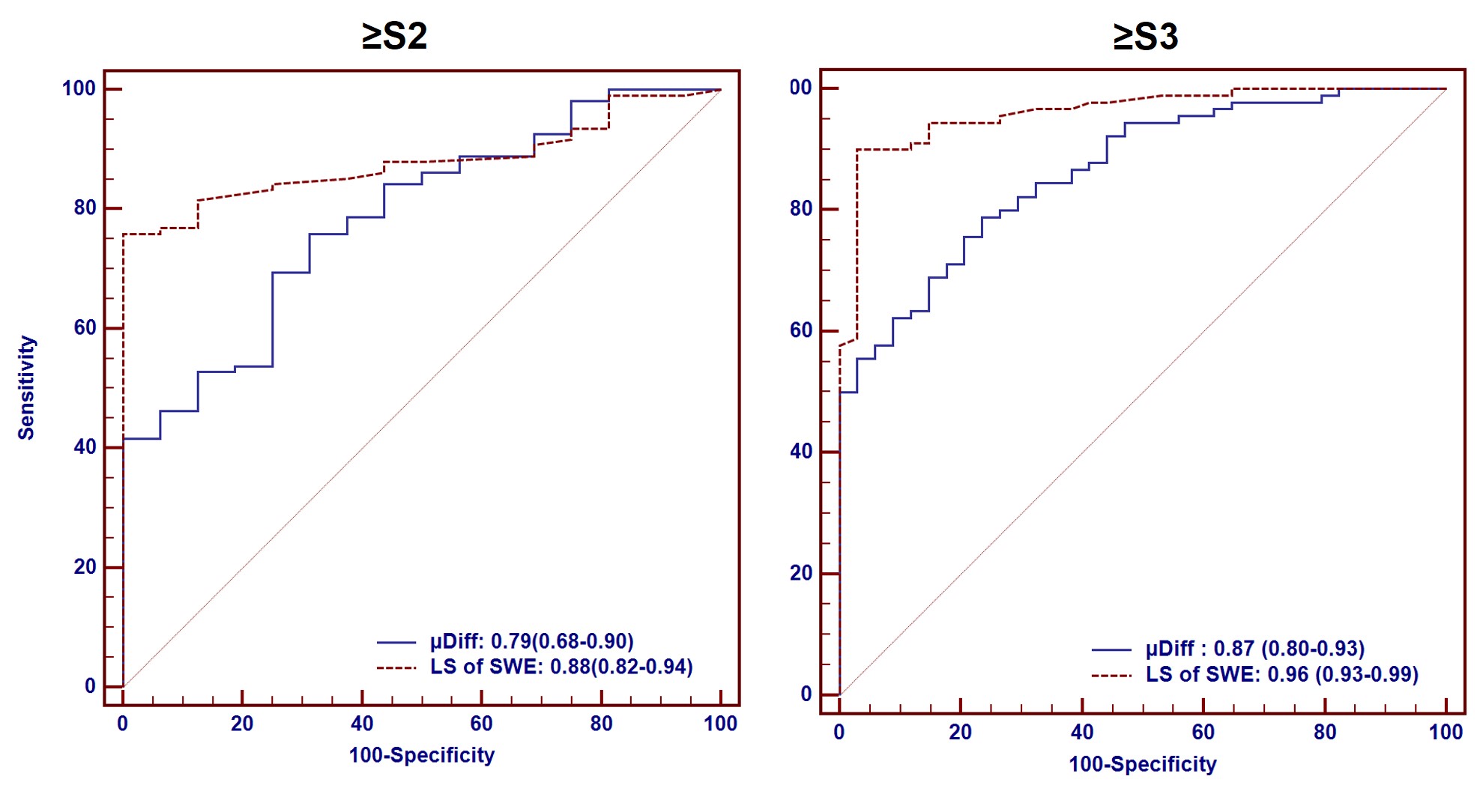
Results: Our results showed the area under the curve of LS was significantly higher than that of µDiff (0.96 vs. 0.87, P<0.05) for advanced fibrosis. However, no significant difference was found between LS and µDiff (0.88 vs. 0.79, P>0.05) for significant fibrosis.
Impact: Although DW MRI-based virtual shear modulus showed significant correlation with the histologic stages of fibrosis, it was inferior than liver stiffness measured using US shear-wave elastography for staging liver fibrosis.
METHODS: This retrospective study included 124 patients (90 men and 34 women; mean age, 55.3±11.2 years; age range, 26–84 years) who underwent multiple b-values DW MRI with a 1.5T MR scanner (MAGNETOM Aera, Siemens Healthcare, Erlangen, Germany) and SWE. Shifted apparent diffusion coefficient was calculated from DW MRI (b=200 and 1500 sec/mm2) and converted to DW MRI–based virtual shear modulus (µDiff) by using an in-house developed program based on MATLAB (Mathworks, Natick, Mass) according to the method proposed in the previous studies [1-2]. µDiff and liver stiffness (LS) of SWE were measured on the right lobe of the liver. Liver fibrosis stage was histologically determined according to Scheuer scoring system: S0 (n=6), S1 (n=10), S2 (n=18), S3 (n=21) and S4 (n=69). The µDiff and SWE were compared with fibrosis stage by Spearman's rank correlation coefficient. Receiver operating characteristic (ROC) curves for µDiff and LS were built and compared for diagnostic performance in staging liver fibrosis.
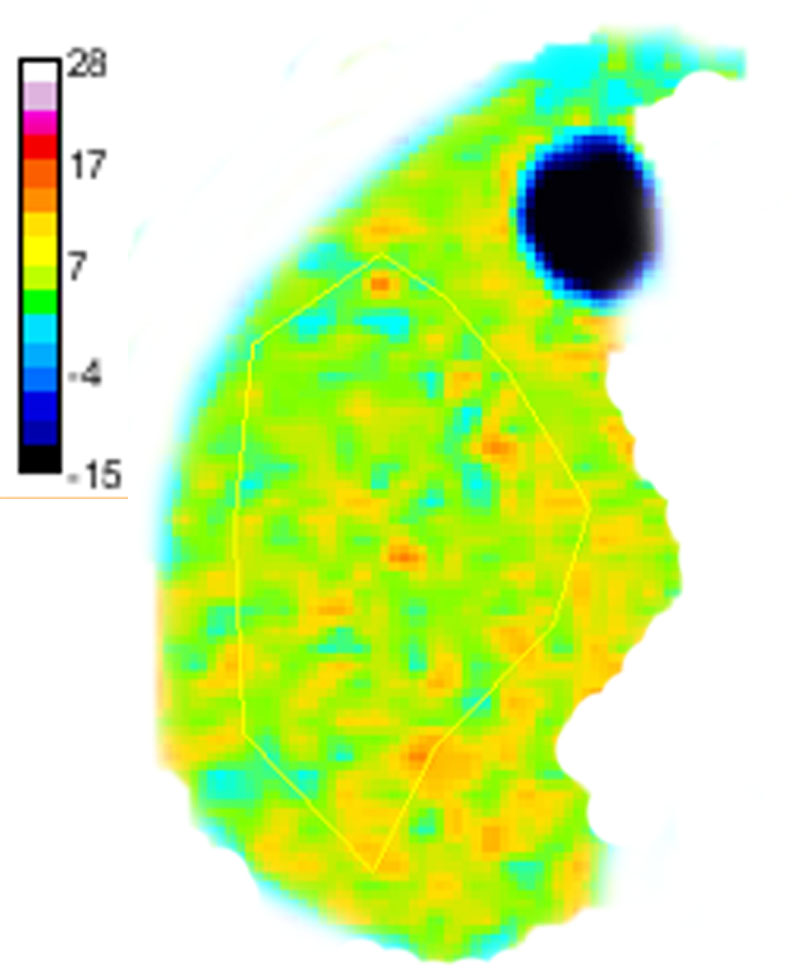
RESULTS: The representative image of DW MRI-based virtual shear modulus is shown in Fig.1. The µDiff and LS showed significant correlations with liver fibrosis stage (rho = 0.46, P < 0.001; rho = 0.76, P < 0.001). The ROC curves of µDiff and LS for the diagnosis of significant fibrosis and advanced fibrosis are shown in the Figs 2, and the areas under the curves of µDiff and LS were 0.79 (95% CI: 0.68-0.90) and 0.88 (95% CI: 0.82-0.94) for significant fibrosis, and 0.87 (95%CI: 0.80-0.93) and 0.96 (95%CI: 0.93-0.99) for advanced fibrosis, respectively. The area under the curve of LS was significantly higher than that of µDiff for advanced fibrosis (P < 0.05), but there was no significant difference between µDiff and LS for significant fibrosis (P > 0.05).
DISCUSSION: Diffusion-weighted (DW) imaging explores the increased hindrance of diffusion in water protons caused by the increased connective tissue in fibrotic liver parenchyma. [1-2]. Previous studies have demonstrated significant correlation between µDiff and MR elastography [1-2]. SWE enables assessment of liver fibrosis by measuring liver stiffness.
CONCLUSION: SWE is superior to DW imaging–based elastography for predicting liver fibrosis, especially for advanced fibrosis.
Acknowledgements
This work was supported by the Youth Project of National Natural Science Foundation of China (Grant No. 82202112), and Youth Project of Natural Science Foundation of Fujian Province (Grant No. 2023J05293)References
1. Marie-Luise Kromrey, Denis Le Bihan, Shintaro Ichikawa, Utaroh Motosugi. Diffusion-weighted MRI-based Virtual Elastography for the Assessment of Liver Fibrosis. Radiology. 2020, 295(1):127-135.
2. Denis Le Bihan,Shintaro Ichikawa, Utaroh Motosugi. Diffusion and intravoxel incoherent Motion MR imaging–based Virtual elastography: A Hypothesis-generating Study in the Liver. Radiology. 2017, 285(2):609-619
Figures