4732
APT-CEST properties of a new biocompatible copolymer p(MPC-AE)5-5 hydrogel phantom: a preliminary study1Clinical Research and Imaging Centre, South Australian Health and Medical Research Institute, Adelaide, Australia, 2Future Industries Institute, University of South Australia, Adelaide, Australia, 3Department of Chemical & Materials Engineering, National Central University, Taoyuan, Taiwan, 4Siemens Healthcare Pty Ltd., Adelaide, Australia, 5Siemens Healthcare GmbH, Germany, Germany
Synopsis
Keywords: Other Preclinical, CEST & MT, hydrogel
Motivation: Biocompatible materials with detectable APT effects are lacking for biomedical applications.
Goal(s): To validate the APT properties of a new synthesised biocompatible copolymer p(MPC-AE)55 hydrogel which has potential exchange between its MPC and AE cross-linkage.
Approach: An experimental phantom with variable copolymer concentration and existing egg protein model was imaged with a research application APT-CEST sequence at 3T and analysed both inline and using CEST-EVAL software.
Results: APT of the new hydrogel increased accordingly with its concentration and this was validated by results for egg protein which agreed with previous work. Both analysis methods were in agreement.
Impact: Understanding the properties of newly synthesized copolymer hydrogel extends its value in biomedical applications including potential for phantoms that could support translation of APT-CEST.
Introduction
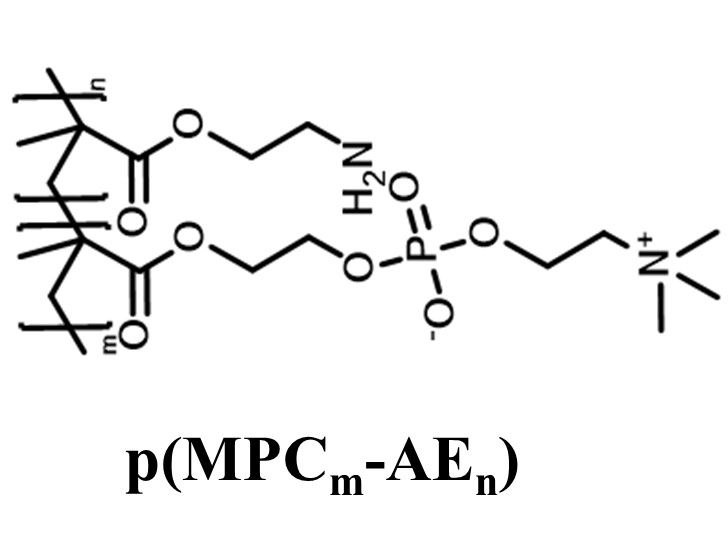
Biocompatible hydrogel is widely used in biomedical applications, including drug delivery and cancer imaging1-2, for cell viability and possibly monitoring treatment by observing the change in pH values1,2. Amide Proton Transfer (APT) is the common magnetisation transfer Chemical Exchange Saturation Transfer (CEST) contrast, and may be of use in brain cancer diagnosis2. Therefore, a biocompatible hydrogel with a detectable APT effect could be beneficial for biomedical applications. A newly synthesised copolymer, named p(MPC-AE)5-5, contains an amide linkage that cross-links to the 2-Methacryloyloxyethylphosphorylcholine (MPC) and 2-aminoethyl methacrylate (AE) polymers. The aim of the study is to evaluate the APT MRI effects on the copolymer hydrogel with known reference samples.Material and Methods
A hydrogel phantom was made using copolymer p(MPC-AE)5-5 with 0.5%, 1%, 2%, and 5% concentration (chemical structure shown in figure 1). A phosphate-buffered saline solution (PBS, pH7), raw egg white, cooked egg, and 30%, 65% and 100% egg white protein (Paleo Protein Powder, Protein Supplies Australia) were used as known reference samples3-4. A 3D gradient-echo research application APT-CEST acquisition was performed on a MAGNETOM Skyra 3T MR scanner (Siemens Healthcare; Erlangen, Germany) using a 64-channel head/neck coil. The signal resulting from a CEST saturation pulse train was acquired for the phantom with flip angle = 7o, TR = 4.11 ms, TE = 2.08 ms, FOV = 220 x 178 mm, matrix size = 128×104 interpolated to 256 x 208, compressed sensing acceleration factor = 5, bandwidth = 700 Hz/pixel and a total of 12 slices with 5mm slice thickness. The CEST saturation consisted of a train of 36 Gaussian‐shaped RF pulses, tpulse = 50 ms, tdelay = 5 ms, Tsat = 2.0 s, DCsat = 91%, B1 = 2.02 μT and relaxation time = 2400 ms. A total 30 z-spectral points were acquired with the saturation offset from -6 to +6 ppm using a 0.5 ppm increment with additional sampling at ± 3.5 ppm. The total acquisition time was 5 minutes and 40 seconds. A B0 map was acquired. Data was processed using the CEST-EVAL software from cest-sources.org (German Cancer Research Center, DKFZ, Heidelberg, Germany) written in Matlab (R2021a, The MathWorks, USA). The Z‐spectrum data were corrected for B0 with motion correction by the software. ROIs were manually drawn on APT maps to obtain the numerical data, was averaged across three slices.Results
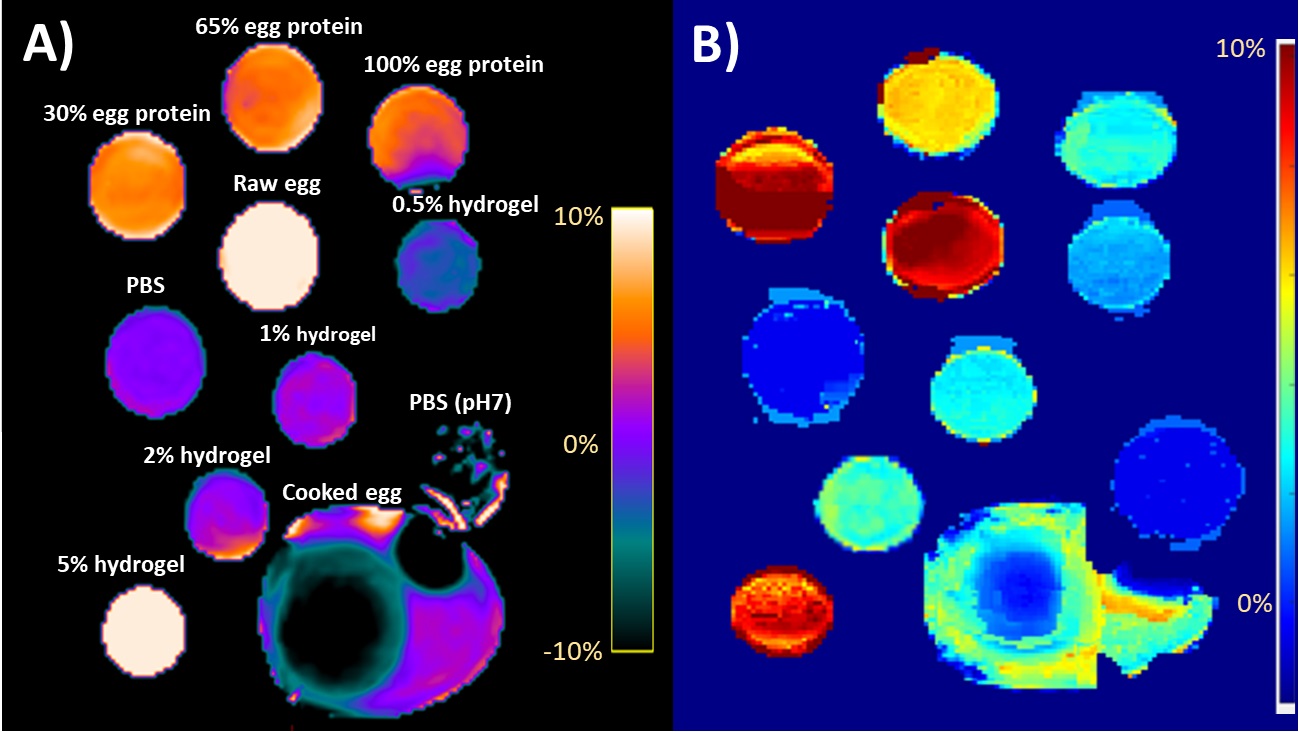
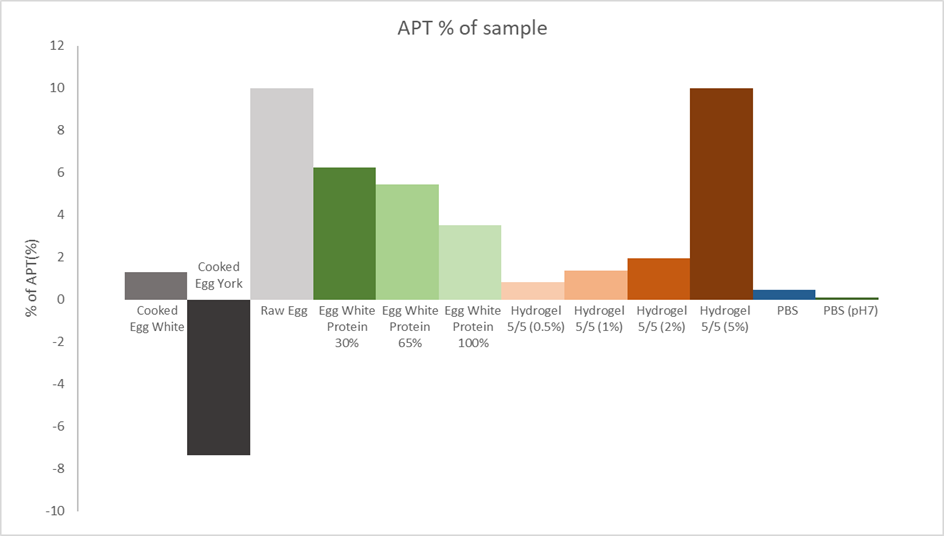
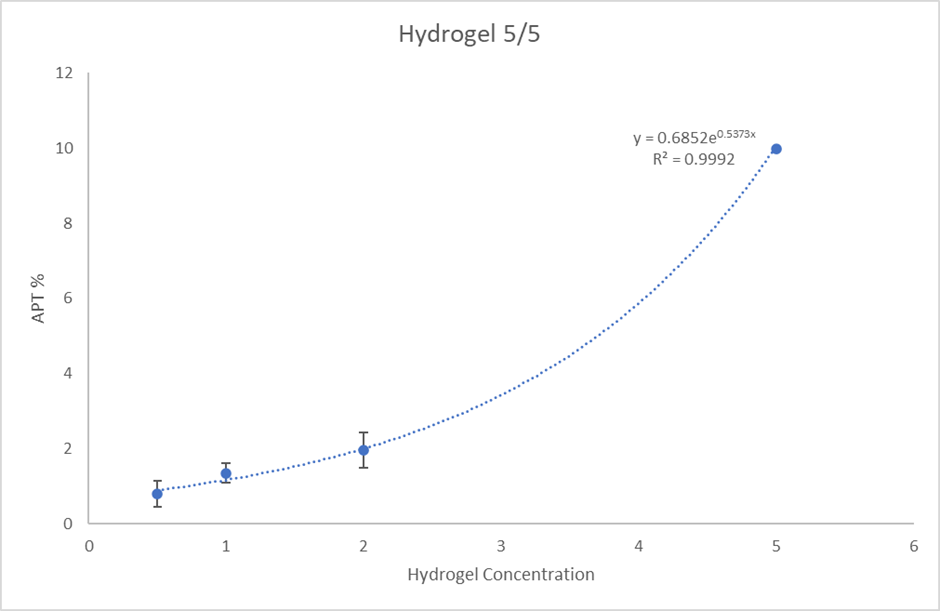
APT maps generated by the MRI scanner and offline toolbox show a high degree of similarity (Figure 2). The measurements indicate the highest values in raw egg white and a decreasing trend from 100% to 30% egg white protein solutions. The APT measurement is close to 10.0% in raw egg solution with low values in cooked egg. The APT measurement of the hydrogel is 0.8%, 1.4% and 1.9% and close to 10.0%, correspondingly from 0.5% to 5.0% concentration (Figure 3). Figure 4 shows the plots of the measurement of copolymer p(MPC-AE)5-5 hydrogel. The results fitted to an exponential relationship (R2 = 0.9992) as the concentration of hydrogel increased up to 5.0%.Discussion
We validated a biocompatible hydrogel with APT-CEST effect against an established egg protein model. Egg white has been used as a model of mobile tissue proteins for CEST imaging and current findings agree with previous work validating the technique3-4. Results generated from the scanner and off-line calculation were in good agreement, indicating either could be used for measurement. The low values from cooked egg show the effects of protein heat denaturation. Our results indicate that the new copolymer p(MPC-AE)5-5 demonstrates APT-CEST effects at 3T MRI and exponentially increases with its concentration. This is likely caused by the magnetisation transfer of protons between the MPC and AE cross-linkage.Conclusion
Copolymer p(MPC-AE)5-5 hydrogel demonstrates APT -CEST effects that increase exponentially with hydrogel concentration. This supports further research on the biomedical applications of copolymer p(MPC-AE)5-5. Having a standardised method for measuring CEST will aid the translation into widespread clinical use of CEST as a quantitative MRI biomarker.Acknowledgements
No acknowledgement found.References
- Han A, Huang J, To A.K.W, et al. CEST MRI detectable liposomal hydrogels for multiparametric monitoring in the brain at 3T. Theranostics. 2020;10(5):2215-2228.
- Huang J, Chen Z, Park S-W, et al. Molecular Imaging of Brain Tumors and Drug Delivery Using CEST MRI: Promises and Challenges. Pharmaceutics. 2022;14(2):45.
- Sui R, Chen L, Li Y, et al. Whole-brain amide CEST imaging at 3T with a steady-state radial MRI acquisition. Magn Reson Med. 2021;86(2):893–906.
- Zhou J, Yan K, Zhu H. A simple model for understanding the origin of the amide proton transfer MRI signal in tissue. Appl Magn Reson. 2012;42(3):393-402.
Figures