4729
Rapid Method for Chemical Shift Saturation Recovery (CSSR) Acquisition with 129Xe MR1State Key Laboratory of Magnetic Resonance and Atomic and Molecular Physics, National Center for Magnetic Resonance in Wuhan, Innovation Academy for Precision Measurement Science and Technology, Chinese Academy of Sciences - Wuhan National Laboratory for Optoelectronics, Wuhan 430071, China, 2University of Chinese Academy of Sciences, Beijing, China
Synopsis
Keywords: Biomarkers, Hyperpolarized MR (Gas), Dynamic Gas Exchange Spectroscopy, Look-locker, Chemical Shift Saturation Recovery, Rapid Acquisition
Motivation: Hyperpolarized 129Xe Chemical Shift Saturation Recovery (CSSR), commonly employed for assessing pulmonary physiological function, is time-consuming and prone to weak signals and potential errors at short exchange times.
Goal(s): To accelerate the acquisition of CSSR while ensuring the precise physiological parameter extraction.
Approach: Techniques of inversion recovery (IR) and look-locker (LL) were combined with conventional CSSR (refer to as IR-LL-CSSR), and the results were compared with that obtained by conventional CSSR and IR-CSSR.
Results: By using the proposed method (IR-LL-CSSR), the acquisition could be accelerated for eight times, and meanwhile preserve the accuracy of the extracted physiological parameters.
Impact: IR-LL-CSSR substantially accelerates CSSR acquisition with 129Xe MRS and also ensures a precise physiological parameter assessment, showing promise for improving the pulmonary assessment in clinic.
Introduction
Hyperpolarized 129Xe MR offers a non-invasive approach to quantify lung physiological function,1 wherein the quantitative parameters such as hematocrit (Hct), time constant (T), and mean transit time (MTT) could be derived using Chemical Shift Saturation Recovery (CSSR) technique.2 Traditional CSSR, however, is time-inefficient, and it yields weak signals at short exchange times due to low dissolved xenon concentration,3 which may introduce the substantial errors in physiological parameters calculation. This study introduced a modified CSSR sequence that combined with techniques of inversion recovery (IR) and Look-Locker (LL) to accelerate the acquisition and enhance signal strength at short exchange times.Methods
All the data were acquired on two male Sprague-Dawley rats. Experiments were performed on a 7.0 T animal MRI scanner. Traditional CSSR (Tra-CSSR), CSSR with inversion recovery (IR-CSSR), and CSSR with IR and look-locker (IR-LL-CSSR) were performed on each rat. All the rats were ventilated with a homebuilt hyperpolarized gas delivery system. All three sequence diagrams are shown in Figure 1. In Tra-CSSR, a 50 kHz bandwidth with 256 sampling points across 24 exchange time points ranging from 2 to 400 ms were used, and three pulses with a flip angle of 90° were used for pre-saturation, saturation, and excitation of the dissolved-phase 129Xe. 4 IR-CSSR was modified based on Tra-CSSR by replacing the saturation pulse with an inversion pulse with a flip angle of 180°, and the time between the pre-saturation and saturation pulses was lengthened to 100 ms. For IR-LL-CSSR, the flip angle of excitation pulse was set to 11° and a delay (td) of 2.5 ms was added between inversion pulse and first excitation pulse, and the repetition time (TR) is 12.7 ms (in red box).To correct the Look-Locker-induced signal recovery slowdown and blood outflow during pre-IR exchange, a modified Månsson model was used to fit the data.2 For Tra-CSSR, the signal can be written as:
$$$S(x) = S_0(1 - e^{-\frac{x}{T}}) + S_1 x$$$
where is the dissolved-phase Xe signal intensity over time ; and are the intercept and slope, respectively; and is the exchange time constant.
For IR-CSSR, the signal can be written as:
$$$S(x) = S_0 \left(1 - 2 \cdot e^{-\frac{x}{T}} \right) + S_1 (x - t_{\text{inv}})$$$
where is the exchange time before applying IR.
For IR-LL-CSSR, it incorporates a correction factor for the slowed signal recovery5,6:
$$$ S(x) = S_0 \left(1 - b \cdot e^{-\frac{x}{T}} \right) + S_1 (x - t_{\text{inv}})$$$
These models enable extraction of pulmonary physiology parameters by fitting $$$S_0$$$, $$$S_1$$$ , and T into the Månsson framework.
Results
Figure 2 shows the signal recovery curve obtained from the IR-LL-CSSR method from a typical rat. Figure 3 shows the representative fitting results of the Månsson model obtained from three different methods, and the results of the three methods are comparable. In the comparison of parameters between the two rats, it was observed that for Hct and MTT, the values for Rat1 were consistently higher across all three methods compared to Rat2. Conversely, T was found to be greater in Rat2 for all three methods.Discussion and Conclusion
In this study, a modified CSSR sequence, IR-LL-CSSR, was developed to achieve accelerated data acquisition for CSSR within 0.4 seconds. Moreover, to accommodate the IR-LL-CSSR methodology, we also refined the current gas exchange model. The fitting results of traditional CSSR and IR-LL-CSSR were in good agreement. Our findings suggest the potential of IR-LL-CSSR for rapid assessment of pulmonary function.Compared with traditional CSSR, IR-LL-CSSR achieve an increased sampling speed by approximately eight folds. The use of IR module enhanced the intensity of the dissolved-phase signal at short exchange time points, improving the fitting accuracy significantly. In conclusion, the proposed method of IR-LL-CSSR overcame the limitations inherent to CSSR, thereby optimizing the evaluation of lung physiological function, which could be instrumental in the clinical diagnosis and therapeutic response assessment of pulmonary diseases in the future.
Acknowledgements
This work is supported by National Natural Science Foundation of China (91859206, 21921004, 11905288, 81871321, 81930049, 82202119), National key Research and Development Project of China (2018YFA0704000), Key Research Program of Frontier Sciences (ZDBS-LYJSC004) and Scientific Instrument Developing Project of the Chinese Academy of Sciences (GJJSTD20200002, YJKYYQ20200067), CAS. Haidong Li acknowledges the support from Youth Innovation Promotion Association, CAS (2020330).References
1. Li, H.D., et al. Damaged lung gas exchange function of discharged COVID-19 patients detected by hyperpolarized Xe-129 MRI. Sci. Adv. 7, 9 (2021).
2. Mansson, S., Wolber, J., Driehuys, B., Wollmer, P. & Golman, K. Characterization of diffusing capacity and perfusion of the rat lung in a lipopolysaccaride disease model using hyperpolarized Xe-129. Magn. Reson. Med. 50, 1170-1179 (2003).
3. Chang, Y.L.V. MOXE: A model of gas exchange for hyperpolarized 129Xe magnetic resonance of the lung. Magn. Reson. Med. 69, 884-890 (2013).
4. Zhang, M., et al. Quantitative evaluation of lung injury caused by PM2.5 using hyperpolarized gas magnetic resonance. Magn. Reson. Med. 84, 569-578 (2020).
5. Look, D.C. & Locker, D.R. Time Saving in Measurement of NMR and EPR Relaxation Times. Review of Scientific Instruments 41, 250-251 (1970).
6. Deichmann, R. & Haase, A. Quantification of T1 values by SNAPSHOT-FLASH NMR imaging. Journal of Magnetic Resonance (1969) 96, 608-612 (1992).
Figures
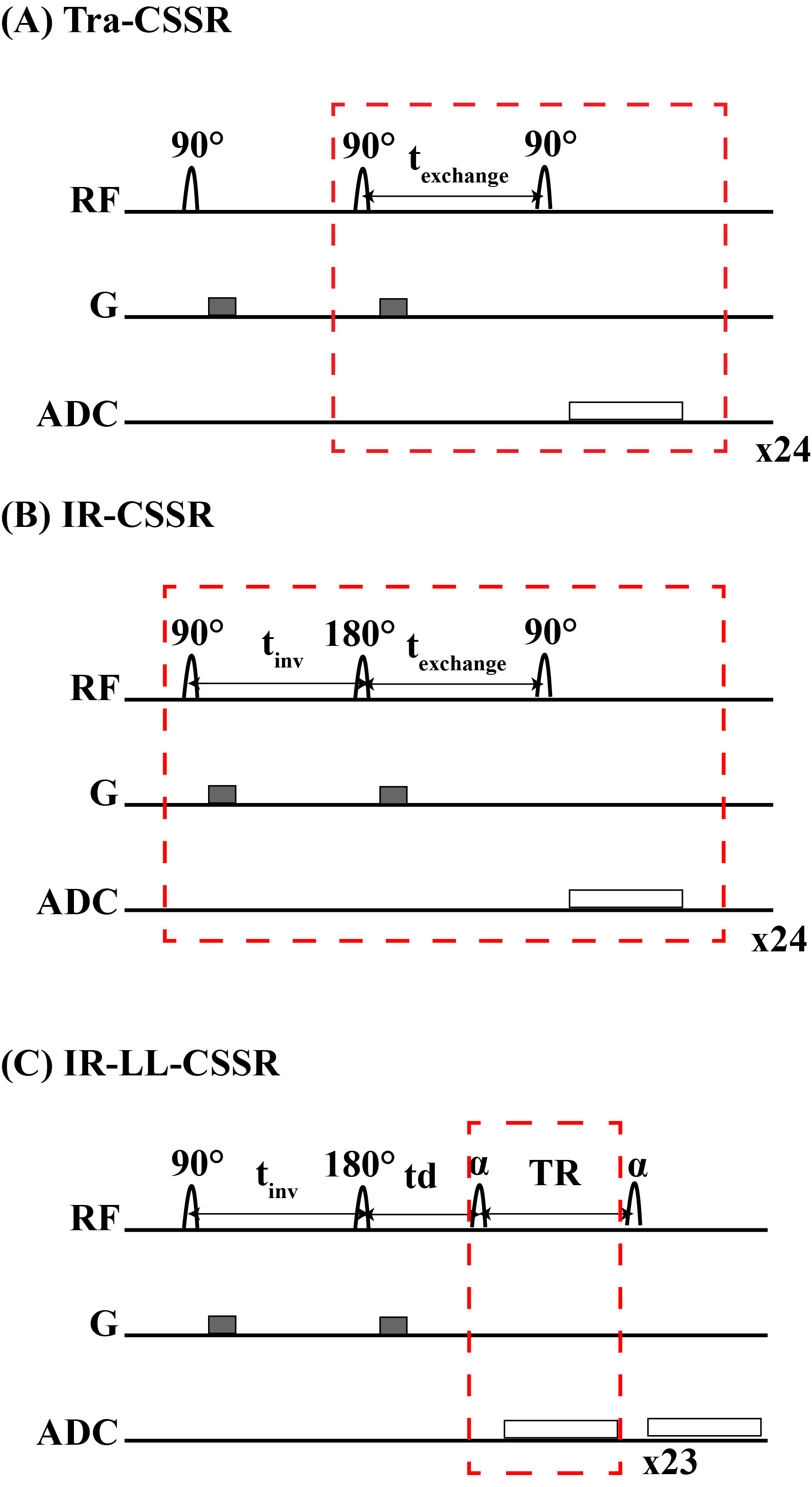
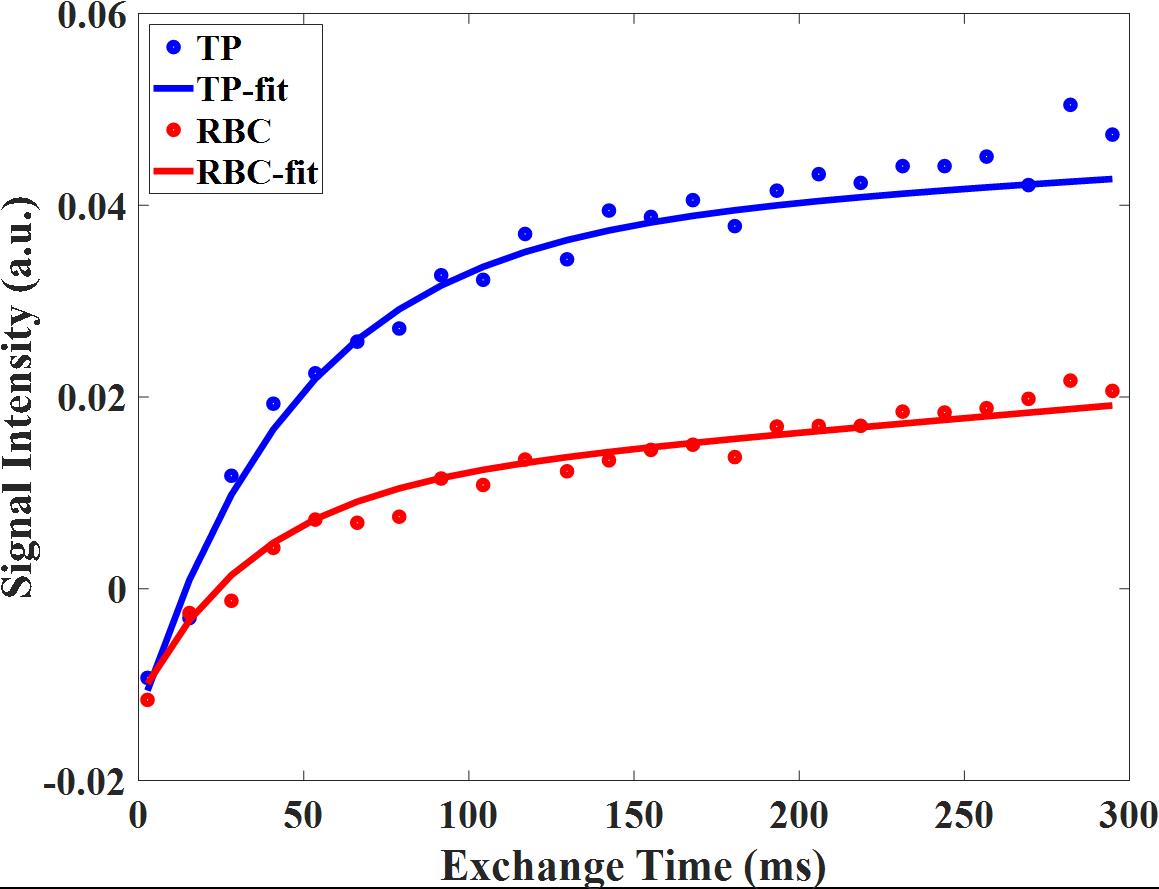
Figure 2. Signal recovery curves obtained from the IR-LL-CSSR method for a typical rat.
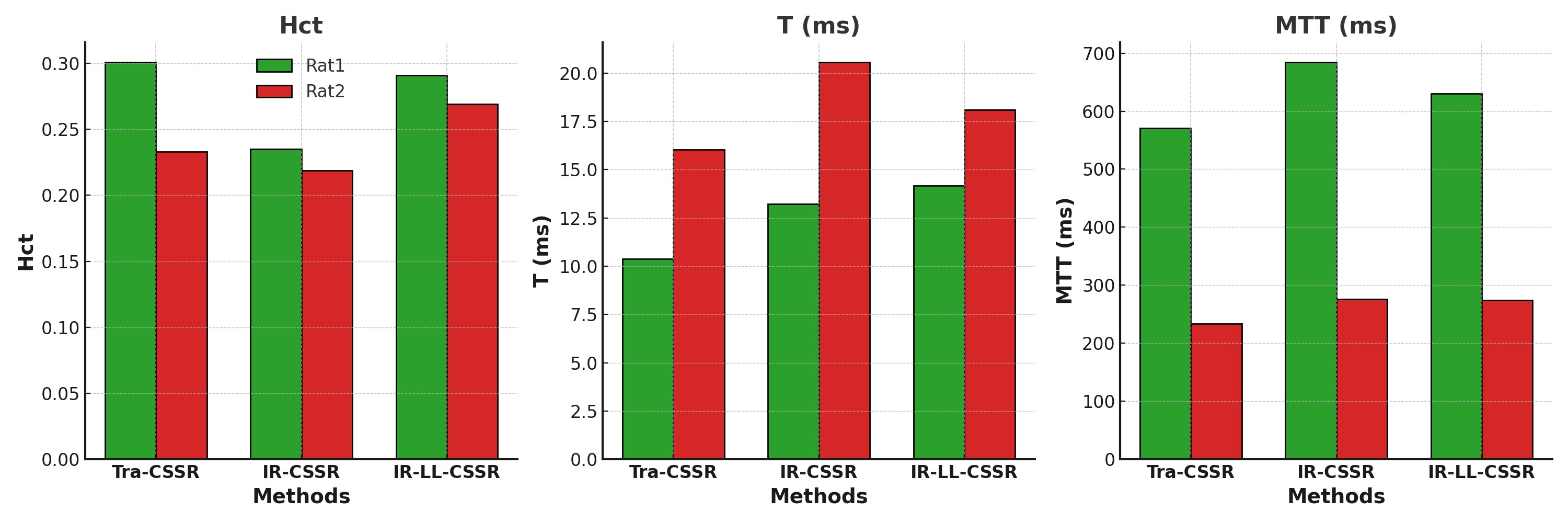
Figure 3. Comparison of representative parameters among different methods for two rats. The parameters include Hematocrit (Hct), Time constant (T) in milliseconds, and Mean Transit Time (MTT) in milliseconds. The three methods employed for measurements are Tra-CSSR, IR-CSSR, and IR-LL-CSSR. Rat1 is represented in green bars, and Rat2 is represented in red bars.