4727
Immunotherapy Sensitiziation via Tumor Acidosis Mitigation by Esomeprazole Monitored with MRI1MD Anderson Cancer Center, Houston, TX, United States, 2The University of Texas Health Science Center at Houston Graduate School of Biomedical Sciences, Houston, TX, United States
Synopsis
Keywords: Biomarkers, Cancer, Hyperpolarized MRI, Immunotherapy, Melanoma, CEST, Esomeprazole
Motivation: Biomarkers to predict immunotherapy response are needed. AcidoCEST MRI and hyperpolarized magnetic resonance spectroscopy (HP-MRS) may predict response.
Goal(s):
- Establish baseline pHe and lactate to pyruvate ratio in tumors with varying immunotherapy response.
- Observe changes after combination treatment with esomeprazole and immune checkpoint blockade (ICB).
Approach: AcidoCEST MRI and HP-MRS were used to measure extracellular pH (pHe) and lactate to pyruvate ratio. Imaging was performed on treated and untreated groups.
Results: Baseline lactate to pyruvate ratio and pHe were higher in the most resistant model compared to other models, but were unchanged in treatment vs control groups for the most resistant model.
Impact: Robust clinical tools are sorely needed to predict immunotherapy response. Development of a non-invasive clinical imaging tool would allow for less wasted time trying ineffective medications and more personalized treatment plans tailored so treatment is as effective as possible.
Introduction
Immunotherapy has taken the cancer world by storm, but resistance has emerged as a clinical problem. One mechanism of immunotherapy resistance is increased extracellular acidity.1 Acidity deactivates cancer killing immune cells, increases activity of regulatory T cells, and interferes with immune cell cross talk.1 Acido-chemical exchange saturation transfer magnetic resonance imaging (AcidoCEST MRI) can noninvasively measure pHe. Lactate production is often elevated in tumors via the Warburg effect.2 To maintain homeostasis, protons must be exported as lactate production increases, increasing pHe. The lactate to pyruvate ratio can be measured via hyperpolarized magnetic resonance spectroscopy of 13C-pyruvate allowing for noninvasive in vivo measurement increased rate of lactate production. Prior work by our collaborators has demonstrated a higher lactate to pyruvate ratio in our most immunotherapy resistant versus sensitive melanoma model.3 VATPase is a proton exporter in some cancers. By inhibiting VATPase with esomeprazole, we hope to improve response to immunotherapy by increasing the pHe and observe esomeprazole induced changes with acidoCEST MRI and HP-MRS.Methods
Our melanoma model was created by serial in vivo passage of a tomato labled B16/BL6 melanoma line under immunotherapeutic pressure (FVAX, CTLA-4, PD-1, PD-L1). We are using the parental cell line (TMT), a passage where 50% of cells survived treatment (F2), one where 75% survived (F3), and one where all cells survived therapy (F4). All four models were implanted in male BL6 mice and allowed to grow for 2 weeks prior to imaging. HP-MRS was performed at the two week timepoint with AcidoCEST MRI following 2-3 days later to establish baseline lactate to pyruvate ratio and pHe, respectively. F4 tumors were implanted into additional mice and allowed to grow for 1 week. After 1 week, combination esomeprazole (or PBS) and immune checkpoint blockade (ICB; αCTLA-4, αPD-1) was initiated. ICB was administered 3h after esomeprazole injection. Treatment occurred every 3 days for 3 total doses. AcidoCEST MRI was performed 24h after the final dose. HP-MRS was performed 2-3 days after acidoCEST MRI. Additional F4 tumor bearing mice were prepared in the same fashion and received esomeprazole (or PBS) only using the same treatment schedule as for combination therapy. AcidoCEST MRI for these mice was taken 3h after the final dose and HP-MRS was acquired 2-3 days after acidoCEST MRI.Results
There was a statistically significant increase in lactate to pyruvate ratio of the F4 group compared with TMT, F2, and F3 groups (p < 0.05). The TMT, F2, and F3 groups did not differ significantly. The pHe of the TMT group was statistically significantly lower than the F2 and F4 groups (p < 0.05). The F2, F3, and F4 groups were not significantly different. Additionally, the TMT and F3 groups were not significantly different. The lactate to pyruvate ratio and pHe after combination treatment with esomeprazole and ICB was not different from that after combination treatment with PBS and ICB. Treatment with esomeprazole alone generated higher lactate to pyruvate ratio compared with PBS alone. Tumor volume curves and survival curves of mice bearing F4 tumors treated with esomeprazole combination with ICB showed no difference to esomeprazole alone, PBS alone, and PBS combination with ICB.Discussion
We hypothesized the pHe would be higher in the most resistant melanoma model (F4) and would be the lowest in the most sensitive model (the parental, TMT), however we observed the opposite of this. Additionally, using pHe alone we could not distinguish between the F2, F3, and F4 models. We expected the lactate to pyruvate ratio to be highest in the most resistant model (F4), which we observed, but we were unable to establish a distinction between the less resistant models. There was no difference in lactate to pyruvate ratio or pHe in the combination esomeprazole + ICB compared with PBS + ICB control whereas we expected the esomeprazole combination group to have a lower lactate to pyruvate ratio and higher pHe. Additionally, no survival benefit or tumor volume benefit was observed with esomeprazole combination with ICB. Despite the lack of effect of esomeprazole, this study shows the feasibility of testing other inhibitors of proton export including AZD3965 (MCT-1 inhibitor) and acetazolamide (CA-IX inhibitor).Conclusion
Lactate to pyruvate ratio can differentiate our most immunotherapy resistant melanoma model from our most sensitive model. pHe is also able to differentiate these models, although pHe paradoxically increased with increasing resistance in our cell line. Esomeprazole was not a beneficial adjuvant to ICB for the most immunotherapy resistant form of our cell line. Further studies will investigate the ability of other inhibitors of proton export to increase pHe in vitro.Acknowledgements
The research has been funded in part by R01CA231513, CPRIT (RP220270), Melanoma Research Alliance and CCTS TL1. We would also like to thank the CCSG-funded Small Animal Imaging (SAIF) for their expertise and assistance in image acquisition.References
1. Scott, K. E.; Cleveland, J. L., Lactate wreaks havoc on tumor-infiltrating T and NK cells. Cell Metabolism 2016, 24 (5), 649-650.
2. Huber, V.; Camisaschi, C.; Berzi, A.; Ferro, S.; et al., In Cancer acidity: An ultimate frontier of tumor immune escape and a novel target of immunomodulation, Seminars in cancer biology, Elsevier: 2017; pp 74-89.
3. Jaiswal, A. R.; Liu, A. J.; Pudakalakatti, S.; Dutta, P.; et al., Melanoma Evolves Complete Immunotherapy Resistance through the Acquisition of a Hypermetabolic PhenotypeCancer Hypermetabolism Confers Immunotherapy Resistance. Cancer immunology research 2020, 8 (11), 1365-1380.
Figures
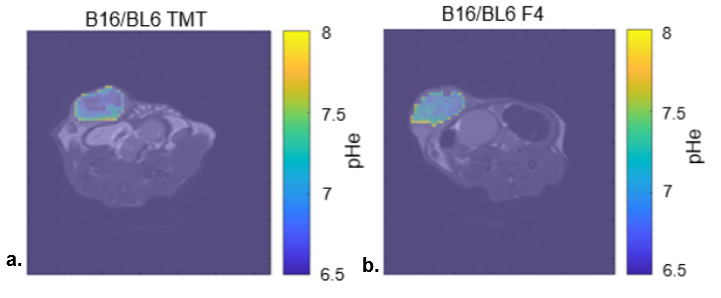
Figure 1. Representative pHe maps generated using acidoCEST MRI of the A) most immunotherapy sensitive (TMT) and B) immunotherapy resistant (F4) cell lines. These were baseline images occurring 16-17 days post implantation.
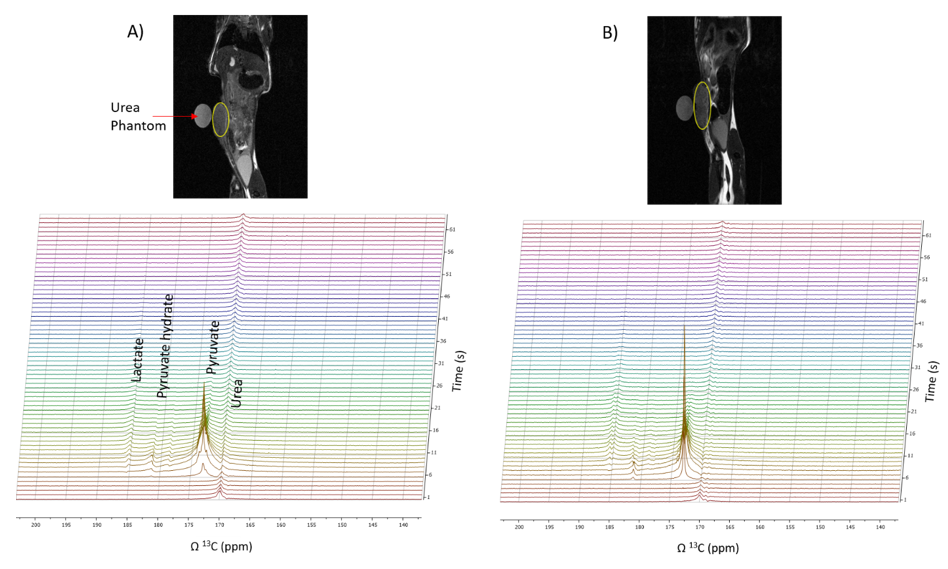
Figure 2. A) Representative T2 coronal MRI of mouse bearing F4 tumor with corresponding dynamic 13C spectroscopy. B) Representative T2 coronal MRI of mouse bearing TMT tumor with corresponding dynamic 13C spectroscopy. Tumors are circled in yellow.
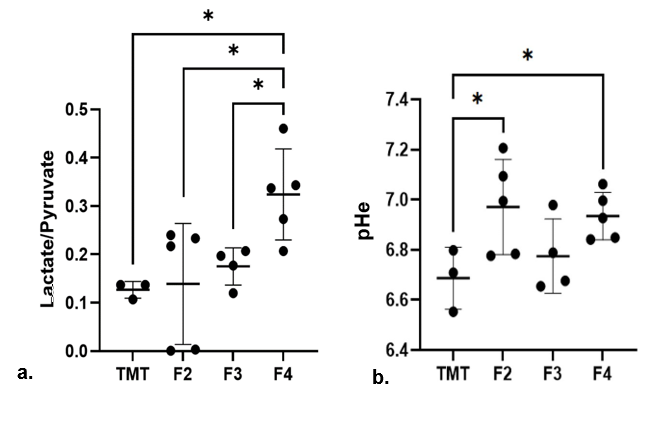
Figure 3. A) Lactate to pyruvate ratio and B) pHe of baseline imaging for each of the four models. Lactate to pyruvate ratio increased from the most sensitive to most resistant model as expected, but pHe increased from the most sensitive to most resistant model which was the opposite of predicted.
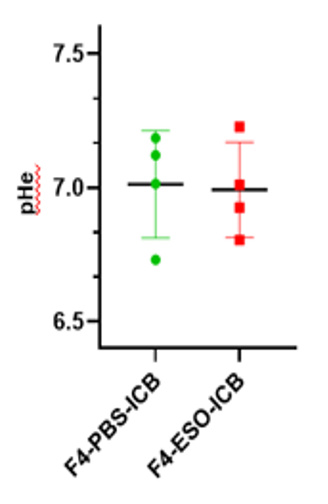
Figure 4. pHe between the PBS combination with ICB and esomeprazole combination with ICB. There was no significant difference between the two groups.
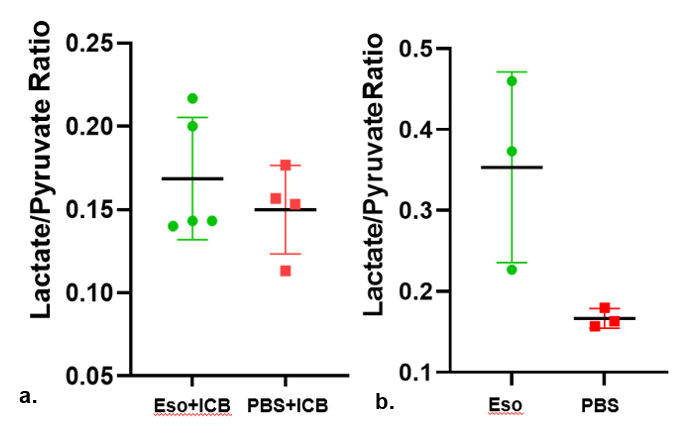
Figure 5. Lactate to pyruvate ratio for A) combination treatment and B) esomeprazole/PBS alone treatment groups. There was no difference in lactate to pyruvate ratio between esomeprazole+ICB versus PBS+ICB. There was a difference between treatment with esomeprazole alone and PBS alone.