4720
Enhanced Solubility and Polarization of 13C-fumarate with Meglumine Allows in vivo Detection of Renal Gluconeogenesis1Advanced Imaging Research Center, UTSW Medical Center, Dallas, TX, United States, 22. Department of Biomedical Engineering, UTSW Medical Center, Dallas, TX, United States, 3Department of Radiology, UTSW Medical Center, Dallas, TX, United States
Synopsis
Keywords: Probes & Targets, Hyperpolarized MR (Non-Gas), Fumarate, meglumine, hyperpolarization, gluconeogenesis, solubility
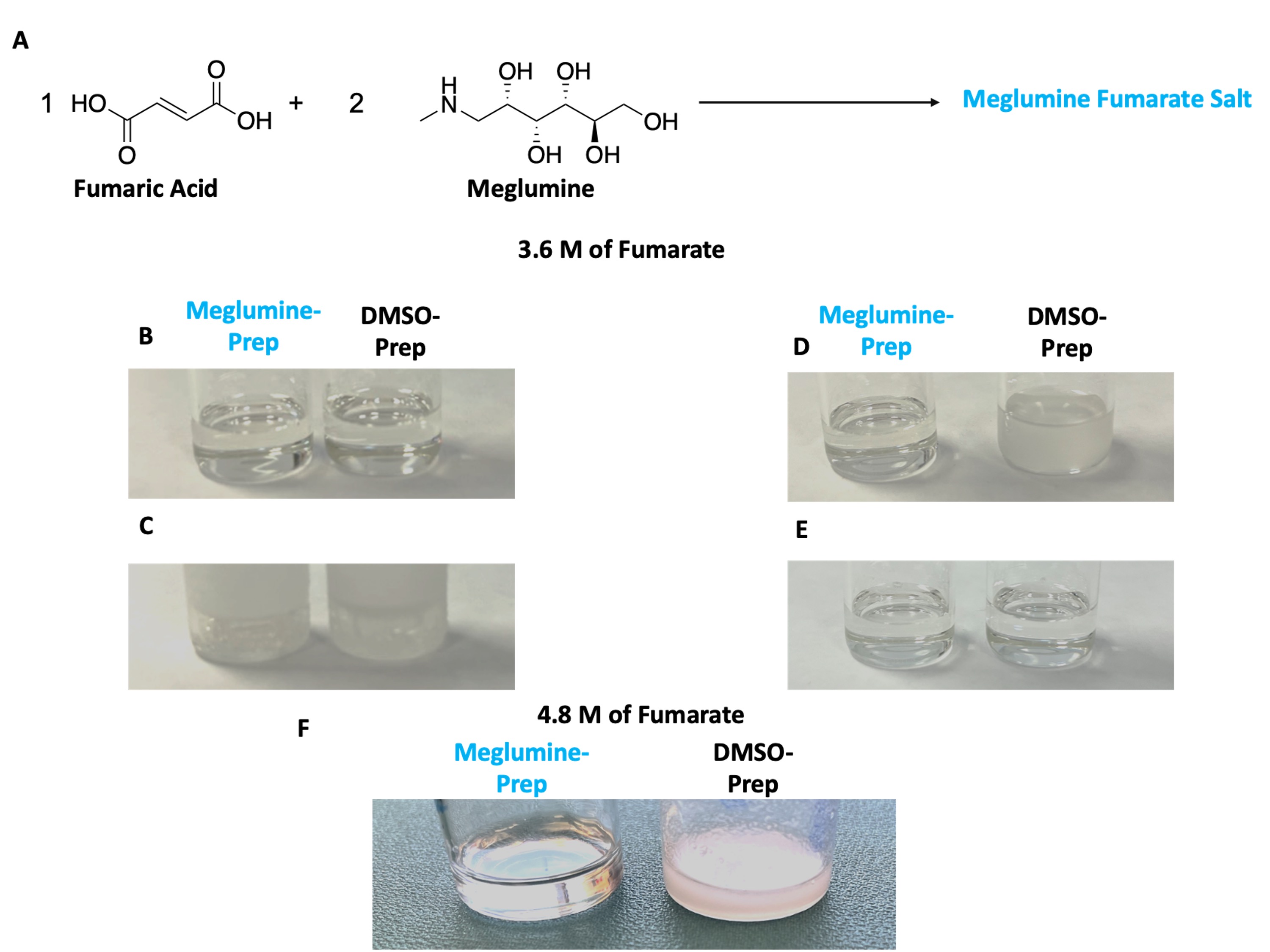
Motivation: Clinical translation of many hyperpolarized substrates, including 13C-fumarate, has been obstructed by its low solubility in water, causing rapid precipitation of the substrates after dissolution when prepared in conventional glassing solvents.
Goal(s): The goal of this study was to enhance water solubility and glassing properties of fumarate.
Approach: We introduced a new formulation of fumarate for DNP by using meglumine as a counterion.
Results: Meglumine significantly improved the polarization performance of fumarate with excellent solubility and glassing properties and previously invisible products along gluconeogenesis were observed in rat kidneys in vivo.
Impact: The solubilizing and vitrifying effect of meglumine counterion is not limited to fumarate. It is applicable to other 13C- and 15N-labeled compounds such as carboxylic acids and amino acids that have poor solubility and can form meglumine salts or adducts.
Introduction
Dissolution dynamic nuclear polarization (DNP) is a powerful technique that enhances magnetic resonance signals in liquid state1. Hyperpolarized (HP) [1-13C]pyruvate has been successful in assessing altered carbohydrate metabolism with diverse in vivo applications2. As a result, several translational studies with HP [1-13C]pyruvate are active at multiple sites around the world. HP 13C-labeled fumarate is another promising probe for clinical translation since its conversion to HP malate via fumarate hydratase is associated with tissue damage (e.g., acute kidney injury, cancer, and myocardial infarction)3-6. Despite its promises in detecting tumor necrosis and kidney injuries, its clinical translation has been limited, primarily due to the low solubility in conventional glassing solvents. No studies have reported HP malate or any other HP products from HP fumarate in healthy tissues3-6. Blocking fumarate transport across cell membranes via the sodium-dependent dicarboxylate acid transporter (DCT) had no effect on the HP malate signal in necrotic tumor tissues, strongly suggesting that fumarate uptake and metabolism in intact cells is slow and does not contribute significantly to the HP malate signal5. As a result, metabolic pathways such as malate-aspartate shuttle or gluconeogenesis that are directly associated fumarate has not been investigated using HP fumarate in normal tissues. However, the absence of products in normal tissues may be attributed to insufficient signal sensitivity.Methods
In this study, we introduced a new formulation of fumarate for DNP by using meglumine, a non-metabolizable derivative of sorbitol as a counterion. We have found that meglumine fumarate vitrifies by itself with enhanced water solubility (4.8 M), which allows the concentration of hyperpolarized fumarate after dissolution up to 120 mM using a clinical DNP polarizer. Meglumine fumarate was conveniently prepared by mixing one equivalent of fumaric acid with two equivalents of meglumine free base in the presence of trace amount of water (approximately 6% by weight) followed by sonication for 90 minutes. pH of resulting preparation was 7.0-7.4.Results and Discussion
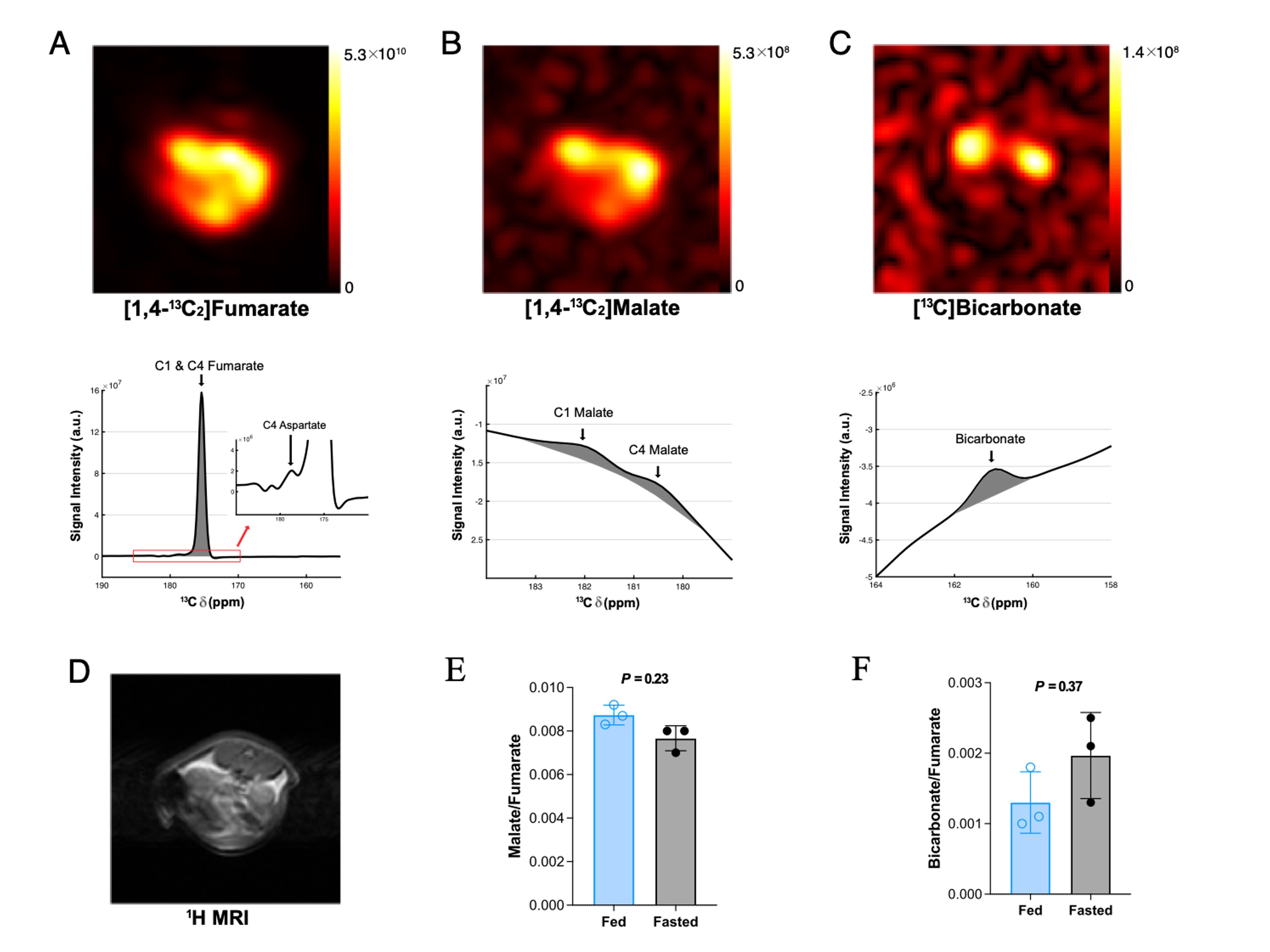
The T1 of HP [1,4-13C2]fumarate at 1 T was longer when the sample was prepared with meglumine (59 s) as compared to the fumarate sample prepared in DMSO (51 s). The T1 of meglumine [1,4-13C2]fumarate at 3 T (60 s) was comparable to the measurements at 1 T. The achievable liquid-state polarization level of meglumine-fumarate is more than doubled (29.4 %) as compared to conventional DMSO-mixed fumarate (13.5 %). In vivo comparison of DMSO- and meglumine-prepared 50-mM hyperpolarized [1,4-13C2]fumarate shows that the signal sensitivity in rat kidneys increases by 10-fold. As a result, [1,4-13C2]aspartate and [13C]bicarbonate in addition to [1,4-13C2]malate can be detected from healthy rat kidneys in vivo using hyperpolarized meglumine [1,4-13C2]fumarate. In particular, the appearance of [13C]bicarbonate is produced via phosphoenolpyruvate carboxykinase, a key regulatory enzyme in gluconeogenesis.Conclusions
In conclusion, we introduced a new formulation of HP [1,4-13C2]fumarate with meglumine and demonstrated that meglumine significantly improves the glassing properties of fumaric acid and produces high concentration of HP meglumine fumarate with excellent 13C polarization. Since meglumine is non-toxic and has been used in humans, these findings should serve as a starting point for future studies in human subjects.Acknowledgements
This study was supported by the National Institutes of Health of the United States (R01 NS107409, P41 EB015908, S10 OD018468, P30 DK127984, R21 EB034413, R21 EB030765, R21 EB031367); U.S. Army Medical Research Acquisition Activity (W81XWH2210485); Cancer Prevention and Research Institute of Texas (RP210099).References
1. Ardenkjær-Larsen, J. H., Fridlund, B., Gram, A., Hansson, G., Hansson, L., Lerche, M. H., ... & Golman, K. (2003). Increase in signal-to-noise ratio of> 10,000 times in liquid-state NMR. Proceedings of the National Academy of Sciences, 100(18), 10158-10163.
2. Kurhanewicz, J., Vigneron, D. B., Ardenkjaer-Larsen, J. H., Bankson, J. A., Brindle, K., Cunningham, C. H., ... & Rizi, R. (2019). Hyperpolarized 13C MRI: path to clinical translation in oncology. Neoplasia, 21(1), 1-16.
3. Clatworthy, M. R., Kettunen, M. I., Hu, D. E., Mathews, R. J., Witney, T. H., Kennedy, B. W., ... & Brindle, K. M. (2012). Magnetic resonance imaging with hyperpolarized [1, 4-13C2] fumarate allows detection of early renal acute tubular necrosis. Proceedings of the National Academy of Sciences, 109(33), 13374-13379.
4. Nielsen, P. M., Eldirdiri, A., Bertelsen, L. B., Jørgensen, H. S., Ardenkjaer-Larsen, J. H., & Laustsen, C. (2017). Fumarase activity: an in vivo and in vitro biomarker for acute kidney injury. Scientific reports, 7(1), 40812.
5. Gallagher, F. A., Kettunen, M. I., Hu, D. E., Jensen, P. R., Zandt, R. I. T., Karlsson, M., ... & Brindle, K. M. (2009). Production of hyperpolarized [1, 4-13C2] malate from [1, 4-13C2] fumarate is a marker of cell necrosis and treatment response in tumors. Proceedings of the National Academy of Sciences, 106(47), 19801-19806.
6. Miller, J. J., Lau, A. Z., Nielsen, P. M., McMullen-Klein, G., Lewis, A. J., Jespersen, N. R., ... & Schroeder, M. A. (2018). Hyperpolarized [1, 4-13C2] fumarate enables magnetic resonance-based imaging of myocardial necrosis. JACC: Cardiovascular Imaging, 11(11), 1594-1606.
Figures