4716
Diagnosis of Early Mild Cognitive Impairment in Type 2 Diabetes Mellitus by Deep Learning of Multimodal Neuroimages and Metadata1Southern Medical University, Guangzhou, China, 2University of North Carolina at Chapel Hill, Chapel Hill, NC, United States, 3Guangzhou University of Chinese Medicine, Guangzhou, China
Synopsis
Keywords: Diagnosis/Prediction, Brain
Motivation: Identification of early cognitive impairment in type 2 diabetes mellitus (T2DM) patients is of paramount importance for mitigating cognitive decline of patients and enhancing their quality of life.
Goal(s): Our objective was to develop a robust deep learning model for diagnosing early cognitive impairment in T2DM using multi-modal neuroimages.
Approach: We developed a multi-modal neural network, which incorporated informative clinical metadata (i.e., MoCA, BMI and HbA1c) to design metadata-induced contrastive Laplacian regularization.
Results: The proposed approach demonstrated significant improvement in accuracy in the identification of T2DM with/without mild cognitive impairment in a dataset with 311 subjects.
Impact: Superior diagnostic performance of the proposed method for early cognitive impairment in T2DM demonstrates its ability in understanding of T2DM cognitive impairment associated brain alterations and its potential applications on other brain disorders.
Introduction
Type 2 diabetes mellitus (T2DM) is a chronic metabolic disorder that affects approximately 415 million people globally1,2. T2DM patients have a 1.5 to 2 times higher risk of experiencing cognitive impairment (CI) compared to healthy individuals3. Neuroimaging evidence based on magnetic resonance imaging (MRI) has revealed alterations in the brains of T2DM patients and unveiled the connection between T2DM-related CI and Alzheimer's disease4,5. Therefore, early identification of T2DM-related CI is of utmost importance. In this work, we aim to propose a deep neural network to enable early diagnosis of CI in T2DM using multi-modal neuroimages, including T1w MRI and diffusion tensor imaging (DTI). Within the realm of neuroimage analysis, deep learning models frequently grapple with the issue of overfitting due to small training datasets, which hinders the full potential of these models in comprehending intricate brain alterations. To address this issue, we integrated multiple informative clinical metadata, including Montreal Cognitive Assessment (MoCA), body mass index (BMI), and Hemoglobin A1c (HbA1c), into the design of metadata-induced contrastive Laplacian regularization for neural network training. Extensive experiments conducted on an in-house dataset with 311 subjects substantiate its exceptional performance in the early detection of CI in T2DM.Materials and Methods
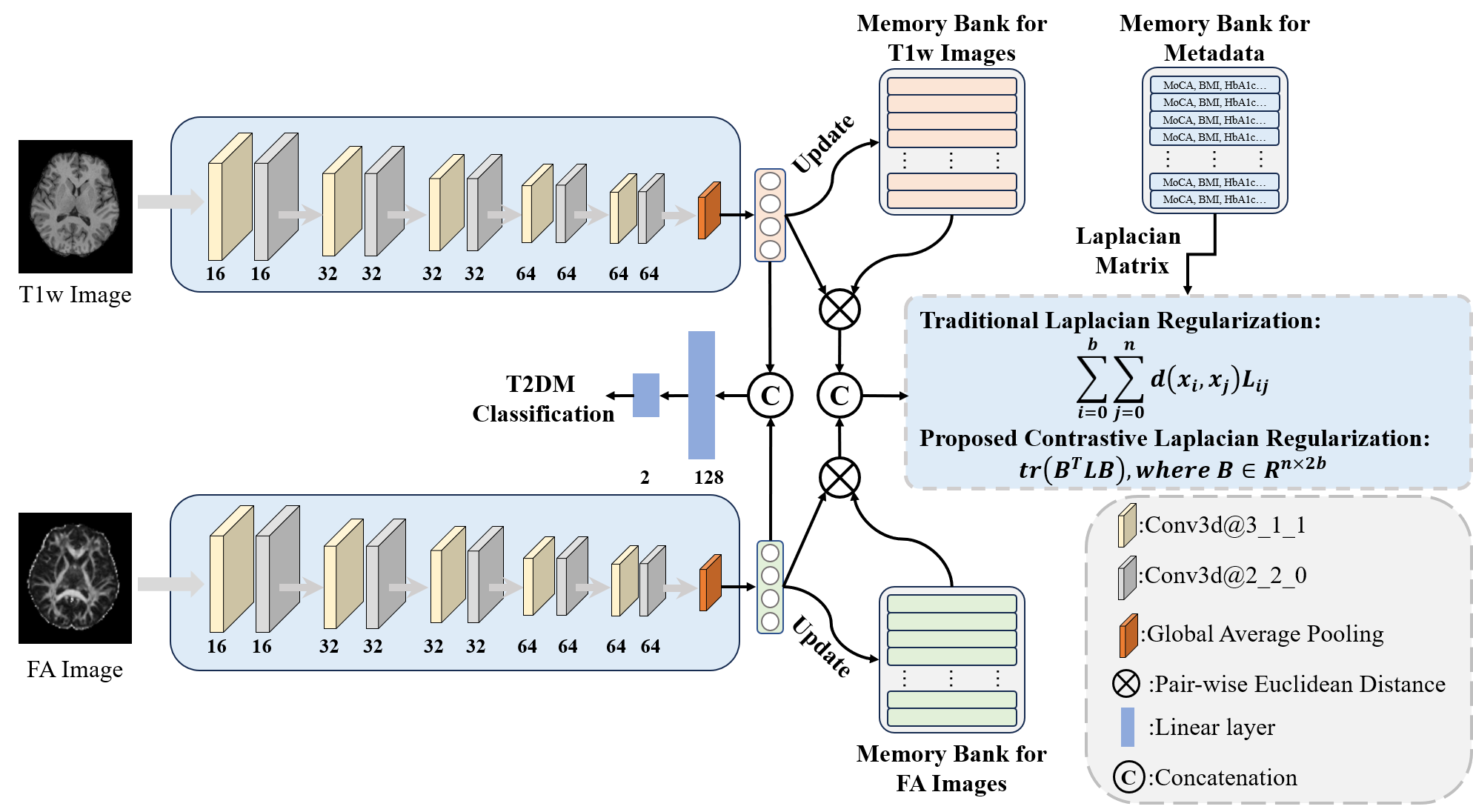
In this study, we develop and validate our proposed method based on an in-house dataset with 124 healthy controls (HC), 122 T2DM without cognitive impairment (T2DM-NCI), and 65 T2DM with mild cognitive impairment (T2DM-MCI), which are summarized in Fig. 1. Each subject has both T1w MRI and DTI, with the details of MRI scanning parameters shown in Fig. 2. For image preprocessing, firstly, we performed skull stripping and intensity inhomogeneity correction on all T1w MRI by FreeSurfer 7.2.06. And all DTI images were preprocessed by FSL 6.0.4 to obtain skull-stripped FA images7. Then, we aligned FA images to the corresponding T1w by ANTs8. Finally, all images were cropped into an identical size of 180 × 200 × 170. As shown in Fig. 3, to effectively extract complementary discriminative features from multi-modal neuroimages for diagnosing early CI in T2DM, two encoders with identical structures were constructed. Specifically, each encoder consists of 10 convolutional layers and one global average pooling layer, among which each convolutional layer with the kernel size of 2 × 2 × 2 and stride of 2 is followed by one convolutional layer with the kernel size of 3 × 3 × 3 and stride of 1. Thereafter, the extracted features from multi-modal neuroimages were concatenated to branch into two linear layers with the units of 128 and 2, respectively, for T2DM diagnosis. In general, clinical metadata can elucidate diverse levels of brain-related disorders, thus offering valuable prior knowledge for network optimization. Consequently, in our pursuit of enhancing the generalization capabilities of deep models for early diagnosis of cognitive impairment in T2DM, we developed an innovative metadata-induced contrastive Laplacian regularization to mitigate the challenge of overfitting within deep learning on small datasets. Differing from traditional local Laplacian regularization in deep learning9, we considered the training samples within each mini-batch as a reference and therefore performed manifold regularization globally in each iteration. In a specific manner, akin to MoCo10, we initially established two memory banks to preserve the extracted features from multi-modal neuroimages. Thereafter, we can access a queue of multi-modal features and the loss of the contrastive Laplacian regularization can be defined as BTLB, where B is the distance matrix between each sample in the memory banks and the samples in the current mini-batch. L is the Laplacian matrix based on binarized Euclidean distance on metadata. In this framework, the total loss in the proposed method includes the regularization loss and categorical cross-entropy loss for T2DM diagnosis.Results
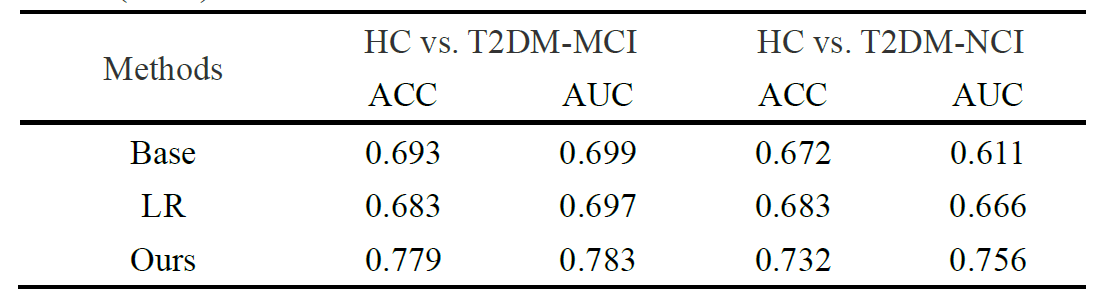
To demonstrate the generalization capabilities of our approach, we employed the 5-fold cross-validation strategy, and the mean accuracy (ACC) and area under the receiver operating characteristic curve (AUC) were summarized in Fig. 4. We conducted a comparison between our method and two alternative models: multi-modal neural network without any regularization (Base), multi-modal neural network with conventional Laplacian regularization (LR). Our proposed method surpasses these rival models, achieving an average accuracy of 0.779 for HC vs. T2DM-MCI and 0.732 for HC vs. T2DM-NCI, respectively.Conclusion
In this work, we proposed a novel metadata-induced contrastive Laplacian regularization network for diagnosing early cognitive impairment in T2DM by utilizing multi-modal neuroimages. Extensive experiments on an in-house dataset with 311 subjects have validated its superior performance on the classification tasks of HC vs. T2DM-MCI and HC vs. T2DM-NC.Acknowledgements
Shijun Qiu was supported in part by the National Natural Science Foundation of China—Major International (Regional) Joint Research Program (81920108019) and Key Program (82330058).References
1. Zheng Y, Ley SH, Hu FB. Global aetiology and epidemiology of type 2 diabetes mellitus and its complications. Nat Rev Endocrinol 2018; 14: 88–98.
2. Tripathi BK, Srivastava AK. Diabetes mellitus: Complications and therapeutics. Med Sci Monit 2006; 12: 18.
3. Cheng G, Huang C, Deng H, Wang H. Diabetes as a risk factor for dementia and mild cognitive impairment: a meta-analysis of longitudinal studies: Diabetes and cognitive function. Internal Medicine Journal 2012;42: 484–91.
4. Sato N, Morishita R. Brain Alterations and Clinical Symptoms of Dementia in Diabetes: AÎ2/Tau-Dependent and Independent Mechanisms. Front Endocrinol 2014;5.
5. Moran C, Beare R, Wang W, Callisaya M, Srikanth V, for the Alzheimer’s Disease Neuroimaging Initiative (ADNI). Type 2 diabetes mellitus, brain atrophy, and cognitive decline. Neurology 2019; 92: e823–30.
6. Sled, J.G., Zijdenbos, A.P., Evans, A.C., A nonparametric method for automatic correction of intensity nonuniformity in MRI data. IEEE Transactions on Medical Imaging 1998;17: 87-97.
7. S.M. Smith, M. Jenkinson, H. Johansen-Berg, D. Rueckert, T.E. Nichols, C.E. Mackay, K.E. Watkins, O. Ciccarelli, M.Z. Cader, P.M. Matthews, and T.E.J. Behrens. Tract-based spatial statistics: Voxel-wise analysis of multi-subject diffusion data. NeuroImage 2006; 31: 1487-1505.
8. Brian B. Avants and Nicholas J. Tustison and Gang Song and Philip A. Cook and Arno Klein and James C. Gee. A reproducible evaluation of ANTs similarity metric performance in brain image registration. NeuroImage 2011; 54: 2033-2044.
9. W. Zhu, Q. Qiu, J. Huang, R. Calderbank, G. Sapiro and I. Daubechies. LDMNet: Low Dimensional Manifold Regularized Neural Networks. IEEE/CVF Conference on Computer Vision and Pattern Recognition 2018; 2743-2751.
10. K. He, H. Fan, Y. Wu, S. Xie, and R. Girshick. Momentum Contrast for Unsupervised Visual Representation Learning. IEEE/CVF Conference on Computer Vision and Pattern Recognition 2020; 9726-9735
Figures