4714
A Large-Scale Analysis of the Impact of Physical Exercise, BMI, and Lifestyle on Brain Age Predicted from T1-weighted MRI Scans1VoxelWise Imaging Technology Inc, Vancouver, BC, Canada, 2Prenuvo Inc, Vancouver, BC, Canada, 3Early Medical, Austin, TX, United States, 4The Institute of Neurodegenerative Diseases of Florida, Boca Raton, FL, United States
Synopsis
Keywords: Diagnosis/Prediction, Brain
Motivation: To study the effects of exercise, BMI and lifestyle factors on brain age.
Goal(s): Developing a model for predicting brain age based on T1-weighted MRI scans.
Approach: T1-weighted MRI scans of 8,770 individuals were examined. Normative brain age curves were generated with over 50,000 volumetric brain MRI scans.
Results: Hypertension, type 2 diabetes, and smoking were associated with increased brain age, while exercise significantly decreased it. Pronounced effects of exercise were found in the overweight group, suggesting an increased benefit. The findings emphasize the importance of exercise in preserving brain volumes likely providing neuroprotective effects.
Impact: Leveraging a brain age estimation model, we revealed protective effects of exercise on the aging brain, particularly pronounced in overweight individuals. This highlights the potential of brain age as a biomarker for monitoring and developing strategies to enhance brain health.
Introduction
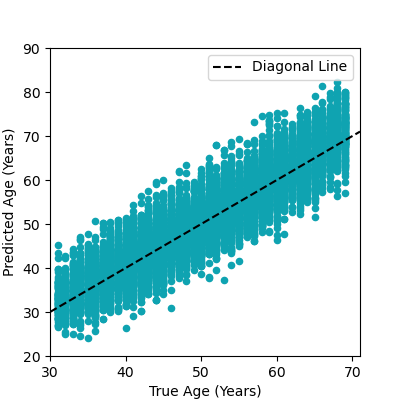
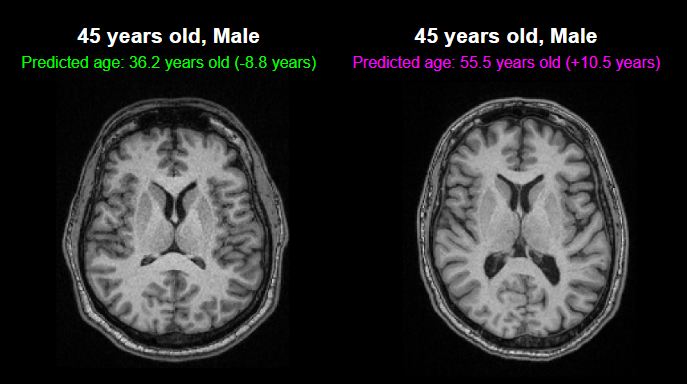
Exercise has been positively associated with preservation of whole brain and gray matter volumes, and improved white matter integrity1,2. While these results provide insights into the effects of exercise on specific areas of the brain, it fails to capture the comprehensive, heterogeneous changes occurring across the entire brain. Furthermore, many of these studies have relied on relatively small to moderate sample sizes, limiting the generalizability of their findings.Brain age is an emerging biomarker that uses neuroimaging features to predict chronological age3. While the concept of brain age is still novel, it has shown to be a useful biomarker in predicting one’s risk for various neurological conditions such as Alzheimer’s disease4. Typically, a normative model is constructed to predict an individual’s age by using machine learning algorithms that capture complex multi-dimensional features from brain MRIs associated with healthy or typical aging. A significant deviation between predicted and chronological age has been shown to be an indication of accelerated brain aging or other abnormalities. The objective of this study is to develop a robust model for predicting brain age based on T1-weighted MRI scans and to investigate the effects of exercise on brain age in a large cohort of adults.Methods
The brain age estimation model is a deep neural network pre-trained on a dataset of T1-weighted scans from 53,542 individuals from the general population (age: 3-95), gathered from 21 public datasets5. The model comprises five repetitive convolutional blocks, each having a three-dimensional convolutional layer, a batch normalization layer, activation using the rectified linear function (ReLU), and a max-pooling layer. The model was further trained and validated on our in-house T1-weighted scans collected from 1,559 adults and then used to estimate brain age of 8,770 unseen adults (age: 30-70; 4,838 males, 3,932 females) without any history of neurological disorders or cancer. All 8,770 participants completed a comprehensive clinical questionnaire, which included information about their exercise habits. They indicated whether they engaged in no exercise (N=1,897), moderate exercise (N=2,154), or vigorous exercise (N=4,719). We investigated the associations between exercise and brain age using multiple linear regression, adjusting for potential confounding factors such as age, sex, ethnicity, daily alcohol consumption, stage-2 hypertension, type 2 diabetes, history of cerebrovascular events or respiratory illness. Additional analysis was performed where we divided the participants into two groups based on their BMI (normal-BMI (BMI < 25.0; N=3,915); overweight (BMI >= 25.0; N=4,855)) and performed multiple linear regression separately for each group.Results
Hypertension (β=0.69, p=1.45e-05), type 2 diabetes (β=1.55, p=1.27e-08), and smoking (β=0.48, p=2.06e-06) were associated with increased brain age, while vigorous exercise significantly decreased brain age (β=-0.45; p=2.05e-04). Moderate exercise showed a trend toward decreasing brain age, but the result was not statistically significant (β=-0.24; p=0.074). Further analysis revealed that vigorous exercise significantly lowered brain age for both normal-BMI (β=-0.43; p=0.027) and overweight group (β=-0.56; p=3.86e-04). Moderate intensity exercise had a significant effect on decreasing brain age in the overweight group (β=-0.36; p=0.045), but it was not significant for the normal-BMI group (β=-0.15; p=0.49).Discussion
Our study reveals a significant and favorable effect of vigorous intensity exercise on the brain, underscoring the importance of exercise in promoting brain health. This findings align with previous studies that have highlighted exercise's neuroprotective benefits, including enhanced neuroplasticity, increased cerebral blood flow, and reduced oxidative stress and inflammation6,7. In our subsequent analyses, we explored the differential impact of exercise on brain age within distinct weight groups. The results indicated the universal benefits of vigorous exercise on brain health for both normal-BMI and overweight individuals. In addition, we found that the effects of both moderate and vigorous exercise on brain age were more pronounced in the overweight group. This could indicate that individuals with higher body weight may experience greater benefits from exercise in terms of brain health. Prior research has suggested that exercise may have a particularly positive impact on cognitive function and brain health for obese individuals8.Conclusion
Our study highlights the importance of vigorous exercise in preventing age-related brain volume loss, benefiting both normal-BMI and overweight individuals, with a stronger impact on the latter. This emphasizes the role of vigorous exercise as a key lifestyle choice for preserving and enhancing brain health.Acknowledgements
1. Erickson KI, Leckie RL, Weinstein AM. Physical activity, fitness, and gray matter volume. Neurobiol Aging. 2014;35(Suppl 2):S20-8. doi: 10.1016/j.neurobiolaging.2014.03.034.
2. Pani J, Eikenes L, Reitlo LS, Stensvold D, Wisløff U, Håberg AK. Effects of a 5-Year Exercise Intervention on White Matter Microstructural Organization in Older Adults. A Generation 100 Substudy. Front Aging Neurosci. 2022;14:859383. doi: 10.3389/fnagi.2022.859383.
3. Tanveer M, Ganaie MA, Beheshti I, Goel T, Ahmad N, Lai K-T et al. Deep learning for brain age estimation: A systematic review. Information Fusion. 2023;96:130-143. doi: 10.1016/j.inffus.2023.03.007.
4. Mishra S, Beheshti I, Khanna P. A Review of Neuroimaging-Driven Brain Age Estimation for Identification of Brain Disorders and Health Conditions. IEEE Rev Biomed Eng. 2023;16:371-385. doi: 10.1109/RBME.2021.3107372.
5. Leonardsen EH, Peng H, Kaufmann T, Agartz I, Andreassen OA, Celius EG et al. Deep neural networks learn general and clinically relevant representations of the ageing brain. Neuroimage. 2022;256:119210. doi: 10.1016/j.neuroimage.2022.119210.
6. Tari AR, Norevik CS, Scrimgeour NR, Kobro-Flatmoen A, Storm-Mathisen J, Bergersen LH, Wrann CD, Selbæk G, Kivipelto M, Moreira JBN, Wisløff U. Are the neuroprotective effects of exercise training systemically mediated?. Prog Cardiovasc Dis. 2019;62(2):94-101. doi: 10.1016/j.pcad.2019.02.003.
7. Machado S, Teixeira D, Monteiro D, Imperatori C, Murillo-Rodriguez E, Rocha FPS et al. Clinical applications of exercise in Parkinson’s disease: what we need to know?. Expert Rev. Neurother. 2022;22(9):771-780. doi: 10.1080/14737175.2016.1179582.
8. Stillman CM, Weinstein AM, Marsland AL, Gianaros PJ, Erickson KI. Body-Brain Connections: The Effects of Obesity and Behavioral Interventions on Neurocognitive Aging. Front Aging Neurosci. 2017;9:115. doi: 10.3389/fnagi.2017.00115.
References
No reference found.Figures