4688
AI-based reconstruction of diffusion weighted images to improve image quality and shorten acquisition time in prostate MRI1diagnostic and interventional Radiology, University hospital Aachen, Germany, Aachen, Germany, 2Diagnostic and interventional Radiology, University hospital aachen, Aachen, Germany, 3Philips GmbH Market DACH, Hamburg, Germany, 4Philips GmbH Market Dach, Hamburg, Germany, 5University hospital aachen, Aachen, Germany
Synopsis
Keywords: AI/ML Image Reconstruction, Prostate, AI, DWI
Motivation: While DWI is crucial for prostate MRI, it suffers from low SNR and CNR.
Goal(s): To use AI-based image reconstruction for DWI and compare image quality, TA and diagnostic certainty with the standard DWI.
Approach: Patients underwent standard prostate MRI protocol and received an extra DWI sequence with less averages and AI-based reconstruction. Image quality and PI-RADS were assessed by two blinded radiologists. ROI-based SNR, CNR and ADC values in lesions were calculated.
Results: TA of AI-DWI was reduced by 57 %, while image quality improved. Lesion ADC values and PIRADS assessment remained the same regardless of reconstruction. AI-DWI outperforms the standard DWI.
Impact: AI-based reconstruction of DWI shows promising results for further improving the accessibility and quality of prostate MRI while reducing scan time.
Introduction
Multiparametric magnetic resonance imaging (mpMRI) and its standardization using the prostate imaging reporting and data system (PI-RADS) have tremendously increased the detection rate of clinically significant prostate cancers1. Accordingly, an increasing number of patients undergo mpMRI for screening purposes. But MRI accessibility is limited and the exam itself is time consuming. Diffusion weighted imaging (DWI) is an essential sequence for MR-based diagnosis of prostate cancer; however, it suffers from low signal-to-noise (SNR) and contrast-to-noise ratios (CNR). Shortening the acquisition time (TA) by conventional MR-acceleration methods would even worsen the per se low SNR and CNR. Recently, reconstruction techniques using Artificial intelligence (AI) have been introduced to MR-imaging and have shown promising results, increasing image quality and shortening acquisition time2. The purpose of this study was to evaluate image quality and diagnostic capability (i.e., PIRADS) of an AI-reconstructed DWI sequence with reduced acquisition time compared to standard DWI sequence in patients-undergoing prostate MRI for screening.Materials and methods
Ongoing study, so far including 30 patients referred to prostate MRI received a standardized protocol (including T2w TSE, contrast enhanced T1w 3D GRE and DWI with ADC map) and an additional DWI sequence with AI-based reconstruction on a 3T system (Philips Elition X, Best, The Netherlands). Both standard DWI and AI-DWI used 2 averages each at b-values of 50, 400, while standard DWI used 13 averages at b-1000 s/mm² and AI-DWI only 7. A separate b=1400 s/mm² images were acquired with 15 averages for standard DWI and 7 for AI-DWI. Standard DWI image reconstruction employed Compressed SENSE (CS). AI-DWI image reconstruction was based on the Adaptive-CS-Net3, i.e., CS reconstruction including a convolutional neural network. Two independent radiologists blinded to the reconstruction type assessed the PIRADS category for each patient using standard Sequences as well as AI-DWI. Additionally, aspects of image quality (noise, delineation of lesion, artifacts) were ranked on a 10-point Likert scale. For semiquantitative analysis of image quality, apparent ROI-based SNR and CNR were calculated as follows: aSNR = SI(lesion)/standard deviation(lesion) and aCNR = SI(lesion) - SI(contralateral normal)/standard deviation(contralateral normal). Additionally, ROI-based mean ADC values were measured for each lesion. Mean values of the qualitative and quantitative parameters were calculated for the AI- and std-DWIs and the difference were assessed with a general linear model. P values of < 0.05 were considered as statistically significant.Results
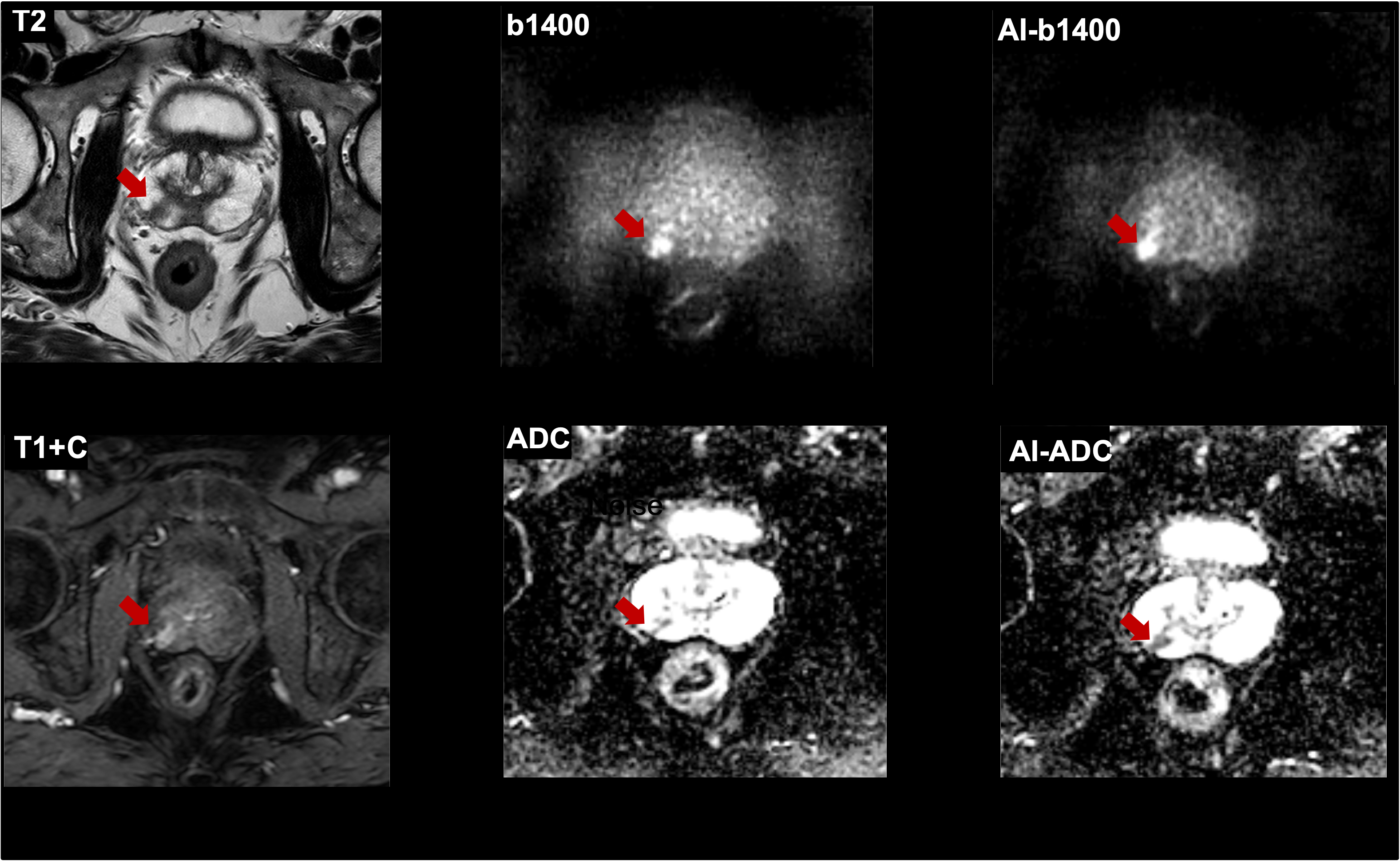
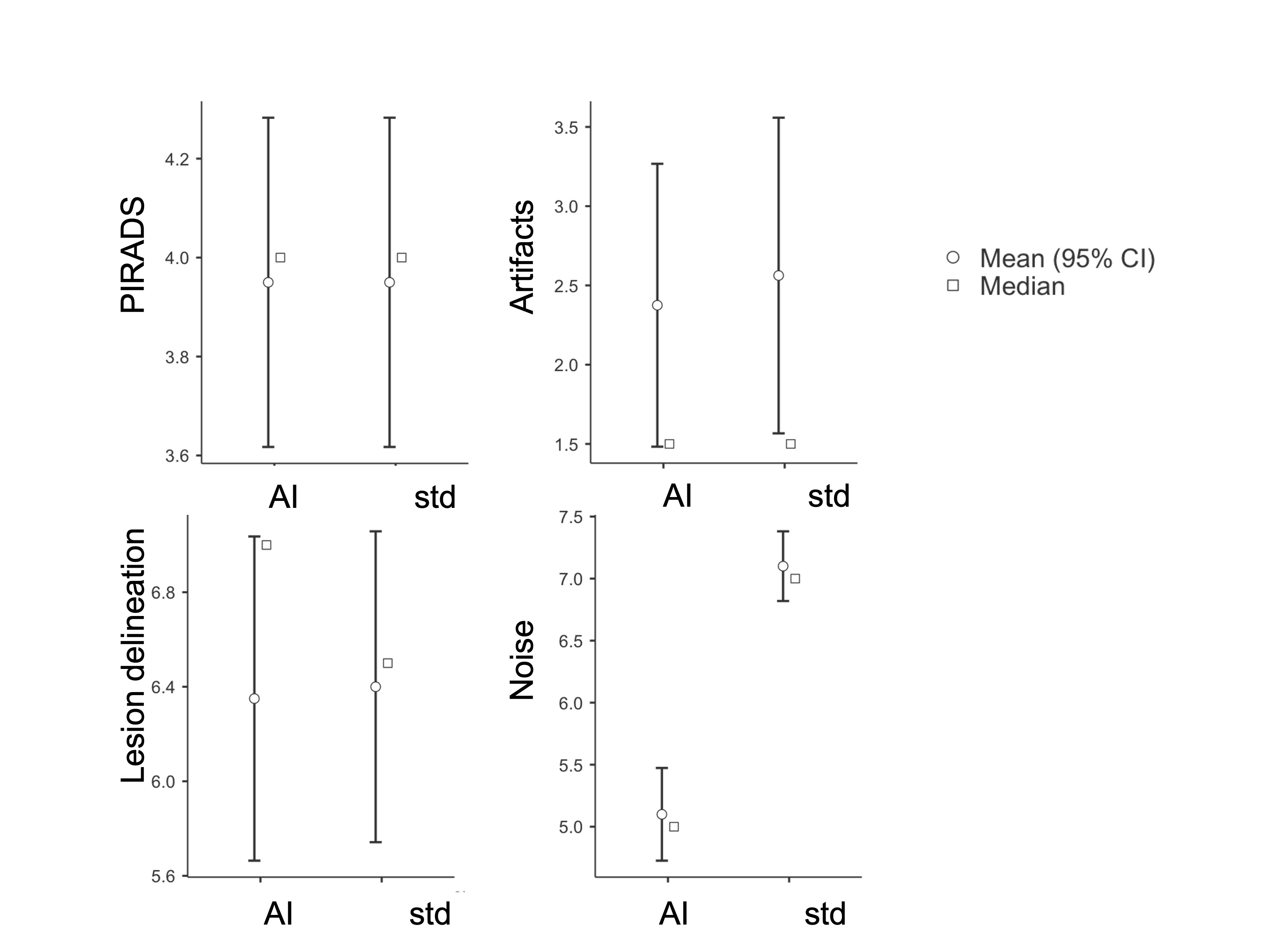
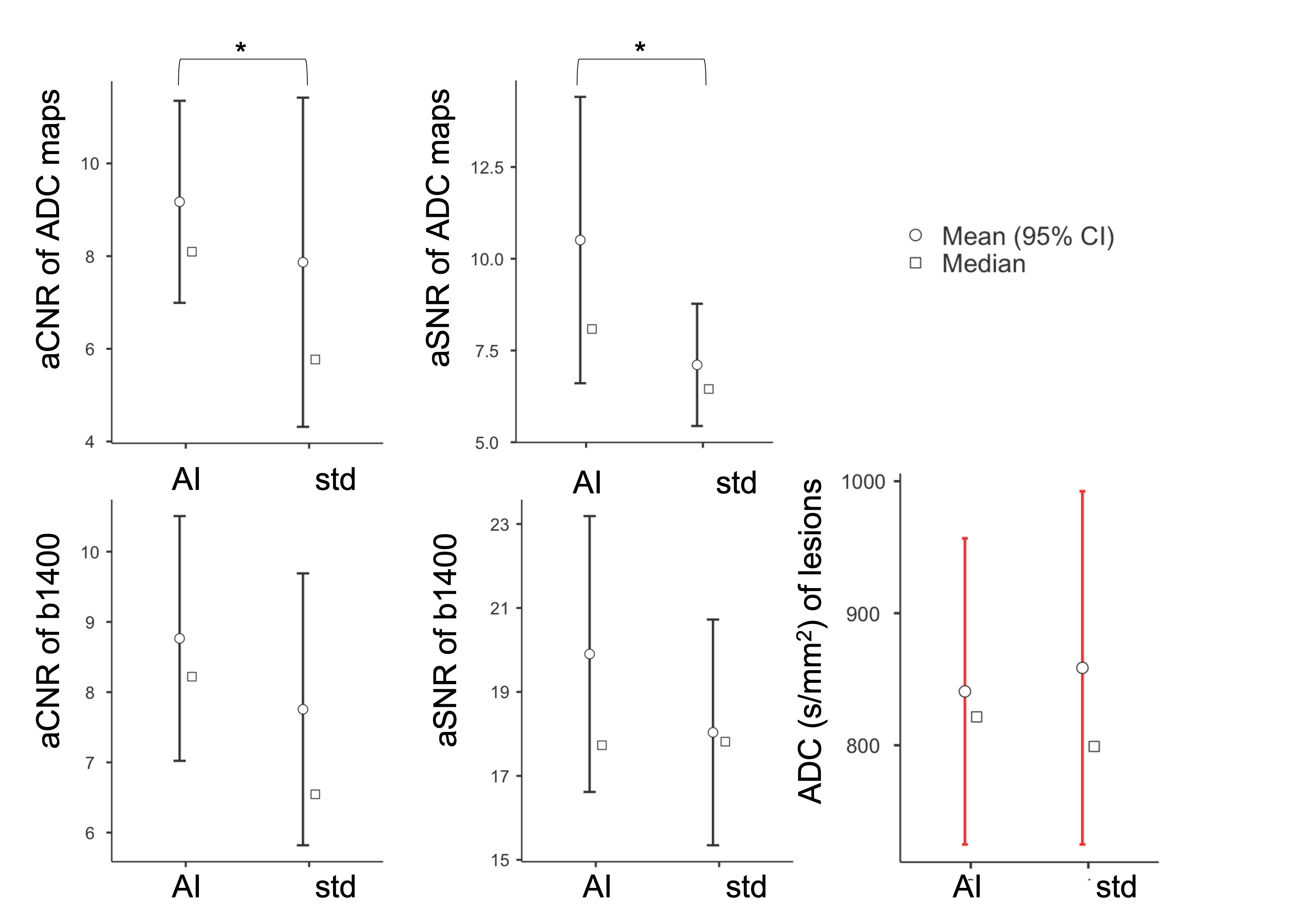
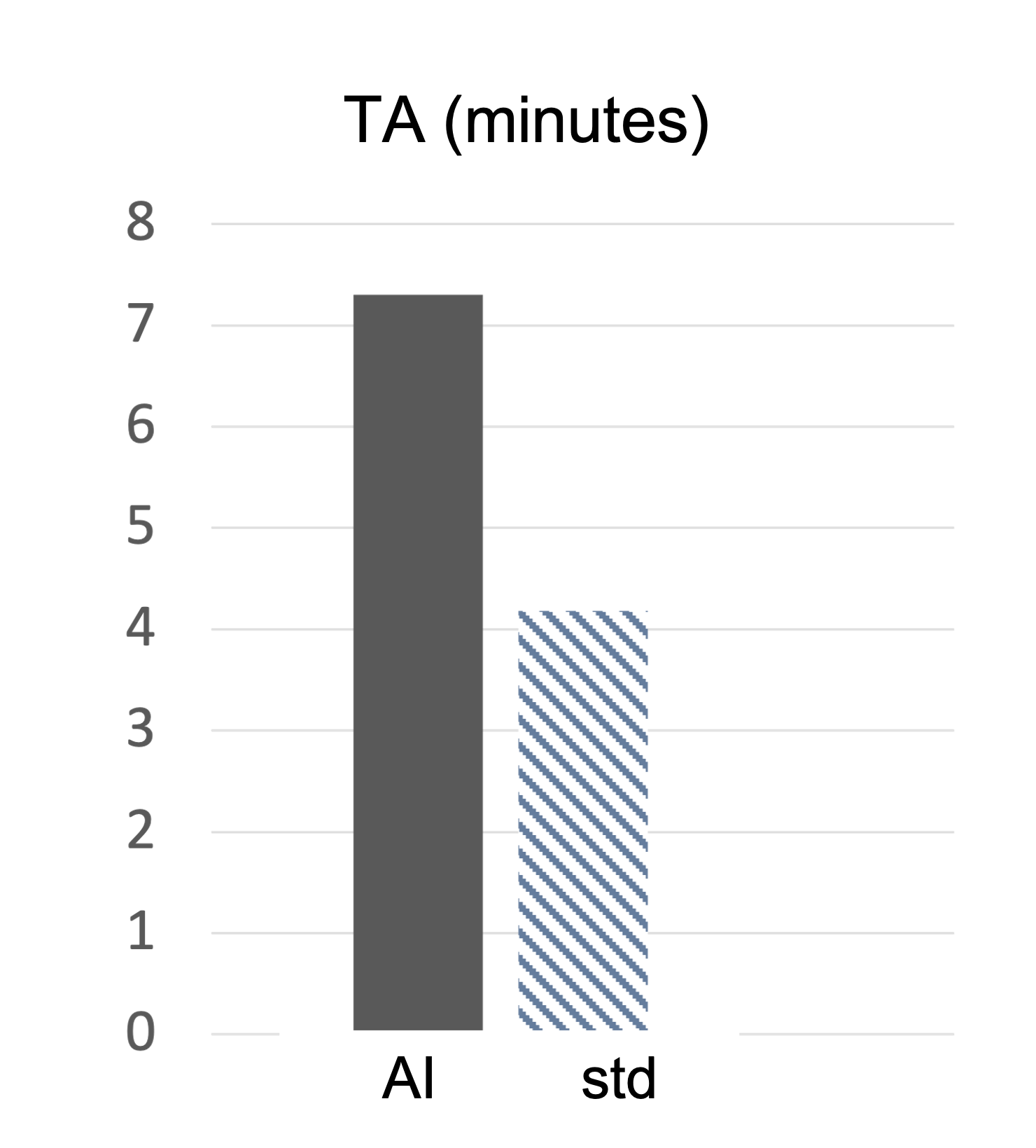
All 30 patients were assigned the same PIRADS category based on the AI-DWI sequences compared to the assessment based on standard DWI. Regarding image quality, the radiologists ranked AI-DWI significantly less noisy than standard DWI (mean noise 5 vs 7; p<0.001). Delineation of lesions and presence of artifacts did not differ significantly between the standard and AI-DWI (Figure 1, 2). ADC values in lesions did not differ from each other regardless of image reconstruction. aCNR and aSNR of the AI-ADC were significantly higher compared to the standard ADC maps (mean-aCNR (AI-ADC) = 9,2; mean-aCNR (Standard ADC) = 7,9; P = 0,005; mean-aSNR (AI-ADC) = 10,5; mean-aSNR (Standard ADC) = 7,1; P = 0,001). AI-b1400 showed higher aSNR and aCNR than the standard DWI, not yielding statistical significance (Figure 3). Acquisition time was reduced by 57 % for AI-DWI compared to standard DWI (Figure 4).Discussion
Preliminary results of our ongoing study demonstrate acceleration of diffusion weighted imaging for prostate MRI based on AI-DWI as compared to standard DWI. At the same time image quality is improved with regards of noise, SNR and CNR, while diagnostic certainty is maintained. AI-based reconstruction has been already successfully used to accelerate T2 weighted imaging in prostate MRI, as well as in musculoskeletal imaging2. Combination of AI-based reconstruction for both T2w and DWI shows promising results for further improving the accessibility and quality of prostate MRI while reducing scan time.Conclusions
Using AI-reconstructed DWI significantly improved image quality while maintaining the PI-RADS score, at the same time reducing acquisition time by 57%.Acknowledgements
No acknowledgement found.References
1. Barentsz JO, Weinreb JC, Verma S, Thoeny HC, Tempany CM, Shtern F, Padhani AR, Margolis D, Macura KJ, Haider MA, Cornud F, Choyke PL. Synopsis of the PI-RADS v2 Guidelines for Multiparametric Prostate Magnetic Resonance Imaging and Recommendations for Use. Eur Urol. 2016 Jan;69(1):41-9. doi: 10.1016/j.eururo.2015.08.038. Epub 2015 Sep 8. PMID: 26361169; PMCID: PMC6364687.
2. Gassenmaier, S.; Afat, S.; Nickel, D.; Mostapha, M.; Herrmann, J.; Othman, A.E. Deep learning-accelerated T2-weighted imaging of the prostate: Reduction of acquisition time and improvement of image quality. Eur. J. Radiol. 2021, 137, 109600.
3. Pezzotti N et al (2020) An adaptive intelligence algorithm for undersampled knee MRI reconstruction. IEEE Access 8:204825– 204838. https://doi.org/10.1109/ACCESS.2020.3034287
Figures