4687
Joint q-Space Sampling Optimization and Reconstruction Framework for Accurate and Fast Diffusion Magnetic Resonance Imaging1Paul C. Lauterbur Research Center for Biomedical Imaging, Shenzhen Institute of Advanced Technology, Chinese Academy of Sciences, Shenzhen, China, 2University of Chinese Academy of Sciences, Beijing, China, 3School of Physics and Optoelectronics, Xiangtan University, xiangtan, China, 4Peng Cheng Laboratory, Shenzhen, China, 5Chinese Academy of Sciences, Shenzhen, China
Synopsis
Keywords: AI/ML Image Reconstruction, Diffusion/other diffusion imaging techniques
Motivation: Current deep learning methods for fast dMRI signal estimation are limited in the accuracy and imaging speed.
Goal(s): Our goal is to enhance the quality of signal estimation and imaging speed for dMRI, by introducing a new deep learning method.
Approach: Our approach fully utilizes the information in both the diffusion gradient domain and spatial domain to design a joint sparse sampling optimization and reconstruction deep learning framework, along with a specifically designed loss function.
Results: The proposed method achieved up to 15x acceleration while maintaining high estimation accuracy, increasing SSIM by 7% compared with other q-space learning approaches.
Impact: The dMRI signal estimation performance of our method is promising, as it incorporates domain knowledge into the deep learning process. This approach improves the acquisition and reconstruction workflow of dMRI, benefiting clinical applicability.
Introduction
Diffusion Magnetic Resonance Imaging(dMRI)is an important technology for noninvasively characterizing the microstructure of the brain tissue, particularly white matter1. By capturing and modeling the Brownian motion of water molecules, dMRI provides valuable insights into tissue properties2–4. However, to effectively capture the intricate patterns of water diffusion across diverse directions and scales, comprehensive sampling of the diffusion gradient space, commonly referred to as q-space, is necessary for dMRI5. Unfortunately, this requirement leads to long scan times, thereby limiting the clinical and research applicability of dMRI.The development of deep learning approaches offers a promising avenue for fast dMRI. In the domain of applying deep learning techniques for rapid diffusion MRI research, the selection of an effective loss function is crucial. However, many studies conducted in the field of fast diffusion MRI have not adequately considered the incorporation of q-space information and spatial domain information while designing the loss function6-8.To address this limitation, in this study, we aim to develop a framework that leverages lower angular resolution measurements to obtain high angular resolution measurements. Our approach fully utilizes the information in both the q-space and spatial domain to design a joint sparse sampling optimization and reconstruction framework, along with a specifically designed loss function.Methods
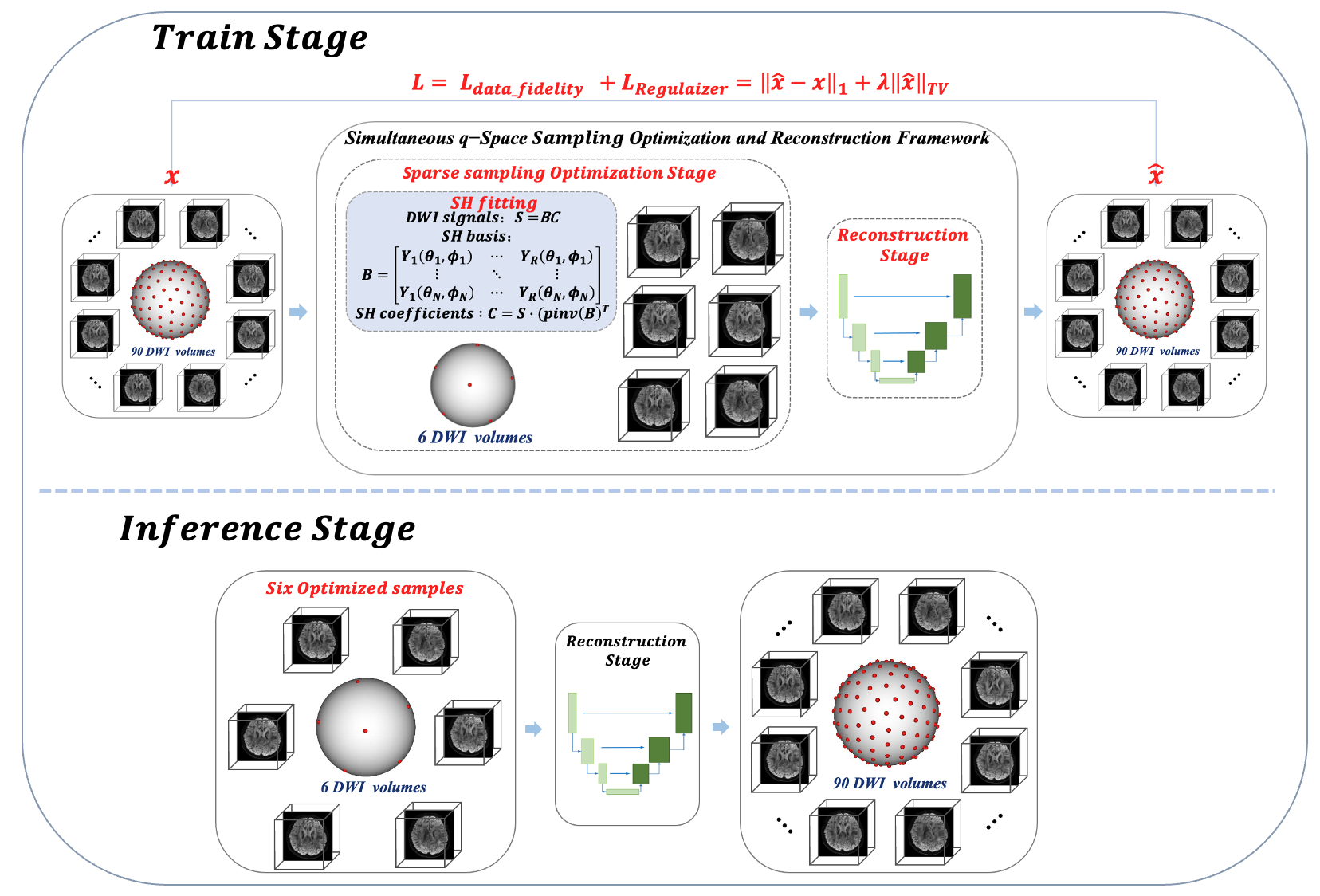
Figure 1 provides an illustration of our proposed framework, which consists of three pivotal elements: a sparse sampling optimization stage, a reconstruction stage, and a thoughtfully crafted optimization function. During the first stage, the dMRI measurements in each voxel are decomposed into a set of spherical harmonics coefficients, along with their corresponding SH basis. These basis functions are specifically linked to the polar coordinate representation of diffusion gradient directions. Through the down-sampling, a set of low angular resolution signals is obtained. These samples are utilized as input for the reconstruction network.Through network updates, the framework is able to identify and acquire optimal sparse sampling points. Here, we adopt U-net9 as our reconstruction model. Other reconstruction models can also be used. Our approach fully explores the information in the dMRI data, both in the q-space domain and spatial domain, by incorporating sparse priors and image regularization into the optimization function.Inspired by works of Ye et al., which assume that the diffusion signal has a sparse representation in the q-space10 and explore the sparsity of diffusion signals for q-DL11, we employ norm and total-variation regularization to reconstruct high angular resolution signal. Total-variation regularization is used ensure sparsity and smoothness in the spatial domain12 and guarantee that more structure details can be restored. The overall designed training loss is:$$Loss=\frac{1}{N}\|\widehat{x}-x\|_{1}+\lambda\|\widehat{x}\|_{TV}$$
$$\widehat x=R_\psi\left(Q_{\theta,\varphi}(x)\right)$$
where $$$\widehat{x}$$$ is the output of the joint optimization sampling and reconstruction network $$$R_{\psi}\left(Q_{\theta,\varphi}(\cdot)\right)$$$ . $$$x$$$ represents the high angular resolution dMRI,$$$\lambda$$$ was empirically set to 2e-7.
Experiments
The data of 230 subjects from the HCP dataset13 were used and split into 175 subjects for training, 24 for validation, and 31 for testing. We compared the performance of our method with learned-dMRI14, reconstruction network with random sampling, and reconstruction network with uniform sampling. The number of epochs for training is 50. The learning rate was empirically set to 1e-3 for the sampling stage and 1e-4 for the reconstruction stage.Results
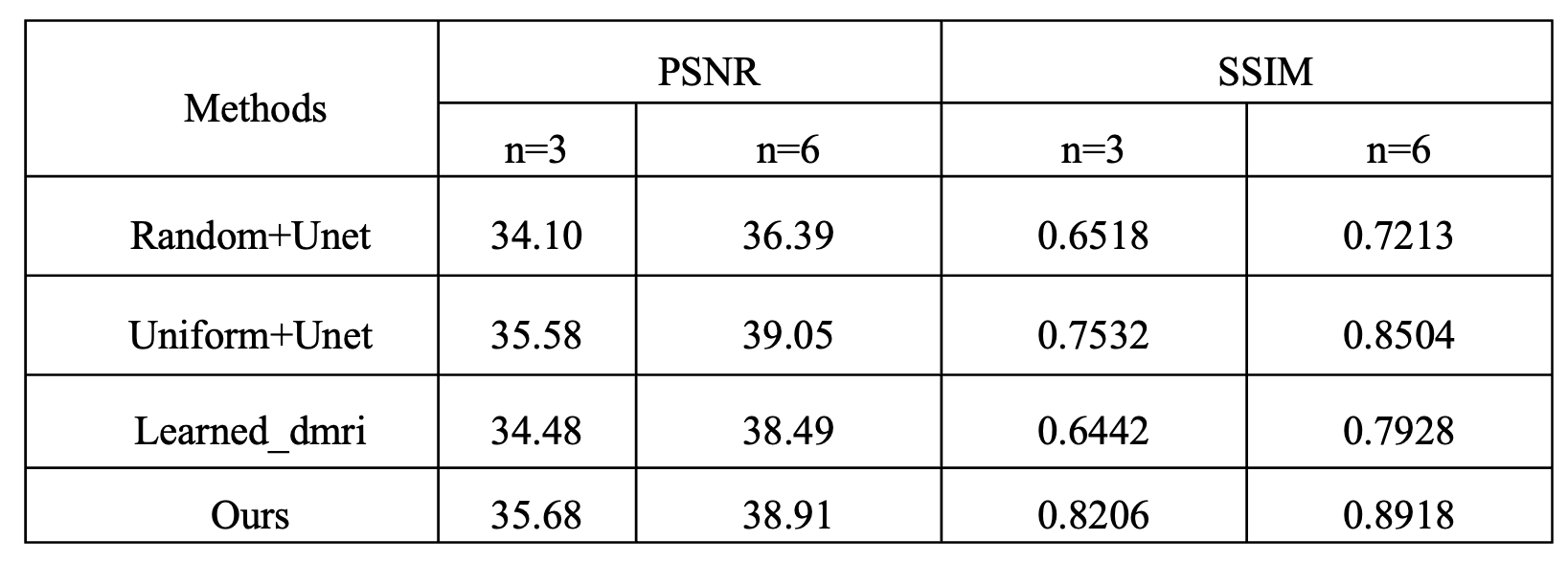
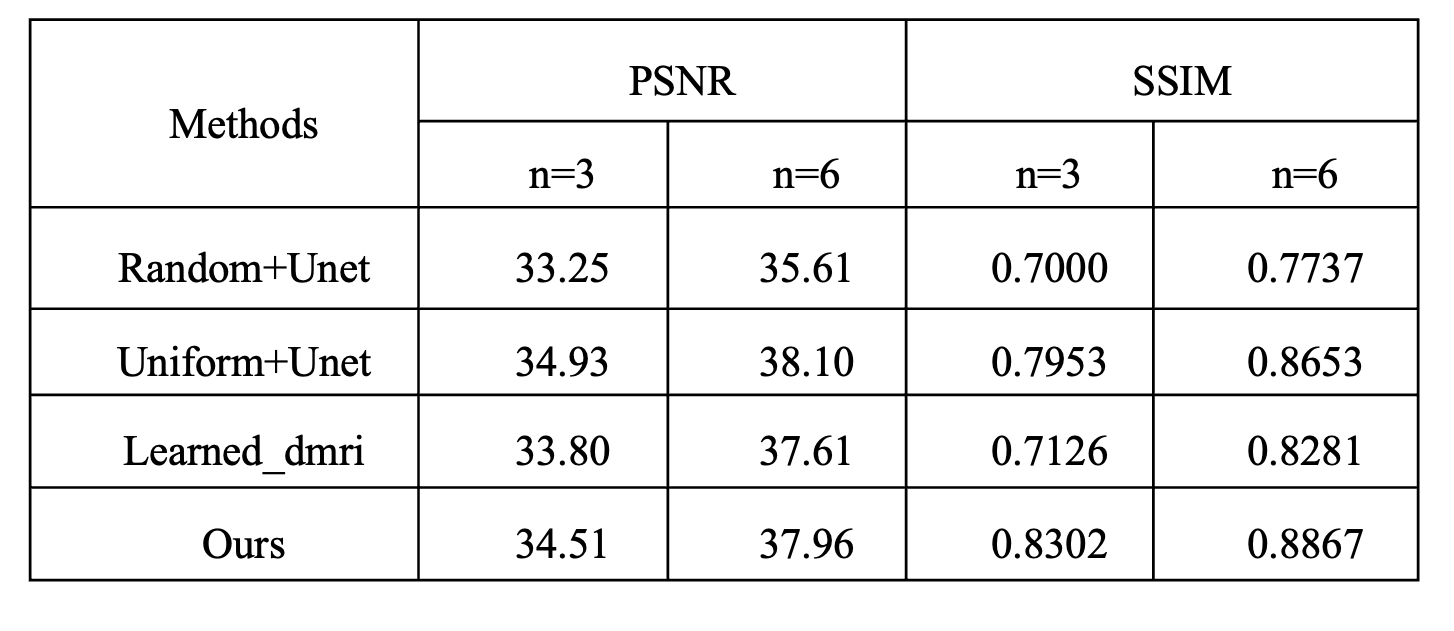
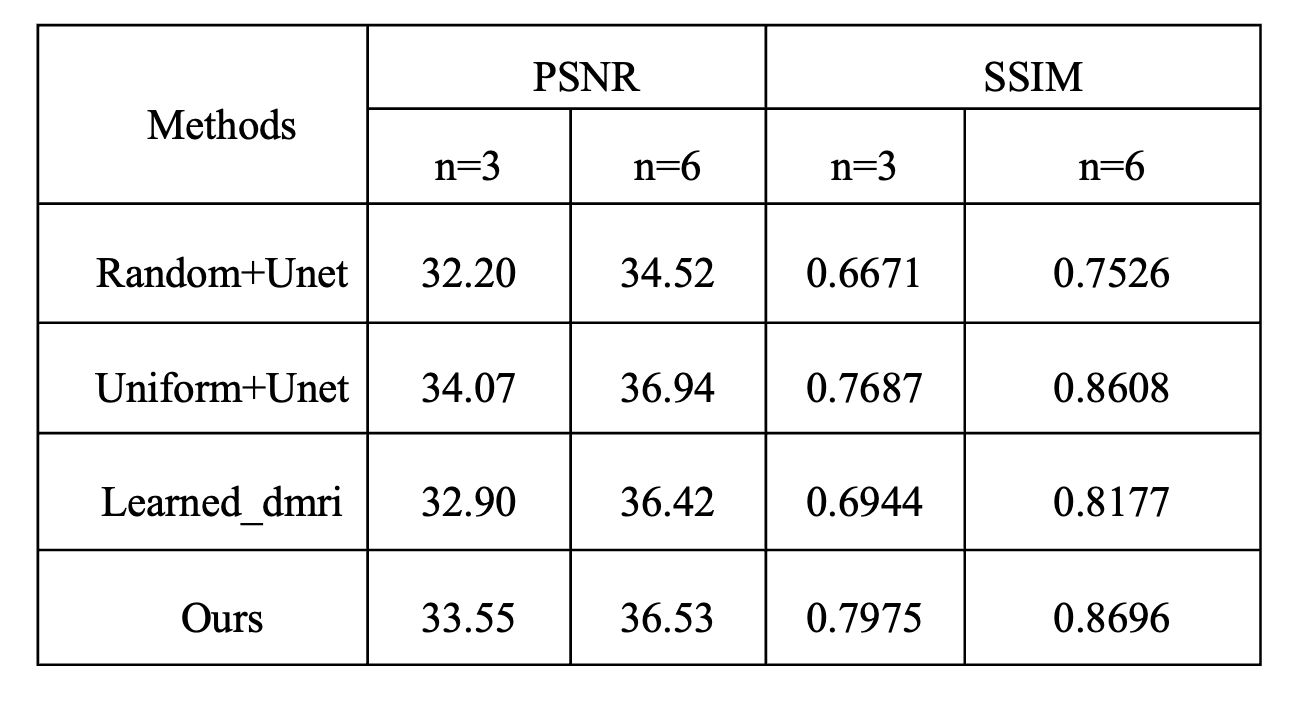
Table 1 shows the quantitative results. The PSNR and SSIM of both methods show an increasing trend as the directions increase. The improvement of our method is obvious, especially in terms of SSIM. Tables 2 and 3 show the reconstruction results using different acquisition protocols. The model trained on the b = 1000 data also performs well on the lower SNR ratio dataset, showing the robustness of our method to noise.Discussion
From an overall perspective, the joint q-space sampling optimization and reconstruction framework incorporating the x-q space prior outperforms the current method. The possible reasons for the good results can be that the sparse prior and data redundancy information in x-q space are fully explored, and TV loss plays an important role in restoring the image details.Conclusion
In this study, we propose a simultaneous q-Space optimization and reconstruction framework to accelerate dMRI, leveraging the sparsity characteristics of q-space and the Total-variation regularization in image space. The framework ensures robust reconstruction performance even with three directions in the q-space. It exhibits strong robustness when tested on lower SNR datasets.Acknowledgements
This research was partly supported by the National Natural Science Foundation of China (62222118, U22A2040), Guangdong Provincial Key Laboratory of Artificial Intelligence in Medical Image Analysis and Application (2022B1212010011), Shenzhen Science and Technology Program (RCYX20210706092104034, JCYJ20220531100213029), and Key Laboratory for Magnetic Resonance and Multimodality Imaging of Guangdong Province (2023B1212060052).References
1. Zheng T, Yan G, Li H, et al. A microstructure estimation Transformer inspired by sparse representation for diffusion MRI[J]. Medical Image Analysis, 2023, 86: 102788.
2. Mori S, Barker PB. Diffusion magnetic resonance imaging: Its principle and applications. Anat Rec. 1999;257(3):102-109.
3.Taouli B, Koh DM. Diffusion-weighted MR Imaging of the Liver. Radiology. 2010;254(1):47-66. doi:10.1148/radiol.09090021
4. Koh DM, Collins DJ. Diffusion-Weighted MRI in the Body: Applications and Challenges in Oncology. Am J Roentgenol. 2007;188(6):1622-1635. doi:10.2214/AJR.06.1403
5. Faiyaz A, Uddin MN, Schifitto G. Angular upsampling in diffusion MRI using contextual HemiHex sub-sampling in q-space. Published online October 2022. Accessed February 9, 2023. http://arxiv.org/abs/2211.00240
6. Tian Q, Bilgic B, Fan Q, et al. DeepDTI: High-fidelity six-direction diffusion tensor imaging using deep learning. NeuroImage. 2020;219:117017. doi:10.1016/j.neuroimage.2020.117017
7. Golkov V, Dosovitskiy A, Sperl JI, et al. q-Space Deep Learning: Twelve-Fold Shorter and Model-Free Diffusion MRI Scans. IEEE Trans Med Imaging. 2016;35(5):1344-1351. doi:10.1109/TMI.2016.2551324
8. Jha RR, Nigam A, Bhavsar A, Pathak SK, Schneider W, Rathish K. Multi-Shell D-MRI Reconstruction via Residual Learning utilizing Encoder-Decoder Network with Attention (MSR-Net). In: 2020 42nd Annual International Conference of the IEEE Engineering in Medicine & Biology Society (EMBC). ; 2020:1709-1713. doi:10.1109/EMBC44109.2020.9175455
9. Ronneberger O, Fischer P, Brox T. U-net: Convolutional networks for biomedical image segmentation[C]//Medical Image Computing and Computer-Assisted Intervention–MICCAI 2015: 18th International Conference, Munich, Germany, October 5-9, 2015, Proceedings, Part III 18. Springer International Publishing, 2015: 234-241.
10. Ye C. Estimation of Tissue Microstructure Using a Deep Network Inspired by a Sparse Reconstruction Framework. In: Niethammer M, Styner M, Aylward S, et al., eds. Information Processing in Medical Imaging. Vol 10265. Lecture Notes in Computer Science. Springer International Publishing; 2017:466-477. doi:10.1007/978-3-319-59050-9_37
11. Ye C, Li Y, Zeng X. An improved deep network for tissue microstructure estimation with uncertainty quantification. Med Image Anal. 2020;61:101650. doi:10.1016/j.media.2020.101650
12. Ning L, Setsompop K, Michailovich O, et al. A joint compressed-sensing and super-resolution approach for very high-resolution diffusion imaging. NeuroImage. 2016;125:386-400. doi:10.1016/j.neuroimage.2015.10.061
13. Van Essen DC, Ugurbil K, Auerbach E, et al. The Human Connectome Project: A data acquisition perspective. NeuroImage. 2012;62(4):2222-2231. doi:10.1016/j.neuroimage.2012.02.018
14. Weiss T, Vedula S, Senouf O, Michailovich O, Bronstein A. Towards Learned Optimal q-Space Sampling in Diffusion MRI. In: Gyori N, Hutter J, Nath V, Palombo M, Pizzolato M, Zhang F, eds. Computational Diffusion MRI. Mathematics and Visualization. Springer International Publishing; 2021:13-28. doi:10.1007/978-3-030-73018-5_2
Figures