4670
Accelerated Convergent Reconstruction for MRI with High and Low Frequency1Inner Mongolia University, Hohhot, China, 2Shenzhen Institute of Advanced Technology,Chinese Academy of Sciences, Shenzhen, China, 3lnner Mongolia Medical University, Hohhot, China
Synopsis
Keywords: AI/ML Image Reconstruction, Brain
Motivation: Theoretically, results of general unfolding network are not a convergence point of the ill-posed problem for MRI reconstruction.
Goal(s): Our goal was to design an accelerated convergence unfolding network that is easier to approach the convergence point.
Approach: Using accelerated gradient descent method as the framework, the proximal gradient descents of MRI high-frequency and low-frequency information are completed in a single iteration, which achieves faster convergence.
Results: The reconstructed MRI of our unrolled network performs better than others.
Impact: The convergence point can be effectively approximated by accelerating convergence rate, but it is still not guaranteed to be the optimal point, and further work should seek the optimal value.
Abstract
Unfolding algorithm models have been successfully applied to rapid reconstruction of MRI. However, finite computility constrains unfolding algorithm iterate only a few times, so the convergence point relies strongly on learning ability of network. In this paper, we propose an accelerated convergent unfolding algorithm that obtains solutions closer to convergence points within several iterations. Our framework adopts the accelerated proximal gradient descent method with two weighted momentum sequences; one is learned through neural networks while the other is solved using traditional soft thresholding. Naturally the two sequences can be associated with high and low frequency information from MRI data. Experiments confirm the superior performance of our method.Introduction
MRI is widely applied in clinical diagnosis, but the slow signal acquisition may result in motion artifacts. Compressed sensing (CS) [1] effectively accelerate MRI reconstruction. Related algorithms [2],[3] utilize the sparsity of images to design regularization terms, and then iteratively obtain the convergence point of inverse problem. Unfolding algorithms [4]-[7] integrate the strengths of deep learning and traditional CS algorithms to accelerate reconstruction. As seen in [6], proposed ISTA-Net learns a soft thresholding function to effectively solve the proximal mapping. However, these algorithms are constrained by memory limitations and typically undergo a few of iterations, whereas theoretically, reconstruction with increased iterations is closer to the convergence point. To address these issues, we propose an Accelerated Gradient (AG) network that leverages the optimization framework [8] to achieve a solution closer to the convergence point with fewer network iterations. The key contributions of our proposed algorithm are (a) proposing an accelerated convergent unfolding network called AG-Net which is essentially equivalent to performing two gradient descents within a single iteration. (b) constructing a wavelet regularization term and representing the two-step proximal gradient operation with soft thresholding and network respectively, thereby introducing network acceleration and sparse priors. (c) a weighted combination of two sequences simultaneously learning low-frequency and high-frequency information in MRI to leverage prior for improved performance. (d) demonstrating competitiveness of our algorithm in comparison to other unfolding algorithms evidenced by both qualitative and quantitative experimental results.Method
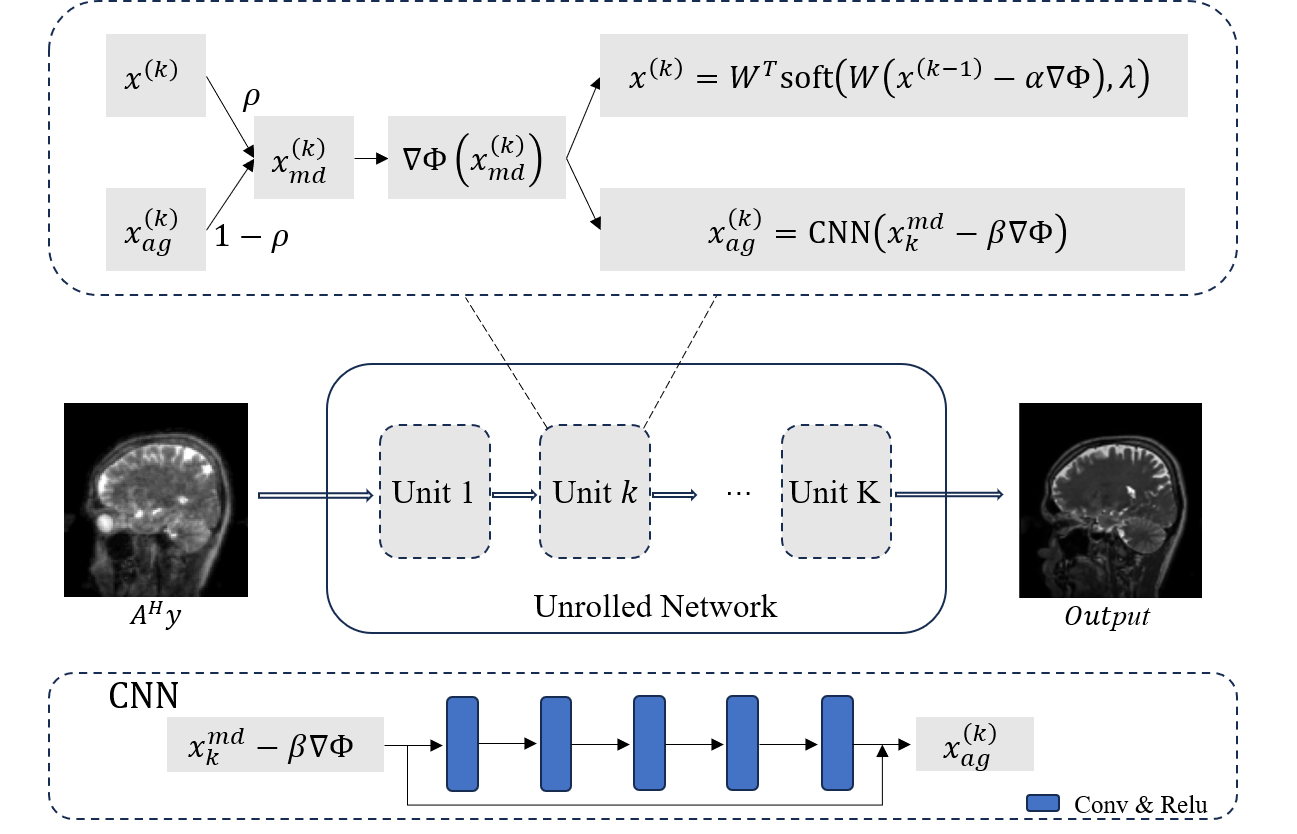
For MRI reconstruction, ill-posed problem is solved by minimizing the variational problem as below $$\min_{x}\Phi(x)+\Psi(x).\quad(1)$$ Here, data consistency term is $$$\Phi(x)=\frac{1}{2}\|\mathcal{A}x-y\|_{2}^{2}$$$. Non-smooth $$$\ell_1$$$ norm term $$$\Psi(x)=\lambda\|\mathcal{W}x\|_{1}$$$ is a sparse regularization on wavelet transform $$$\mathcal{W}$$$. Variate $$$x$$$ represents MR image to be recovered and $$$y$$$ is k-space measurement. For Parallel MRI we have $$$\mathcal{A} = MFS$$$ where $$$M$$$ is the sampling matrix, $$$F$$$ is Fourier transform, and $$$S$$$ stands for sensitivity maps [9,10].Accelerated iterative procedure for solving the nonsmooth problem (1) by AG algorithm is outlined as follows:\begin{equation}\begin{aligned}x_{md}^{(k)}&=(1-\rho)x_{ag}^{(k-1)}+\rho x^{(k-1)}\\ x^{(k)}&= \mathcal{P}(x^{(k-1)},\nabla\Phi(x_{md}^{(k)}),\alpha)\\ x_{ag}^{(k)}&=\mathcal{P}(x_{md}^{(k)}, \nabla \Phi(x_{md}^{(k)}), \beta). \end{aligned}\end{equation} $$$\mathcal{P}(\cdot)$$$ represents the proximal mapping, which can be expanded as follows:\begin{equation}\begin{aligned} x^{(k)}&= \mathop{\arg\min}\limits_{u} \Phi(x)+\left\langle\nabla\Phi,u-x^{(k-1)}\right\rangle\\ &+\frac{1}{2\alpha}\| u-x^{(k-1)}\|_{2}^{2}+\Psi(x).\quad(2) \end{aligned}\end{equation} \begin{equation}\begin{aligned} x_{ag}^{(k)} &= \mathop{\arg\min}\limits_{u} \left \langle \nabla \Phi, u \right \rangle + \frac{1}{2\beta} \| u-x_{md}^{(k)}\|_{2}^{2}+\Psi(x).\quad(3) \end{aligned}\end{equation}To ensure the synergy between networks and wavelet transform for reconstruction, (2) is solved by ISTA [11] as follows.\begin{equation}\begin{aligned} r^{(k)}&=x^{(k-1)}-\alpha\nabla\Phi,\\ &=x^{(k-1)}-\alpha \mathcal{A}^{H}(\mathcal{A}x^{(k-1)}-y)\\ x^{(k)}&=\mathop{\arg\min}\limits_{x}\frac{1}{2\alpha} \|x- r^{(k)}\|_{2}^{2}+\Psi(x)\\ &=\mathcal{W}^{H}\text{soft}(\mathcal{W}r^{(k)},\lambda). \end{aligned}\end{equation} And (3) is solved by convolutional networks training to perform soft thresholding as follows. \begin{equation}\begin{aligned} r_{ag}^{(k)}&= x_{md}^{(k)}-\beta\nabla\Phi,\\ &=x_{md}^{(k)}-\beta\mathcal{A}^{H}(\mathcal{A}x^{(k-1)}-y)\\ x_{ag}^{(k)}&=\text{CNN}(r_{ag}^{(k)}) \end{aligned}\end{equation} As illustrated in Fig.1, we propose an unfolding model AG-Net based on the AG algorithm. In comparison to conventional unfolding algorithms, our approach completes two gradient descents within a single iteration step, resulting in significantly accelerated convergence rates.
Results
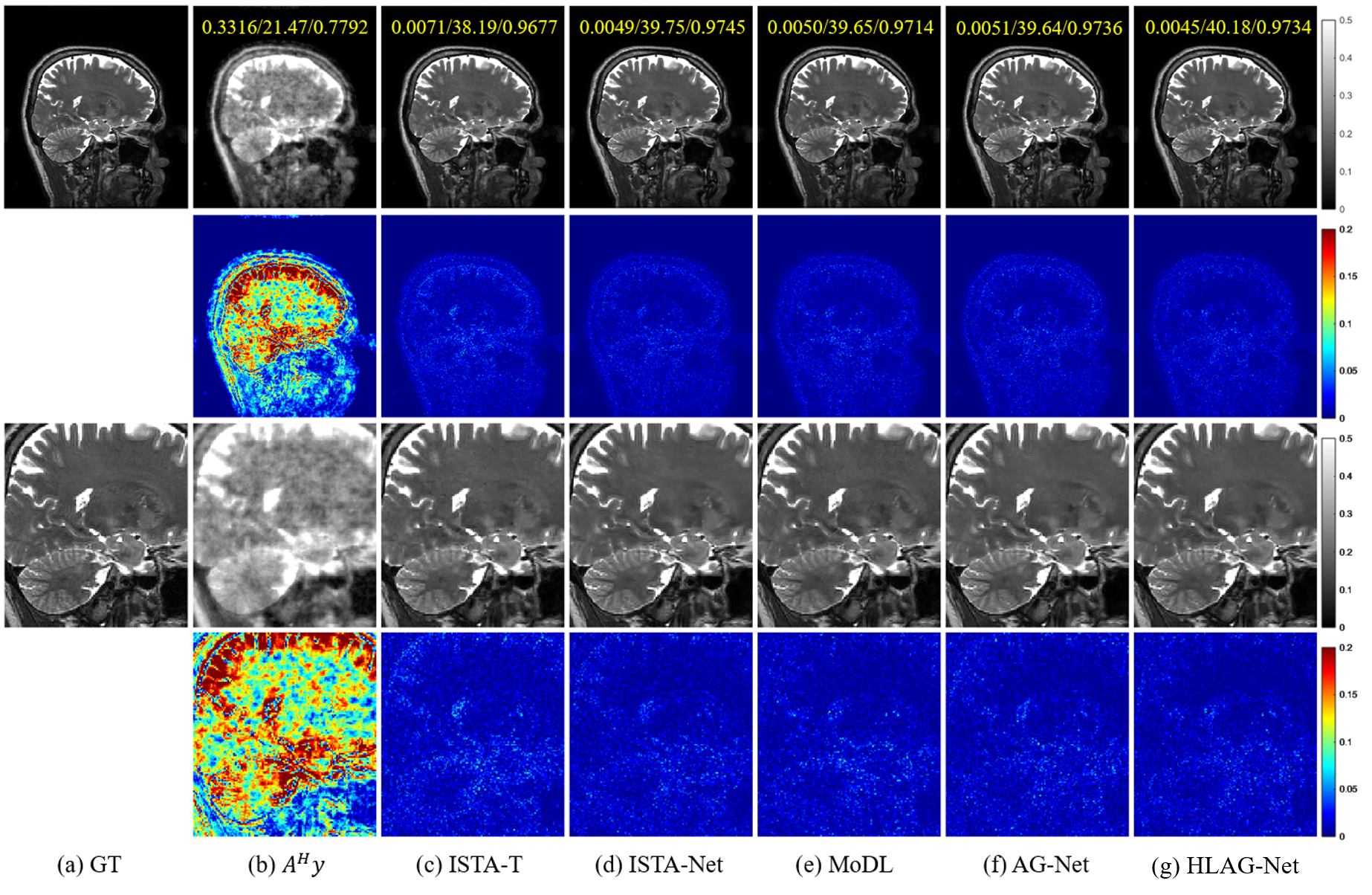
The MRI data and 6x sampling matrix in this study are acquired from MoDL [7]. Fully sampled images for training are 360 images of size $$$12\times256\times232$$$ from four subjects, while 164 data from the fifth volunteer are utilized for testing. The model is implemented on an Ubuntu 18.04 and Tesla V100 (GPU, 32 GB memory). All quality evaluations are calculated by NMSE/PSNR/SSIM. We compare our proposed AG-Net and HLAG-Net with traditional optimization reconstruction method ISTA-T with wavelet regularization and state-of-the-art unfolding methods, including ISTA-Net [6], and MoDL [7]. We present the reconstruction performance in Fig 2. Unfolding network model exhibits superior performance than traditional optimization algorithm and HLAG-Net has the best performance.Conclusions and Discussion
Inspired by AG algorithm, we propose a novel reconstruction network named AG-Net for MR imaging, along with its high-low frequency version HLAG-Net. AG-Net makes the most of the strengths of network and traditional CS while taking into account image prior extracted by deep learning and wavelet transform to accelerate convergence within limited iterations with good interpretability. Experimental results demonstrate that compared to other unfolding algorithms, our algorithm achieves superior reconstruction quality.Acknowledgements
This work was supported in part by the National Key R$$$\&$$$D Program of China (2021YFF0501503, 2020YFA0712202 and 2022YFA1004202); National Natural Science Foundation of China (U21A6005, 62125111, 12026603, 62206273, 61771463, 81830056, U1805261, 81971611, 61871373, 81729003, 81901736, 12061052); Key Laboratory for Magnetic Resonance and Multimodality Imaging of Guangdong Province (2020B1212060051). Young Talents of Science and Technology in Universities of Inner Mongolia Autonomous Region (No. NJYT22090).References
[1] D. Donoho, “Compressed sensing,” IEEE Transactions on Information Theory, vol. 52, no. 4, pp. 1289–1306, 2006.
[2] M. Lustig, D. Donoho, and J. M. Pauly, “Sparse mri: The application of compressed sensing for rapid mr imaging,” Magnetic Resonance in Medicine: An Official Journal of the International Society for Magnetic Resonance in Medicine, vol. 58, no. 6, pp. 1182–1195, 2007.
[3] M. Lustig and J. M. Pauly, “Spirit: iterative self-consistent parallel imaging reconstruction from arbitrary k-space,” Magnetic resonance in medicine, vol. 64, no. 2, pp. 457–471, 2010.
[4] Y. Yang, J. Sun, H. Li, and Z. Xu, “Deep admm-net for compressive sensing mri,” in Proceedings of the 30th International Conference on Neural Information Processing Systems, NIPS’16, (Red Hook, NY, USA), p. 10–18, Curran Associates Inc., 2016.
[5] K. Hammernik, T. Klatzer, E. Kobler, M. P. Recht, D. K. Sodickson, T. Pock, and F. Knoll, “Learning a variational network for reconstruction of accelerated mri data,” Magnetic resonance in medicine, vol. 79, no. 6, pp. 3055–3071, 2018.
[6] J. Zhang and B. Ghanem, “Ista-net: Interpretable optimization-inspired deep network for image compressive sensing,” in 2018 IEEE/CVF Conference on Computer Vision and Pattern Recognition, pp. 1828–1837, 2018.
[7] H. K. Aggarwal, M. P. Mani, and M. Jacob, “Modl: Model-based deep learning architecture for inverse problems,” IEEE Transactions on Medical Imaging, vol. 38, no. 2, pp. 394–405, 2019.
[8] S. Ghadimi and G. Lan, “Accelerated gradient methods for nonconvex nonlinear and stochastic programming,” Math. Program., vol. 156, p. 59–99, mar 2016.
[9] K. P. Pruessmann, M. Weiger, M. B. Scheidegger, and P. Boesiger, “Sense: sensitivity encoding for fast mri,” Magnetic Resonance in Medicine: An Official Journal of the International Society for Magnetic Resonance in Medicine, vol. 42, no. 5, pp. 952–962, 1999.
[10] M. Uecker, P. Lai, M. J. Murphy, P. Virtue, M. Elad, J. M. Pauly, S. S. Vasanawala, and M. Lustig, “Espirit—an eigenvalue approach to autocalibrating parallel mri: where sense meets grappa,” Magnetic resonance in medicine, vol. 71, no. 3, pp. 990–1001, 2014.
[11] A. Beck and M. Teboulle, “A fast iterative shrinkage-thresholding algorithm for linear inverse problems,” SIAM Journal on Imaging Sciences, vol. 2, no. 1, pp. 183–202, 2009.
Figures