4662
RAKI informed unrolled iterations for robust simultaneous multi-slice reconstruction on new datasets1Shenzhen Technology University, Shenzhen, China, 2Department of Radiology, The First Hospital of Tsinghua University, Beijing, China, 3Center for Biomedical Imaging Research, Department of Biomedical Engineering, School of Medicine, Tsinghua University, Beijing, China, 4GE HealthCare MR Research, Beijing, China, 5Lab of Molecular Imaging and Medical Intelligence, Department of Radiology, Longgang Central Hospital of Shenzhen, Shenzhen, China
Synopsis
Keywords: AI/ML Image Reconstruction, Data Processing, SMS,VarNet
Motivation: To improve reconstruction quality of Simultaneous Multi-Slice (SMS) imaging
Goal(s): To develop a deep learning reconstruction method without sacrificing image detail and fidelity, even in data-scarce scenarios.
Approach: Our approach involves a novel integration of subject-specific RAKI and a Variational Network (VarNet) within an unrolled iteration framework, testing three different guidance strategies to improve reconstruction quality.
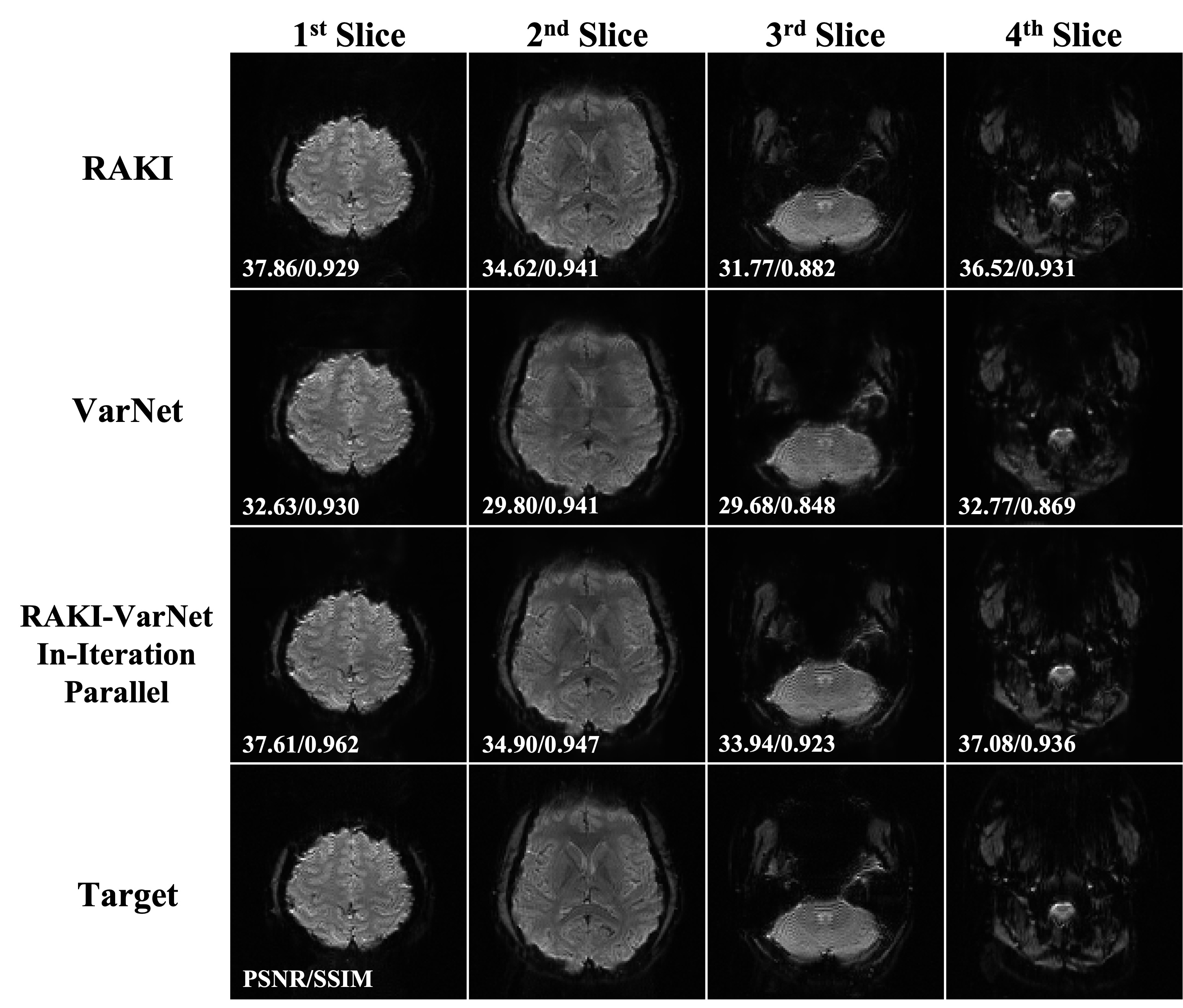
Results: The RAKI-VarNet In-Iteration Parallel method yielded the most promising results, showing a reduction in noise and artifacts while maintaining robustness on both seen and unseen data sets, including challenging EPI data.
Impact: This technique presents a robust solution for high-fidelity SMS MRI reconstruction with improved generalizability and detail preservation.
Introduction
Simultaneous Multi-Slice (SMS) imaging1 marks a significant step forward in MRI for reduced scan times and broader slice coverage. For parallel imaging-based SMS reconstruction, deep learning approaches have branched into two categories:subject-specific and extensive data-trained models. Subject-specific models like Reconstruction using Artificial-neural-networks for k-space Interpolation (RAKI) 2 are custom-made for individual subjects, ensuring predictable and consistent results on new datasets, although they may not achieve the very highest acceleration factors. In contrast, models like VarNet3, trained on large datasets, show potential for achieving very high acceleration factors but might encounter difficulties when applied to new, unseen data.Each deep learning strategy has its unique set of trade-offs: subject-specific methods like RAKI can lead to increased noise at high acceleration factors, whereas extensive data-trained methods may produce images that are excessively smooth and lack fine detail. Acknowledging these strengths and weaknesses, our research proposes a novel deep learning-based unrolled iteration reconstruction technique that effectively incorporates the subject-specific advantages of RAKI. This approach aims to blend the reliable performance of subject-specific learning with the enhanced capabilities of broad data-trained models to improve image quality, especially in situations of high acceleration where traditional subject-specific methods are challenged, and in unfamiliar datasets where generic extensive data-trained methods might underperform.Methods
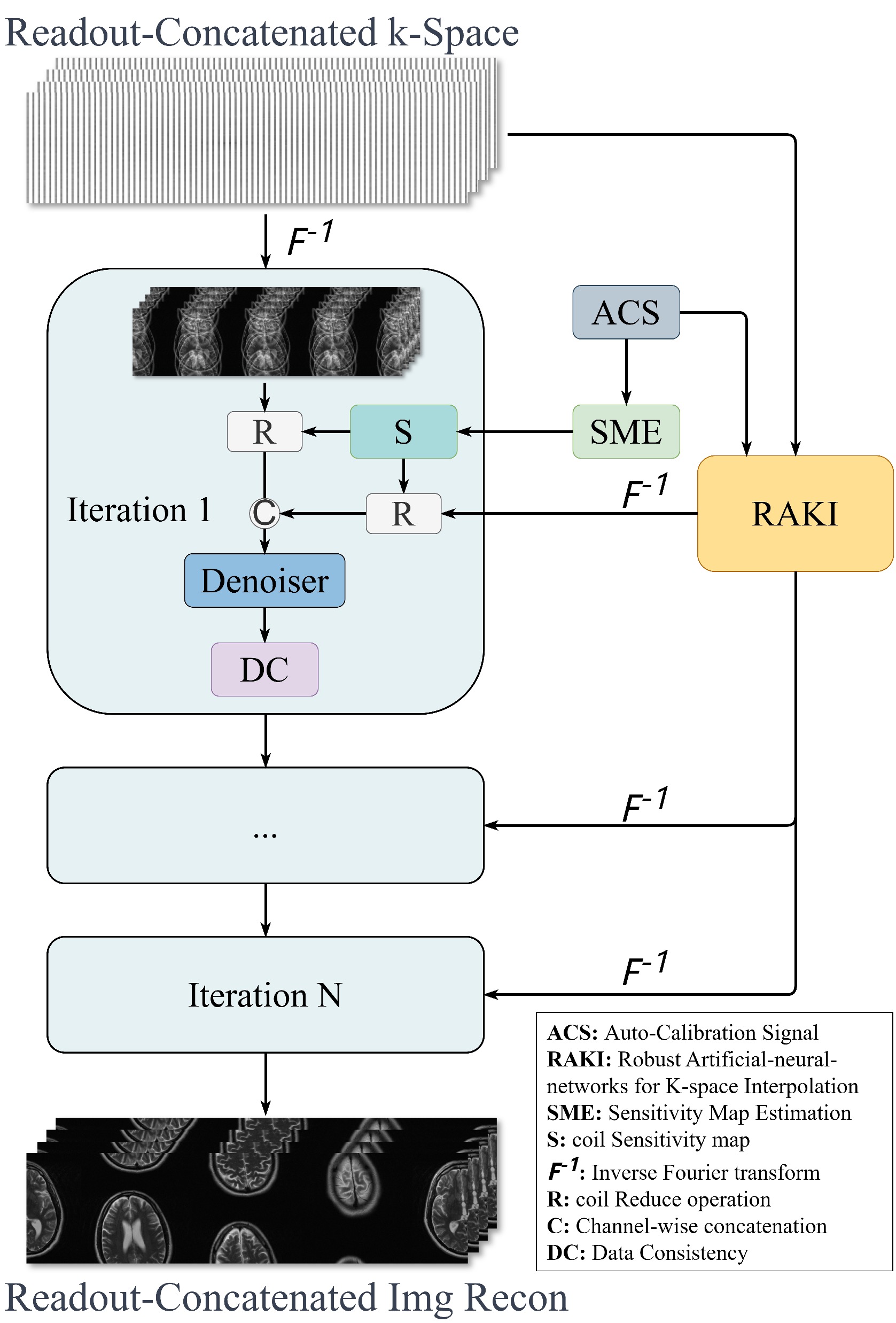
Integrating RAKI with unrolled iteration reconstructionThe core of our approach is the guidance provided by Reconstruction using Artificial-neural-networks for k-space Interpolation (RAKI)2, which informs the deep learning model of subject-specific initial estimation. We adopt readout concatenation scheme4 and explore three distinct guidance strategies: Cascade, End-Stage Parallel, and In-Iteration Parallel. In the Cascade guidance strategy, the RAKI reconstruction results are fed directly into the deep learning unrolled iteration model, i.e., Variational Network (VarNet)3. For the End-Stage Parallel guidance, a convolutional layer merges the RAKI results with the VarNet output. The In-Iteration Parallel guidance, depicted in Figure 1, involves concatenating the RAKI results with the data to be reconstructed along the channel dimension before each iteration. This concatenated input is then processed by the denoiser component of the model, which can range from a simple convolutional layer to a more complex UNet architecture. Throughout the unrolled iteration process, a data consistency (DC) module refines the reconstruction, resulting in the final image after N iterations.
Experiments on fastMRI
Anatomical images of 150 subjects from the fastMRI5 dataset were used to simulate SMS data and train the models. The model robustness and fidelity were tested using the official fastMRI validation set. We trained all models on mixed MB factors of 4 and 8, constrained by GPU memory to three iteration modules. SSIM loss function and AdamW optimizer were used over 50 epochs, with a batch size of one. Training was executed on dual Nvidia A40 GPUs.
Experiments on unseen anatomical data and EPI data
For robustness assessment, we tested the fastMRI trained model on FLAIR data acquired from a local SIEMENS Prisma 3.0T MRI scanner with 32-channel head coil. Since the fastMRI dataset also contains some FLAIR data, no retraining or fine-tuning was applied. Additionally, we tested our method on EPI data acquired from 17 volunteers on a local GE SIGNA Premier 3.0T system. A subset of the EPI data was acquired using a partial Fourier factor of 0.66 to further challenge the reconstruction process. To fine-tune the model, we selected 10 subjects to adjust the pre-trained fastMRI weights. The rest data were reserved for the testing phase to evaluate the performance of the proposed reconstruction method under real-world conditions. Note that all the above experiments were done with synthesized SMS acceleration for direct assessment of PSNR and SSIM.
Results
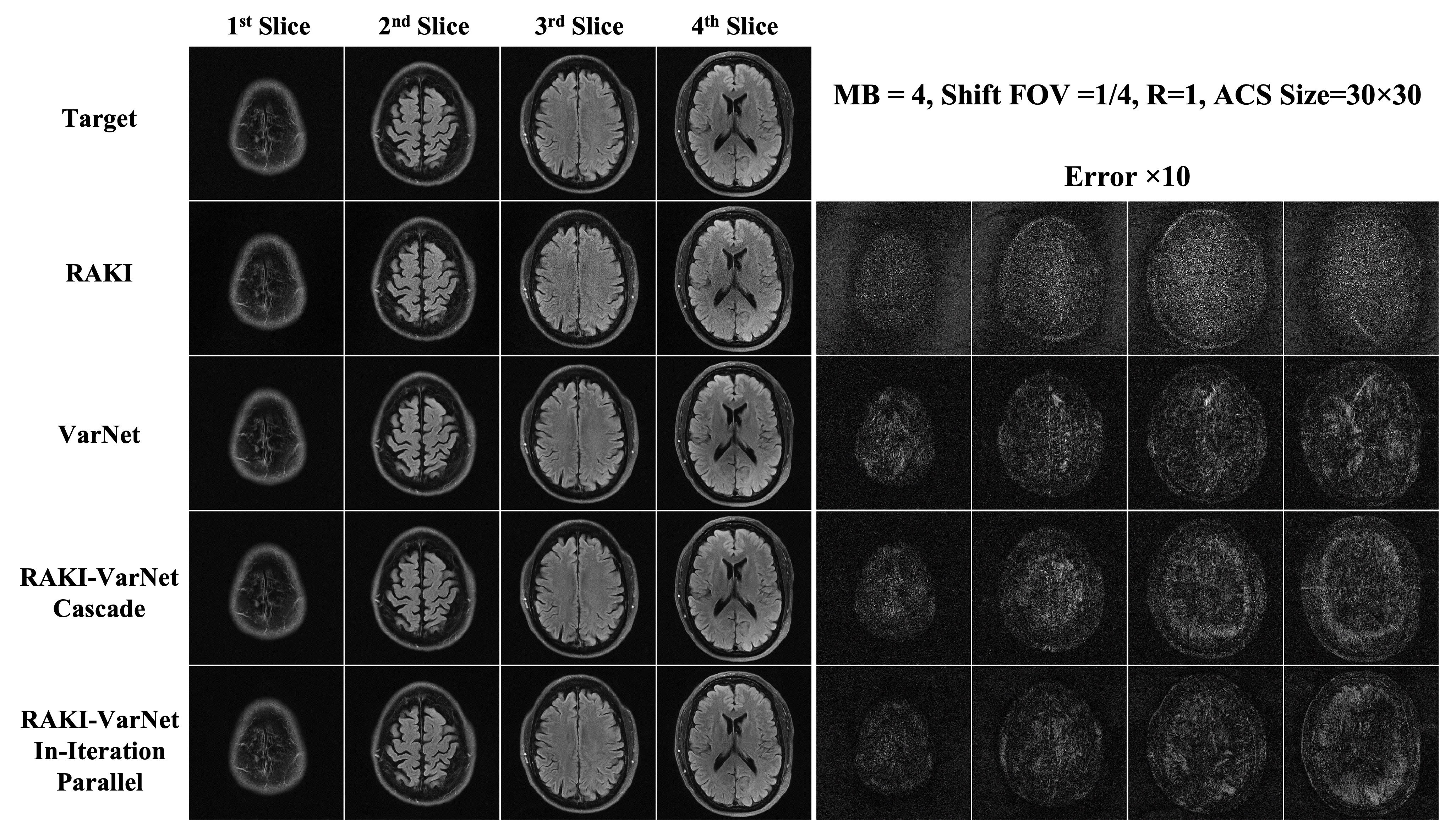
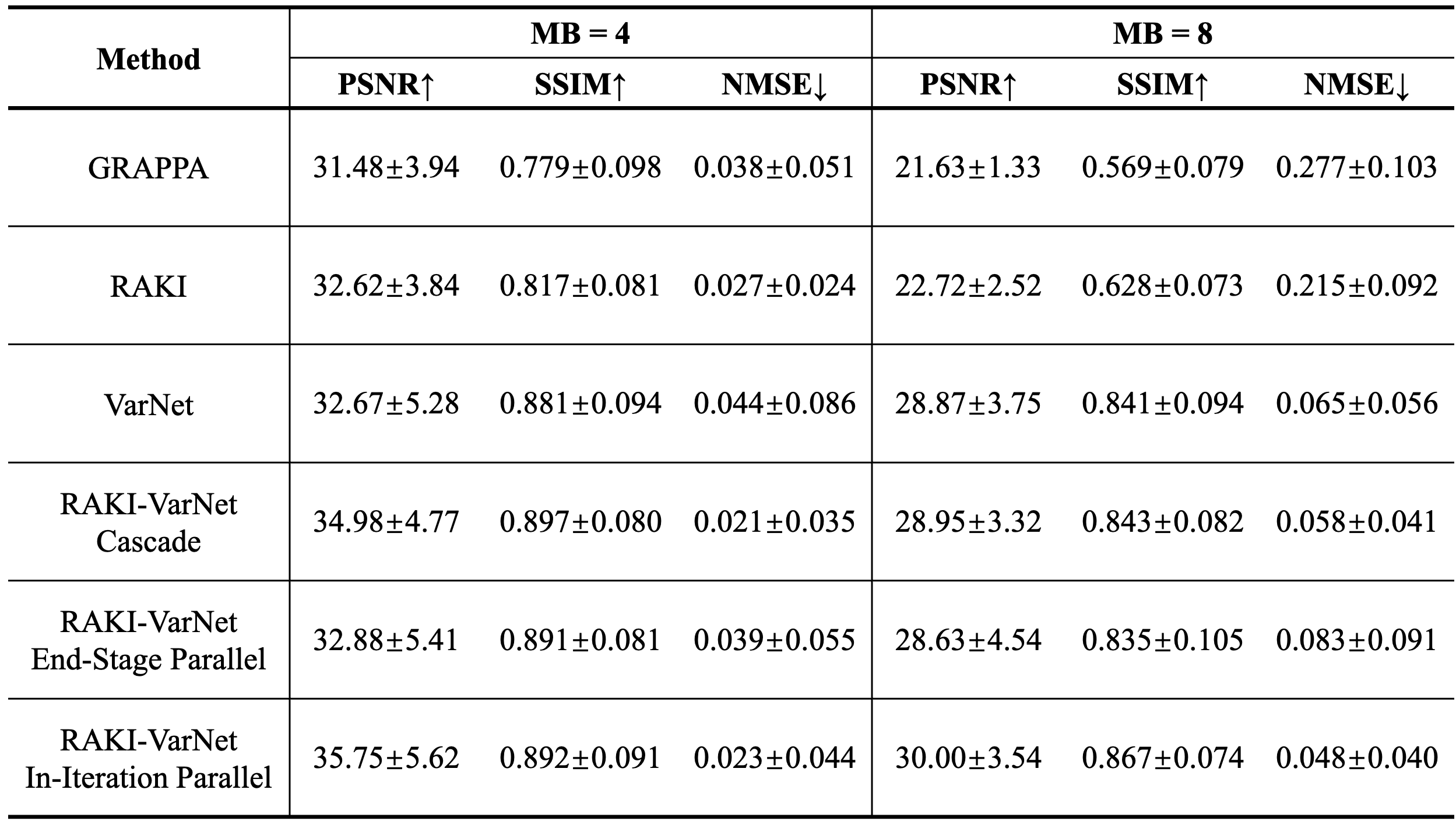
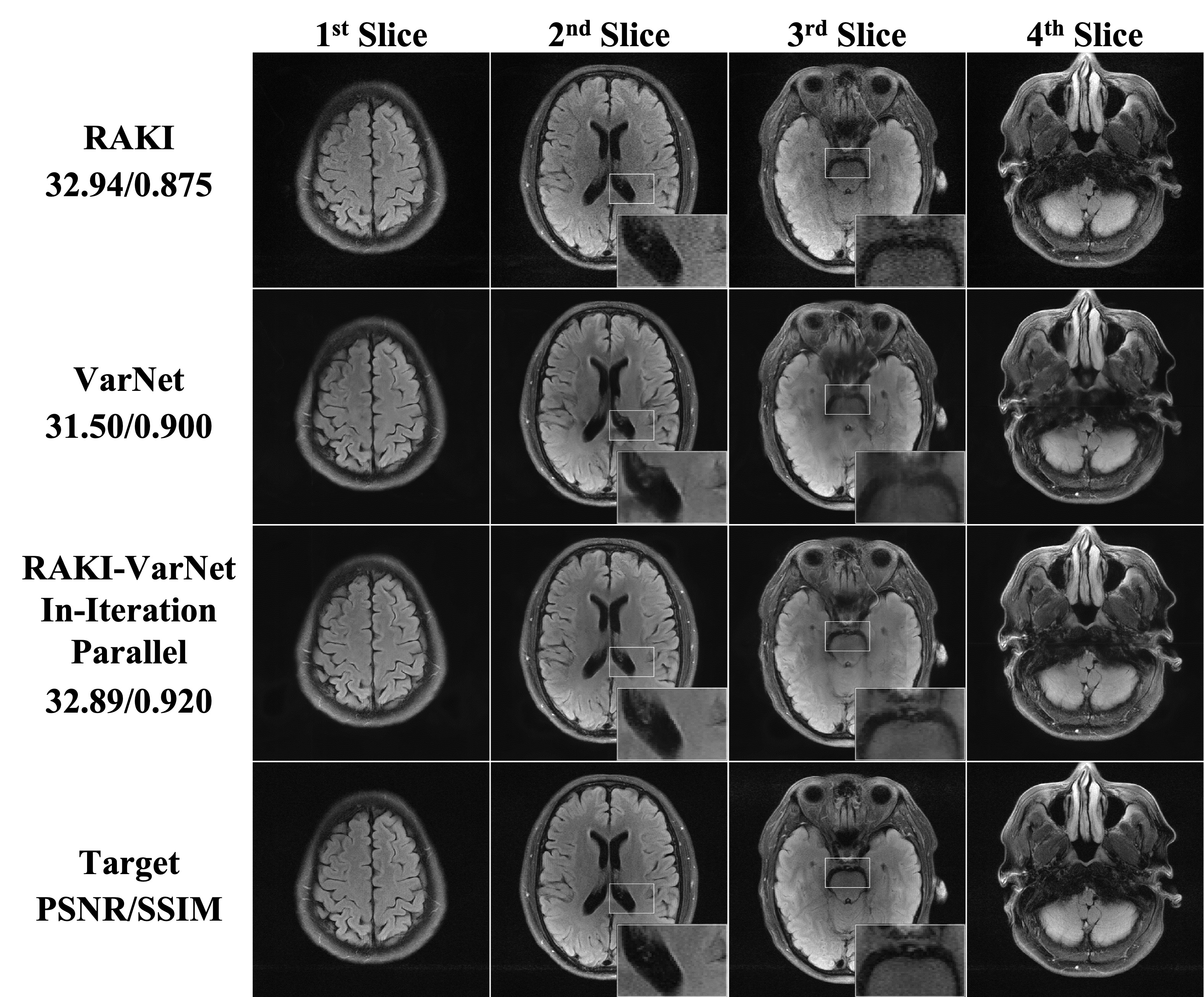
As shown in Figures 2-5, the RAKI method usually leads to noticeable noise amplification at high accelerations, similar to traditional SENSE or GRAPPA method. In contrast, the VarNet method demonstrates lower noise levels but may introduce some extra artifacts. When the RAKI reconstruction results are fed into VarNet, there is a marked reduction in noise and artifacts. The best results are achieved with the RAKI-VarNet In-Iteration Parallel strategy. The proposed method also demonstrates robust performance on unseen FLAIR data without any fine-tuning and achieves the best image quality in EPI data reconstruction with minimal fine-tuning.Discussion and Conclusion
The study shows that a RAKI-informed deep learning method holds promise for SMS MRI by maintaining detail and fidelity, even at high acceleration factors and unfamiliar dataset. Future research will aim to expand this approach's applicability across various imaging conditions.Acknowledgements
This work was supported by the National Natural Science Foundation of China (No. 62101348), Shenzhen Higher Education Stable Support Program (No. 20220716111838002), and Natural Science Foundation of Top Talent of Shenzhen Technology University (No. 20200208 and No. GDRC20213).
References
1. Setsompop, Kawin, et al. “Blipped‐controlled aliasing in parallel imaging for simultaneous multislice echo planar imaging with reduced g‐factor penalty.” Magnetic resonance in medicine 67.5 (2012): 1210-1224.
2. Akçakaya, Mehmet, et al. “Scan-Specific Robust Artificial-Neural-Networks for k-Space Interpolation (RAKI) Reconstruction: Database-Free Deep Learning for Fast Imaging.” Magnetic Resonance in Medicine, Jan. 2019, pp. 439–53, https://doi.org/10.1002/mrm.27420.
3. Sriram, Anuroop, et al. "End-to-end variational networks for accelerated MRI reconstruction." International Conference on Medical Image Computing and Computer-Assisted Intervention. Springer, Cham, 2020.
4. Moeller, Steen, et al. "Multiband multislice GE‐EPI at 7 tesla, with 16‐fold acceleration using partial parallel imaging with application to high spatial and temporal whole‐brain fMRI." Magnetic resonance in medicine 63.5 (2010): 1144-1153.
5. Zbontar, J., Knoll, F., Sriram, A., Murrell, T., Huang, Z., Muckley, M. J., ... & Lui, Y. W. (2018). fastMRI: An open dataset and benchmarks for accelerated MRI. arXiv preprint arXiv:1811.08839.
Figures