4660
A combined application of Deep Learning Recon and MRI mute technique1Beijing Wandong Medical Technology Co., Ltd, Beijing, China, 2intelligent perception institute, Midea Corporate Research Center, Shanghai, China
Synopsis
Keywords: AI/ML Image Reconstruction, Machine Learning/Artificial Intelligence, mute, acoustic reduction, Deep learning
Motivation: MRI mute technique reduces scanning noise by lowering the gradient slew rate which increase echo spacing, resulting in image blurring and longer scan time.
Goal(s): To design a scanning method that simultaneously reduces scan time and scanning noise without compromising image SNR and clarity.
Approach: Develop a DL-Recon post-processing model to enhance SNR and clarity of images which are acquired from optimized knee scanning protocol with mute technique.
Results: The proposed scanning method improves SNR about 38% and reduces scan time and noise sound pressure separately about 44.8% and 86%.
Impact: Combining DL-Recon with mute sequences help doctors to diagnose more patients. It also enhances the success of clinical scans by decreasing scan noise to improve patient comfort. This is a successful application of DL-Recon with mute scanning technique.
INTRODUCTION
Traditional filtering methods in the image domain are commonly used to improve the SNR of images. However, concerns about the loss of image details, these methods have not been widely applied to magnetic resonance imaging (MRI). Recently, the MRI images denoising and enhancement technique of deep learning reconstruction (DL-Recon) has greater advantages and potential in terms of improving the image SNR and preserving image details compared to traditional denoising methods [1]. In addition, MRI scan noise is another major issue. Excessive scan noise can cause significant interference and stimulation for patients, leading to motion artifacts and scan failure due to patient motion. Some patients even avoid MRI scans due to the unbearable noise. Currently, major manufacturers offer mute sequences (which reduce the gradient slew rate) to reduce scan noise. However, the increased echo spacing of mute sequences can result in image blurring, leading to their limited use in clinical practice [2]. In this study, it aims to develop a faster, quieter, and image clearer scanning method by reducing the number of excitations in sequences to decrease scan time, utilizing the mute function to reduce scanning noise, and using DL-Recon's image denoising and enhancement technique to improve the image SNR and clarity.METHODS
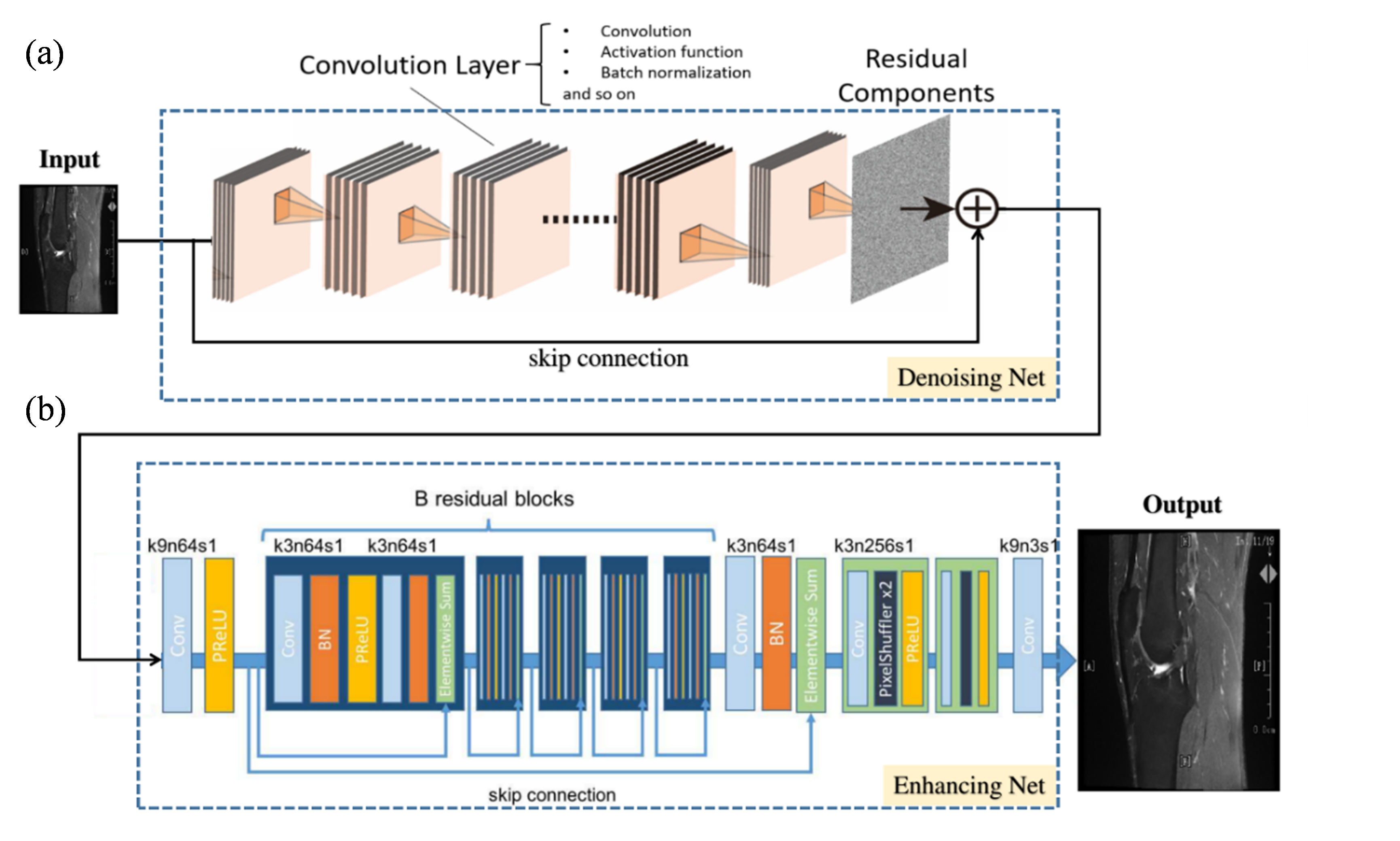
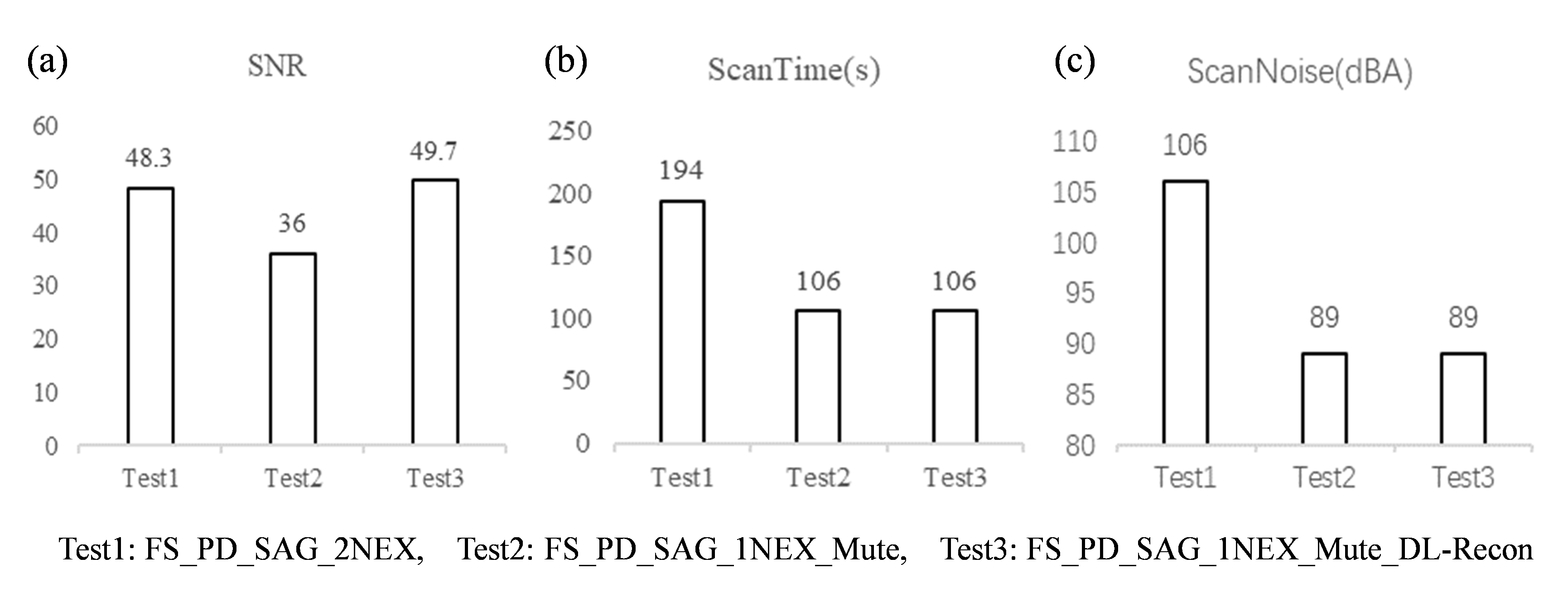
This study was conducted on the i_Field1.5T MRI system from Wandong Medical Technology Co., Ltd. This system provides a denoising and enhancement DL-Recon model specifically designed for knee MRI images as shown in Fig.1. The model is divided into two cascaded sub-modules: a denoising module using DnResNet illustrated in Fig.1(a), and a M-SRResNet enhancement module illustrated in Fig.1(b). The loss function is designed to combine L1 error and perceptual quality[3,4]. The training data consists of 20% MRI images and 80% synthetic images. This method significantly improves the SNR and clarity of MRI images. The mute function is an optional sequence parameter which could reduce the gradient slew rate to 20T/m/s. Six healthy volunteers were recruited for knee scan using the same scanning protocols for each participant, including Test1: FS_PD_SAG_2NEX which is routine clinical protocol with 2 excitation averages, Test2: FS_PD_SAG_1NEX_Mute which is mute protocol with 1 excitation average, Test3: FS_PD_SAG_1NEX_Mute_DL-Recon which is mute protocol with 1 excitation average using DL-Recon for images.RESULTS
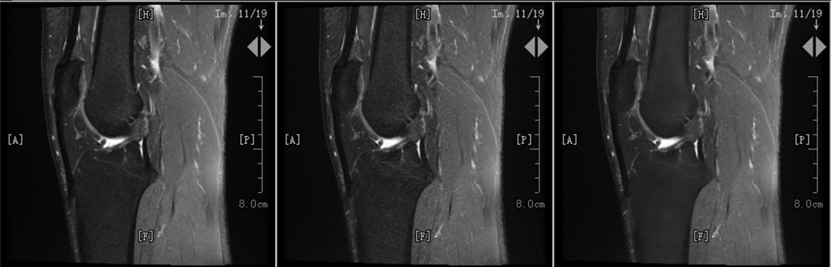
Fig.2 shows a significant decrease in image SNR and clarity after using one excitation mute protocol. However, after using DL-Recon, the image SNR and clarity are significantly improved, and the image quality is comparable to that of the clinical scanning protocol. Fig.3(a) demonstrates that the image SNR of optimized mute protocol increases from 36 to 49.7 with about 38% improvement after using DL-Recon. In Fig.3(b), the scan time of optimized mute protocol decreases to 106s, a reduction of 44.8%. In Fig.3(c), the scan noise of optimized mute protocol is about 89dBA, resulting in an 86% reduction in noise pressure.DISCUSSION
The results indicate that the optimized mute sequence combined with DL-Recon can improve image SNR and image clarity, while reducing scan time and noise. The mute function, due to the decreased gradient slew rate, increases the echo spacing and consequently prolongs the scan time. In the future, further optimization of other accelerated scanning parameters can be explored to further reduce scan time.CONCLUSION
In this study, the denoising and enhancement functions of DL-Recon are combined with mute technique to achieve faster, quieter, and image clearer MRI scan method. This successful integration of DL-Recon with other MRI scanning techniques, such as mute sequences, serves as an example for expanding the application development of DL-Recon.Acknowledgements
No acknowledgement found.References
1. Alexander Selvikvåg Lundervold, Arvid Lundervold, “An overview of deep learning in medical imaging focusing on MRI”, Zeitschrift für Medizinische Physik, Volume 29, Issue 2, Pages 102-127, 20192.
2. Heismann, Björn, Martin Ott, and David Grodzki. "Sequence‐based acoustic noise reduction of clinical MRI scans." Magnetic resonance in medicine, 73(3) pp.1104-1109, 2015.3.
3. https://doi.org/10.48550/arXiv.2002.128894.
4. C. Ledig et al., "Photo-Realistic Single Image Super-Resolution Using a Generative Adversarial Network," 2017 IEEE Conference on Computer Vision and Pattern Recognition (CVPR), pp. 105-114, 2017.
Figures