4657
A Deep Learning Model to Generate Customizable RF Pulse Shapes for Power Independent of Number of Slices Simultaneous Multi-Slice Imaging1Computer Science, Math, Physics, and Statistics, University of British Columbia Okanagan, Kelowna, BC, Canada, 2Department of Radiology, Faculty of Medicine, The University of British Columbia - Vancouver, Vancouver, BC, Canada, 3The BioMedical Engineering and Imaging Institute, Icahn School of Medicine at Mount Sinai, New York, NY, United States
Synopsis
Keywords: Acquisition Methods, RF Pulse Design & Fields, simultaneous multi-slice
Motivation: Designing radiofrequency pulses can be a challenging, time consuming, iterative process.
Goal(s): Simplify the radiofrequency pulse design process using deep learning.
Approach: First, a complex model was trained on a dataset of ~34k RF pulses. Second, a simpler model was trained on a dataset of 1.2M RF pulses. Both models output the characteristics needed to generate a fully sampled radiofrequency waveform.
Results: Model 2 performed better than Model 1, however, the root mean squared error in expected vs. generated slice profiles on a subset of the test data was still high at 36.5%. Future work will implement an optimization loop.
Impact: A fully functioning deep learning model could serve as a tool for researchers designing power independent of number of slices pulses to improve slice profiles for SMS imaging as well as novel applications such as in ex-nuclei imaging.
Introduction
Simultaneous multi-slice (SMS) imaging accelerates image acquisition time with minimal impact on signal-to-noise ratio by separating simultaneously acquired slices using information from sensitivity encoding1. Power-independent-of-number-of-slices (PINS) radiofrequency (RF) pulses enables SMS 180° pulses with power deposition comparable to single-band1-4. In order to limit the number of slices over the field of view, multiband SMS pulses are typically used for excitation, whereas PINS pulses can be used for 180° pulses to reduce power deposition4. However, the development of custom-designed PINS pulses that yield desirable slice profiles requires time-consuming, iterative tuning2,5. The goal of this work was to simplify the design process by training a deep learning model to generate PINS 180° RF pulses given a desired slice profile.Deep learning in combination with conventional pulse design practices has been used to generate and optimize RF waveforms for use in single band and multiband pulses for MRI6,7 We explored 2 approaches to develop a deep learning model to generate custom PINS RF pulse shapes (Figure 1). The first model took a desired slice profile as input, and returned a PINS sampled RF envelope as output, which could be reconstructed into the full PINS waveform. This approach required 124 discrete datapoints to be classified. Our second approach simplified the task of the model by reducing the output to 5 characteristic parameters of the PINS RF waveform, which could be fed into a pulse design algorithm to construct the full RF and gradient waveforms.
Methods
For the first approach, we trained a variation of ResNet18 on a dataset of 34,000 PINS sampled envelopes and gradient profile pairs by varying the number of RF pulse lobes, gradient duty cycle, and band edges (Figure 2). The model was trained for 50 epochs using mean square error (MSE) loss. From the sampled envelope, a noise floor was implemented, and the full RF and gradient waveforms were constructed.For the second approach, a 5-layer forward-feed neural network was trained with ~1.2M generated PINS 180° RF pulse inputs with the corresponding 5 pulse characteristic parameter labels: gradient duty cycle, number of lobes, stopband edge frequency, passband edge frequency, and pulse duration. The range of training data were chosen in order to achieve the broadest range of pulses, focusing on model generalizability rather than commonly used RF waveforms or slice profiles. These parameters were then fed into a PINS pulse design algorithm from which an RF pulse and simulated slice profile were generated and used for validation with the model input4. Train and validation MSE loss were recorded as a function of epoch (Figure 3). A full list of parameters for both models is shown in Figure 2. The Root MSE (RMSE) of the slice profiles was calculated on a subset of test data (n=1000), limited by computational resources. The outputs of the models were visually inspected, and an average example is shown in Figure 5. Deep learning was done using the PyTorch deep learning framework5.
Results
The first model generated results with significant noise. With the added noise floor, PINS sampled RF envelopes and waveforms such as those seen in Figure 4 were acquired. The training for the second model was stopped at 125 epochs following an optimization technique called early stopping (Figure 2). Model-generated slice profiles were visually validated with the model inputs and showed a wide range of variation from the numerically calculated slice profiles (Figure 5). The mean RMSE of the smaller subset of test data was 36.5%.Discussion
The poor results from the first model could be explained by the relatively small dataset, and large number of output neurons to classify. The model was unable to generate clean gradients, and therefore unable to generate reasonable slice profiles.The second model's architecture was much simpler, but showed a high mean RMSE when calculated on the subset of test data. This discrepancy between the model-generated and numerically calculated slice profiles suggests that the second model needs additional complexity. High accuracy is required, especially in the case of the band edges, where even deviations on the order of 10–2 can make relatively large differences.
Conclusion
Our models serve as a proof of concept for using deep learning to design PINS 180° RF waveforms. Future work for model 2 will involve training our dataset on more complex models such as ResNet9 and VGG10 and introducing an optimization loop (gradient descent) following an initial deep learning classification. A fully functioning model could serve as a tool for researchers designing PINS pulses to improve slice profiles for SMS imaging.Acknowledgements
The University of British Columbia
NSERC
References
- Bushberg JT, Boone JM. The essential physics of medical imaging. Lippincott Williams & Wilkins; 2011 Dec 20
- Feldman RE, Islam HM, Xu J, Balchandani P. A SEmi‐Adiabatic matched‐phase spin echo (SEAMS) PINS pulse‐pair for B1‐insensitive simultaneous multislice imaging. Magnetic resonance in medicine. 2016 Feb;75(2):709-17.
- Norris DG, Koopmans PJ, Boyacioğlu R, Barth M. Power independent of number of slices (PINS) radiofrequency pulses for low‐power simultaneous multislice excitation. Magnetic resonance in medicine. 2011 Nov;66(5):1234-40.
- Barth M, Breuer F, Koopmans PJ, Norris DG, Poser BA. Simultaneous multislice (SMS) imaging techniques. Magnetic resonance in medicine. 2016 Jan;75(1):63-81.
- Balchandani P, Qiu D. Semi-adiabatic Shinnar–Le Roux pulses and their application to diffusion tensor imaging of humans at 7T. Magnetic resonance imaging. 2014 Sep 1;32(7):804-12.
- Shin D, Kim Y, Oh C, An H, Park J, Kim J, Lee J. Deep reinforcement learning-designed radiofrequency waveform in MRI. Nature Machine Intelligence. 2021 Nov;3(11):985-94.
- Sloth Vinding M, Ellegaard Lund T. Clipped DeepControl: deep neural network two-dimensional pulse design with an amplitude constraint layer. arXiv e-prints. 2022 Jan:arXiv-2201.
- Paszke A, Gross S, Massa F, et al. PyTorch: An Imperative Style, High-Performance Deep Learning Library. In: Advances in Neural Information Processing Systems 32. Curran Associates, Inc.; 2019:8024–8035.
- He K, Zhang X, Ren S, Sun J. Deep residual learning for image recognition. In Proceedings of the IEEE conference on computer vision and pattern recognition 2016 (pp. 770-778).
- Sengupta A, Ye Y, Wang R, Liu C, Roy K. Going deeper in spiking neural networks: VGG and residual architectures. Frontiers in neuroscience. 2019 Mar 7;13:95.
Figures
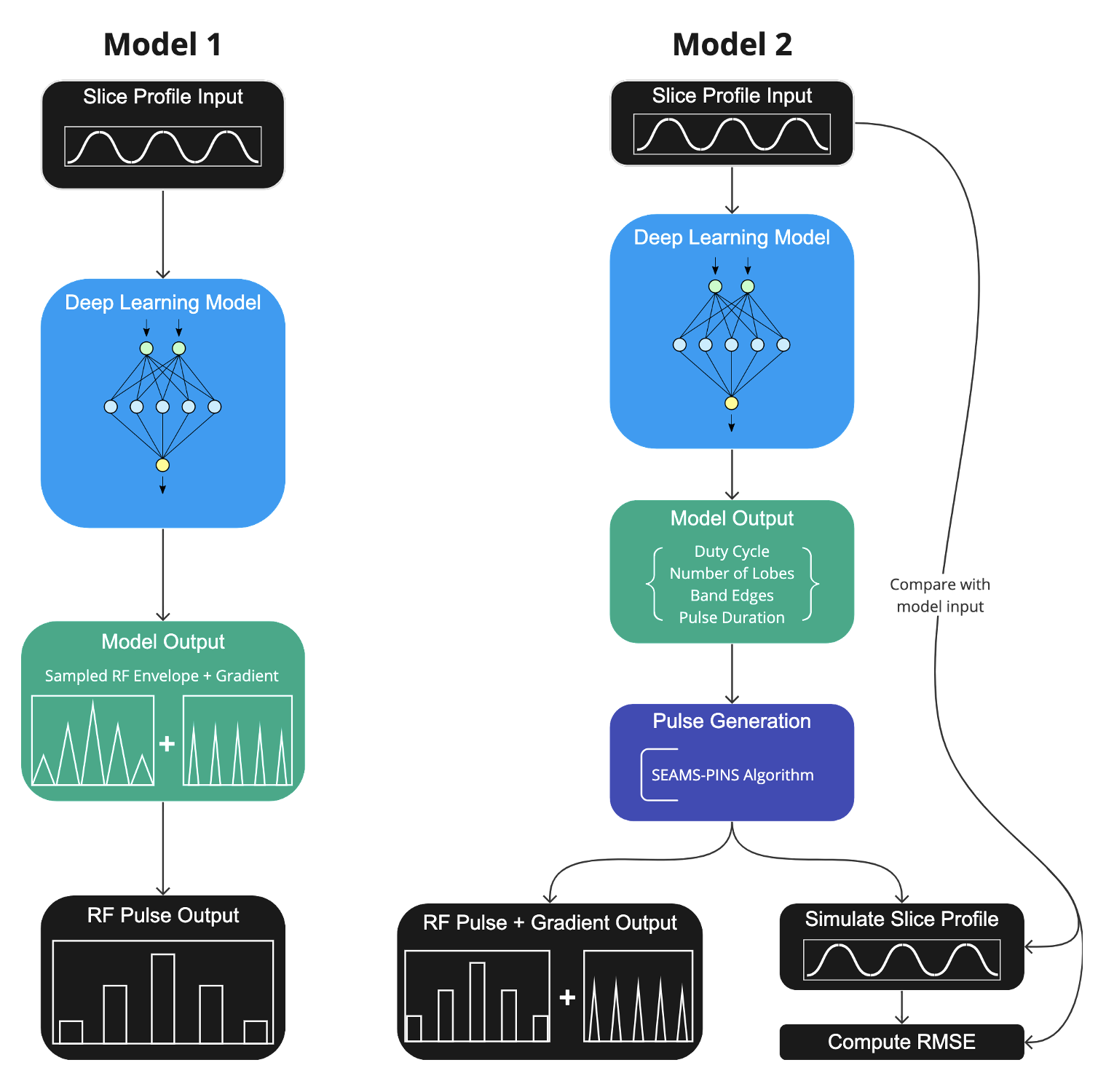
Figure 1. Model Pipelines
Left: The deep learning model in approach 1 takes a slice profile as input and returns the sample RF envelope and gradient, from which the full RF waveform is reconstructed.
Right: The deep learning model in approach 2 takes an RF pulse as input and returns 5 pulse generation parameters: gradient duty cycle, number of pulse lobes, filter band edges, and pulse duration. These parameters are fed into the pulse algorithm, which outputs the RF pulse and simulated slice profile.
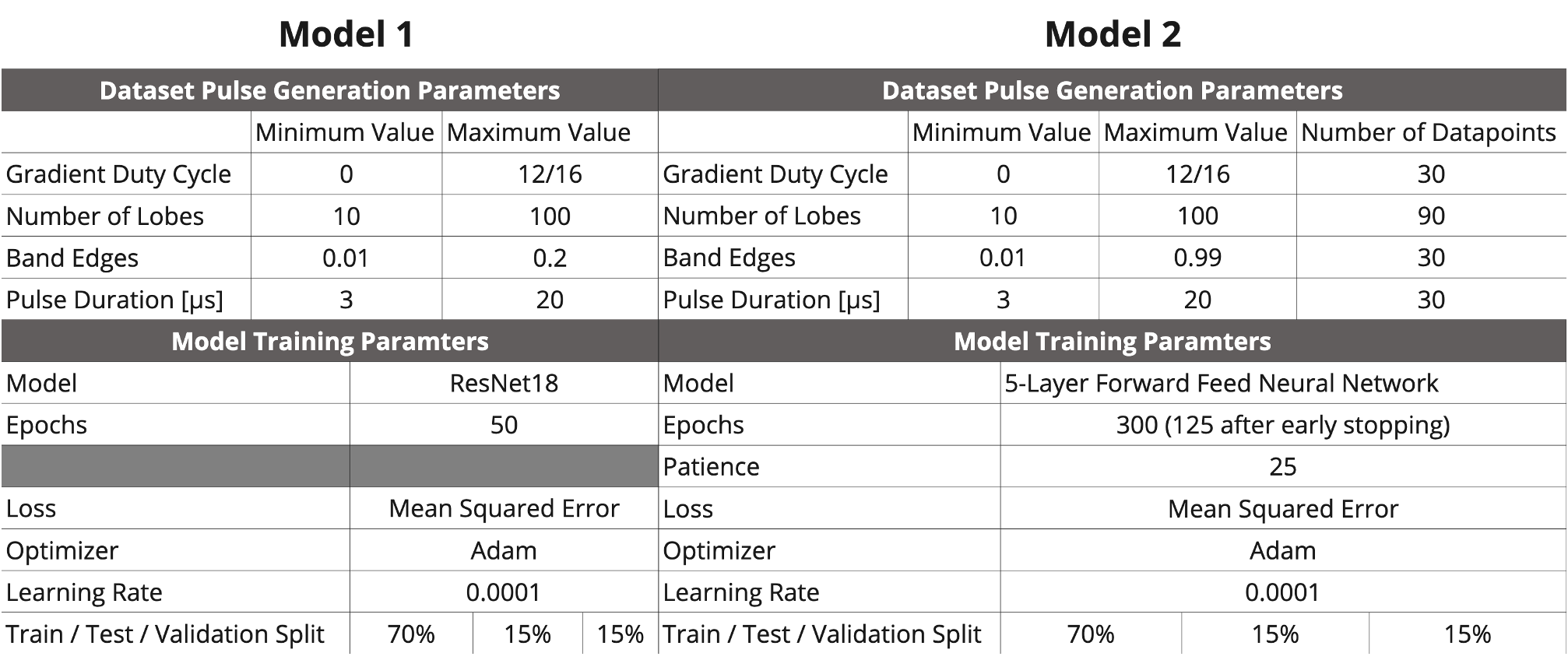
Figure 2. Table of pulse generation and deep learning model parameters. The minimum and maximum values are shown, as well as the number of datapoints for each parameter. The model was trained for 300 epochs. When the differences between the model’s train and validation loss curves are at a minimum, early stopping is implemented to avoid overfitting.
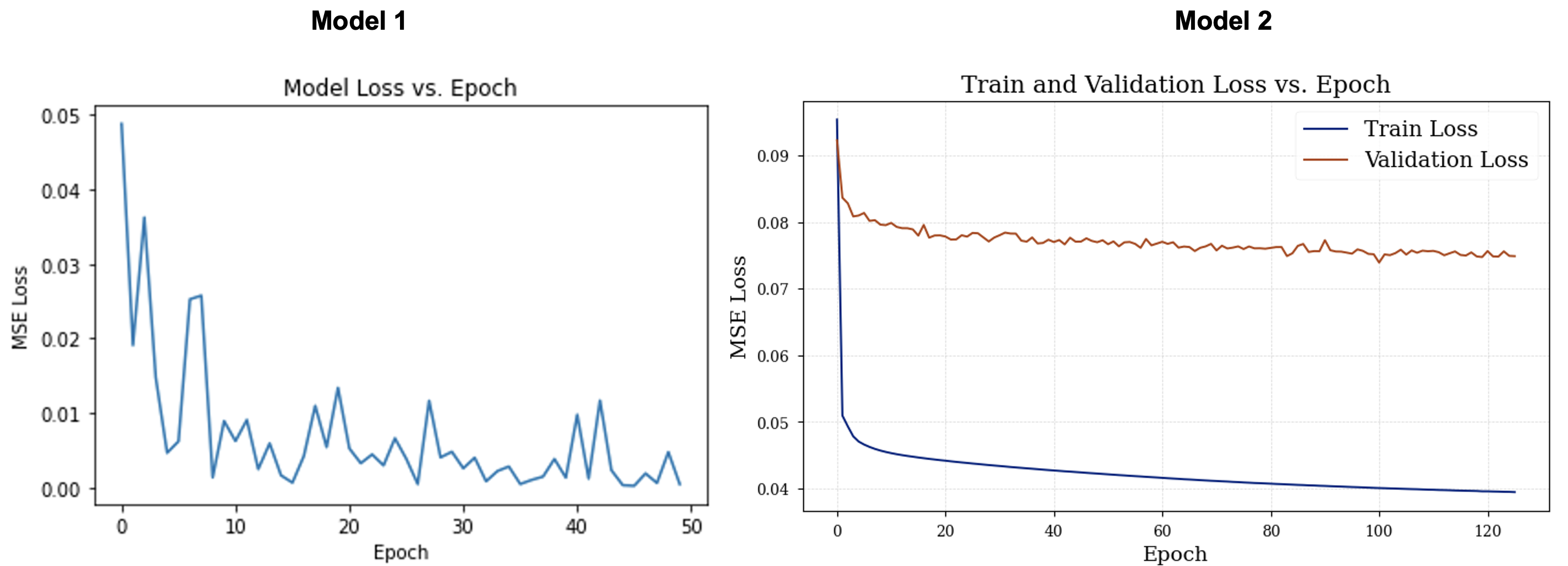
Figure 3. Model train and validation MSE loss curves as a function of epoch for model 1 (left) and model 2 (Right). The loss function for model 1 is indicative of overfitting.
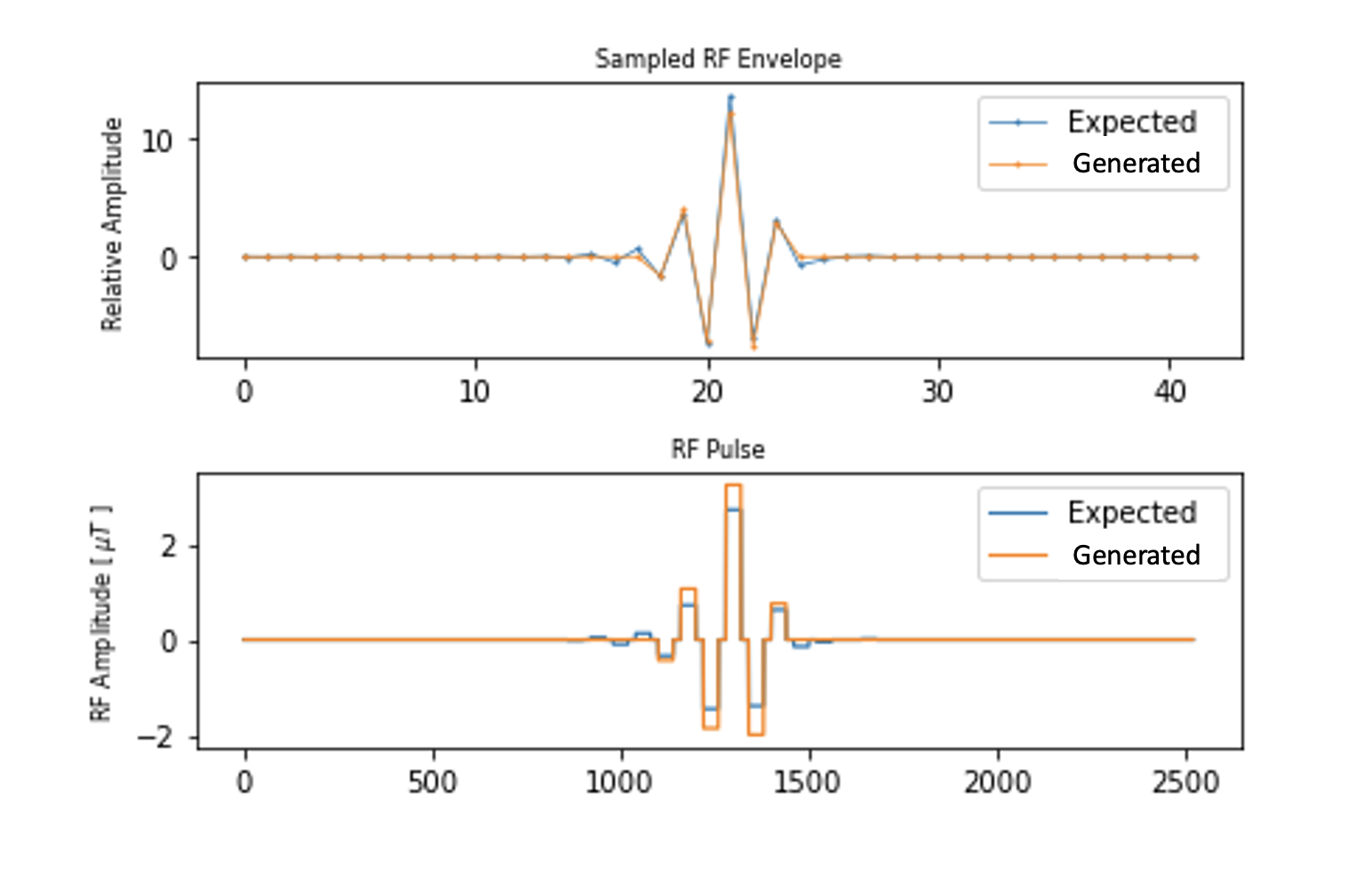
Figure 4. Generated and expected sampled RF envelope and reconstructed full RF waveform from model 1.
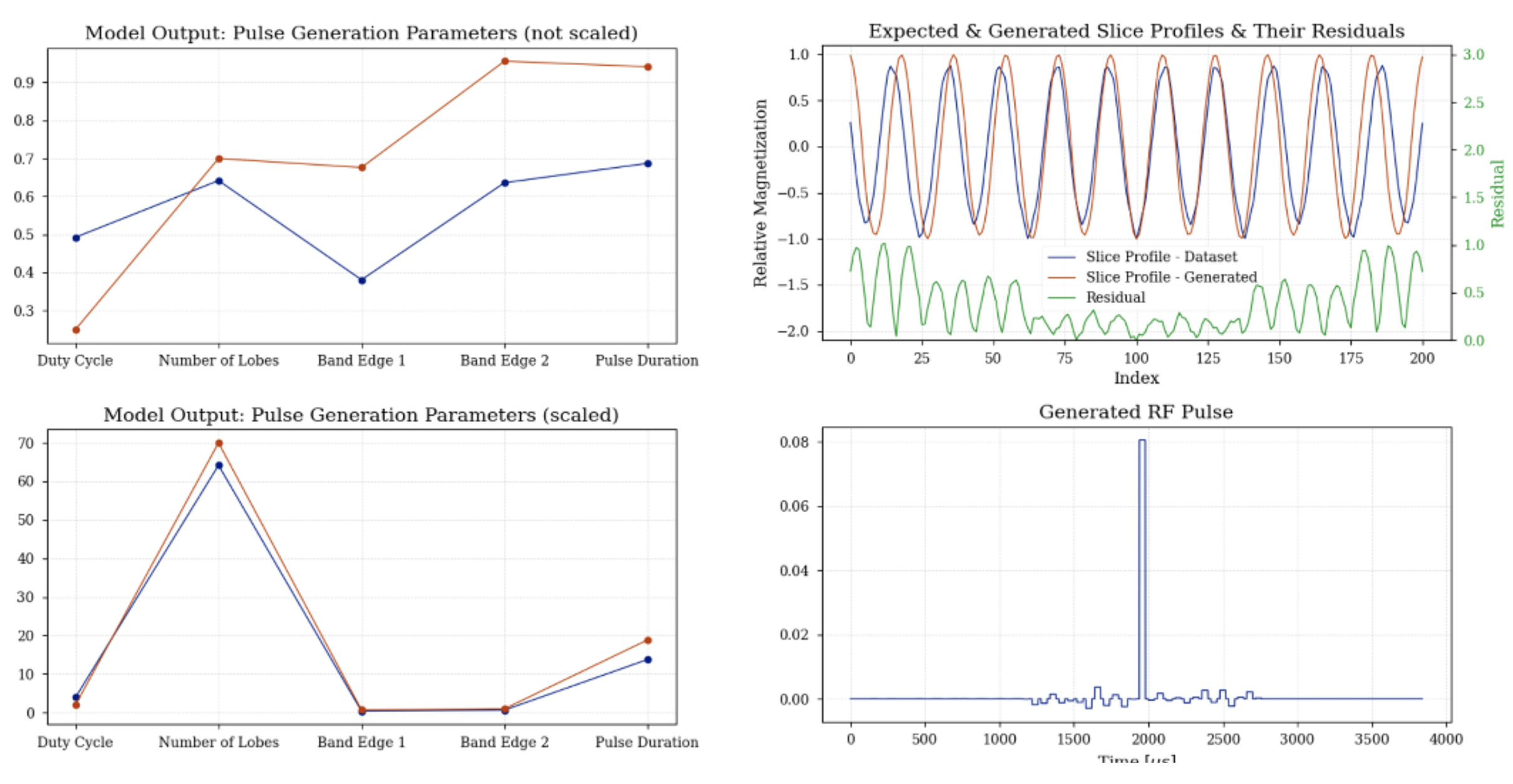
Figure 5. Direct output of the model (upper left); output of the model after re-scaling to actual values (lower left); input slice profile, simulated slice profile, and their residual (upper right); resultant RF pulse (lower right).