4630
Improving Self-Gated Radial MR Elastography for Free-Breathing Quantification of Liver Stiffness in Children1Radiological Sciences, University of California, Los Angeles, Los Angeles, CA, United States, 2Bioengineering, University of California, Los Angeles, Los Angeles, CA, United States, 3US MR R&D Collaborations, Siemens Medical Solutions USA, Inc., Salt Lake City, UT, United States, 4Physics and Biology in Medicine Interdepartmental Program, University of California, Los Angeles, Los Angeles, CA, United States, 5US MR R&D Collaborations, Siemens Medical Solutions USA, Inc., Austin, TX, United States, 6Pediatrics, University of California, Los Angeles, Los Angeles, CA, United States
Synopsis
Keywords: Liver, Pediatric
Motivation: MR elastography (MRE) detects liver fibrosis by measuring hepatic stiffness (HS). Breath-holding (BH) is required to avoid motion artifacts, but this is challenging in children. Previous radial free-breathing (FB) MRE eliminated the BH, but required 2 min/slice.
Goal(s): To reduce scan time for radial FB-MRE and analyze the effects of self-gating on HS.
Approach: Radial FB-MRE was modified to acquire lower resolution and perform spatial interpolation, which reduced the scan time. Self-gating was performed to compensate for breathing motion.
Results: In 23 children, self-gated radial FB-MRE (1 min/slice) yielded more accurate and repeatable HS than non-self-gated radial FB-MRE, with respect to standard BH-MRE.
Impact: Self-gated free-breathing MR elastography (MRE) of the liver produced accurate and repeatable hepatic stiffness in 1 min/slice, with respect to standard cartesian breath-held MRE, and can be beneficial for children who cannot perform breath-holding.
Introduction
Magnetic resonance elastography (MRE) can detect liver fibrosis by measuring hepatic stiffness (HS) (1–3) . To avoid motion artifacts in the liver, standard Cartesian gradient-echo (GRE) MRE requires breath-holding (BH), which is challenging for children (4). Due to motion robustness, radial free-breathing (FB) MRE was proposed to overcome this challenge (5, 6). Radial FB-MRE showed close agreement and repeatable HS with respect to Cartesian BH-MRE (5, 6). However, it required ~2 min/slice. Here, we proposed an accelerated self-navigated radial FB-MRE method that covered 4 slices in 4 minutes (1 min/slice), and investigated the effects of self-gated reconstruction on radial FB-MRE HS quantification in terms of agreement, repeatability, and technical quality in children at 3T in comparison with Cartesian BH-MRE.Methods
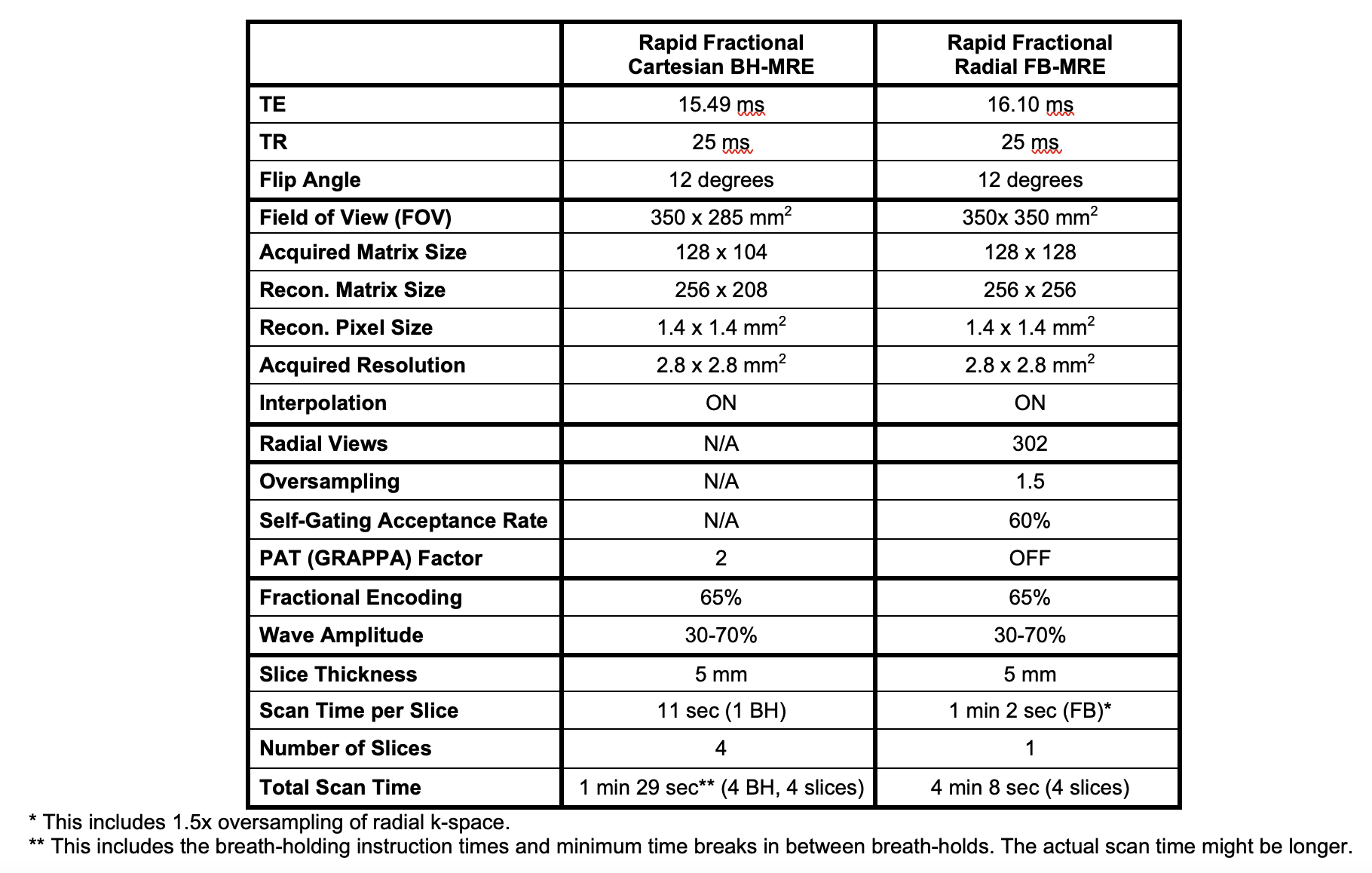
Study Cohort and MRE Experiments:This IRB-approved HIPAA-compliant study enrolled 23 children (14F, 9M, 11 healthy and 12 overweight (body mass index [BMI] >85th percentile)). [median, interquartile range (IQR)] age was [13.1, 5.3] years and BMI was [88.8, 24.9]th percentile. To analyze repeatability, both BH-MRE and research application FB-MRE were acquired twice during same exam on a 3T scanner (MAGNETOM PrismaFit, Siemens Healthineers, Erlangen). Imaging parameters for BH and FB-MRE were matched (Table 1). A prototype flexible MRE passive driver (Mayo Clinic, Rochester, MN) was used for improved subject comfort.
FB-MRE Pulse Sequence and Image Reconstruction:
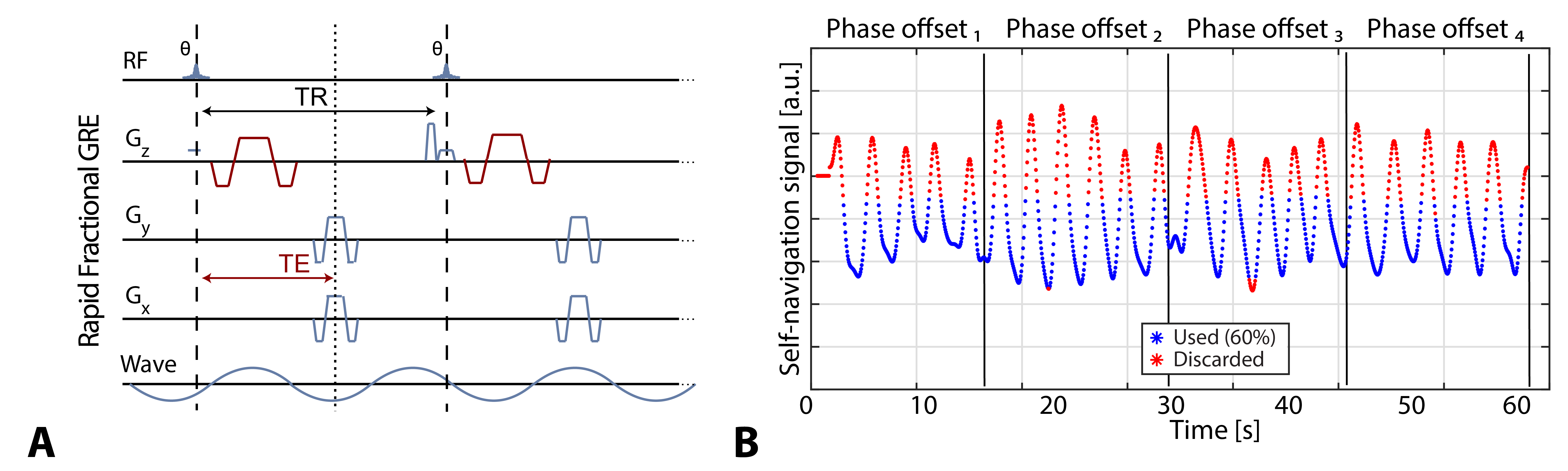
Radial FB-MRE based on rapid GRE (7) and fractional encoding (8) was extended to include gradient delay corrections (9), in-plane interpolation, and self-navigated motion compensation (10). Previous radial FB-MRE acquired higher in-plane resolution (5, 6), which required longer scan time (2min/slice). With the adoption of lower acquired in-plane resolution and in-plane interpolation, as performed in Cartesian BH-MRE, scan time is reduced to 1 min/slice. To evaluate different self-gating thresholds, scanner’s reconstruction pipeline was executed offline. A sequence diagram and an example self-navigation curve are shown in Figure 1A and B, respectively. FB-MRE scans were reconstructed (1) without self-gating and (2) using self-gating with an 60% acceptance rate to select radial views close to expiration. Radial FB-MRE was oversampled by 1.5x to mitigate undersampling artifacts from self-gating.
Analysis:
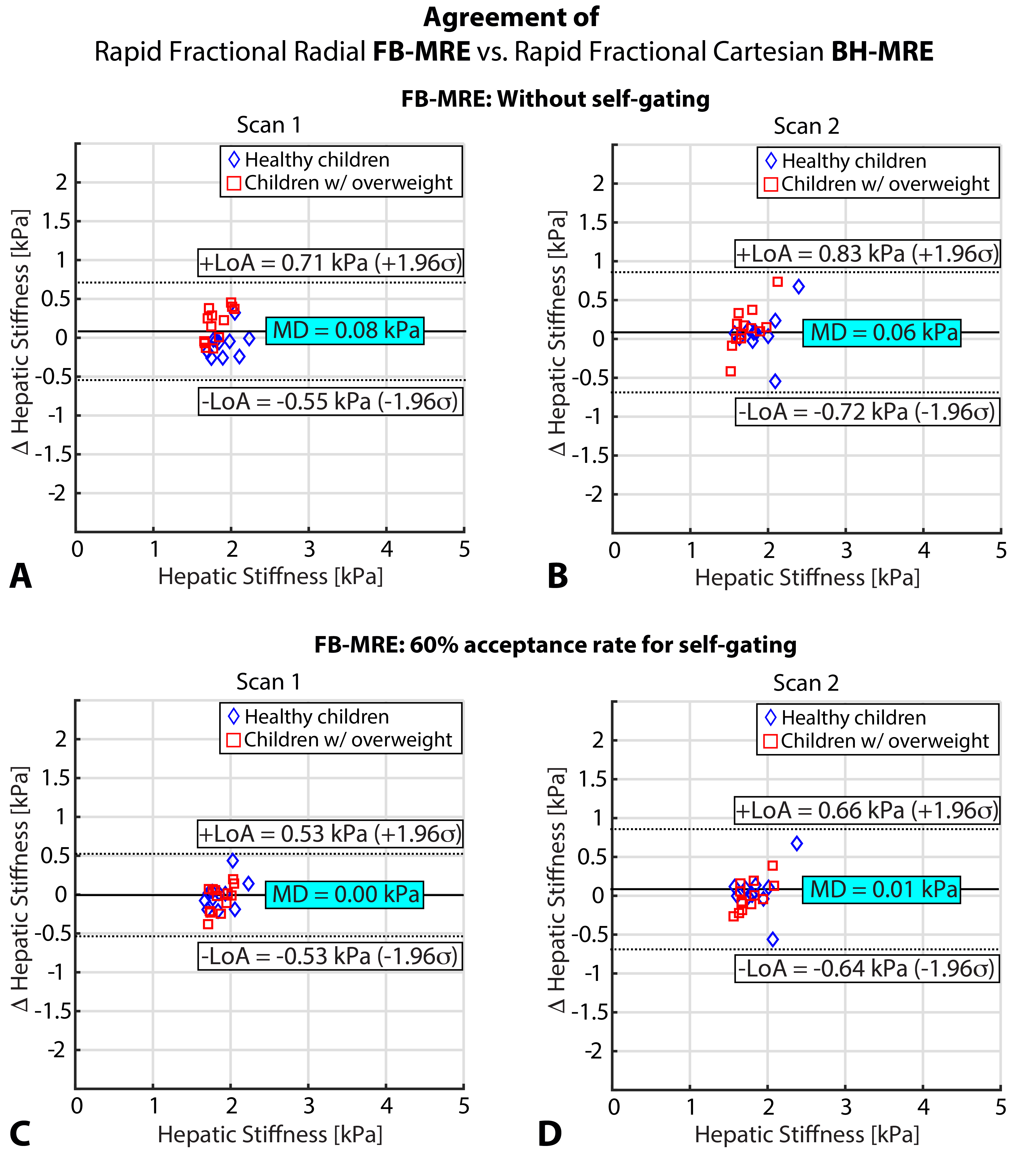
HS was measured inside liver regions with $$$\geq$$$90% confidence interval (CI) (4, 6). Bland-Altman (BA) analysis in terms of mean difference (MD) and 95% limits of agreements (LoA) (11, 12) was used to examine agreement of radial FB-MRE methods compared to Cartesian BH-MRE. To evaluate repeatability, BA analysis and within-subject coefficient of variation (wCV) were used. Technical quality was assessed by ratio of MRE-measurable liver area (90% CI on stiffness confidence mask) to total liver area, manually contoured in all four slices.
Results
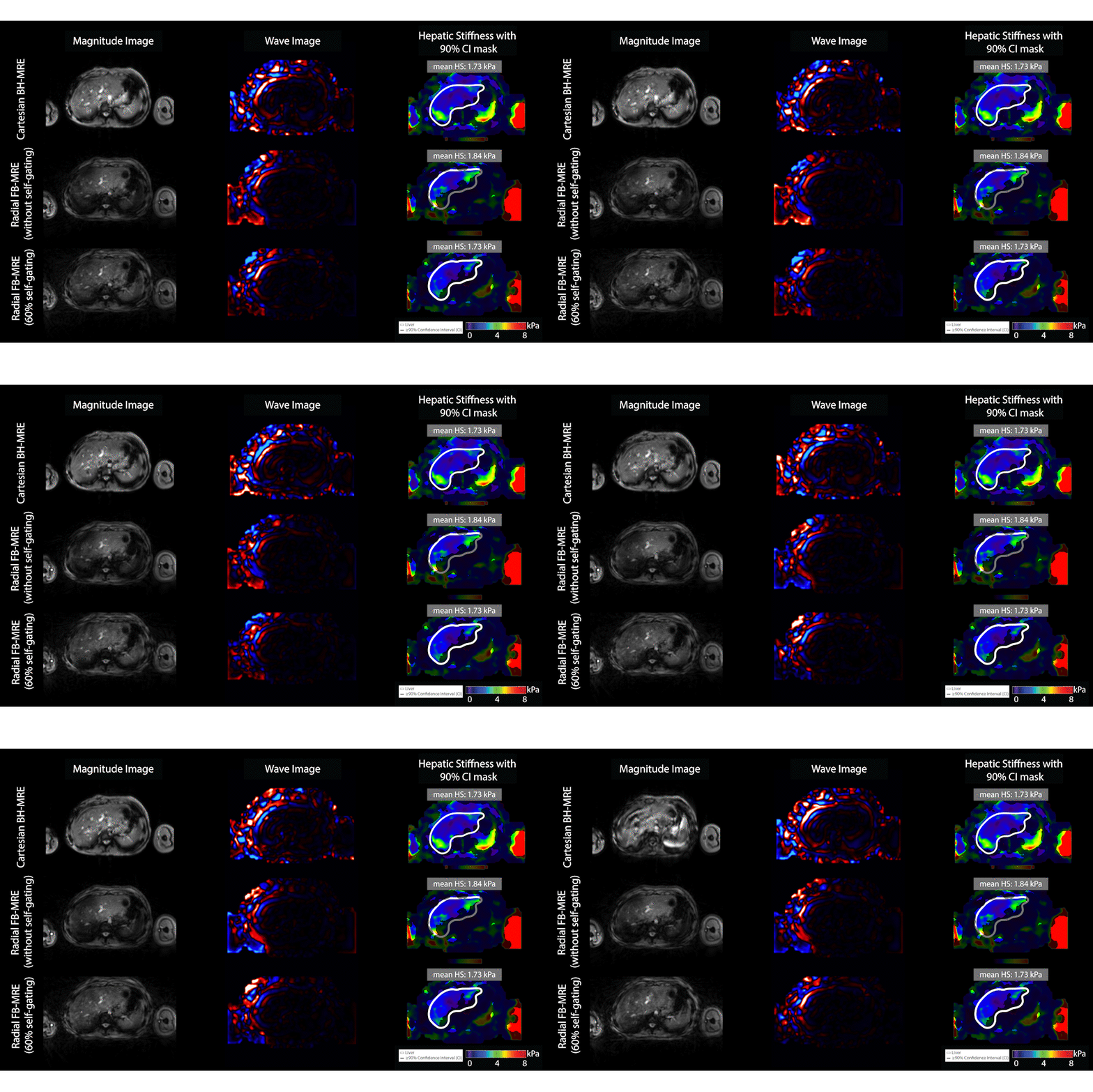
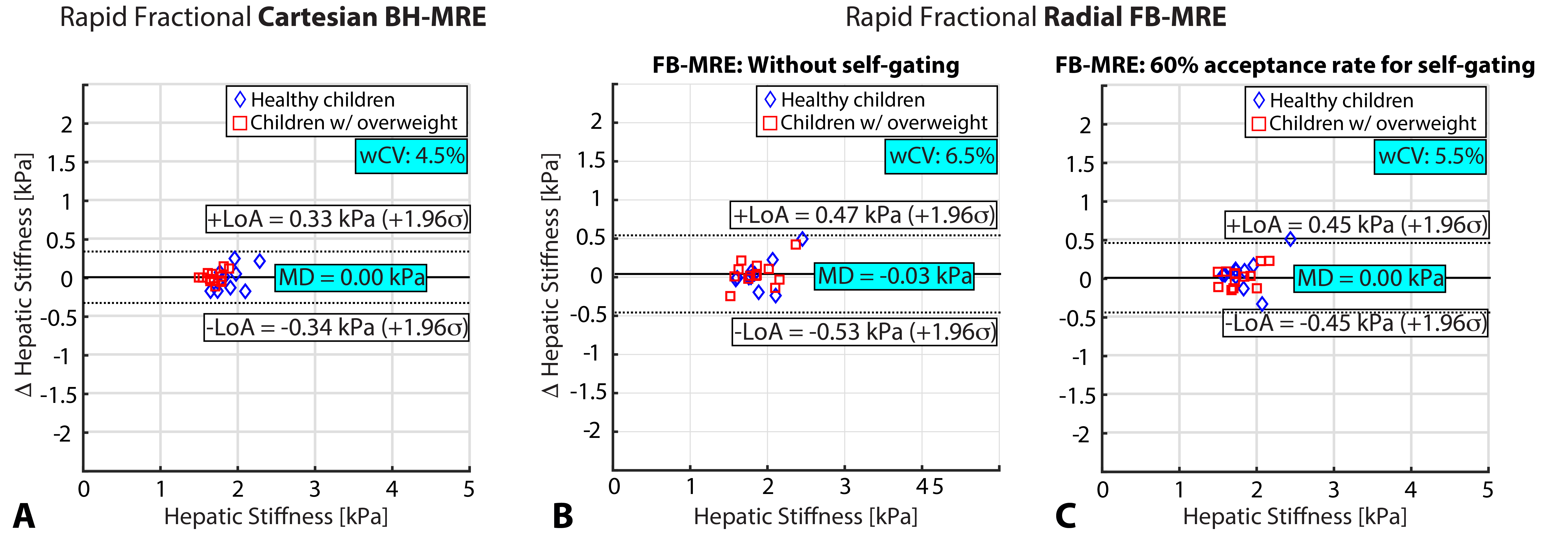
Figure 2 shows representative MRE images and maps for a 16-year-old male, whose self-navigation curve was plotted in Figure 1B. All three methods showed consistent HS values for this slice. BA plots (Figure 3) showed good agreement between BH-MRE and FB-MRE with and without self-gating. MD and LoA between BH-MRE and FB-MRE with self-navigation are smaller/narrower than those of FB-MRE without self-navigation. BA plots (Figure 4) demonstrated repeatability of BH-MRE and FB-MRE techniques. wCV for Cartesian BH-MRE, radial FB-MRE, and self-gated radial FB-MRE were 4.5%, 6.5%, 5.5%, respectively, indicating acceptable repeatability according to QIBA(13). In scan 1, [median, IQR] of measurable liver area were [93%, 8%] for BH-MRE, [44%, 24%] for FB-MRE without self-gating and [42%, 25%] for self-gated FB-MRE. Scan 2 had similar measurable liver area (BH-MRE: [91%, 14%], FB-MRE: [41%, 19%] and [39%, 20%] for self-gated FB-MRE).Discussion
We evaluated our proposed radial FB-MRE in terms of agreement, repeatability, and technical quality compared to Cartesian BH-MRE in 23 children at 3T. Compared to previous radial FB-MRE work, our study has faster scan time (1 min/slice versus 2min/slice), enabling acquisition of more liver slices in same total duration (5). Scan duration already included oversampling that is beneficial for self-gating. Self-gating benefitted HS quantification accuracy, as it helped produce closer agreement of HS compared to Cartesian BH-MRE.All MRE techniques achieved wCV<7%, indicating acceptable repeatability according to QIBA(13).
Lastly, the measurable liver area of the radial FB-MRE techniques is smaller than the Cartesian BH-MRE. Yet the area from FB-MRE methods contained the most representative liver regions, and therefore produced HS that closely agreed with BH-MRE. Future work may test the performance in fibrotic livers and may investigate the optimum self-navigation acceptance rate.
Conclusion
Self-navigated radial FB-MRE with rapid fractional encoding accurately measured hepatic stiffness in 1 min/slice with close agreement and similar repeatability compared to corresponding Cartesian BH-MRE in children at 3T. Self-navigated radial FB-MRE could be promising for HS quantification in children.Acknowledgements
This work was supported by the National Institutes of Health under Award Numbers NIH/NIDDK R01DK124417 and NIH/NIBIB U01EB031894, and the National Center for Advancing Translational Sciences under Award Number UL1TR001881.The authors thank investigators at the Mayo Clinic for providing the prototype flexible MRE passive driver suitable for children. The authors thank the clinicians, study coordinators and the MRI technologists at UCLA.References
1. Idilman IS, Li J, Yin M, Venkatesh SK: MR elastography of liver: current status and future perspectives. Abdominal Radiology 2020; 45:3444–3462.
2. Xanthakos SA, Podberesky DJ, Serai SD, et al.: Use of magnetic resonance elastography to assess hepatic fibrosis in children with chronic liver disease. Journal of Pediatrics 2014; 164:186–188.
3. Singh S, Venkatesh SK, Wang Z, et al.: Diagnostic performance of magnetic resonance elastography in staging liver fibrosis: A systematic review and meta-analysis of individual participant data. Clinical Gastroenterology and Hepatology 2015; 13:440-451.e6.
4. Schwimmer JB, Behling C, Angeles JE, et al.: Magnetic resonance elastography measured shear stiffness as a biomarker of fibrosis in pediatric nonalcoholic fatty liver disease. Hepatology 2017; 66:1474–1485.
5. Kafali SG, Bolster BD Jr, Shih S, et al.: Self-Navigated Radial Free-Breathing Magnetic Resonance Elastography of the Liver with Rapid Motion Encoding in Children at 3T. ISMRM 2022.
6. Kafali SG, Armstrong T, Shih SF, et al.: Free-breathing radial magnetic resonance elastography of the liver in children at 3 T: a pilot study. Pediatr Radiol 2022.
7. Davison KK, Birch LL, Chamarthi S, et al.: Rapid Acquisition Technique for MR Elastography of the Liver. Magn Reson Imaging 2008;.64:2391–2404.
8. Rump J, Klatt D, Braun J, Warmuth C, Sack I: Fractional encoding of harmonic motions in MR elastography. Magn Reson Med 2007; 57:388–395.
9. Armstrong T, Zhong X, Wu HH: Free-Breathing Liver Fat Quantification in Adults with NAFLD using a 3D Stack-Of-Radial MRI Technique. Magn Reson Med 2018.
10. Zhong X, Armstrong T, Nickel MD, et al.: Effect of respiratory motion on free-breathing 3D stack-of-radial liver R*2 relaxometry and improved quantification accuracy using self-gating. Magn Reson Med 2020; 83:1964–1978.
11. Obuchowski NA, Reeves AP, Huang EP, et al.: Quantitative imaging biomarkers: A review of statistical methods for computer algorithm comparisons. Stat Methods Med Res 2015; 24:68–106.
12. Raunig DL, McShane LM, Pennello G, et al.: Quantitative imaging biomarkers: A review of statistical methods for technical performance assessment. Stat Methods Med Res 2015; 24:27–67.
13. May CP: QIBA Profile: Magnetic Resonance Elastography of the Liver 5 Stage 2: Consensus Profile. 2018.
Figures