4605
Enhancing Breast Lesion Diagnosis Through DISCO and Deep Learning Reconstruction-Based DWI1Department of Magnetic Resonance, The First Affiliated Hospital of Zhengzhou University, Zhengzhou, China, 2MR Research China, GE Healthcare, Beijing, China
Synopsis
Keywords: Breast, Breast, deep learning; DWI: differential diagnosis; DISCO
Motivation: With breast cancer now ranking as the predominant global cancer, there is a pressing need to enhance diagnostic accuracy and reduce unnecessary biopsies through the utilization of advanced imaging techniques.
Goal(s): Our aim is to augment the precision of breast disease diagnosis by improving the contrast-enhanced MRI and DWI in routine scans.
Approach: We developed a model that combines DISCO with deep learning-reconstructed DWI at a b-value of 800 s/mm² for differential diagnosis.
Results: The integration of deep learning-reconstructed DWI and DISCO serves to significantly enhance the capability to differentiate between benign and malignant breast conditions.
Impact: This advancement directly heightens the diagnostic efficiency of breast cancer within routine scanning sequences, contributing to more effective clinical solutions, and ultimately elevating both the quality of life and survival rates for patients.
Introduction:
Breast cancer stands as the second leading cause of cancer-related fatalities in women, following lung cancer. The key to reducing mortality rates lies in early screening and treatment. Contrast-enhanced MRI in combination with DWI represents a widely adopted and effective diagnostic approach. Nevertheless, breast MRI frequently grapples with the challenge of elevated false-positive rates, underscoring the critical need for improved diagnostics. In this study, we leverage the accessible deep learning post-processing pipeline [1,2] provided by manufacturers to explore the utility of high temporal and spatial resolution sequences, specifically the Differential Subsampling with Cartesian Ordering (DISCO), and deep learning reconstruction in DWI, with the aim of enhancing diagnostic accuracy.Materials and methods
MRI scans were conducted using a 3.0 Tesla MRI scanner (SIGNA Premier, GE Healthcare, WI, USA). A total of 111 female patients with breast lesions, aged between 27 and 65 years, underwent breast DISCO examination and deep learning reconstructed-DWI. Based on pathological results, the patients were categorized into two groups: the malignant lesion group, consisting of 72 patients, and the benign lesion group, consisting of 39 patients.Quantitative and semi-quantitative parameters obtained from the DISCO examination included the following: Bolus arrival time (BAT), extravascular extracellular volume fraction (Ve), initial area under the gadolinium curve (IAUGC), rate constant (Kep), Contrast Enhancement Ratio (CER), maximum enhancement slope (MaxSlope), and volume transfer constant (Ktrans). The deep learning-based DWI was conducted with b values of 800 s/mm², respectively. These parameter values were measured by delineating the region of interest in the solid components of the lesions.Results and discussion
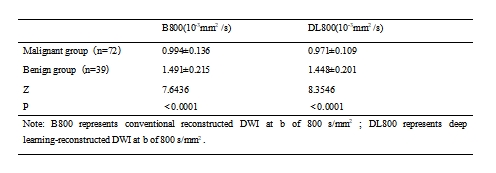
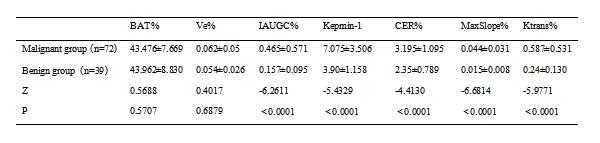
The ADC value of DWI at b of 800 s/mm² values in the malignant group consistently registered lower values compared to the benign group, and these disparities were statistically significant (all P < 0.05), as outlined in Table 1. It's worth noting that the differences observed were statistically significant. Additionally, the ADC values obtained from deep learning-reconstructed DWI were found to be lower than those obtained from conventionally reconstructed images.Regarding the DISCO parameters, there were no notable differences observed in BAT and Ve values when comparing the benign and malignant disease groups (P>0.05). However, in the malignant group, IAUGC (0.465), Kep (7.075) min⁻¹, CER (3.195), MaxSlope (0.0438), and Ktrans (0.5867) min⁻¹ values all exhibited statistical significance by being higher than their counterparts in the benign group (all P < 0.05), as demonstrated in Table 2.
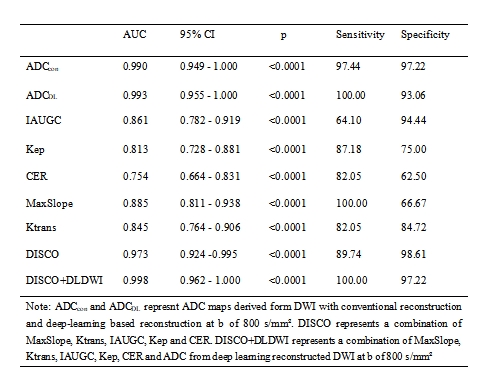
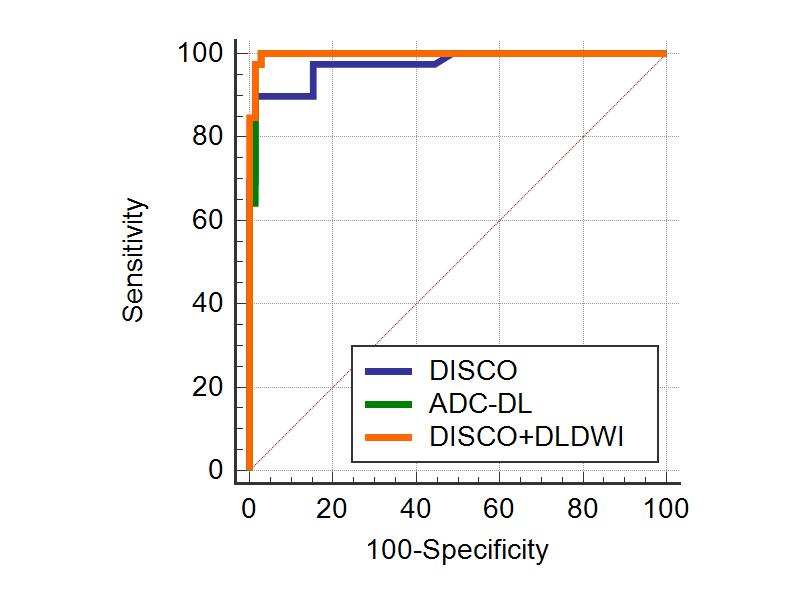
The AUC (Area Under the Curve) of each parameter in the differential diagnosis, ranked from highest to lowest, is as follows: ADCDL(0.993), ADCcon (0.99), MaxSlope (0.885), Ktrans (0.845), IAUGC (0.861), Kep (0.813), CER (0.754) (Fig. 1, Table 3). Notably, the diagnostic parameters MaxSlope, Ktrans, IAUGC, Kep, and CER from DISCO are combined as the DISCO group. The results revealed that the AUC (0.973) of the DISCO group surpassed the AUC of every single parameter in DISCO. Moreover, the DISCO+DLDWI group, which amalgamates ADCDL and DISCO, exhibited the highest AUC (0.998), signifying its exceptional value in the realm of differential diagnosis.
Conclusions
Deep learning contributes significantly to enhancing DWI diagnosis, and DISCO proves its worth in the diagnosis of breast lesions. By combining DISCO with deep learning-reconstructed DWI, we can achieve superior diagnostic performance in the context of breast cancer.Acknowledgements
No acknowledgment.References
[1]Minjae Kim et al., Thin-Slice Pituitary MRI with Deep Learning–based Reconstruction: Diagnostic Performance in a Postoperative Setting,Radiology: Volume 298: Number 1—January 2021
[2] Kevin M. Koch et al., Analysis and Evaluation of a Deep Learning Reconstruction Approach with Denoising for Orthopedic MRI,Radiology: Artificial Intelligence Volume 3: Number 6—2021
Figures