4562
3D UTE With Twisted Trajectories1GE Healthcare, FALLBROOK, CA, United States, 2UCSD, San Diego, CA, United States
Synopsis
Keywords: Pulse Sequence Design, Data Acquisition
Motivation: Radial UTE can often be impacted by aliasing artifacts if undersampling is required to achieve a short scantime. More efficient trajectories may alleviate these limitations.
Goal(s): Our goal is to study how much aliasing reduction can be achieved in UTE MRI by applying a small amount of spiral twist to the readout trajectory.
Approach: In order to add some twist/spiral to the UTE trajectories, we simply added an orthogonal gradient while simultaneously ramping down the radial-out read gradient.
Results: Images using a longer, twisted readout trajectory results in less visible aliasing artifacts and increased SNR.
Impact: UTE MRI undersampling artifacts were found to be reduced using simple twisted k-space trajectories, hence allowing a reduction in scantime.
Introduction
Imaging short T2 tissues often encountered in the musculoskeletal system using MRI requires specialized pulse sequences with very short echo times (TE). The common feature of many ultrashort TE (UTE) sequences is that data acquisition is started as soon as possible after the RF excitation, and k-space is acquired in a center out fashion. There have been various k-space trajectories employed for UTE imaging, such as straight radial-out projection acquisition (PR) [1], to more spiral-like techniques such as twisted projection imaging (TPI) [2], acquisition-weighted stack of spirals (AWSOS) [3], and Cones [4]. These spiral-like acquisitions provide high data collection efficiency per unit time. Generally, non-Cartesian trajectories provide the flexibility to undersample the number of k-space spokes to accelerate the acquisition time at the expense of undersampling artifacts. Undersampled straight radial out PR trajectory spokes often exhibit only mild diffuse streaking artifacts, while undersampling of more curved, spiral-like trajectories (alike to circular rings) causes more severe artifacts [5]. Here we investigate via theoretical analysis and imaging experiments the tradeoffs in terms of scan-time and image quality (artifact and SNR) between a straight-out radial acquisition, and a simple modified trajectory that allows some twist of the k-space trajectory.Theory
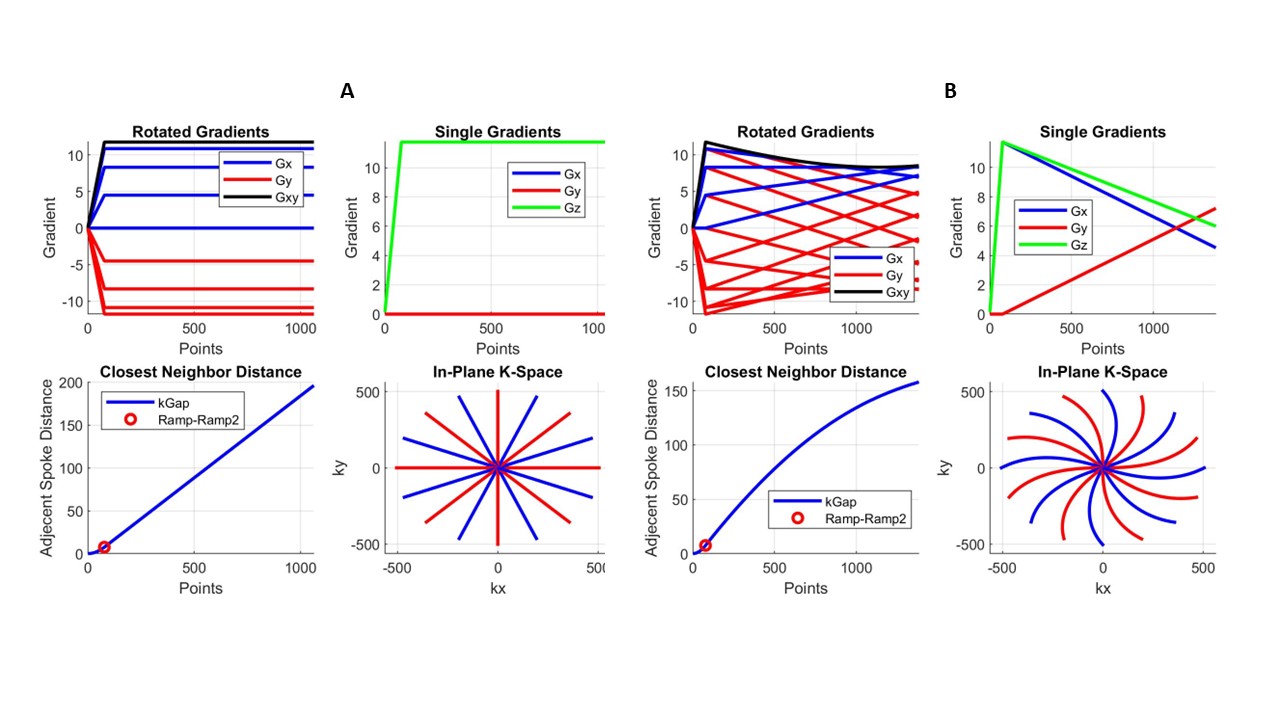
The Nyquist theorem states that the supported reconstruction FOV is inversely related to how closely spaced adjacent k-space points are located. With straight-out trajectories, k-space points on adjacent spokes diverge from one another linearly with the distance from the origin (see Fig.1A). Once this divergence has increased past the Nyquist aliasing criterium, diffuse streaking/hazing artifacts are often observed. The goal of spiral-like acquisition methods such as Cones is to reduce/limit the distance of two adjacent k-space points once two spokes have diverged past the Nyquist level. These methods typically employ numerical calculation/optimization to design the trajectories. In our work here, we study how much aliasing reduction can be achieved by a simple additional application of an orthogonal read gradient while simultaneously ramping down the radial-out read gradient as shown in Fig.1B. This causes the k-space trajectory to curve (see Fig.1B bottom right) hence reducing the maximum distance of k-space points compared to radial-out acquisition (Fig.1A,B bottom left panels).Numerical Simulations
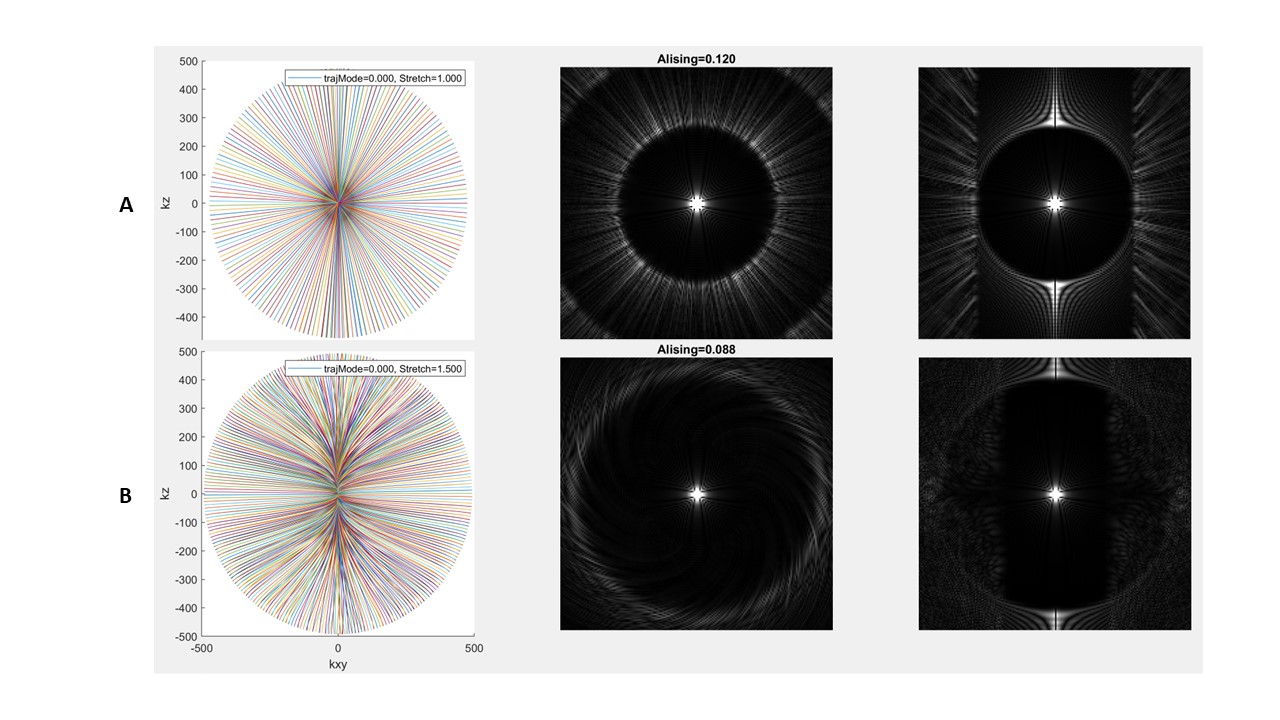
Point Spread Functions (PSFs) were generated for two different trajectory lengths, one using a pure radial-out readout, the other using orthogonal gradients resulting in about 30% longer readout durations. The k-space trajectory simulations are based on a FOV = 20 cm, and isotropic res = 1 mm. The PSFs are shown in Fig.2 for in-plane k-space (kx-ky: middle) and reformatted (kx-kz: right) in order to show the aliasing energy in regions outside the supported Nyquist FOV. The high undersampling for the radial-out trajectory results in a smaller region of Nyquist FOV support, while the longer trajectories result in a larger region of support.Experiments
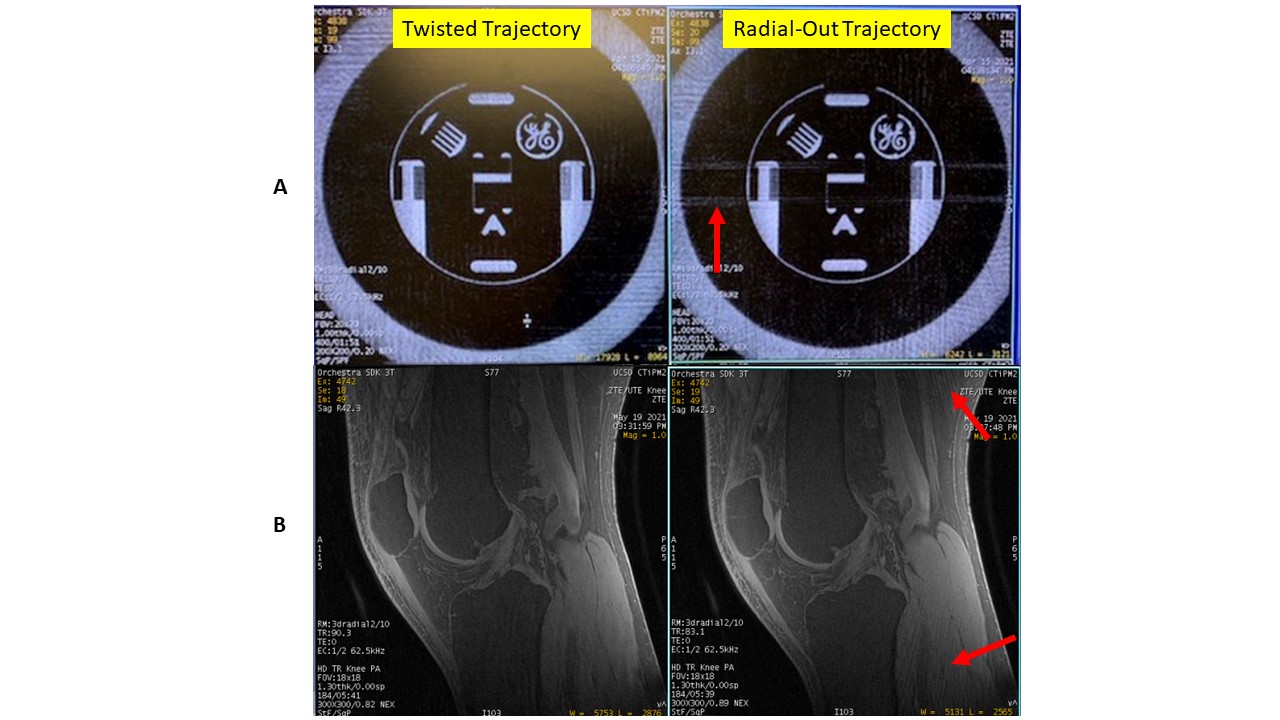
A standard resolution phantom was imaged using a clinical 3T MRI system (Signia HDx GE Healthcare) with a T/R head coil. Acquisition parameters included BW = ±62.5 kHz, FOV = 20 cm and resolution = 1 mm, using TE = 30 µs. The native symmetry axis of the trajectory design was along z, perpendicular to the axial images shown in Fig.3A. The images generated by the radial-out trajectory results in visible aliasing artifacts (red arrow). On the other hand, the image using a longer, twisted readout trajectory results in less visible aliasing artifacts. Finally, the SNR in the images from the longer trajectories is moderately higher than the shorter trajectories, as expected. Similar results were observed in the sagittal in-vivo knee images shown in Fig.3B. Noticeable more streaking can be observed (red arrows) in the image using the radial-out acquisition.Conclusion
We have investigated the image quality and SNR tradeoffs between radial-out vs twisted k-space trajectories. Undersampling artifacts were found in the images from the short straight acquisition trajectories. A modified trajectory with some twist was found to provide a good balance to optimize image quality vs scantime.Acknowledgements
No acknowledgement found.References
[1] Rahmer et al. MRM 55:1075–1082 (2006)
[2] Qian et al, MRM 60:135–145 (2008)
[3] Boada et al MRM 37:706-715 (1997)
[4] Gurney et al. MRM 55:575-582 (2006)
[5] Scheffler et al, MRM 40:474-480 (1998)
Figures