4511
An End-to-End deep learning compressed sensing reconstruction model with adaptive shrinkage threshold1Center for Biomedical Imaging Research, Department of Biomedical Engineering, School of Medicine, Tsinghua University, Beijing, China
Synopsis
Keywords: AI/ML Image Reconstruction, Machine Learning/Artificial Intelligence
Motivation: Using deep learning methods to improve image quality and computation speed of compressed sensing reconstruction.
Goal(s): Develop a model-based deep learning model with adaptive threshold selection module to improve the reconstruction quality.
Approach: Introducing a new shrinkage function with adaptive threshold selection for Model-driven deep learning networks, and emploits End-to-End strategy for multicoil reconstruction.
Results: Experiments demonstrate the efficacy of End-to-End reconstruction strategy with sensitivity reconstruction module, and show that proposed adaptive threshold selection method can effectively reduce reconstruction errors.
Impact: We develop an End-to-End deep learning reconstruction network with adaptive threshold selection module. This network canenforce the performance of state-of-art model-based deep learning method for CS reconstruction, and achieve good reconstruction quality at R=8.
Introduction
The theory of compressed sensing (CS) allows for the reconstruction of sub-Nyquist-sampled data by utilizing the sparsity priors of MR images. CS-MRI is widely used to accelerate image acquisitions[1,2]. Deep learning network has been applied to CS-MRI reconstruction, while model-driven deep learning networks, including ISTA-Net[3] and Admm-Net[4], have demonstrated success than conventional computation techniques, and provide better reconstruction quality.Recently, a new deep learning architecture that integrates ISTA-Net and an adaptive threshold selection module based on Bayes Shrinkage[7], named aISTA-Net[8], has achieve better reconstruction results in artifact removal and detail preservation. Concurrently, the End-to-End architecture[9], which directly estimates sensitivity information from multi-coil undersampled data, is remarkable in multi-coil reconstruction. Inspired by this, we incorporate a sensitivity estimation module to aISTA-Net for multi-coil reconstruction. Our result suggests the efficacy of the proposed End-to-End strategy and adaptive shrinkage module for improving the reconstruction performance.
Method
TheoryThe CS reconstruction problem can be written as[1]
$$ x=arg\min_{x} \left \| Ax-b \right \|_{2}^{2} +\lambda \left \| \Psi x \right \| _{1} $$
where $$$A$$$ denotes encoding matrix, $$$b$$$ denotes acquired k-space data, $$$\Psi$$$ denotes sparse transform, and $$$ x $$$ is the image to be reconstructed. Proximal gradient decent is used for reconstruction:
$$ x_{k+1}=P\left \{ x_{k}-t_{k}\bigtriangledown (Ax-b) \right \} $$
where $$$P$$$ is the proximal operator
$$P(x)=\Psi ^{-1} S_{\lambda } (\Psi x)$$
and $$$ S_{\lambda }$$$ stands for the soft-thresholding function. Since the aliasing artifacts caused by under-sampling are noise-like in the transform domain[1,2], one observes
$$\Psi m=\Psi y+n$$
where $$$m$$$ is the aliased image, $$$y$$$ is the truth value, $$$n$$$ is the noise-like incoherent artifacts. Assuming that wavelet coefficients of natural images obey a Laplacian distribution, the shrinkage threshold can be determined by minimizing the mean-squared error between the denoised coefficients $$$\Psi \hat{m} $$$ and true coefficients $$$\Psi y $$$, according to Bayes Shrinkage theory[7]:
$$ \lambda_{A} =\frac{\sigma ^2}{\sigma_{x} } $$
where $$$\sigma$$$ stands for the noise level of $$$n$$$, $$$\sigma_{x}$$$ stands for standard deviation of sparse domain.
In ISTA-Net, a learnable nonlinear transform function G consisting of several convolution blocks is adopted to replace the original sparse transform,
$$ x=arg\min_{x} \left \| Ax-b \right \|_{2}^{2} +\lambda \left \| G x \right \| _{1} $$
Based on the coefficients of feature maps, an adaptive threshold can also be obtained to distinguish signals from aliasing artifacts.
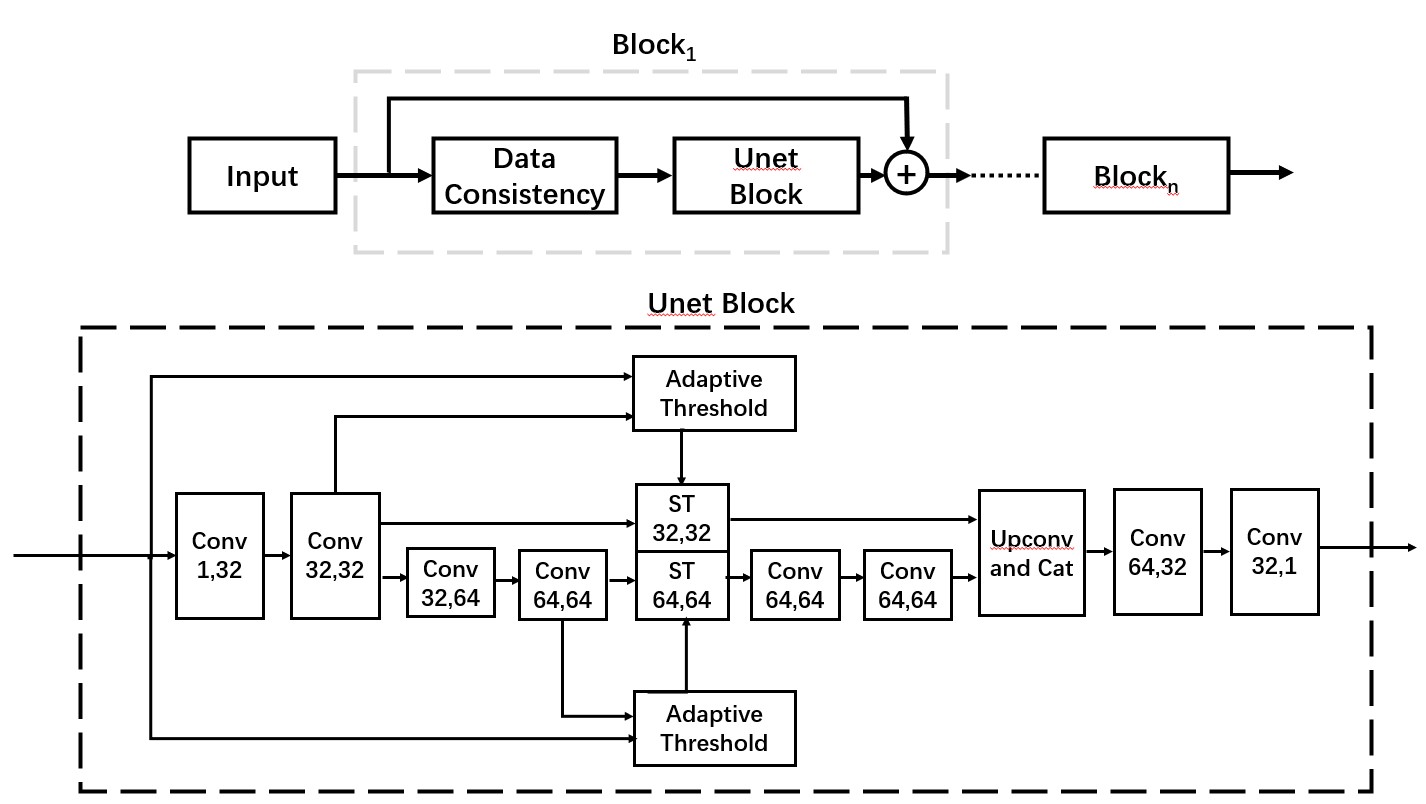
Therefore, we propose an auISTA-Net with $$$\lambda$$$ replaced by $$$\lambda_{A}$$$, and further integrate it with Unet architecture. Fig. 1 depicts the auISTA-Net architecture. The adaptive threshold selection module computes $$$\lambda_{A}$$$ from previous input and feature maps. The median estimation of the k-space of the input aliasing image before each iteration is used to determine the noise level of incoherent artifacts. $$$\sigma_{x}$$$ is calculated from each feature maps.
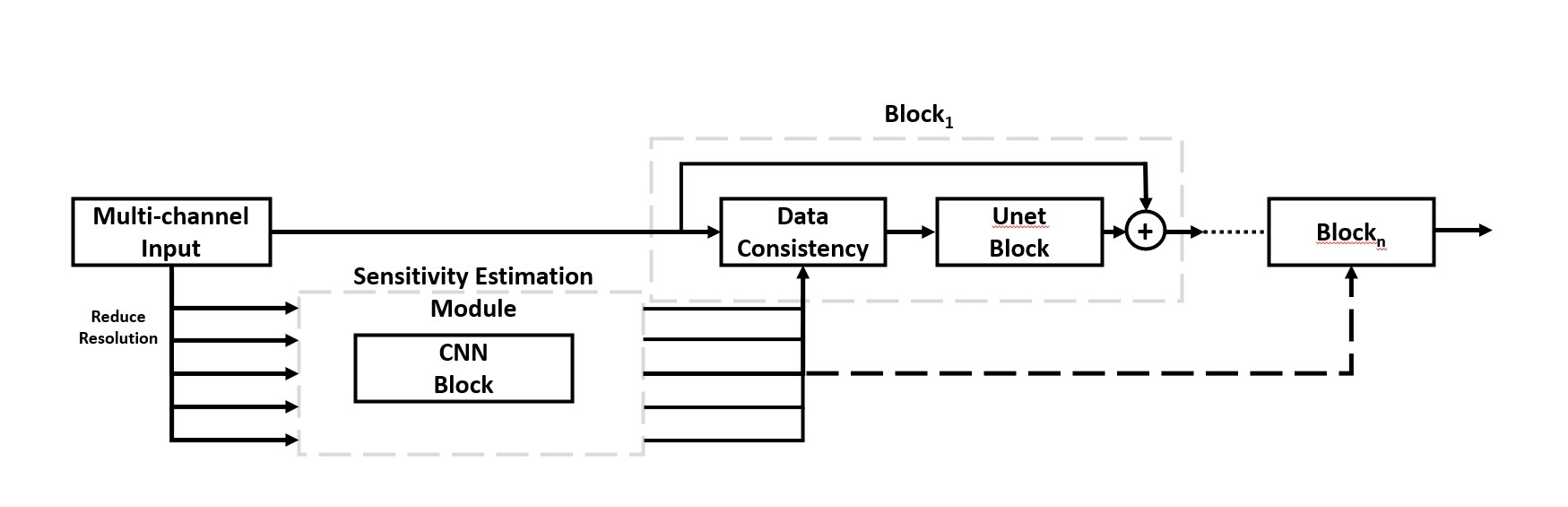
To reconstruct multicoil data, we introduce an additional module to estimate sensitivity information, and generate an End-to-End auISTA-Net. Within this module, a CNN block is employed to smooth the low-resolution multicoil images and calculate the sensitivity maps of each coil. The architecture of whole model is show in Fig. 2.
Data acquisition
The network is trained on a subset of fastmri dataset[10]. 39840 slices from 2D T2-weighted and T1-weighted fully-sampled brain images are chosen as training data. All data are under-sampled using a sampling mask with an acceleration factor of 8. After training, we test the network on 50 subjects with 800 2D T2-weighted slices.
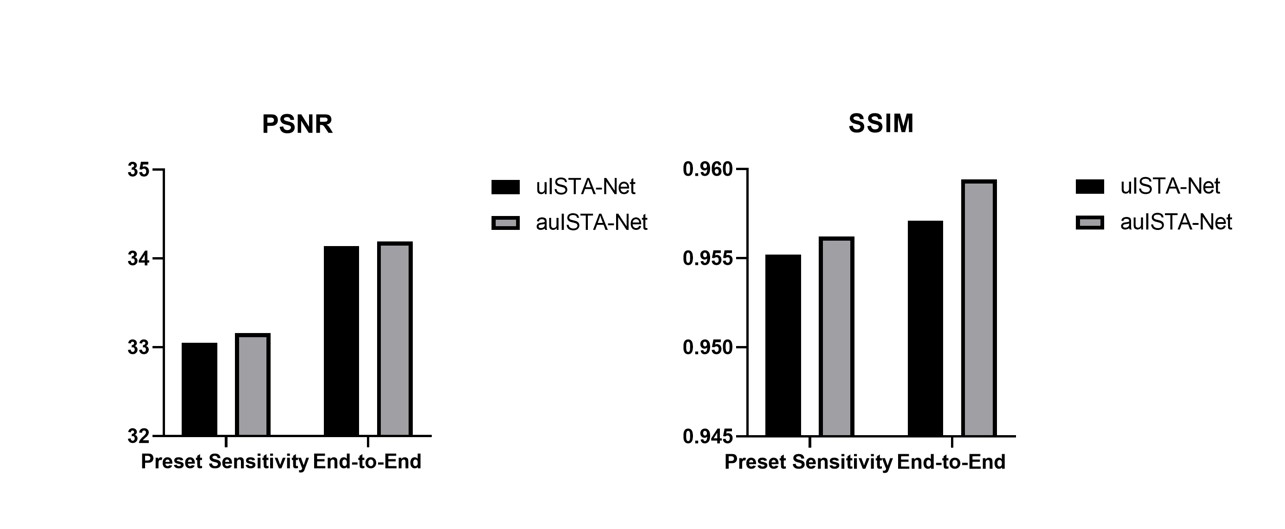
The proposed auISTA-Net is trained with SSIM as the loss function. uISTA-Net, which shares the same design as the proposed method but lack the adaptive threshold selection module, is trained for comparison. We also trained models without the sensitivity estimation module to prove the efficiency of proposed module. Those models are trained with pre-generated sensitivity maps.
Result
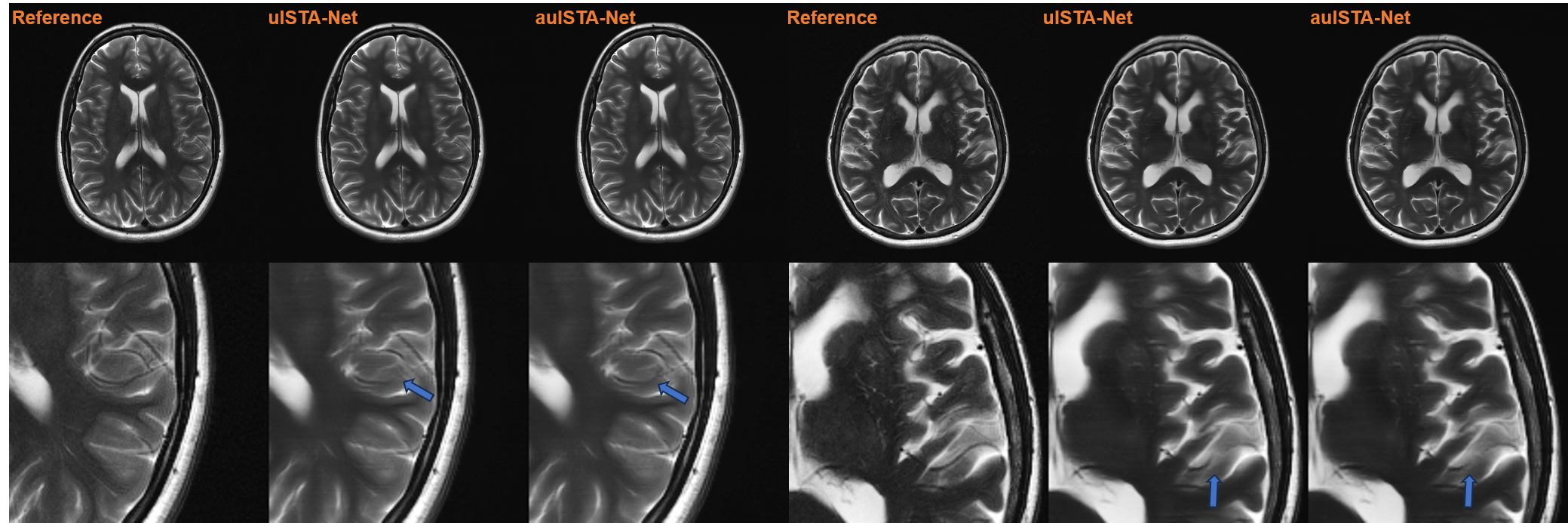
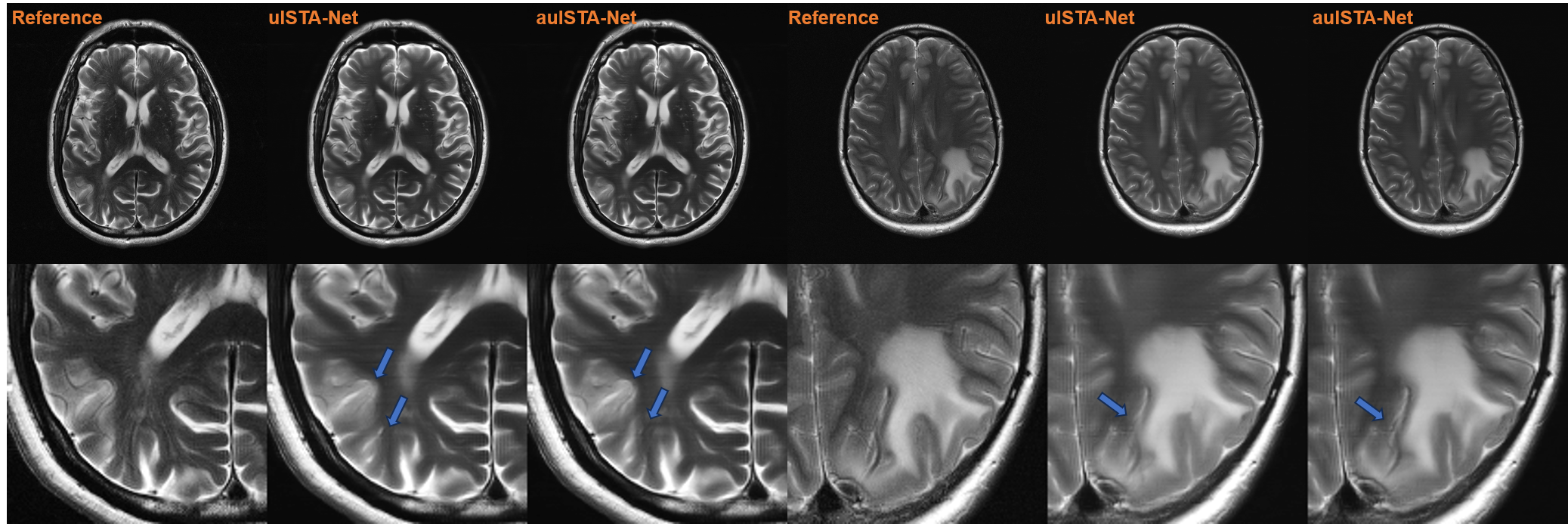
The outcomes of the End-to-End uISTA-Net and auISTA-Net are depicted in Fig. 3 and Fig. 4. In comparison to the uISTA-Net, the auISTA-Net preserves more details and yields sharper edges. In addition, auISTA-Net fixes several fake structures that are present in uISTA-Net.The average PSNR and SSIM of proposed method, both with and without sensitivity estimation module are shown in Fig.5, and further demonstrate the efficacy of the proposed adaptive threshold selection module and sensitivity estimation module.
Conclusion and Discussion
In this work, we develop an End-to-End deep learning reconstruction network with adaptive threshold selection module to enforce the performance of state-of-art model-based deep learning method for CS reconstruction. Experiments demonstrate that the proposed adaptive threshold selection method can effectively reduce reconstruction errors while preserving detailed information of anatomical structures, and also prove the efficiency of End-to-End reconstruction strategy with sensitivity reconstruction module.Acknowledgements
No acknowledgement found.References
1. Lustig, M., Donoho, D., & Pauly, J. M. (2007). Sparse MRI: The application of compressed sensing for rapid MR imaging. Magnetic Resonance in Medicine: An Official Journal of the International Society for Magnetic Resonance in Medicine, 58(6), 1182-1195.
2. Jaspan, Oren N., Roman Fleysher, and Michael L. Lipton. "Compressed sensing MRI: a review of the clinical literature." The British journal of radiology 88.1056 (2015): 20150487.
3. Zhang, Jian, Ghanem B.(2018). "ISTA-Net: Interpretable optimization-inspired deep network for image compressive sensing." Proceedings of the IEEE conference on computer vision and pattern recognition.
4. Sun, Jian, Li H., Xu Z.(2016). "Deep ADMM-Net for compressive sensing MRI." Advances in neural information processing systems.
5. Khare, K., Hardy, C. J., King, K. F., Turski, P. A., & Marinelli, L. (2012). Accelerated MR imaging using compressive sensing with no free parameters. Magnetic Resonance in Medicine, 68(5), 1450-1457.
6. Varela‐Mattatall, G., Baron, C. A., & Menon, R. S. (2021). Automatic determination of the regularization weighting for wavelet‐based compressed sensing MRI reconstructions. Magnetic Resonance in Medicine, 86(3), 1403-1419.
7. Chang, S. G., Yu, B., & Vetterli, M. (2000). Adaptive wavelet thresholding for image denoising and compression. IEEE transactions on image processing, 9(9), 1532-1546.
8. Lian Y., Guo H. (2023). A deep learning approach for compressed sensing reconstruction using adaptive shrinkage threshold. Proceedings of the 32th Annual Meeting of ISMRM, Toronto, UK. .
9. Sriram, A., Zbontar, J., Murrell, T., Defazio, A., Zitnick, C. L., Yakubova, N., ... & Johnson, P. (2020). End-to-end variational networks for accelerated MRI reconstruction. In Medical Image Computing and Computer Assisted Intervention–MICCAI 2020: 23rd International Conference, Lima, Peru, October 4–8, 2020, Proceedings, Part II 23 (pp. 64-73). Springer International Publishing.
10. Zbontar, J., Knoll, F., Sriram, A., Murrell, T., Huang, Z., Muckley, M. J., ... & Lui, Y. W. (2018). fastMRI: An open dataset and benchmarks for accelerated MRI. arXiv preprint arXiv:1811.08839.
Figures